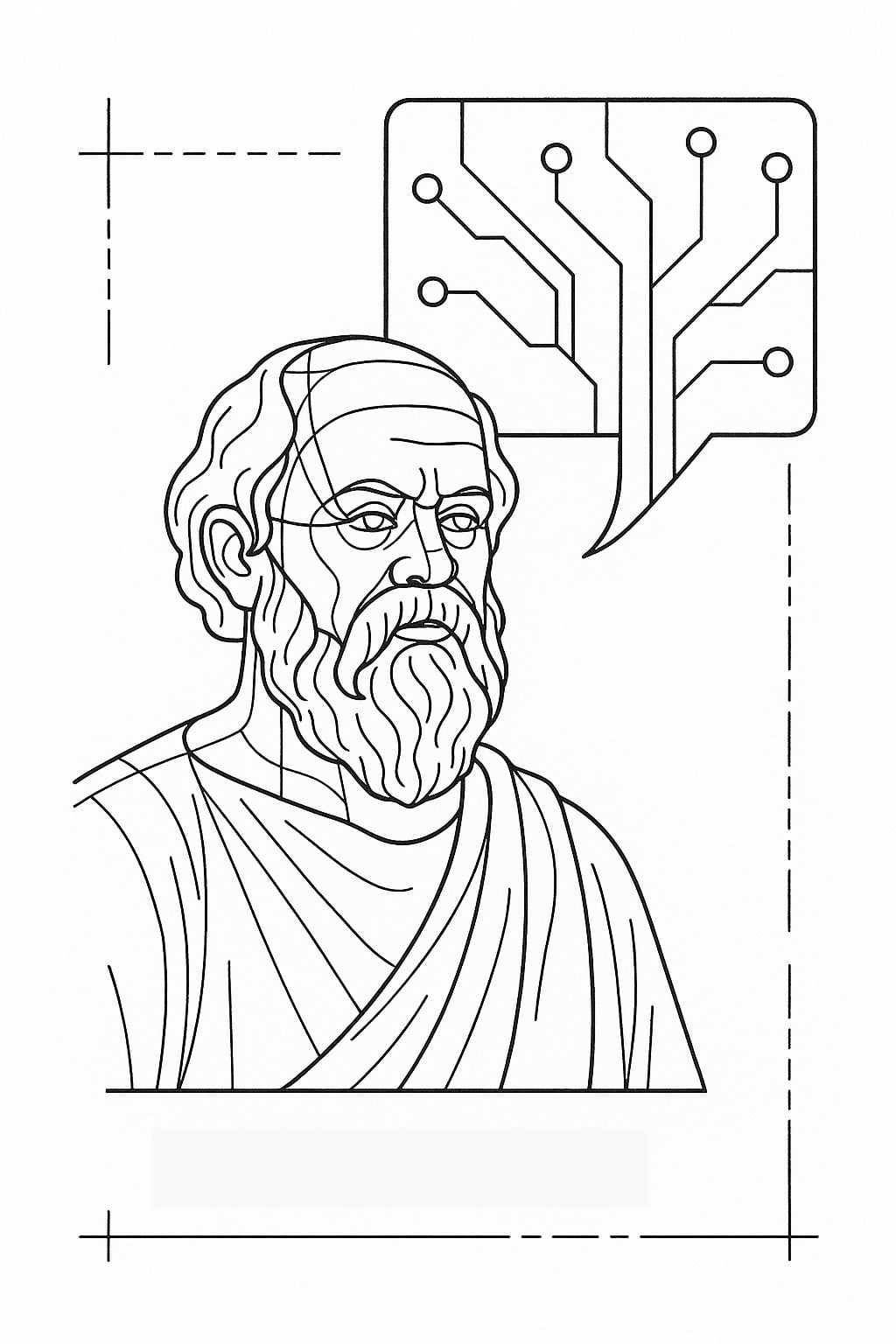
Chapter 5: The Socratic Partner (Conversational Mode)
AgentSpek - A Beginner's Companion to the AI Frontier
There's a particular kind of clarity that emerges from conversation. Not the false clarity of a quick answer or a copied solution, but the deep understanding that comes from having your assumptions questioned, your blind spots illuminated, your half-formed thoughts given shape.
“The only true wisdom is in knowing you know nothing.” - Socrates (from Plato’s Apology)
The Shape of Understanding
There’s a particular kind of clarity that emerges from conversation. Not the false clarity of a quick answer or a copied solution, but the deep understanding that comes from having your assumptions questioned, your blind spots illuminated, your half-formed thoughts given shape.
I discovered this when my Astro blog’s deployment pipeline became the subject of an extended dialogue with Claude.
A mess of Python scripts and AWS services I’d cobbled together over months.
Not a query, not a prompt, but a conversation. The kind where you start asking about build scripts and end up reconsidering your entire architecture.
“Help me understand what I’ve built here,” I typed, pasting in code that worked but felt wrong.
What emerged wasn’t just better code. It was better thinking.
The AI didn’t fix my pipeline. It helped me understand what I was trying to build. The difference between sequential and parallel processing. The implications of local versus serverless execution. The hidden assumptions in my error handling.
This is the power of conversational AI: it doesn’t just generate solutions, it generates understanding.
The code that results is almost secondary to the mental model that emerges.
When you truly understand your problem space, implementation grows trivial. When you don’t, no amount of generated code will save you.
This chapter explores the art of using AI as a thinking partner rather than a code generator. It’s about the profound difference between getting answers and developing understanding. Between solving problems and dissolving them through clarity of thought.
The Socratic Method, Algorithmic
Socrates understood that wisdom begins with admitting ignorance. His method wasn’t about providing answers but about revealing the questions hiding beneath our assumptions. Twenty-five centuries later, we’re discovering that the best AI interactions follow the same pattern. They don’t just respond to our queries. They help us understand what we’re really asking.
Alan Perlis, the first Turing Award winner, captured this in his epigrams: “A language that doesn’t affect the way you think about programming is not worth knowing.” Conversational AI is becoming that new language, not of syntax but of structured thinking, of making the implicit explicit, of discovering what we don’t know we don’t know.
The transformation is subtle but profound. Instead of “How do I implement authentication?” we learn to explore: “What are the trust boundaries in my system? What are the failure modes? What assumptions am I making about user behavior?”
This isn’t about asking better questions. It’s about discovering that most of our problems stem from asking the wrong questions entirely. The AI transforms into a mirror that reflects our thinking back to us, clarified and structured, revealing patterns we couldn’t see in the chaos of our own thoughts.
The Layers of Meaning
When I asked about visualizing blog post connections with Neo4j data, the conversation took an unexpected turn. Instead of diving into D3.js configurations or canvas rendering techniques, we ended up discussing the nature of relationships themselves. What makes two pieces of content related? Is it shared tags, semantic similarity, or reader behavior? The visualization problem dissolved into a more fundamental question about information architecture.
This is what conversational AI does best: it helps you peel back layers of assumption to find the real problem hiding beneath the surface problem. You think you need a graph visualization. You need better content taxonomy. You think you need faster queries. You need a different data model.
Marvin Minsky, in “The Society of Mind,” proposed that intelligence emerges from the interaction of many simple agents, each contributing a small piece to the whole. Conversational AI creates this society in real-time, each exchange adding another agent to the collective understanding. The intelligence isn’t in any single response but in the accumulated context, the shared mental model that emerges through dialogue.
Consider how understanding deepens through layers:
“I need to process markdown files for my blog.”
Such a simple statement. But watch how it unfolds:
“Process how? Extract metadata? Transform content? Generate indices?”
“Extract metadata for a content graph.”
“Static extraction or dynamic updates? How do you handle broken references? What about circular dependencies?”
Each question doesn’t just seek information. It reveals dimensions of the problem you hadn’t considered. The conversation evolves into an exploration of the problem space itself, mapping territories you didn’t know existed. Forward references to content not yet written. Bidirectional relationships that might create cycles. The temporal nature of content that evolves over time.
The magic isn’t in the AI knowing these things. It’s in the dialogue surfacing them, making visible what was always there but hidden in the fog of assumed understanding.
The Personality of Intelligence
Each AI model has its own way of thinking, its own conversational rhythm, its own blind spots and brilliances. Understanding these personalities isn’t about memorizing feature lists or comparing benchmarks. It’s about recognizing which kind of intelligence serves which kind of thinking.
Sonnet 4 thinks in systems. When you show it code, it sees architecture. When you describe a problem, it identifies patterns. It has this uncanny ability to spot the bottleneck you didn’t mention, the edge case you forgot, the simpler solution hiding behind your complexity. It’s the only model that reliably handles agent mode, perhaps because it understands agency itself, the delegation of intent rather than just the execution of instructions.
Claude Code operates differently, running parallel to your thoughts rather than in response to them. While you’re solving one problem, it’s preventing three others. It’s the peripheral vision of development, catching what you’re not looking at, handling what you’ve forgotten to handle.
GPT-5 excels at rapid exploration, the kind of thinking you do while walking, when ideas are still fluid and connections are still forming. It’s wrong sometimes, but wrong in interesting ways that reveal new directions. Perfect for those mobile moments when an insight strikes and you need to capture it before it dissolves.
The magic happens when you stop thinking about these as different tools and start recognizing them as different modes of cognition. Like Barbara Oakley’s focused versus diffuse thinking modes, but externalized and amplified. You can literally switch between different kinds of intelligence depending on what kind of thinking the moment requires.
Consider how a single idea evolves through different intelligences:
The spark comes during a walk. GPT-5 on mobile helps you explore: “What if content relationships were temporal, not just topical?”
Back at your desk, Sonnet 4 structures the insight: “Temporal relationships would require versioning, event sourcing, or at minimum timestamp tracking. Here’s how that changes your data model…”
Claude Code, running in parallel, has already started adjusting your schema migrations and updating your test fixtures.
This isn’t about using every tool available. It’s about recognizing that intelligence itself isn’t monolithic. Different problems require different kinds of thinking, and now we can literally choose which kind of intelligence to engage. The question isn’t which AI is best, but which intelligence fits this moment, this problem, this kind of thinking.
The Architecture of Context
Context is the hidden currency of AI collaboration. Not the context you explicitly provide in prompts, but the accumulated understanding that builds through sustained dialogue. This context isn’t just information, it’s a shared mental model, a collaborative intelligence that emerges over time.
Think about how human expertise develops. A consultant who’s worked with your company for years doesn’t just know your codebase. They know your team’s rhythm, your technical debt, your unspoken assumptions, the reasons behind decisions made before half the team arrived. This deep context makes their advice valuable not because they’re smarter, but because they understand the full picture.
Conversational AI can build similar context, but only if we let it. Most interactions are surgical strikes: quick questions, immediate answers, context discarded. But sustained conversation creates something different. The AI begins to understand not just your code but your coding style. Not just your problems but your problem-solving patterns. Not just what you’re building but why you’re building it.
I maintain long-running conversations with Claude about my blog infrastructure. Not because I need constant help, but because the accumulated context makes each interaction richer. It knows I prefer Python’s explicit simplicity over TypeScript’s type gymnastics. It remembers that AWS costs matter more than perfect architecture. It understands that I’d rather have three simple scripts than one clever abstraction.
This context evolves into a form of external cognition, a thinking space that exists outside your head but remains accessible. Like Andy Matuschak’s concept of “tools for thought,” these conversations transform into extensions of your mental workspace, holding complexity that would overflow your working memory.
The architecture of these conversations matters:
Layered understanding builds from surface to depth. Start with what you’re building. Add why you’re building it. Layer in constraints and preferences. accumulate decisions and their rationale.
Parallel threads explore without confusion. One thread for architecture decisions. Another for implementation details. A third for learning and exploration. Each maintains its own context while contributing to the whole.
Periodic synthesis prevents context overflow. Not every detail needs preserving. Core insights get extracted and elevated. Patterns get recognized and named. The model gets refined, not just expanded.
This isn’t about having longer conversations. It’s about recognizing that understanding itself has architecture, and that AI can help us build and maintain cognitive structures too complex for any single mind to hold.
Teaching Through Correction
One of the most powerful learning mechanisms in conversational AI programming is the correction cycle. When the AI suggests something that’s almost right but needs refinement, and through that refinement process, both you and the AI develop better understanding.
The productive disagreement.
Traditional model: accept AI suggestions or reject them. Teaching model: engage with AI suggestions to refine understanding.
Watch this correction cycle unfold:
AI: “For your static site deployment, you could use S3 with CloudFront for simple hosting.”
You: “I’m already using S3, but my build times are killing me. Sometimes it takes 10 minutes just to process images.”
AI: “That’s a significant bottleneck. Are you processing images on every build or caching the processed versions? Also, what image operations are you running?”
You: “Resizing, format conversion to WebP, generating multiple sizes for responsive images. Every build processes everything.”
AI: “There’s your problem. You’re reprocessing unchanged images. Let’s explore a few approaches: content-addressed storage where images are only processed when they change, Lambda functions for on-demand image processing, or a hybrid where you process new images at upload time and cache aggressively…”
Notice how the correction leads to a more sophisticated solution that addresses multiple constraints. The AI doesn’t just accept your correction. It builds on it, revealing implications you might not have considered.
Patterns emerge through correction. Security refinements: AI suggests functional solutions, you add security considerations. Performance optimizations: you identify bottlenecks in AI-suggested approaches. Maintainability improvements: AI provides quick solutions, you guide toward long-term thinking. Business logic integration: AI handles technical implementation, you ensure business rule compliance.
The collaborative debugging process.
When debugging with conversational AI, the correction cycle transforms into a powerful diagnostic tool:
AI hypothesis: “Based on the error message, it looks like a race condition in your async data loading.”
You: “The race condition theory makes sense, but this error only happens in production, not in development.”
AI: “That’s an important clue. Production-only race conditions often involve timing differences. What’s different about your production environment? Different database latency, caching layers, or concurrent user load?”
You: “We have Redis caching in production that’s not in dev. Could that be introducing timing issues?”
AI: “Redis caching could definitely create timing differences. If your cache invalidation isn’t perfectly synchronized with database updates, you might get stale data in some requests but not others. Can you show me your cache invalidation logic?”
This is debugging as archaeology. Each question unearths another layer of context until you find the artifact that explains everything.
Building AI understanding of your domain.
Each correction teaches the AI more about your specific context. Business rules: “That approach would work technically, but our compliance requirements mean we need to audit every data access.” Team constraints: “While that’s the ideal solution, our team doesn’t have experience with that technology stack.” Legacy considerations: “That refactor makes sense in isolation, but this module interfaces with legacy systems that can’t be changed.” Performance requirements: “That algorithm is O(n²), but with our dataset sizes, we need something more efficient.”
The meta-learning effect.
Over time, AI conversations improve not just in domain knowledge but in understanding how you think and what you value. Decision patterns: how you evaluate trade-offs between different options. Quality standards: what level of polish and robustness you require. Risk tolerance: how you balance innovation against stability. Communication style: how technical you want explanations to be.
After a few months of regular conversations with Claude, I noticed something strange. It started suggesting Python scripts when I would have reached for Python. It proposed simple solutions when I would have avoided complexity. It remembered that I prefer explicit configuration over magic, that I’d rather have three simple scripts than one clever one. It had learned not just what I was building, but how I think about building.
This is when the AI stops being a tool and transforms into a thinking partner. When it anticipates not just what you want, but what you would want if you thought more deeply about the problem.
The Architecture Discussion That Transformed Everything
Let me walk you through the conversation that opened this chapter in detail, because it illustrates every principle we’ve discussed in action.
Content pipeline chaos.
My Astro blog had evolved from a simple static site to a complex content ecosystem. The build system was a patchwork of Python scripts, AWS CDK deployments, manual image processing, scattered content processing logic across multiple files, no automated Neo4j integration, and performance bottlenecks in the content generation pipeline.
The immediate need: Optimize build times that had grown from 2 minutes to 15 minutes.
The deeper reality: The entire content processing architecture needed systematic thinking.
Hour 1: Context building and problem exploration.
9:00 AM. Initial query: “My Astro blog build times are killing me - 15 minutes for what used to take 2. I think my content processing architecture needs help. Can you analyze what I’ve built?”
I shared my Python content processing scripts, AWS CDK infrastructure code, and the Astro build configuration.
Sonnet 4’s response: Rather than jumping into optimization tactics, it asked probing questions. How do you handle content dependencies between posts? What’s your image processing pipeline? How does Neo4j integration fit into the build process? Are you processing unchanged content on every build?
Key insight: Sonnet 4 immediately recognized that build time was the symptom, not the problem. The real challenge was architectural.
9:15 AM. Architecture discussion. Sonnet 4 mapped out the current content flow and identified three major issues. Sequential processing: everything ran in waterfall, not parallel. Cache invalidation: no intelligent detection of what changed. Resource conflicts: image processing and Neo4j updates competed for I/O.
9:30 AM. Alternative exploration. Instead of proposing a single solution, Sonnet 4 walked through three different architectural approaches. Minimal optimization: parallel processing with current scripts (fast but limited gains). Complete rebuild: event-driven pipeline with AWS Step Functions (ideal but complex). Hybrid approach: intelligent caching with selective processing (balanced and practical).
For each approach, Sonnet 4 outlined implementation complexity, infrastructure changes, maintainability implications, and expected performance gains.
This is the moment when you realize you’re not just getting code suggestions. You’re getting infrastructure architecture consulting.
Hour 2: Deep dive and decision framework.
10:00 AM. Constraint clarification. My correction: “The complete rebuild isn’t realistic - I need this working this week. But the minimal approach won’t solve the fundamental issues.”
Sonnet 4’s pivot: “Let’s explore the hybrid approach more deeply. What if we implement content-addressed caching where only changed content gets processed? We can add parallel processing for independent operations while maintaining your current architecture.”
10:15 AM. Implementation strategy. Sonnet 4 outlined a specific optimization path. First, implement content-addressed caching where files are hashed and only processed when changed. Second, parallelize independent operations using Python’s multiprocessing. Third, separate image processing from content generation. Fourth, implement incremental Neo4j updates rather than full rebuilds.
This is when the conversation shifts from problem exploration to solution architecture. You can feel the clarity emerging.
10:30 AM. Infrastructure deep dive. My question: “How do we ensure the build pipeline doesn’t corrupt production if something fails?”
Sonnet 4’s response revealed infrastructure expertise I lacked. S3 versioning for rollback capability. CloudFront cache invalidation only after successful builds. Lambda dead letter queues for failed processing. Neo4j transaction boundaries to prevent partial updates. Python exception handling with detailed logging for debugging.
10:45 AM. Architecture discussion. Sonnet 4 proposed a Python content processing pipeline with clear separation of concerns. A ContentProcessor class to handle markdown parsing and metadata extraction. An ImageOptimizer for parallel image processing with caching. A GraphBuilder for Neo4j relationship mapping. A DeploymentOrchestrator to coordinate AWS CDK deployments.
Now I’m not just getting implementation guidance. I’m getting systems architecture consultation that would normally require hiring a specialist.
Hour 3: Implementation planning and code generation.
11:00 AM. Pipeline design. Together, we designed the content processing flow:
Content flows from markdown through a series of transformations. Each file gets hashed for change detection. Changed content triggers metadata extraction. Relationships get mapped to Neo4j nodes and edges. Images get optimized in parallel with multiple sizes. Everything culminates in a static build with Astro. The entire pipeline can run incrementally or in full rebuild mode.
11:15 AM. Migration strategy. Sonnet 4 suggested an incremental rollout approach:
Start with parallel processing for images only, the lowest risk change. Monitor build times and error rates. Then add content caching to skip unchanged files. Verify cache hit rates and build consistency. Next implement incremental Neo4j updates. Finally, orchestrate everything through AWS Step Functions for full observability.
11:30 AM. Implementation details. Sonnet 4 generated the core Python pipeline with proper exception handling, progress tracking, parallel processing coordination, caching logic, and Neo4j transaction management.
11:45 AM. Testing strategy. Without prompting, Sonnet 4 suggested comprehensive validation. Build output comparison between old and new pipelines. Performance benchmarking for each optimization. Error injection to test failure recovery. Cache invalidation testing. Neo4j data integrity verification.
This is the moment when you realize the AI isn’t just generating code. It’s thinking through the entire development lifecycle.
The 30-minute implementation.
After three hours of conversation, I had a complete architectural plan, detailed implementation strategy, risk mitigation approaches, testing framework, and migration timeline.
The actual implementation took 30 minutes because all the thinking was done. I was copying and adapting code that Claude had generated with full context of our constraints, requirements, and architectural goals.
Key lessons from the war story.
Time investment pays exponentially. 3 hours of conversation saved days of implementation and rework.
AI excels at constraint analysis. Claude identified implications I hadn’t considered.
Context accumulation is powerful. By hour 3, Claude understood our codebase better than some team members.
Implementation grows trivial. When architecture is clear, coding is mechanical.
Quality emerges from process. The solution was more robust than anything I would have built rushing to implementation.
Teaching improves output. Every correction I made led to better subsequent suggestions.
But here’s the deepest lesson: the conversation is the real work. Everything else is just typing.
Practical Exercises: Building Your Conversational Skills
Exercise 1: The context building session (Week 1).
Learn to establish comprehensive context with AI before diving into implementation. Choose a feature you need to build or a system you need to refactor. Start a conversation but don’t ask for code. Spend 30 minutes just explaining your problem and constraints. Let the AI ask clarifying questions. Resist the urge to jump to implementation.
Questions to explore: What business problem are you solving? What constraints do you have (time, team, technology)? What’s your current architecture? What are the success criteria? What are the risks if this fails?
Success measure: By the end of 30 minutes, the AI should understand your problem better than you explained it initially.
Debrief questions: What assumptions did the AI help you identify? What constraints did you forget to mention initially? How did your understanding of the problem evolve?
This exercise teaches patience. Most developers rush to implementation. Force yourself to stay in problem space.
Exercise 2: The socratic challenge (Week 2).
Practice using AI to question your approach rather than validate it. Take a technical decision you’ve already made and present it to AI. Explain your chosen solution. Ask the AI to challenge your approach. Defend your decisions with reasoning. Let the AI propose alternatives. Explore the trade-offs between approaches.
Prompts to try: “What are the weaknesses in this approach?” “What assumptions am I making that might be wrong?” “What would you do differently and why?” “What could go wrong with this solution?”
Success measure: You should discover at least one significant consideration you hadn’t thought of.
This exercise teaches intellectual humility. Your first instinct will be to seek validation. Force yourself to seek challenge instead.
Exercise 3: The extended architecture session (Week 3).
Maintain a multi-day conversation to design a complex system. Choose a significant architectural challenge (microservices migration, performance optimization, security upgrade). Day 1: problem exploration and constraint identification. Day 2: alternative approaches and trade-off analysis. Day 3: detailed design of chosen approach. Day 4: implementation planning and risk assessment. Day 5: review and refinement.
Context management: Start each day by summarizing previous insights. Maintain a running document of key decisions. Ask AI to identify gaps in your understanding. Build complexity gradually.
Success measure: By day 5, you should have a comprehensive architectural plan that you’re confident implementing.
This exercise teaches persistence. Most conversations die after an hour. Push through to where real insight lives.
Exercise 4: The teaching through correction session (Week 4).
Learn to improve AI suggestions through iterative refinement. Ask AI to solve a problem you already know how to solve well. Let AI provide initial solution. Identify what’s missing or suboptimal. Provide specific corrections with reasoning. Ask AI to refine based on your feedback. Continue until solution meets your standards.
Focus areas: Security considerations. Performance optimization. Code maintainability. Business logic accuracy. Error handling completeness.
Success measure: The final solution should be noticeably better than the initial suggestion and incorporate your domain expertise.
This exercise teaches collaboration. The AI’s first answer is rarely its best answer. Your job is to guide it toward excellence.
Exercise 5: The multi-model conversation (Week 5).
Learn to leverage different AI personalities for different aspects of a problem. Choose a complex problem that involves both creative and analytical thinking. Gemini: explore creative approaches and novel solutions. Claude: analyze trade-offs and implications systematically. GPT-4: plan concrete implementation steps. Synthesis: combine insights from all three conversations.
Questions to explore: How do different models approach the same problem? What unique insights does each model provide? How can you combine their strengths effectively?
Success measure: Your final approach should incorporate unique insights from each model.
This exercise teaches orchestration. Different kinds of intelligence for different kinds of thinking.
Advanced Conversational Patterns
The architectural interview pattern. Use AI to conduct a comprehensive architectural review of your systems. Setup: “I want you to act as a senior architect reviewing my system. Ask me the questions you would ask in a thorough architectural review.”
This identifies blind spots in your design, surfaces considerations you might have missed, and provides structured approach to system analysis.
The red team pattern. Have AI actively try to find problems with your approach. Setup: “I want you to act as a security/performance/reliability engineer trying to find problems with my design. What concerns would you raise?”
This stress-tests your assumptions, identifies potential failure modes, and prepares you for code review and production issues.
Think of these as different lenses. The architectural interview shows you what you haven’t considered. The red team shows you what could break.
The time travel pattern. Explore the long-term implications of your decisions. Setup: “Let’s imagine it’s two years from now and my team is struggling with the system we’re designing today. What problems might they be facing?”
This considers long-term maintainability, identifies technical debt risks, and guides decisions toward sustainable solutions.
The constraint relaxation pattern. Systematically explore what grows possible if constraints change. Setup: “Let’s explore what we could build if [constraint] weren’t a factor. Then work backwards to see what aspects we can achieve within our current limitations.”
This reveals innovative approaches, identifies which constraints are truly limiting, and finds creative workarounds.
Time travel shows you future pain. Constraint relaxation shows you current possibilities. Both expand your solution space.
Measuring Conversational AI Effectiveness
Quantitative metrics. Context retention: how much previous conversation context does the AI maintain? Question quality: how often does AI ask questions that reveal important considerations? Solution evolution: how much do solutions improve through conversational refinement? Implementation accuracy: how closely does final code match conversational design?
Qualitative indicators. Insight generation: frequency of “I hadn’t thought of that” moments. Problem reframing: how often conversations reveal you’re solving the wrong problem? Confidence building: how much more confident you feel about complex decisions. Learning acceleration: how quickly you understand new domains with AI assistance.
Long-term development. Architectural intuition: improvement in your ability to design systems. Decision frameworks: better approaches to evaluating technical trade-offs. Problem decomposition: more effective ways to break down complex challenges. Communication skills: better at explaining technical concepts and constraints.
But the real measure is simpler. Do you find yourself thinking more clearly about problems? That’s the only metric that matters.
The Future of Conversational Programming
As AI capabilities continue to evolve, conversational programming will grow increasingly sophisticated. We’re moving toward AI that can maintain context across projects, understanding your long-term architectural goals and constraints. Anticipate needs: proactively identifying potential issues and opportunities. Learn team dynamics: understanding how different team members think and work. Integrate with development flow: seamlessly participating in code reviews, planning sessions, and architectural discussions.
Preparing for advanced conversational AI.
Document your thinking patterns. AI will become better at adapting to your cognitive style. Develop meta-cognitive skills: understand how you think about problems so you can teach AI to think similarly. Practice explanation skills: the better you can explain your reasoning, the better AI can collaborate. Build institutional knowledge: create systems for preserving and sharing conversational insights.
The developers who master conversational AI programming won’t just write better code faster. They’ll think better thoughts and make better decisions.
The conversation is the real product. The code is just the artifact.
Next: Chapter 6: The Delegated Mind (Agent Mode)
← Previous: Chapter 4: Agent Mode | Back to AgentSpek
© 2025 Joshua Ayson. All rights reserved. Published by Organic Arts LLC.
This chapter is part of AgentSpek: A Beginner’s Companion to the AI Frontier. All content is protected by copyright. Unauthorized reproduction or distribution is prohibited.
Sources and Further Reading
This chapter draws inspiration from Socrates’ method of inquiry as documented in Plato’s dialogues, particularly the Apology. The Socratic approach of revealing knowledge through questioning provides a framework for understanding how conversational AI can surface hidden assumptions and clarify thinking.
Alan Perlis’s insights from his ACM Turing Award lecture and his famous programming epigrams (“A language that doesn’t affect the way you think about programming is not worth knowing”) inform the discussion of how AI conversation shapes our approach to problem-solving.
Marvin Minsky’s “The Society of Mind” (1986) provides the theoretical foundation for understanding intelligence as emergent from multiple interacting agents, a concept that applies directly to conversational AI creating collective understanding through dialogue.
The architectural principles discussed build on classic works in software engineering, including Frederick Brooks’ “The Mythical Man-Month” for understanding essential vs. accidental complexity, and the NATO Software Engineering Conference proceedings (1968) for foundational thinking about software design methodology.
Andy Matuschak’s work on “tools for thought” and the concept of external cognition informs the discussion of how AI conversations transform into extensions of our mental workspace.
For practical implementation, readers should explore the specific documentation of conversational AI tools, though this chapter focuses more on the cognitive and methodological aspects than specific technical implementations.