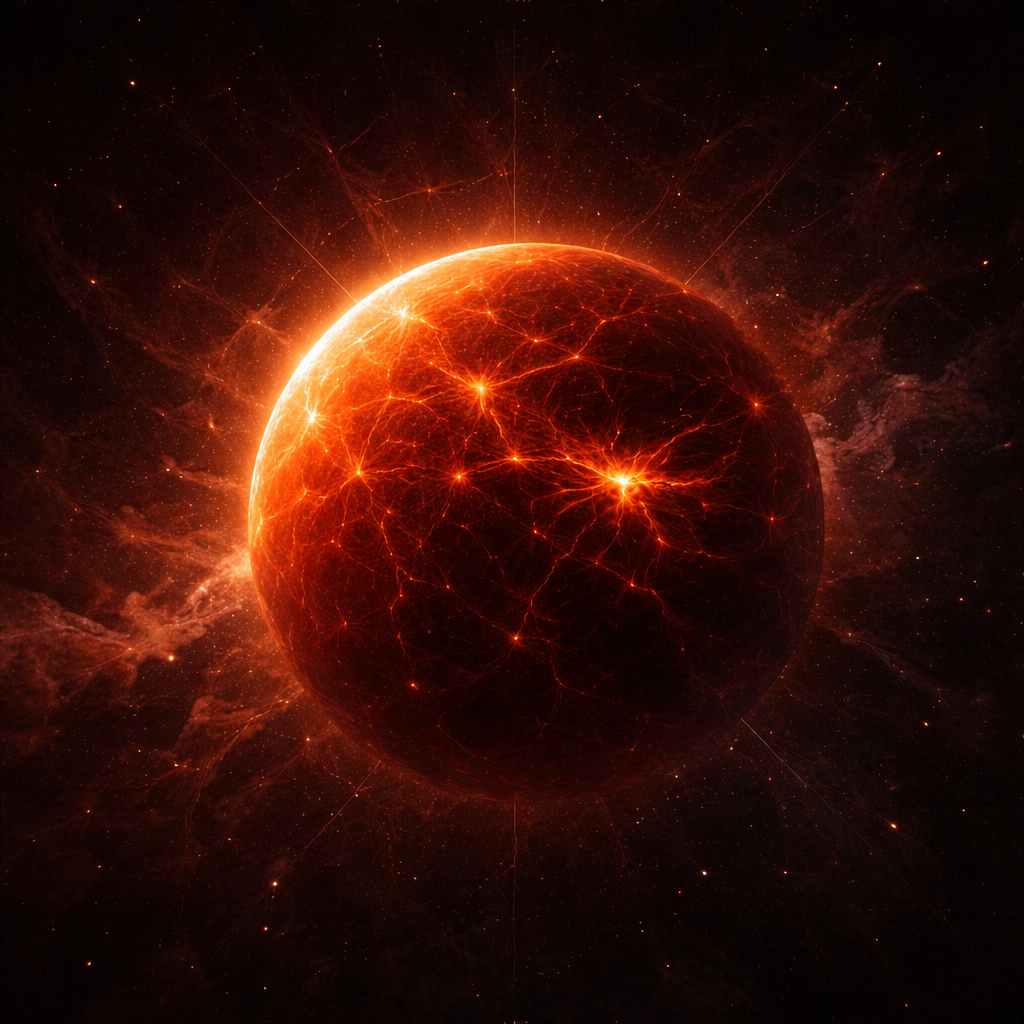
Betelgeuse: Decan 31 - Power & Creation
The Hand of the Central One
The photons entering your eyes right now left Betelgeuse in 1477—from the year the printing press arrived in England, when Leonardo da Vinci began his career, when the Renaissance exploded across Europe. 548 years that photon traveled, witnessing humanity's creative revolution, arriving tonight to ask: What are you creating that will seed what comes after?
New to The Decan Log? Start with the Introduction: Living by the Stars to understand the 10-day decanal system, how it works, and why ancient Egyptian timekeeping offers a better framework for personal growth than modern weeks.
Living this decan? For a personal account of ten days under this star, read the decan journal.
For ten days you held steady with Polaris—the North Star, the fixed point around which all else revolves. You found your true north. Now comes what direction enables: the power to create. And not the careful, measured creativity of careful, measured people. The raw, volcanic, world-seeding creativity of a dying giant that refuses to go quietly.
The Star That Boils
The photons entering your eyes tonight left Betelgeuse in 1477.
This is not metaphor. This is physics. That red-orange light traveled 548 years through the void—departing when William Caxton established the first English printing press, when Leonardo da Vinci was twenty-five years old and beginning his artistic career, when the Renaissance was exploding across Italy like a cultural supernova, when Columbus had not yet sailed but would in fifteen years.
You are literally seeing the past. Not the recent past of a few seconds or minutes, but the deep past of half a millennium. The photons striking your retina witnessed the birth of mass communication, the democratization of knowledge, the moment when individual creative power became amplifiable in ways previously impossible.
And what you’re seeing when that light finally arrives—that massive red-orange beacon in Orion’s upper shoulder—is not calm. It’s not stable. It’s not gently radiating like our Sun, a yellow dwarf in the comfortable prime of middle age.
Betelgeuse is boiling.
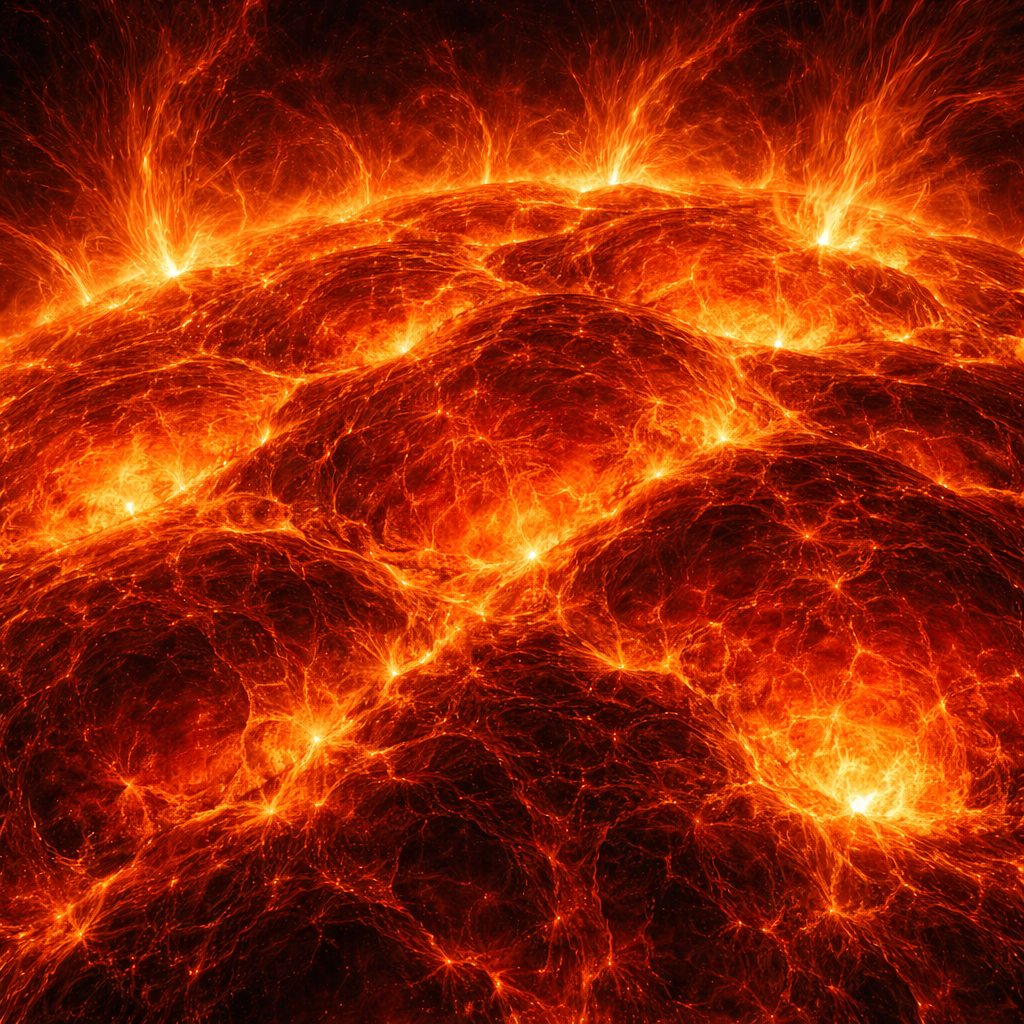 Betelgeuse’s surface isn’t smooth—it’s a roiling cauldron of convection cells larger than planetary orbits. Hot plasma rises from the core at 30 km/s, breaks through the surface, transforms everything it touches. Creation at cosmic scale.
Its surface has only a few giant convection cells—and each one is larger than Earth’s entire orbit around the Sun. Think about that. A single bubble on this star’s surface spans a distance that takes our planet a full year to travel. Hot material rises from deep inside the star at thirty kilometers per second, breaks through the photosphere, cools, sinks back down. Rise. Break. Cool. Sink. The surface literally bubbles like a pot left too long on a cosmic stove.
Unlike our Sun’s relatively calm exterior, Betelgeuse’s photosphere is a violent, churning cauldron. The star is asymmetric. Lumpy. Constantly reshaping itself. Modern telescopes can actually resolve its disk—not just a point of light but a visible sphere—and what they see is a surface that looks different every time they observe. Sometimes these convective plumes don’t just rise to the surface; they erupt completely, launching Surface Mass Ejections that temporarily dim the star while seeding space with material for future star formation.
For three thousand years, humans have watched this star and called it powerful. The Babylonians saw it as the arm that draws the bow. The Arabs named it “The Hand of the Central One.” Medieval astrologers associated it with martial honors, kingly fortune, and dangerous creative force.
They didn’t have spectroscopes. They couldn’t measure convection velocities or calculate mass ejection volumes. But they didn’t need to. What they saw with naked eyes—that unmistakable red-orange glow, pulsing and variable, blood-colored in a sea of white and blue stars—told them everything they needed to know.
This was raw creative power that could not be contained.
The Lesson of Decan 31
Creation is not smooth. Creation is eruption.
The universe doesn’t make new things gently. It makes them through violence, through convection, through mass ejections that temporarily dim the creator. What you build may obscure you while you build it. The dust cloud clears later. The material endures.
The Star: Betelgeuse (Alpha Orionis)
Betelgeuse sits 548 light-years away, marking Orion’s right shoulder. It’s one of the largest stars visible to the naked eye—a red supergiant so massive that if placed at our Sun’s position, it would engulf Mercury, Venus, Earth, Mars, and extend past Jupiter’s orbit to approximately the asteroid belt.
The numbers strain comprehension. Its radius spans roughly 764 times our Sun’s, with some estimates pushing past 900 solar radii. Its volume exceeds our Sun’s by a factor of 330 million. It radiates with the luminosity of 100,000 to 126,000 suns, the variation a product of its pulsations. Despite containing 16 to 19 times our Sun’s mass, its surface temperature runs cooler—around 3,500 Kelvin compared to our Sun’s 5,778 K. This is the paradox of red supergiants: enormous but cool, powerful but dying.
And despite its 8 to 10 million years of age—young in absolute terms—Betelgeuse is ancient for a star of its mass. It’s already in late-stage evolution, burning through its fuel at a pace that would horrify any accountant.
The star is so large, so unstable, that it’s visible as an actual disk through modern telescopes—not just a point of light but a resolved sphere with surface features. We can watch the convection cells rise and fall. We can see the star literally reshape itself over months and years.
And we know its fate: Betelgeuse will explode as a Type II supernova.
Not might. Will.
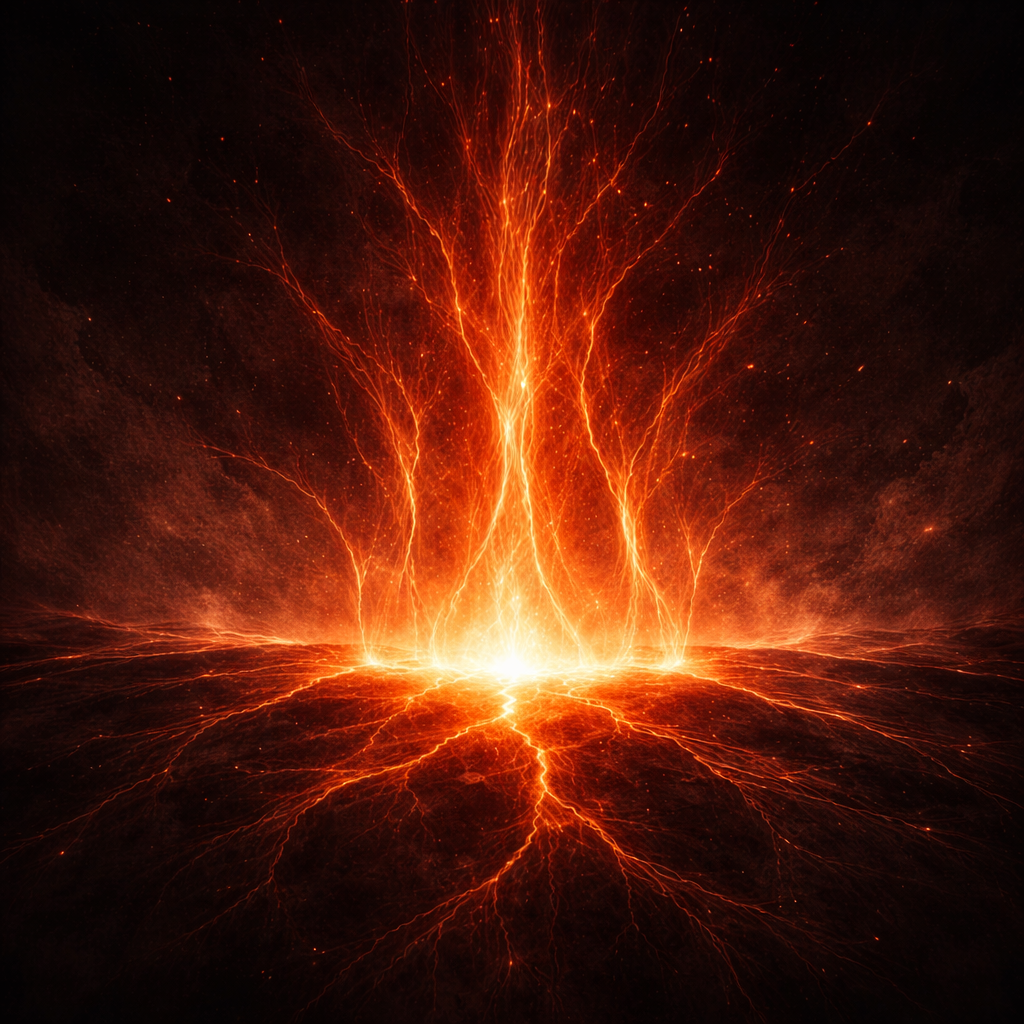 The Great Dimming of 2019-2020: Betelgeuse faded to its lowest brightness in 200 years. A massive convection cell erupted, ejecting 100+ million miles of material that cooled into dust and blocked the star’s light. This wasn’t death—this was creation through disruption.
The Great Dimming: Creation Through Disruption
In late 2019, Betelgeuse did something that sent astronomers scrambling for their instruments and sent headlines racing around the world. It dimmed. Not by a little. Dramatically.
The star that normally shines at magnitude 0.5—among the ten brightest points in the night sky—faded to magnitude 1.7, losing two-thirds of its light. For months, it was the faintest Betelgeuse had been in over two centuries of systematic observation. Orion’s shoulder seemed to be failing.
Was this the prelude to supernova? Was the star’s core finally collapsing? Were we about to witness the most spectacular astronomical event in four hundred years—the explosion of a visible supergiant?
The answer was both simpler and more profound: Betelgeuse wasn’t dying. It was creating.
Here’s what happened: A massive convection cell—larger than Earth’s entire orbit around the Sun—bubbled up from deep inside the star. When this rising plume of superheated plasma reached the surface, it didn’t just cool and sink back down like a normal convection cycle. It erupted. Violently. The star launched a Surface Mass Ejection more than one hundred million miles wide—a blob of stellar atmosphere bleeding out into space.
This ejected material cooled rapidly in the vacuum, condensing into dust that blocked the star’s light from reaching Earth. Betelgeuse dimmed itself through its own creative eruption, obscured by the debris of its making.
The dust cloud eventually dispersed. The star returned to normal brightness. But the ejected material didn’t vanish. It’s out there now—enriched gas and heavy elements drifting through interstellar space, eventually to be incorporated into future nebulae, future stars, future planets. Perhaps future life.
The star didn’t die. It created. And in the act of creating, it temporarily disappeared.
This is what creative power looks like at cosmic scale. Not neat. Not controlled. Not a smooth progression from concept to completion. Creation is violent. Disruptive. Obscuring. And ultimately, generative.
The Great Dimming wasn’t failure. It was the physics of creation made visible across 548 light-years.
The Companion Star: Power Requires Partnership
In 2025—as this decan begins—astronomers confirmed what had long been suspected: Betelgeuse has a companion.
Her name is Siwarha, Arabic for “her bracelet.” Astronomers call her “Betelbuddy.” She’s a modest star—roughly one solar mass, practically invisible against Betelgeuse’s overwhelming brilliance. The mass ratio between them is staggering: sixteen to one, perhaps eighteen to one. A basketball orbiting a stadium. A candle beside a bonfire.
Yet this tiny companion shapes the supergiant’s behavior in profound ways.
Siwarha orbits within or near Betelgeuse’s extended atmosphere, sweeping through the giant’s diffuse outer layers on a six-year cycle. As she orbits, she clears away the light-blocking dust that Betelgeuse constantly sheds. She creates periodic patterns in the star’s brightness that would otherwise appear as random chaos. She makes visible what would remain hidden.
Even the most powerful creative force requires a companion.
Betelgeuse cannot be fully understood without Siwarha. The giant’s six-year brightness variations, long a puzzle, suddenly make sense when you account for the tiny star orbiting through the debris. The pattern emerges from the partnership.
This is the physics of creative power: it is relational, not isolated. The supergiant needs the small companion. The bonfire needs the candle-bearer who clears the smoke.
Who is your Betelbuddy? Who clears the dust your creation kicks up? Who makes visible the patterns hidden in your chaos? The most powerful creative force in Orion has a partner. So might you.
The 1477 Light: Time Travel by Photon
When you observe Betelgeuse tonight, you’re not just seeing a star. You’re receiving a message from 1477—a pivotal year in human history when the very nature of creative power was being transformed.
In London, William Caxton was establishing the first English printing press, translating and publishing books that would spread ideas faster than any messenger could carry them. In Florence, Lorenzo de’ Medici was patronizing artists whose work would define Western aesthetics for centuries. In Vinci, a twenty-five-year-old named Leonardo was beginning to paint, sculpt, engineer, and imagine devices that wouldn’t be built for five hundred years.
The Gutenberg Bible had been printed just twenty-two years earlier. Knowledge was transitioning from handwritten manuscripts that took months to produce to printed books that could be reproduced in days. The Renaissance was not coming—it was exploding, transforming every field it touched, democratizing access to ideas that had once been locked away in monasteries and courts.
Columbus would sail in fifteen years. Martin Luther would nail his theses to a church door in forty. The world these photons left behind was on the verge of transformation so profound that we still live in its aftermath.
The light you see tonight witnessed that explosion.
It departed Betelgeuse at the exact moment when human creative power was becoming amplifiable, shareable, unstoppable. The printing press did to knowledge what Betelgeuse’s mass ejections do to stellar material: violent distribution that seeds future creation.
You are connected to that moment across 548 years of travel through the void. The photon that enters your eye tonight passed through space while empires rose and fell, while technologies transformed and vanished and transformed again, while the Renaissance gave way to Reformation gave way to Enlightenment gave way to Industry gave way to Information.
All that history, and the light kept traveling. Arriving now. To you.
What are you creating that participates in that lineage?
Historical Layers: The Hand That Draws the Bow
Babylonian and Akkadian Traditions
Four thousand years ago, the astronomers of Mesopotamia watched this star rise over their ziggurats and saw it as part of a celestial shepherd. The constellation we call Orion was MULSIPA.ZI.AN.NA—the True Shepherd of Anu, guardian of the celestial equator, divine caretaker of the most important region of the sky.
Anu was the supreme god of the heavens. His shepherd stood watch over the realm between the northern and southern celestial spheres, staff in hand, authority absolute. Betelgeuse marked the shoulder from which that divine authority flowed.
Before Orion was a hunter, he was a protector. Before he drew a bow, he held a shepherd’s crook. The power Betelgeuse represents isn’t just the power to destroy—it’s the power to guide, to guard, to shepherd others through darkness. Creation and protection intertwined.
The Arabic Name
The name “Betelgeuse” is a corruption of a corruption—and therein lies a teaching.
The original Arabic was Yad al-Jawzā’: “The Hand of the Central One.” Medieval scholars misread the Arabic letter yā’ as bā’, turning “Yad” into “Bed.” Later scholars “corrected” this to refer to the armpit (ibt), creating “Betelgeuse.”
A mistake built on a mistake. Yet it stuck. Centuries of astronomers have called this star by an erroneous name, and the name has become canonical.
Creation doesn’t require purity of origin. The word is wrong, and the word is real. The name is corrupted, and the name endures. Your creative power doesn’t have to emerge from perfect conditions or correct processes. What matters is that it exists, that it persists, that it radiates despite the errors in its lineage.
Greek Mythology: The Giant Hunter
To the Greeks, Orion was a giant hunter—son of Poseidon, legendary for beauty, strength, and skill. His death stories vary. In one, Artemis killed him accidentally, tricked by her jealous brother Apollo. In another, he boasted he could hunt every beast on Earth, and Gaia sent a scorpion to humble him. In a third, he violated divine boundaries and paid with his life.
Every version shares a theme: power without wisdom leads to destruction.
Orion had the strength. He had the skill. What he lacked was the judgment to know when to stop, when to be humble, when to acknowledge that even giants have limits. He died and was placed among the stars—the first celebrity, immortalized by his own excess.
Betelgeuse marks his shoulder: the source of his power, the origin point of the arm that drew the bow. The lesson isn’t that power is wrong. The lesson is that power must serve something beyond itself. Perseus had Athena’s guidance. Orion had only his own pride.
What guides your power?
The Four Royal Stars
Medieval Persian astrologers recognized four stars as the Royal Watchers—guardians of the four quarters of the sky. Aldebaran watched the East. Regulus guarded the North. Antares held the West. Fomalhaut, which you may have passed through in earlier decans, maintained the South.
Betelgeuse was not among them. It occupied a different role: not guardian, but source. Not the one who watches, but the one who empowers those who act. The Royal Stars maintained order. Betelgeuse disrupted it—through creation, through transformation, through the volatile energy that makes new things possible.
The medieval astrologers associated Betelgeuse with martial honors, success through voyages abroad, kingly attributes, and great fortune—but also with treachery, violence, and the danger of hubris. The same star that blessed could destroy. The same power that created could consume.
This is the nature of creative force: it doesn’t discriminate. It empowers whatever it touches.
Entering Orion: Five Decans with the Hunter
You’ve spent ten days with Polaris, finding your true north. Before that, you moved through Perseus with Algol, consuming the challenge that eclipsed you, wielding the monster you’d slain.
Now you enter Orion.
No constellation dominates winter skies like the Hunter. His belt of three bright stars is the most recognized pattern in human stargazing—visible from every inhabited continent, used as a pointer to dozens of other celestial objects, burned into the consciousness of every culture that has looked up on cold clear nights.
For the next five decans—fifty days—you will traverse the Hunter’s body. You begin at Betelgeuse, the right shoulder where power originates. From there you’ll descend to Rigel at the left foot, where grounded mastery stabilizes the aim. Then back up to Bellatrix at the left shoulder, the female warrior whose force is strategic. Through the Belt you’ll pass—first Alnilam at the center, the structural alignment that creates legacy, then Mintaka at the western edge, the cosmic connection, the portal to what lies beyond.
Five stars. Fifty days. One complete arc through the Hunter.
You begin at the shoulder—the power source.
Consider the anatomy: the shoulder isn’t where you aim (that’s the eye). It’s not where you release (that’s the hand). It’s not where you stand (that’s the foot). The shoulder is where force originates before it flows to action. You don’t strike with your shoulder; you power the strike from it. You don’t draw the bow with your shoulder; you anchor the draw there.
Betelgeuse is the source before expression. The force before form. The potential before the kinetic.
And it’s red—the color of heat, blood, urgency, creative ferment. While Rigel at the Hunter’s foot burns blue-white with controlled intensity, Betelgeuse glows red-orange with volatile, barely-contained power. These are the bookends of the Hunter’s body: red chaos above, blue precision below.
The arc you’re beginning teaches a complete creative cycle: power to mastery, mastery to strategy, strategy to structure, structure to connection. From shoulder to foot to shoulder to belt to belt. From building to completing to strategizing to aligning to transcending. Betelgeuse starts this fifty-day journey with volcanic creative force.
The question is not whether you have power. You do. The question is what you’ll create with it.
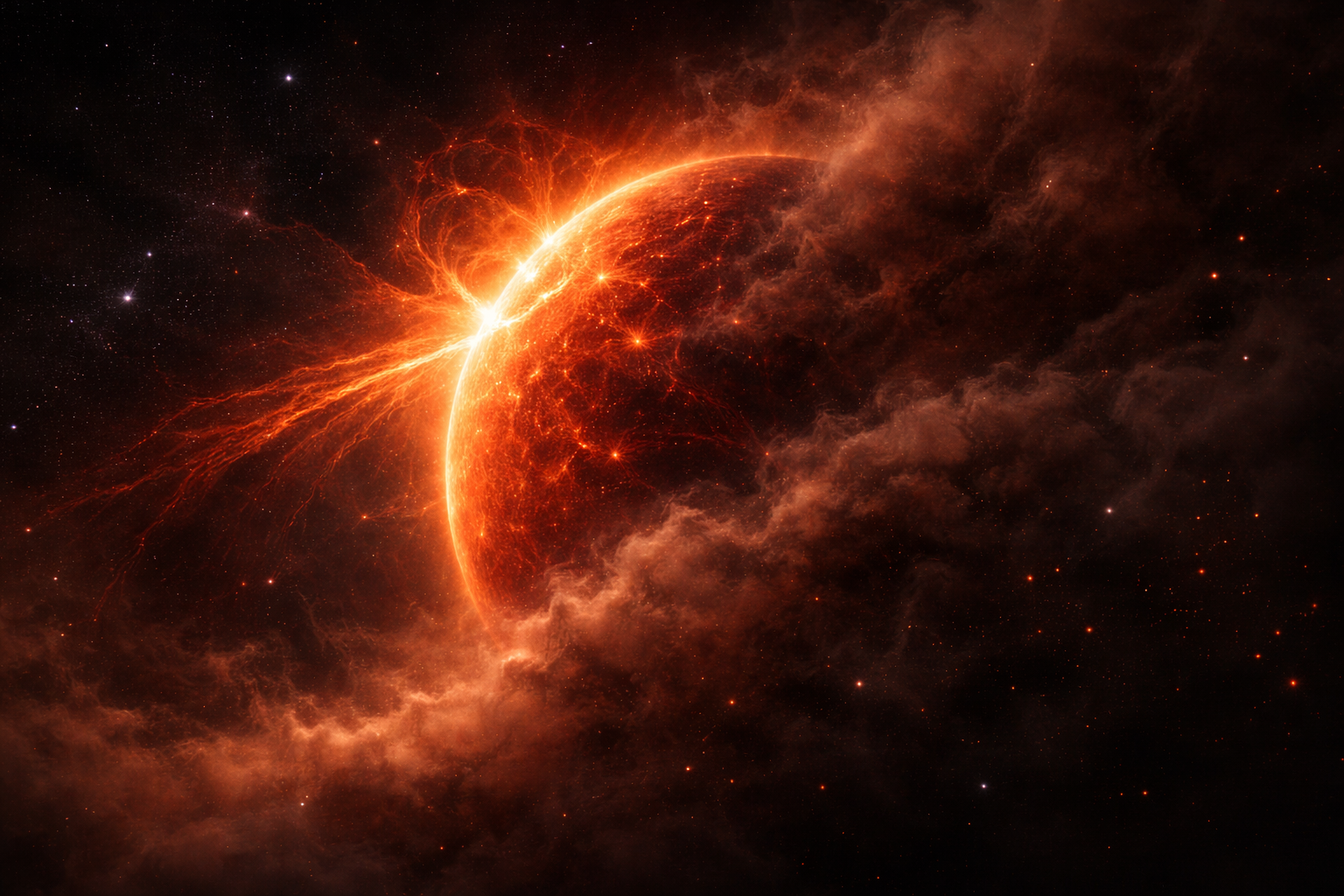 Betelgeuse marks Orion’s upper left shoulder (right shoulder from the Hunter’s perspective)—the power source that draws the bow. Compare it to Rigel’s blue-white brilliance at the lower right foot. Red power above, blue mastery below. The Hunter needs both.
The Three Phases
Phase 1: The Convection Rises (Days 1-3 | Jan 14-16)
You’ve spent ten days establishing your true north with Polaris. The fixed point is set. The compass bearing is clear. Now comes the question that follows all orientation: What will you create from that stillness?
 Days 1-3: The Convection Rises. What hot material stirs in your depths, demanding to break through the surface?
Deep inside Betelgeuse, superheated plasma rises from the core at thirty kilometers per second. It pushes upward through layers of stellar material, driven by temperature differentials so extreme they’d vaporize anything on Earth. The star doesn’t choose to convect. The physics demands it. Heat rises. Pressure builds. Eventually, something breaks through.
You feel this too. There’s something in you that’s been heating. A project deferred. A confrontation avoided. A creative impulse you’ve contained because the timing wasn’t right, the resources weren’t there, the circumstances weren’t perfect. You’ve been managing it, controlling it, keeping it from erupting.
These three days ask you to stop managing and start noticing. What’s rising? Not what you think should rise, not what would be convenient, but what’s actually pressurizing—the thing that keeps returning to your thoughts, the work that calls you when you’re supposed to be doing something else, the words that want to be said.
Your Polaris gave you direction. Betelgeuse asks what that direction points toward. True north is not a destination—it’s an orientation that enables movement. Movement toward what? The answer lives in your convection zone, in the creative heat you’ve been containing.
Go outside on the first night of this phase. Find Orion in the southern sky. Look up and left from the belt, and find the red-orange star marking the Hunter’s shoulder. That’s Betelgeuse—unmistakably red in a field of white and blue stars. Something in you may be equally red, equally unstable, equally ready to change form. Watch the star. Feel what rises.
Phase 2: The Surface Eruption (Days 4-7 | Jan 17-20)
Now you make things.
Days 4-7: The Surface Eruption. The dust cloud you kick up may temporarily obscure you. That’s the physics of creation.
The Great Dimming taught us something essential about creation: Betelgeuse didn’t fade because it was dying. It faded because it was making. A massive convection cell erupted through the surface, ejecting material that cooled into dust and blocked the star’s own light. The creator became temporarily invisible behind the debris of creation.
This is what the middle phase of any decan feels like—the flow phase, the active phase, the phase where things actually get built. And building is messy. It consumes resources. It generates waste alongside value. It disrupts the people around you who’ve grown accustomed to your undimmed availability.
For these four days, your only obligation is output. Write, build, code, paint, construct—whatever your medium, produce something concrete each day. Not polished. Not finished. Just extant. The artifact matters more than its refinement. First drafts, failed experiments, ugly prototypes—these are the convection plumes breaking through your surface. Some of this material will become dust. Some will seed future work. You can’t know which is which until the eruption completes.
Notice who gets disturbed. Creative output changes the equilibrium around you. People who benefited from your contained energy may resist its release. Document that resistance, but don’t let it stop the eruption. Betelgeuse doesn’t ask permission to eject its atmosphere. The physics demands expression.
And remember: you don’t have to create alone. Betelgeuse has Siwarha, its small companion star orbiting through the dust, clearing paths, making patterns visible. Who is your creative companion? Who can witness the mess and stay present? Involve them. Let someone see the eruption in progress. The most powerful star in Orion’s shoulder has a partner. So might you.
Phase 3: The Supernova Preparation (Days 8-10 | Jan 21-23)
Betelgeuse will explode. Not might—will. Somewhere between tomorrow and a hundred thousand years from now, the star’s core will exhaust its nuclear fuel, collapse in a fraction of a second, and blow itself apart in one of the most violent events the universe permits.
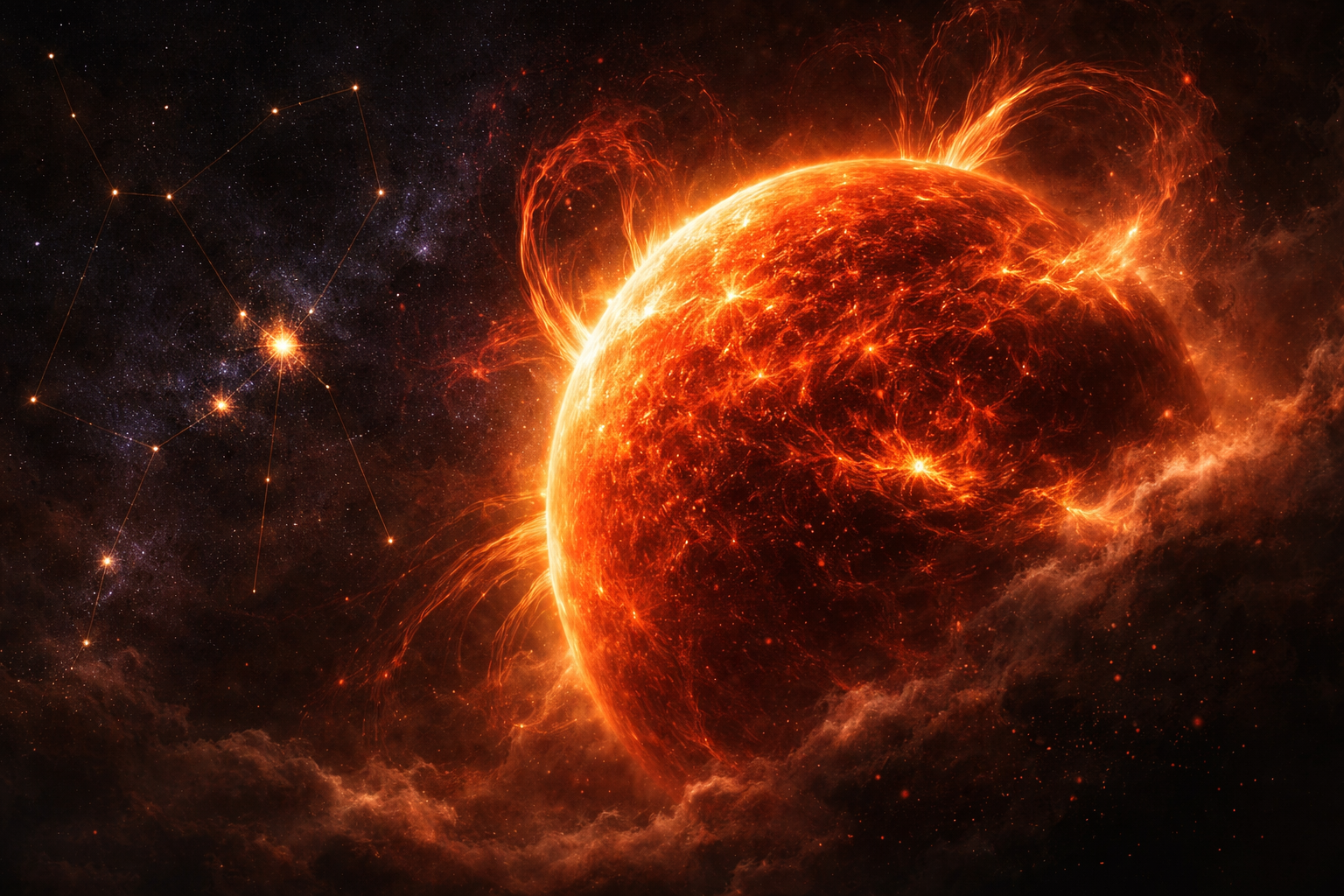 Days 8-10: Supernova Preparation. What seed material will survive the transformation?
This is the reflection phase, but not reflection in the gentle sense. This is reflection with the awareness of ending—of transformation so complete that what exists now will not exist afterward except as scattered material seeding something new.
Look at what you created during the eruption phase. What actually exists now that didn’t exist ten days ago? Not intentions. Not plans. Artifacts. Words on pages. Code in repositories. Paintings on canvas. Conversations that changed relationships. Decisions that closed doors and opened others. Be ruthless in your inventory—the question is not what you meant to create but what you actually made.
Now ask the harder question: What in your life is in late-stage evolution? What’s still burning but clearly heading toward transformation? Careers end. Relationships transform. Projects complete or get abandoned. Bodies age. The awareness of impermanence isn’t morbid—it’s clarifying. Betelgeuse doesn’t spend its final millennia pretending it will burn forever. It burns knowing exactly what it is: a temporary configuration of matter that will soon become something else entirely.
When the supernova comes, Betelgeuse’s material will seed new nebulae, new stars, perhaps new planets and new life. The star ends. The material endures. What seed material did your creation this decan generate? What will survive the current form and contribute to future work? What heavy elements did you forge that couldn’t have been forged any other way?
On the last night of this phase, go outside and find Betelgeuse one more time. Watch it knowing you’ve completed a creative cycle. Some of what you made will become dust. Some will become foundation for what comes next. You can’t always tell which is which until time reveals it. But the making itself—the eruption, the mess, the temporary dimming as resources got consumed—that was real. That was the physics of creation working through you as it works through dying stars.
Tomorrow, Rigel rises. Blue-white precision awaits. What you created with power, you’ll now be asked to manifest with mastery. The raw material is ready for refinement.
Daily Tracking
Each night of this decan, spend a few minutes with your journal. Note what you created, what you deployed, what you contained. Watch Betelgeuse when the sky permits—the red-orange glow serves as a kind of accountability partner, pulsing its variable light across 548 years to ask: What did you make today?
Don’t overcomplicate the tracking. A line or two suffices. The point isn’t to document exhaustively but to maintain awareness—to notice the arc from convection to eruption to preparation, to feel the phases as they move through you.
Finding Betelgeuse: The Red Shoulder of Orion
After sunset in January, face south around 8-10 PM. Orion dominates the sky—the most recognizable constellation visible to humans, the Hunter that has guided eyes upward for as long as our species has looked at stars.
Start with the Belt. Three bright stars in a distinctive row: Alnitak, Alnilam, Mintaka from left to right. Once you find the Belt, everything else orients from there.
From the Belt, look up and to the left. The bright red-orange star is Betelgeuse. Variable in brightness (magnitude ~0.0 to +1.6 depending on its pulsation phase), but unmistakably red. Nothing else in Orion matches this color—it’s the dying supergiant marking the Hunter’s right shoulder, the source of his power.
For contrast, look down and to the right from the Belt. The brilliant blue-white star is Rigel, marking the Hunter’s left foot. These two stars—Betelgeuse above and Rigel below—embody the visual metaphor of this arc: red chaos versus blue precision, power versus mastery, creation versus manifestation. The Hunter needs both.
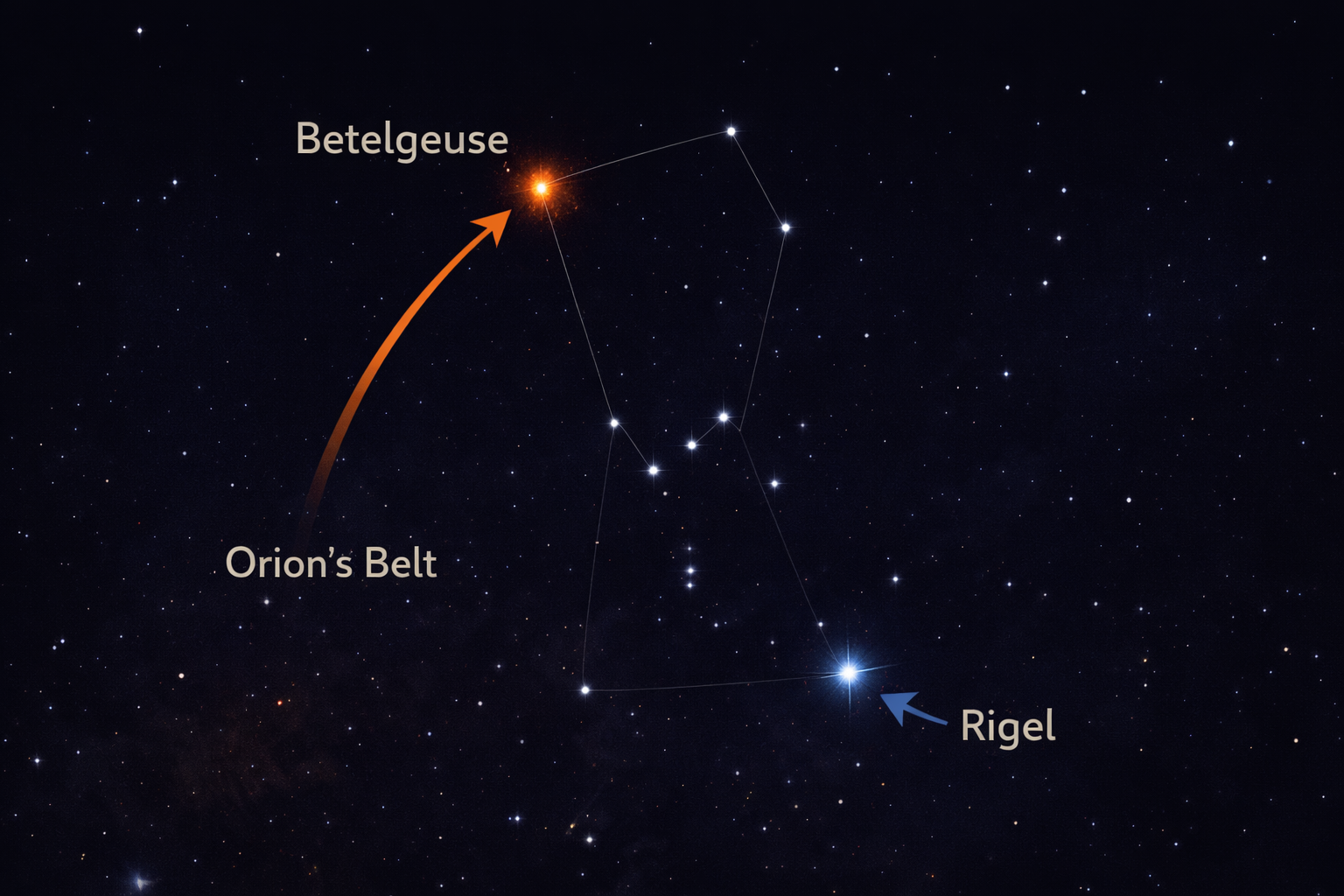 Find Orion’s Belt, look up and left for the red shoulder star. That’s Betelgeuse. Look down and right for blue-white Rigel. The decanal transition embodied in the Hunter’s body.
The Observation Practice
Spend a few minutes each night with Betelgeuse. Locate it in Orion’s shoulder. Notice the color—distinctly red, blood-colored in a field of white and blue stars. Feel the distance: 548 light-years, which means you’re seeing 1477 light. The photons entering your eye tonight left that star when the printing press arrived in England, when Leonardo was beginning his career, when the Renaissance was exploding across Italy.
Contemplate what you’re creating that connects to that moment of transformation. The printing press did to knowledge what Betelgeuse’s mass ejections do to stellar material: violent distribution that seeds future creation. You participate in that lineage whether you recognize it or not.
Imagine your own convection—what’s rising from your depths? What hot material is breaking through your surface? What must erupt, and what must you let erupt?
Think about the supernova that will come. This star will explode. What in your life is in supernova preparation? What must transform?
Look at both Betelgeuse and Rigel together—the red shoulder, the blue-white foot. Power precedes mastery. Creation precedes manifestation. What raw material are you generating now that will become refined later?
If the star seems dimmer than usual, you may be witnessing natural variability—or even a minor dimming event like the one in 2019. This is the creation star doing what creation stars do: reshaping, erupting, making itself anew. Watch it without judgment. Watch yourself the same way.
End-of-Decan Review (January 23)
Before you move to Rigel, sit with what happened.
On Power & Creation
What did you actually create? Be ruthless—list what exists now that didn’t exist ten days ago. Not intentions. Artifacts.
Compare your Day 1 intention to Day 10 reality. What enabled what worked? What blocked what didn’t?
Where did you deploy power versus hoard it? The convection metaphor is precise: hot material rises, or it stagnates. Which did you do?
Who witnessed your creation? Did you involve a companion, or did you try to erupt alone?
Did your creation align with your true north from Polaris? Direction without action is drift. Action without direction is chaos. Did you integrate both?
On Supernova Awareness
What in your life is in late-stage evolution—still burning but heading toward transformation? Name it without flinching.
What ended or transformed during these ten days? Some supernovas are small. Some are enormous. All matter.
What seed material survives? When the current form explodes, what heavy elements will scatter into future work?
On the Arc
You’ve now traveled from Polaris through Betelgeuse. Direction established. Power deployed. The question that carries you into Rigel: What raw material is ready for mastery?
Betelgeuse creates. Rigel refines. What did you build that now needs polish? What eruption produced material worth perfecting?
Bring that to the blue-white foot of the Hunter.
Preparing for Decan 32: Rigel
January 24 - February 2, 2026: Rigel (Beta Orionis) – “Manifestation & Mastery”
Rigel marks the Hunter’s left foot—the grounded stance that enables the aim. At magnitude +0.13, it’s the seventh brightest star in the sky and Orion’s brightest star, outshining even Betelgeuse most of the time. It sits 860 light-years away, which means you’re seeing light from 1165 CE—from when the Crusades were underway, when medieval Europe was building cathedrals, when Genghis Khan’s grandfather was still alive. Where Betelgeuse shows you Renaissance light, Rigel shows you medieval light. Different eras of creation, different phases of the creative cycle.
The physics tell the story. Betelgeuse is red: a cool surface (~3,500 K), massively luminous through sheer size. It’s expanded, diffuse, chaotic, dying. Rigel is blue-white: a hot surface (~11,000 K), luminous through intense nuclear burning. It’s concentrated, precise, brilliant. From size to intensity. From expansion to concentration. From red diffusion to blue focus.
The Transition
You’re moving from raw creative force to precise manifestation. From building to completing. From the shoulder that powers the draw to the foot that grounds the aim. The red chaos of creation gives way to the blue-white crystallization of mastery.
Carry forward from Betelgeuse what serves you: the creation itself (what you actually built), the creative confidence (proof that you can make things), the urgency (time is finite—supernova awareness keeps you honest), the willingness to consume resources, and the connection to your true north from Polaris.
Leave behind what doesn’t: chaos for its own sake, roughness that served the building but not the finishing, heat without light, creation without completion.
Rigel will ask whether you can take raw creation and bring it to excellence. Whether you can move from expansive building to focused finishing. Whether you can translate red chaos into blue precision.
Betelgeuse taught you to create with power. Rigel teaches you to manifest with mastery.
The Hunter’s arc continues.
The Stellar Physics of Creative Power
Size as Expansion
Betelgeuse is one of the largest stars visible to the naked eye. Its radius spans approximately 764 times our Sun’s—some estimates push it past 900. If you placed Betelgeuse where our Sun sits, its surface would engulf Mercury, Venus, Earth, Mars, the asteroid belt, and possibly Jupiter.
This is what happens when a massive star runs out of hydrogen in its core and begins fusing heavier elements. It expands. Dramatically. The star becomes less dense overall, its outer layers puffing outward to distances that would have seemed impossible during its main sequence life.
Power sometimes manifests as expansion. Taking up more space than you “should.” Reaching beyond normal boundaries. Growing until you can’t be ignored. Your creative power may require similar expansion—claiming territory, asserting presence, refusing to remain contained within limits that no longer fit.
Convection as Chaos
Our Sun has millions of small convection cells creating a relatively smooth surface. Betelgeuse has only a few—and each one spans distances larger than Earth’s orbit. Hot plasma rises from the core at thirty kilometers per second, breaks through the photosphere, cools at the surface, sinks back down. The surface is permanently boiling. Permanently unstable. Permanently reshaping.
Creation is not smooth. If your creative process feels turbulent—some days hot, some days cool, constantly reshaping itself—you’re not doing it wrong. You’re doing it like a red supergiant does it. The boiling IS the process. Trust the convection.
The Great Dimming as Disruption
When Betelgeuse ejected material in 2019, it temporarily dimmed by two-thirds. The creative act obscured the creator. The eruption blocked the light.
Creation often involves temporary dimming. When you pour resources into making something, you may become less visible. Less available. Less bright in the areas you were bright before. This is not failure. This is the physics of creation—energy redirected from maintenance to generation, from shining to building.
The star returned to brightness. You will too.
Supernova as Destiny
Betelgeuse will explode. This is not speculation or possibility—it’s certainty. Sometime in the next hundred thousand years (tomorrow in astronomical terms, or long after human civilization has transformed beyond recognition), the star’s core will exhaust its nuclear fuel. Iron will accumulate at the center. Fusion will cease. The core will collapse in a fraction of a second.
What happens next is violence on a scale that defies comprehension.
The outer layers, no longer supported by radiation pressure, will plunge inward at a significant fraction of the speed of light. They’ll hit the incompressible core and rebound. The supernova shockwave will tear through the star and blow it apart.
For weeks, Betelgeuse will shine brighter than the full Moon. Visible during the day. A new star in Orion’s shoulder, bright enough to read by, bright enough to cast shadows.
And in that explosion, heavy elements will be forged that cannot be created any other way. Iron. Gold. Uranium. The atoms that make up your blood, your bones, your brain—they were created in explosions exactly like this. You are, quite literally, made of exploded stars.
The ultimate creative act is self-destruction for the sake of what comes next.
Betelgeuse will cease to exist as a star so that its material can seed new nebulae, new stellar nurseries, new solar systems, new planets, perhaps new life. The star ends. The material endures. The creation outlives the creator.
What in you must “supernova”? What current form must explode into something new to seed what comes after? What are you holding onto that needs to release its material into the universe?
The Companion as Witness
Siwarha orbits within Betelgeuse’s atmosphere, clearing dust, creating patterns, making visible what would otherwise be chaos. The companion is tiny—one solar mass to Betelgeuse’s eighteen—but essential.
Even the most powerful creative force benefits from partnership. Power is not isolated. It exists in relationship. The giant needs the small companion to reveal its patterns. You need your Betelbuddy to clear your dust.
Who is witnessing your creation? Who is orbiting your work, small but essential, making patterns visible that you can’t see from inside the boil?
Closing: The Photon’s Question
The photon that left Betelgeuse in 1477 didn’t know it was heading toward a planet called Earth. It didn’t know that on that planet, creatures made of exploded stars would evolve to look up and wonder about their origins. It simply radiated outward, as photons do, at the only speed physics allows.
For 548 years, that photon traveled.
It crossed the space where other stars would form and die. It passed through regions where nothing existed but thin hydrogen and the occasional cosmic ray. It entered our solar system, passed the orbits of Neptune and Uranus and Saturn and Jupiter, threaded the asteroid belt, continued past Mars, and arrived at Earth on the exact night you chose to look up.
And in that final moment—the photon striking your retina, triggering a cascade of electrochemical signals that your brain interprets as “red-orange light”—the 548-year journey ends. The message arrives.
The message is a question: What are you creating that connects to the Renaissance of your time?
The printing press democratized knowledge. Leonardo transformed art. Columbus sailed toward unknown horizons. The Renaissance exploded because individuals claimed creative power and used it—not waiting for permission, not apologizing for disruption, not containing their output to safe and approved channels.
You live in another moment of transformation. AI is reshaping every field it touches. Biotechnology is rewriting the code of life. Space is becoming accessible. Information flows at speeds that would have seemed like magic to the observers of 1477.
The creative tools available to you exceed anything Leonardo could have imagined. The distribution channels available to you exceed anything Caxton could have built. The reach available to you exceeds anything the Renaissance dreamers could have dreamed.
What are you making with all that power?
Betelgeuse doesn’t apologize for boiling. It doesn’t ask permission to erupt. It doesn’t contain its convection cells to socially acceptable sizes. It simply radiates—548 light-years of radiation, witnessed by anyone with eyes to see, feeding photons into the universe whether anyone observes them or not.
For ten days, you hold creative power. Not as concept but as practice. Not as aspiration but as action. You create daily. You deploy resources. You tolerate mess. You erupt when eruption serves the work. You dim temporarily to generate what must be generated. You prepare for transformations you can’t predict but know are coming.
The universe wasn’t made by calm, stable processes. It was made by explosions, by convection, by mass ejections, by the violent creativity of dying stars that refused to go quietly into the cosmic night.
You’re made of that material.
The iron in your blood was forged in a supernova. The calcium in your bones was created in stellar explosions. The oxygen you breathe was fused in the cores of ancient giants. You are, quite literally, the universe’s creative debris—exploded star-stuff that somehow became conscious and capable of creating in turn.
Now make something with it.
Go outside tonight. Find Orion rising in the east. Locate the red shoulder star—Betelgeuse, the Hand of the Central One, the boiling surface of creative power. Watch it glow with 548-year-old light. Feel your own convection rising, your own material seeking expression, your own power demanding deployment.
Then create.
Welcome to Decan 31: Power & Creation.
Polaris taught unwavering purpose. Betelgeuse teaches raw power deployed in service of that purpose.
Create accordingly. Burn accordingly. Erupt accordingly.
Next Decan: January 24, 2026. Rigel rises in the south. Blue-white mastery awaits. Bring what you’ve created to excellence. From power to precision. From red to blue. From Betelgeuse to Rigel. The Hunter’s arc continues.
Next in The Decan Log: Rigel: Decan 32 - Manifestation & Mastery — From creative eruption to grounded mastery. From red chaos to blue precision. The Hunter descends from shoulder to foot.
Previous: Polaris: Decan 30 - True North — The fixed point around which all else revolves.
Last Updated: January 13, 2026