Mirach: Decan 27 - Reflection & Compassion (December 5-14)
The Girdle of Andromeda and the Warmth that Sustains
The photons entering your eyes right now left Mirach around 1825. For thousands of years this warm orange star marked the girdle—the center, the waist, the place where forces balance. December 5-14: allow reflection to reveal what action concealed, let compassion tend wounds liberation exposed.
New to The Decan Log? Start with the Introduction: Living by the Stars to understand the 10-day decanal system, how it works, and why ancient Egyptian timekeeping offers a better framework for personal growth than modern weeks.
Living this decan? For a personal account of ten days under this star, read the decan journal.
The universe doesn’t care about your theories of causation. Sometimes the lesson is in the not-knowing itself.
The Star That Glows
The photons entering your eyes right now left Mirach around 1825—from the era when the Erie Canal opened, when Beethoven completed his Ninth Symphony, when humanity still believed in celestial perfection and unchanging stars.
But Mirach knew better. It had already evolved.
For thousands of years, this star has marked the girdle of Andromeda—al-maraqq in Arabic, “the girdle” or “waist.” Not the dramatic head or the distant feet, but the center. The place where upper meets lower, where forces balance, where the body bends.
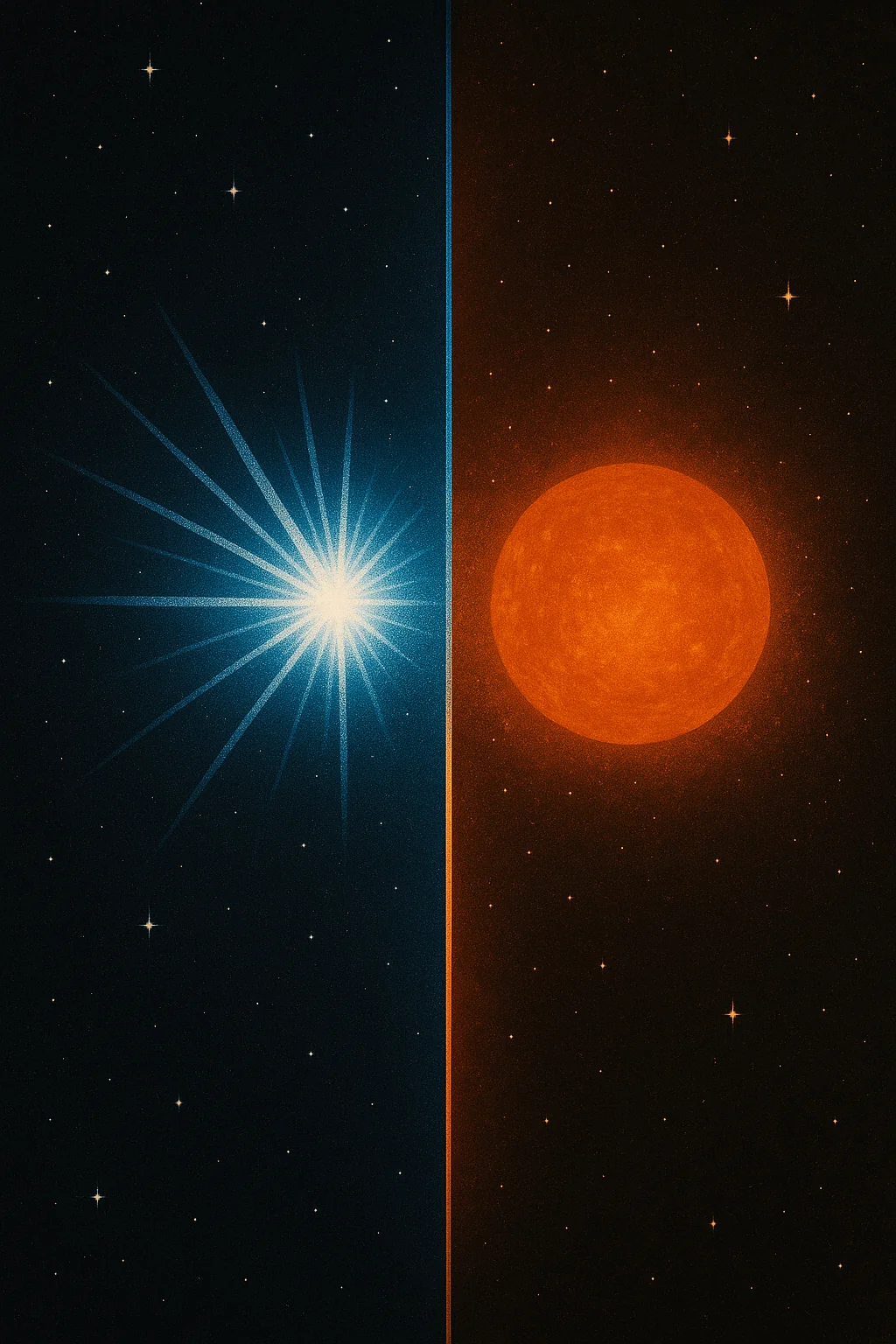
At 3,800 Kelvin, Mirach glows orange-red. Compare this to our Sun’s 5,800K yellow-white or Sirius’s 9,900K brilliant blue-white. Mirach is cooler, older, softer. It’s roughly 200 times the Sun’s diameter, 2,500 times as luminous, but that power spreads across vast surface area.
This is not fierce flash. This is sustained warmth.
A giant star in its helium-burning phase, fusing heavier elements in its core after exhausting hydrogen fuel. What once burned hot and compact now glows gentle and vast. Evolution changed its temperature, not its power. The warmth you feel from a bonfire versus the searing heat of a welding torch—same energy source, different expression.
Mirach sits 200 light-years away. Its photons travel across two centuries of space to reach your eye. When you look up on a clear December night, you’re receiving light from when your great-great-great-grandparents were young, when the world was unrecognizable, when Mirach was already teaching: what evolves doesn’t diminish—it transforms.
This is the lesson of Decan 27
Sustained warmth heals what intense heat broke. Reflection reveals what action concealed.
The Star: Mirach (Beta Andromedae)
Mirach is the middle bright star in the “V” shape that forms Andromeda’s torso. Find the Great Square of Pegasus (four bright stars forming a nearly perfect square). From the northeastern corner star (Alpheratz), two chains of stars extend upward and to the left. Mirach is the middle star in the upper chain—bright, distinctly orange if you use averted vision, unmistakable once located.
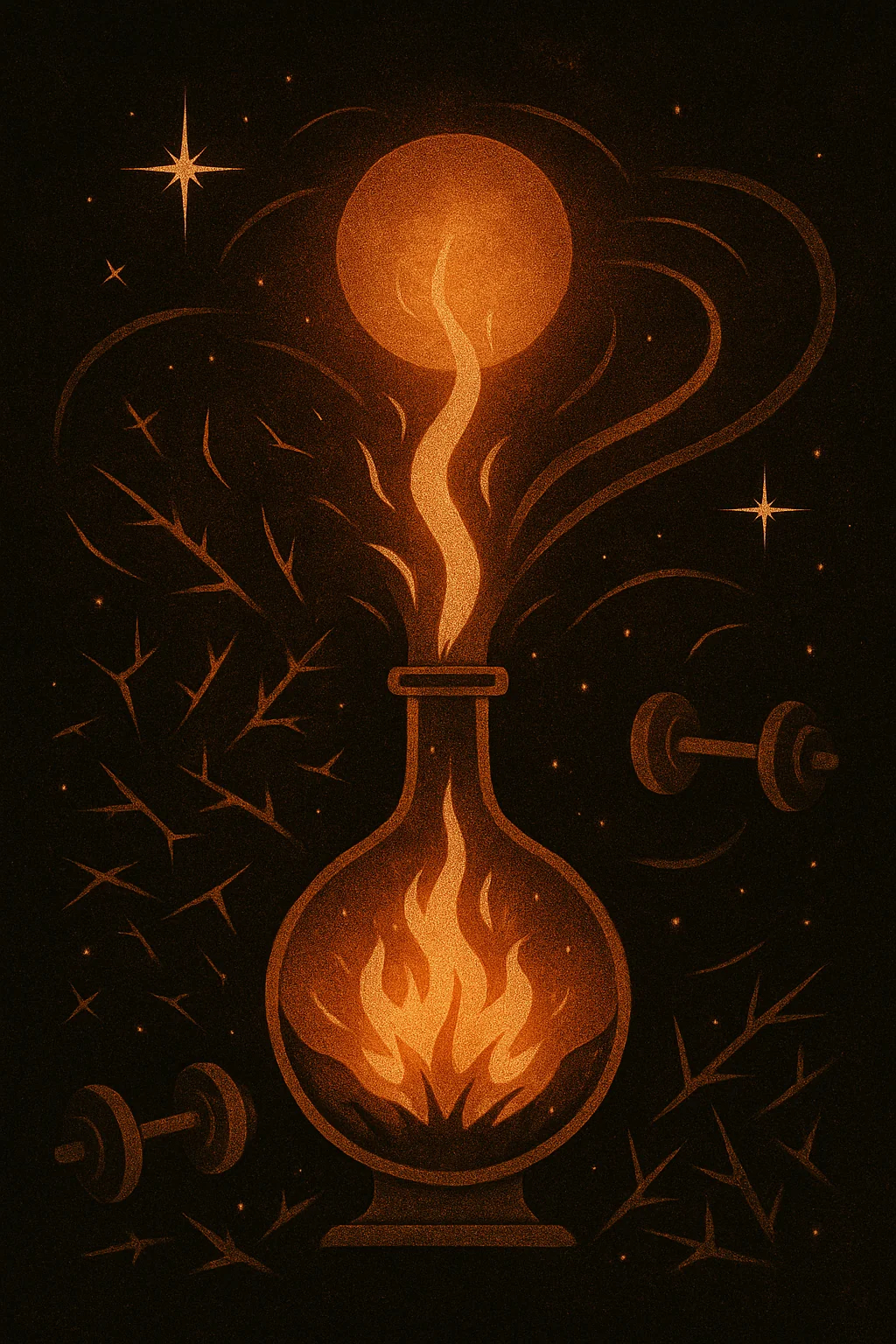 From Pegasus’s Great Square, follow the chain of stars extending northeast. Mirach marks the girdle—center, balance point, where reflection occurs.
At magnitude 2.06, it’s nearly as bright as Polaris. But unlike Polaris’s steady white glow, Mirach radiates orange-red warmth. If you observe with binoculars, the color becomes obvious—a gentle ember suspended in space.
The Physics of Evolved Stars
Mirach wasn’t always this way.
Four billion years ago, Mirach was a main-sequence star similar to Sirius—hot, compact, blue-white, burning hydrogen into helium in its core through nuclear fusion. Stable. Intense.
Then it exhausted its core hydrogen. The fusion stopped. Gravity began winning—the core contracted, heated up further, until it reached temperatures sufficient to fuse helium into carbon and oxygen. Meanwhile, a shell of hydrogen around the core began fusing, releasing additional energy.
The star’s outer layers, now heated by this shell fusion, expanded dramatically. The surface temperature dropped (less heat spread across more area), but total luminosity increased (more surface area radiating). Mirach swelled to roughly 100 times its original diameter, shifted from blue-white to orange-red.
This is stellar evolution. The star that once burned hot and compact now glows warm and vast.
Eventually—in perhaps 100 million years—Mirach will shed its outer layers entirely, creating a planetary nebula. Its core will become a white dwarf, slowly cooling over billions of years. But for now, it rests in this middle phase: evolved from main sequence, not yet post-giant, holding space between intensities.
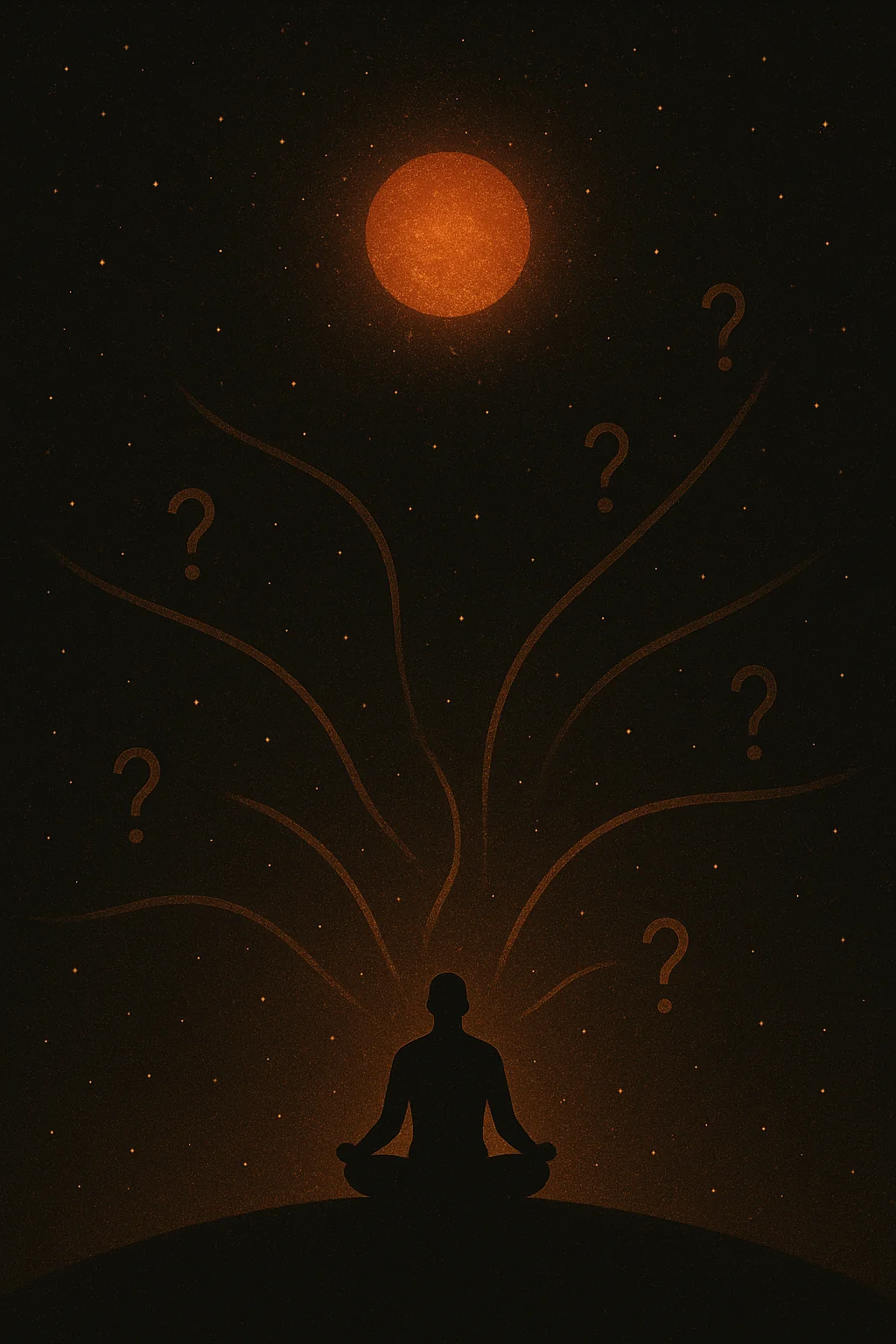 Main sequence → Red giant → Planetary nebula → White dwarf. Mirach is in the red giant phase: sustained warmth after intense heat, integration before final transformation.
This is the physics you’re observing when you look at Mirach: a star that has transformed its energy expression, expanded its boundaries, softened its temperature while maintaining power. Not dying. Evolving.
Andromeda: From Sacrifice to Salvation
Mirach marks the waist of Andromeda, the chained woman—the constellation that tells one of Greek mythology’s most complex stories about sacrifice, salvation, and what happens when you’re bound to a rock waiting for a monster.
The Setup: Vanity and Divine Punishment
Andromeda’s mother, Queen Cassiopeia, bragged that she (or her daughter, depending on the version) was more beautiful than the Nereids—the 50 sea nymphs who attended Poseidon. The Nereids complained to Poseidon. The sea god, enraged, sent Cetus, a massive sea monster, to ravage the kingdom’s coast.
King Cepheus consulted an oracle. The only way to appease Poseidon: sacrifice Andromeda. Chain her to a rock at the water’s edge, let Cetus devour her, save the kingdom.
She was punished for her mother’s vanity.
So they chained her. Arms spread, feet bound, waiting. The innocent paying for another’s hubris.
The Rescue: Perseus and Medusa’s Head
Perseus, fresh from beheading Medusa, flew overhead on winged sandals (or riding Pegasus, depending on version). He saw Andromeda chained to the rock, fell in love instantly, and negotiated with Cepheus: “Let me save her, and I’ll marry her.”
Cepheus agreed.
When Cetus emerged from the sea, Perseus either:
- Used Medusa’s severed head to turn the monster to stone, or
- Slashed the beast with his sword.
Either way, he killed the monster, freed Andromeda, and married her. She became a queen, bore him children, and after death was placed among the stars—bound no longer, honored instead.
The Deeper Teaching
But consider what Andromeda endured:
She did nothing wrong. Her mother boasted. The gods punished her. Her father chained her. She waited, helpless, for a monster she hadn’t angered to devour her as payment for sins she didn’t commit.
Then a hero arrived—but only because he happened to fly overhead. Only because he found her beautiful. Only after he negotiated terms with her father (not with her).
She was saved, yes. But she was never asked what she wanted. She was traded from one binding to another.
This is the wound Mirach marks: the place where unjust suffering meets unexpected salvation, where trauma and rescue intertwine, where you’re grateful to be alive but aware you were never given agency.
Cassiopeia sits nearby, the “W” constellation circling the north pole eternally—punishment for her vanity, forced to spend half her time upside-down in the sky, humiliated forever.
Cetus, the monster, also became a constellation—the whale, sprawling across the southern sky.
Perseus holds Medusa’s head (marked by Algol).
And Andromeda stands among them, arms no longer chained but eternally positioned as if they were. The posture remains.
Mirach marks her center—the waist, the girdle, the place where she bent under chains, the place where reflection now occurs on what that ordeal meant.
Historical Layers
Ancient Mesopotamia and the “Field”
Before Greek mythology attached Andromeda’s story, Babylonian astronomers knew these stars as “The Field” or “The Furrow”—agricultural references suggesting cultivation, tending, the patient work of growing things. Mirach would have been one star among many in this region associated with planting and harvest timing.
The shift from “field” to “chained woman” is striking. From the patient work of seasonal cycles to the dramatic story of sacrifice. Both are present in December’s sky—the agricultural rhythm and the mythological trauma.
Arabic Astronomy: The Girdle
Medieval Arabic astronomers preserved and refined Greek star names. They called this star al-maraqq—the girdle, the waist, the sash. Not just an anatomical marker, but specifically the belt that cinches, that holds together, that marks the center of balance.
The girdle as the place where upper body meets lower body. Where breath meets digestion. Where solar plexus transitions to sacral center. Where forces integrate.
In some traditions, the girdle also marked modesty, protection, readiness for action (girding one’s loins meant preparing for physical work or battle). Mirach as the star of preparation, of containment, of holding center while periphery moves.
European Renaissance: The Navigational Role
By the Renaissance, Andromeda served practical purposes for navigators and cartographers. Mirach, being bright and distinctly colored, was used as a reference point for locating the Andromeda Galaxy (M31), which appears as a smudge near Mirach in small telescopes.
The star became a guide—pointing toward something vast and distant, a doorway to perceiving entire galaxies beyond our own.
This is Mirach’s teaching across cultures: center, girdle, integration point, guide, the place you return to when seeking balance or preparing for next action.
The Three Phases
The 10-day rhythm: Initiate (Days 1-3) → Flow (Days 4-7) → Reflect (Days 8-10). Each phase has its practices, its energy, its purpose.
Phase 1: Recognize Exhaustion (Days 1-3)
The first nights of Mirach’s decan, you’re coming off Alpheratz—the bright blue-white star that marked liberation, breaking chains, pushing through constraints. That work was necessary. It was also costly.
Mirach’s warmth (3,800K) after Alpheratz’s intensity (13,800K) makes visible what action concealed: you’re exhausted. The freedom to rest reveals how tired the fight made you.
The practices are receptive:
- Notice depletion without judgment. Exhaustion isn’t failure. It’s the bill for work done. Name it: “I am very tired from [specific intensity].”
- Allow rest. Bath, early bed, sauna, nap. Tending the body = first act of compassion. Not luxury—requirement.
- Watch for lowered tolerance. Fatigue shows up as irritation, grumpiness, shortened fuse. When you snap over something trivial, ask: “Am I actually annoyed, or am I just exhausted?”
- Practice quick repair. If you’re sharp with someone, reach out soon. Text, apologize, acknowledge you were worn down. Don’t let small conflicts fester.
- Observe Mirach. Find the orange star marking Andromeda’s girdle. Feel the color difference from Alpheratz’s blue-white. One temperature doesn’t negate the other—they’re phases of different work.
This is the Initiate phase of reflection: making visible what liberation exposed. You pushed hard. You broke through. Now: compassionate assessment of the cost.
Phase 2: Integrate Across Domains (Days 4-7)
You’re recovering. Energy returns—but differently. Not the fierce flash of liberation work, but the sustained glow of tending multiple fires simultaneously.
Like Mirach spreading its power across 200 times the Sun’s diameter, you’re learning to distribute attention: trading, family, creative work, observation, self-care. Not compartmentalized—synergistic. Each domain strengthens the others when approached with Mirach’s steady warmth.
The practices are multifaceted:
- Tend multiple areas daily. Don’t binge one domain and neglect others. Spend time with family, execute trading plans, write/publish, observe stars, take sauna. Brief presence across domains > intense focus on one.
- Practice patience over urgency. Trading example: let theta decay work rather than chasing dramatic moves. Harvest calmness, not volatility. Reflection before execution.
- Prepare during calm, not panic. Buy insurance (financial or metaphorical) when it’s cheap and you don’t need it yet. Compassion for future self = proactive risk management.
- Notice rhythm, not just results. Does your work follow natural cycles? Mon/Tue intensity, Wed/Thu completion? Honor the pattern rather than forcing constant linear productivity.
- Observe Mirach nightly. Build pattern recognition through repetition. Some nights will be fleeting glimpses (clouds, brief windows). Some will be clear sustained observation. Both teach. Wonder accepts surprise AND discipline.
- Track what you’re gaining. Strength? Boundary clarity? Skill development? Integration isn’t passive—you’re actively building capacity to hold multiple dimensions simultaneously.
This is the Flow phase of reflection: discovering how warmth sustains what heat couldn’t. You’re not just recovering from intensity—you’re learning a different mode of power. Sustained glow. Multi-domain presence. Tending, not forcing.
Phase 3: Acknowledge Mystery (Days 8-10)
By the Reflect phase, something strange happens. You’ve accomplished everything—closed cycles, executed plans, tended relationships. But you feel different. Surreal. Liminal. Walking between existence and something else.
This is Mirach’s deepest teaching: the universe doesn’t care about your theories of causation. Sometimes things go inexplicably wrong despite perfect conditions. Sometimes they go inexplicably right despite exhaustion. The lesson is in accepting the not-knowing.
The practices are integrative:
- Honor natural cycles. If you’re worn down, acknowledge it. These are reflection days—not productivity days, not performance days. Integration days. Let yourself be tired.
- Go slow to go fast. Sprint to start (necessary to break through) → marathon pace to sustain (necessary to last). Both phases have purpose. Recognize when to shift.
- Celebrate milestones without attachment. Note achievements. Don’t cling to them. The work continues. Success is a waypoint, not destination.
- Extend benefit of the doubt. To yourself, to others, to circumstances. When causation fails (did everything “right” but outcome didn’t match), choose curiosity over certainty. Humility through mystery.
- Prepare for next phase. Algol begins tomorrow—renewal through challenge. How does reflection (compassionate assessment) ready you to face what eclipses your light?
- Final Mirach observation. Watch the orange star one last time. Notice: you found it more easily on Day 10 than Day 1. Consistent gentle presence built recognition. This is the integration proof.
Ask on the final day:
- “What wounds did Mirach’s warmth reveal that Alpheratz’s heat concealed?”
- “What did I integrate across multiple domains (not just survive in one)?”
- “Where did I choose wonder over certainty, curiosity over cocky assumption?”
- “How do I now carry compassion—for self, for others, for life’s non-linear nature?”
You’ve watched Mirach rise, cross the sky, set for 10 nights. The pattern is internalized. Reflection isn’t weakness. It’s the evolved state—cooler surface temperature, wider reach, sustained power.
Daily Tracking
For each day of this decan, track:
Reflection & Compassion Actions:
- Acknowledged exhaustion without self-criticism
- Practiced self-care (rest, recovery, warmth)
- Caught irritation early and repaired quickly
- Chose curiosity over certainty when outcomes didn’t match expectations
- Tended multiple life domains (not just one)
- Prepared for future challenges during current calm
- Observed wonder alongside discipline
Mirach Observation:
- Observed tonight: Yes / No / Cloudy
- Subjective experience: (How did Mirach feel to observe?)
Theme Resonance (1-10):
- Score: __/10
- Notes: (How much did today resonate with Reflection & Compassion?)
Finding Mirach
After sunset, face northeast. Locate the Great Square of Pegasus—four bright stars forming an almost perfect square. Find Alpheratz, the northeastern corner star (also Alpha Andromedae—it belongs to both constellations).
From Alpheratz, two chains of stars extend upward and to the left. Follow the upper chain. Mirach is the middle bright star—magnitude 2.06, distinctly orange-red if you use averted vision or binoculars.
Once you’ve located Mirach, observe its color. White stars are closer to their peak blackbody radiation in the visible spectrum. Orange-red stars have cooler surfaces—their peak emission shifts toward infrared. You’re seeing evidence of stellar evolution: expanded size, cooler temperature, transformed power expression.
If you have binoculars or a small telescope, look near Mirach for the Andromeda Galaxy (M31). It appears as a faint elongated smudge about 3 degrees away. The galaxy contains roughly 1 trillion stars, sits 2.5 million light-years distant, and will eventually collide with our Milky Way in about 4.5 billion years.
Mirach points toward vastness. The girdle as gateway to perceiving entire galaxies.
When you observe, contemplate this: What exhaustion am I carrying? What have I been too busy to feel? What does this orange warmth, spread across vast surface, teach about sustainable power?
If clouds block your view some nights, that’s part of the teaching too. Reflection doesn’t require perfect conditions. It requires willingness to look when looking is possible, and patience when it’s not.
End-of-Decan Review
On December 14, ask:
About Exhaustion:
- What did Mirach’s warmth make visible that action concealed?
- Did I allow rest without guilt? Where did I struggle with this?
- Did fatigue show up as irritation? How quickly did I repair?
- What self-care practices sustained me? (Specific: sauna, nap, bath, etc.)
About Integration:
- Which life domains did I tend simultaneously? (List them)
- Did I notice synergy—ways one domain supported another?
- Where did I practice patience over urgency?
- What preparation did I make during calm (not panic)?
- Did I honor natural rhythms (cycles, patterns) rather than forcing linearity?
About Mystery:
- Where did outcomes not match expectations despite “right” actions?
- Did I choose curiosity over certainty when causation failed?
- What humility did non-linear reality teach me?
- Where am I operating from cocky assumption versus wonder?
About Observation:
- How many nights did I observe Mirach? (Target: 5-7)
- Did recognition improve over the 10 days?
- What did nightly ritual add that journaling alone wouldn’t provide?
Confirmation Bias Check:
- How much was genuine integration versus seeing what I wanted to see?
From Decan 26 (Alpheratz):
- How did liberation’s intensity prepare me for reflection’s warmth?
To Decan 28 (Algol):
- How does compassionate reflection ready me to face challenges?
Preparing for Algol
On December 15, Decan 28 begins. Algol—Beta Persei, the Demon Star marking Medusa’s eye in Perseus’s hand—rises. The theme shifts from “Reflection & Compassion” to “Renewal through Challenge.”
Andromeda was chained to the rock. Perseus wielded the severed head.
From tending wounds to facing monsters. From integration to confrontation. From sustained warmth to scheduled eclipse.
Ask on Day 1 of the next decan:
- “What challenge eclipses my light right now?”
- “Does this obstacle follow a rhythm I can map?”
- “What mirror (like Perseus’s polished shield) lets me look at danger without being petrified?”
- “How did Mirach’s reflection prepare me to face Algol’s test?”
Watch Mirach set in the west as Perseus rises in the east. Andromeda remains visible between them—the chained woman, the girdle, the integration point.
The constellation wheel turns. Reflection becomes action. Compassion becomes courage.
The Stellar Physics
Core: Helium fusion producing carbon and oxygen
Shell: Hydrogen fusion surrounding the core
Envelope: Expanded outer layers (100x original diameter)
Surface Temperature: 3,800K (orange-red, cooler than main sequence)
Luminosity: 2,500x Sun (power spread across vast area)
This is not a dying star. This is an evolved star in a stable phase that will last hundreds of millions of years.
The same nuclear fusion that powered Mirach as a compact blue-white main-sequence star still powers it now. But the structure changed. Core helium burning plus shell hydrogen burning released enough energy to push the outer layers outward. More surface area. Cooler temperature per area. Transformed expression of same power source.
For humans, the metaphor is precise:
Intense focus (main sequence): Compact, hot, bright, burning primary fuel efficiently. Sprint mode. High performance in narrow band.
Sustained presence (red giant): Expanded, warm, luminous across wider spectrum. Marathon mode. Distributed power across multiple domains.
Both are powerful. Both are legitimate phases. The star doesn’t diminish when it evolves—it transforms how it expresses power.
Mirach will eventually shed its outer layers, creating a planetary nebula—a glowing shell of gas illuminated by the core’s ultraviolet radiation. The core will become a white dwarf, slowly cooling over billions of years. But between “main sequence intensity” and “final stellar remnant,” there’s this: the red giant phase. The integration period. The sustained warmth. The reflection that precedes ultimate transformation.
Observe Mirach and remember: evolution isn’t decline. It’s restructuring. What you’ve become isn’t less than what you were—it’s differently powerful.
Resources
For Understanding Mirach:
- Wikipedia: “Beta Andromedae” and “Red Giant”
- Richard Hinckley Allen, Star Names: Their Lore and Meaning (1899)
- Jim Kaler’s STARS page (www.astro.illinois.edu/~jkaler/sow/mirach.html)
For Observing:
- Stellarium (free planetarium software)
- SkySafari app (mobile star identification)
- Sky & Telescope articles on Andromeda
- Clear Outside app (astronomy weather forecasting)
For Reflection & Compassion:
- Pema Chödrön, The Places That Scare You: A Guide to Fearlessness in Difficult Times
- Tara Brach, Radical Acceptance
- Kristin Neff, Self-Compassion: The Proven Power of Being Kind to Yourself
- David Whyte, Consolations: The Solace, Nourishment and Underlying Meaning of Everyday Words
- Rainer Maria Rilke, Letters to a Young Poet
For Andromeda Mythology:
- Ovid, Metamorphoses (Book IV)
- Robert Graves, The Greek Myths
For Stellar Evolution:
- Carl Sagan, Cosmos (Chapter 9: “The Lives of the Stars”)
- Neil deGrasse Tyson, Death by Black Hole
Your exhaustion is real. Your need for rest is legitimate. The wound liberation exposed requires tending, not denial.
The next 10 days will ask you to distribute attention across multiple domains—not frantically, but with sustained warmth. Family and work and creative projects and self-care and observation, all flowing together. Not compartmentalized. Synergistic.
You will encounter mystery. Outcomes that don’t match inputs. Plans that succeed or fail for inexplicable reasons. Choose curiosity over certainty. Extend benefit of the doubt. Accept that the universe doesn’t owe you linear causation.
And when Algol rises, when the next challenge eclipses your light, you’ll be ready—not because you’re perfectly healed, but because you’ve practiced compassion, honored your rhythm, and learned that evolved stars don’t burn less bright. They burn differently.
Mirach proves it. The girdle holds center. Reflection integrates what action scattered.
Previous Chapter: Introduction: Living by the Stars
Next Chapter: Algol: Decan 28 - Renewal through Challenge
© 2025 Joshua Ayson. All rights reserved. Published by Organic Arts LLC.
This chapter is part of The Decan Log: A 10-Day Journaling System Aligned with the Stars. All content is protected by copyright. Personal use encouraged. Unauthorized commercial reproduction prohibited.