Alnilam: Decan 34 - Continuity & Legacy
The photons entering your eyes right now left Alnilam around 25 CE, from the year Jesus of Nazareth walked Roman-occupied Judea, when Liu Xiu proclaimed the Eastern Han dynasty, when the Silk Road carried silk and philosophy across continents, when institutions were being forged that still govern civilization two thousand years later. Those photons traveled the void carrying a question: What are you building that will still stand when the next two thousand years have passed?
New to The Decan Log? Start with the Introduction: Living by the Stars to understand the 10-day decanal system, how it works, and why ancient Egyptian timekeeping offers a better framework for personal growth than modern weeks.
Living this decan? For a personal account of ten days under this star, read the decan journal.
For ten days you struck with precision at Bellatrix, the Female Warrior's sword arm, deploying accumulated power with tactical intelligence. You identified the vulnerability. You timed the strike. You moved. Now comes what strategic action must serve: the structural center that holds after the strike lands. Not another blow. Not further tactics. What endures.
The Star at the Center
The photons entering your eyes tonight left Alnilam around 25 CE.
This is not metaphor. This is physics. That blue-white light traveled approximately two thousand years through the void, departing when Jesus of Nazareth was alive and walking in Roman-occupied Judea, when Emperor Tiberius sat on the throne of an empire whose legal principles still govern modern nations, when Liu Xiu proclaimed the Eastern Han dynasty in China on August 5th of that same year, when the Silk Road carried silk and philosophy between civilizations that would shape everything that followed.
You are literally seeing the ancient world. Photons that witnessed the founding of institutions that have endured for two millennia, arriving now at your retina, tonight, in this moment.
And what you're seeing when that light arrives is the center of the most recognized pattern in the sky.
Alnilam sits at the center of Orion's Belt: the structural core, the brightest of three, the pearl that holds the string together. Where Bellatrix strikes and Rigel grounds, Alnilam endures. The Hunter's anatomy demands a center. This is it.
Alnilam is a B0 Ia blue-white supergiant, the most luminous star in Orion's Belt. At approximately 27,000 Kelvin surface temperature, it burns nearly five times hotter than our Sun. Its luminosity ranges from 275,000 to over 500,000 times our Sun's output depending on distance estimates, which remain genuinely uncertain for a star this far away. What is certain: among the three Belt stars, Alnilam is the brightest, the most massive as a single star, and the most luminous.
And it stands alone.
This is the detail that matters most for understanding Alnilam's teaching. Alnitak, the eastern Belt star, is a triple star system. Mintaka, the western Belt star, is a sextuple system, six stars gravitationally bound in nested orbits. But Alnilam is singular. One star. The center of the Belt is not a committee or a system. It is a single point of concentrated luminosity holding the visual structure together.
Legacy requires a singular center. A core that holds.
Since 1943, Alnilam's spectrum has served as one of the standard anchor points by which all other B0 Ia stars are classified. It is literally the definition of what a blue-white bright supergiant looks like. Other stars are measured against it. The center star became the measuring stick.
What you build as legacy becomes the standard others measure against.
The Name: A String of Pearls
The name Alnilam derives from the Arabic al-nizam (النظام), meaning "the string of pearls" or "the arrangement." The word comes from nazm, meaning to string together, to arrange, to order.
Look at Orion's Belt tonight. Three stars in a row. A string of pearls.
And Alnilam is the center pearl.
The name does not describe a single star. It describes a relationship, a position within a structure, a role in an arrangement. You cannot have a center without edges. You cannot have a string without pearls on either side. Alnilam's identity is inseparable from its position between Alnitak and Mintaka, the eastern and western stars that frame it.
Legacy is not a solo performance. It is a structural position: the center that gives the arrangement its meaning.
Every culture that looked at the sky named these three stars. The Maori called them Tautoru, "string of three." The Lakota Sioux saw Tayamnicankhu, the spine of a bison. Filipino peoples called them Balatik, a ballista trap. The Chinese named the whole asterism Shen (参), meaning "three," and Alnilam specifically was Shen Su Er, "Second Star of Three Stars." In Latin America: Las Tres Marias, the Three Marys. In the Netherlands: Drie Konings, Three Kings.
No asterism in the entire sky has been more universally recognized across every culture in human history than Orion's Belt. And Alnilam sits at its center.
The thing that endures is the thing that connects. The pearl at the center of the string, the star at the middle of the Belt, the structure that holds the pattern recognizable across every civilization that has ever looked up.
The 25 CE Light: When Institutions Were Born
When the photons you see tonight left Alnilam, the world was building things that would still stand two thousand years later.
Consider what existed in 25 CE and what remains:
Christianity. In 25 CE, Jesus of Nazareth was approximately twenty-nine or thirty years old, on the cusp of his public ministry. Within five years of this date, the crucifixion would occur, and from those events a movement would emerge that became the world's largest religion with 2.4 billion adherents today. The light from Alnilam departed when the founder was still alive and walking the earth. The institution that grew from his life has endured every century since.
Roman Law. The legal principles being refined under Tiberius directly produced the concepts of trial by jury, civil rights, contract law, personal property, legal wills, and the idea of corporations. Every Western legal system traces its architecture to what Roman jurists were codifying when that photon left the star. The word "senate" comes from this era's institution. The U.S. Congress models itself on it.
The Eastern Han Dynasty. On August 5, 25 CE, Liu Xiu proclaimed himself Emperor Guangwu, founding the Eastern Han dynasty and restoring Chinese imperial rule after the interregnum of Wang Mang's Xin dynasty. Liu Xiu was noted as one of the rare founding emperors who did not murder his generals after consolidating power. The Eastern Han endured until 220 CE and produced advances in papermaking, the seismoscope, and literary traditions that persist to this day.
The Silk Road. By 25 CE, the overland trade routes connecting Rome to China had been operating for 155 years. Chinese silk reached Roman markets. Buddhist philosophy traveled east along the same roads. The Parthian Empire controlled the crucial middle section. This was the peak era of Eurasian connectivity, and the trade patterns established then shaped global commerce for the next two millennia.
The Latin Alphabet. The letters being used across the Roman Empire in 25 CE are the direct ancestors of the letters you are reading in this sentence. The Julian Calendar in use that year became the Gregorian Calendar you use today. Roman roads built in this era are still driven on in Europe.
The light from Alnilam departed when these things were being built. It arrives now, and they are still standing.
That is continuity. That is legacy. Not what lasted a decade or a century, but what endured through the fall of Rome, through the Dark Ages, through the Renaissance, through world wars, through the digital revolution, through everything, and is still here.
The photon that left Alnilam in 25 CE asks: What are you building that could survive that journey?
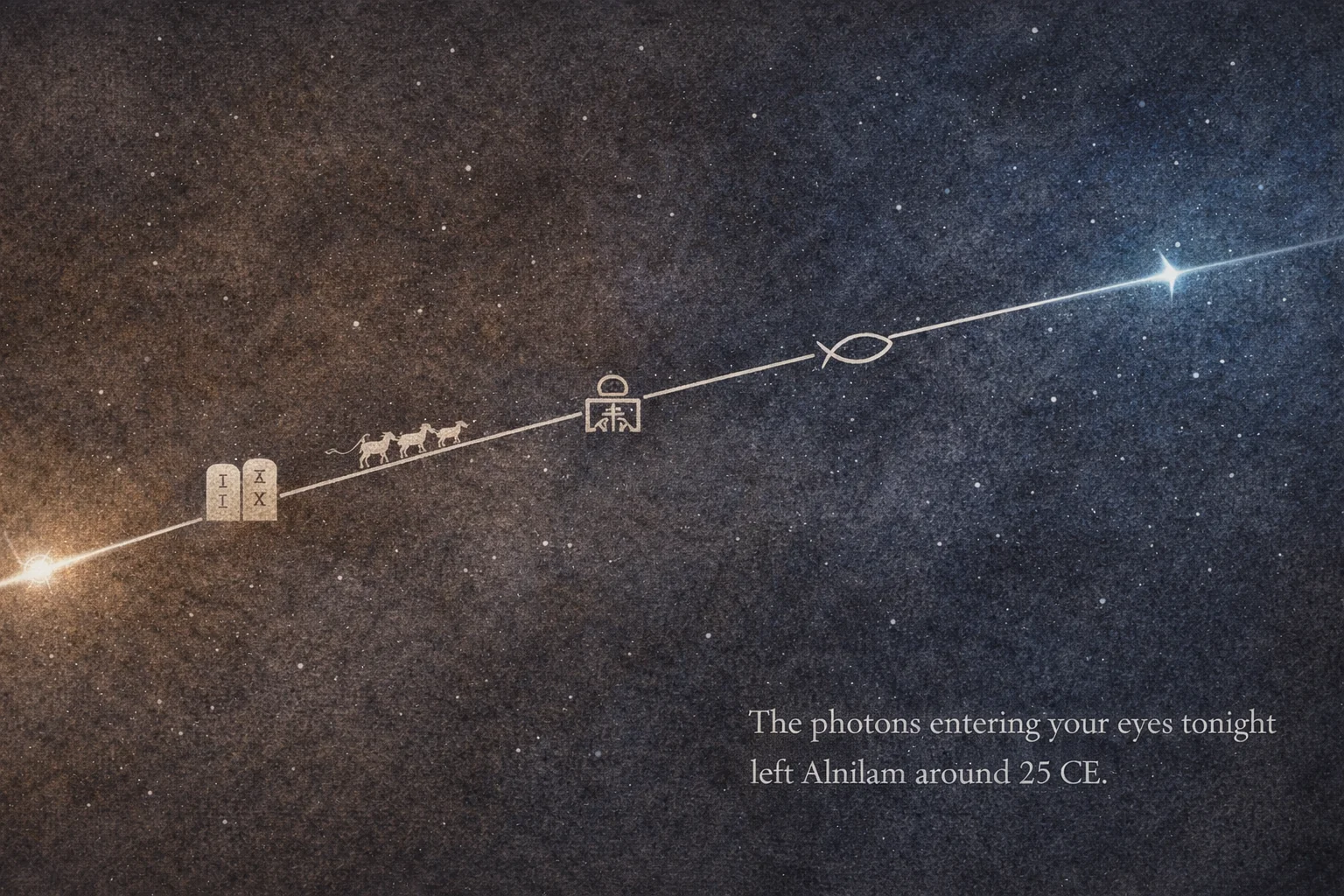
The light entering your eyes tonight departed when Jesus walked Judea, when Liu Xiu founded a dynasty, when Roman jurists wrote laws we still follow. Two thousand years of travel through the void. Two thousand years of institutions enduring on Earth. Alnilam's light and humanity's legacy traveled the same distance.
What the 25 CE Photon Passed Through
The photon traveling toward you for two thousand years departed at a moment of institutional founding and crossed through every subsequent era of human civilization:
25-476 CE: The Roman Empire, from Pax Romana through decline and fall, the structures surviving even as the empire did not.
476-1000: The so-called Dark Ages, when Roman law was preserved in monasteries while new civilizations emerged on the ruins.
622-1258: The Islamic Golden Age, when scholars in Baghdad's House of Wisdom translated Roman and Greek knowledge into Arabic, preserving and advancing it.
1165: The year Rigel's light departed, when medieval guilds codified mastery and Notre-Dame rose over Paris.
1453: Constantinople fell, sending scholars west with ancient texts, sparking the Renaissance.
1477: The year Betelgeuse's light departed, when the printing press arrived in England.
1775: The year Bellatrix's light departed, when strategic will defeated empire.
1969: Humans walked on the Moon, guided by calculations descended from Greek mathematics preserved through the chain of transmission the photon had been traveling alongside.
2026: The photon arrives. You observe it. The institutions born in 25 CE are still functioning.
Two thousand years of civilization, and the photon from Alnilam witnessed it all from the void, arriving at the same moment you're being asked: what legacy are you building?
The Center Holds
In every culture's mythology of Orion's Belt, the center star carries special significance. It is the core. The keystone. The structural element without which the pattern loses coherence.
The Egyptians saw Orion as the god Sah, called "the Father of the Gods" in the Pyramid Texts of the Old Kingdom. Sah was later merged with Osiris, forming Osiris-Sah, the god of death, the afterlife, and resurrection. The Pyramid Texts state: "The sky conceives you with Orion, the netherworld bears you with Orion." The pharaoh traveled to Orion after death, ascending to the stars through structures built to last.
The Great Pyramid of Giza, completed around 2560 BCE, was built with its King's Chamber southern air shaft pointing toward Orion's Belt. Robert Bauval's Orion Correlation Theory proposes that the three Giza pyramids mirror the three Belt stars: Khufu aligns with Alnitak, Khafre with Alnilam, Menkaure with Mintaka. The center pyramid corresponds to the center star.
Whether the correlation is precise enough to satisfy astronomers remains debated. What is not debatable is this: the Egyptians built structures to connect pharaohs to Orion. They built structures to last forever. And the pyramids have lasted 4,500 years so far, the oldest of the Seven Wonders and the only one still standing.
They built for legacy. They pointed at Alnilam.
The Babylonians, four thousand years ago, knew Orion as MULSIPA.ZI.AN.NA, the True Shepherd of Anu, guardian of the supreme sky god. The Belt was the Shepherd's staff, the instrument of authority. But authority requires a center, a point of balance. Hold a staff at the end and it wobbles. Hold it at the center and it is controlled.
Alnilam is where you hold the staff.
The Stellar Wind: What Legacy Costs
Alnilam does not burn quietly. It is losing itself.
The star drives one of the most powerful stellar winds known to astronomy. At speeds up to 2,000 kilometers per second, roughly 0.7% the speed of light, Alnilam blasts matter from its own surface into space. The mass loss rate is approximately two millionths of a solar mass per year. That number sounds small until you calculate it: Alnilam sheds the equivalent of one Earth mass roughly every seventeen days.
The star is giving itself away.
Twenty million times the rate of the Sun's solar wind. The mechanism is radiation pressure: Alnilam's extreme luminosity physically pushes matter off its surface. Ultraviolet photons slam into metal ions in the stellar atmosphere, transferring momentum outward, driving iron and carbon and nitrogen into the void. The spectral lines of these elements act as sails catching photon momentum, and the wind screams outward at millions of miles per hour.
The consequences are permanent. Alnilam's original mass was likely over 40 solar masses. That mass has been and is being shed. The star will not follow the normal evolutionary path for massive stars. Instead of swelling into a red supergiant like Betelgeuse, Alnilam will likely strip itself down to become a Wolf-Rayet star, a hot compact remnant surrounded by its own expelled material. Then it will supernova, leaving behind a black hole.
Legacy costs. Building what endures requires spending what you have.
The matter Alnilam ejects does not vanish. It enriches the surrounding interstellar medium with heavy elements, the iron, carbon, and nitrogen that will seed future generations of stars and planets. The star that loses itself becomes the raw material for what comes next. Its death will seed life.
The Roman Empire fell. But Roman law persists. The empire lost itself, but the principles it shed into the cultural medium became the foundation for everything that followed. Christianity's founder died. The movement endured. Liu Xiu's dynasty ended in 220 CE. The institutions he built shaped Chinese civilization permanently.
Legacy is not what survives intact. Legacy is what you shed into the environment that becomes essential to what comes after.
Alnilam sheds one Earth mass every seventeen days, blasting matter into space at 2,000 km/s. The star is giving itself away. But the expelled material seeds future stars, future planets, future life. Legacy is not preservation. Legacy is transmission.
The Nebula That May Not Exist
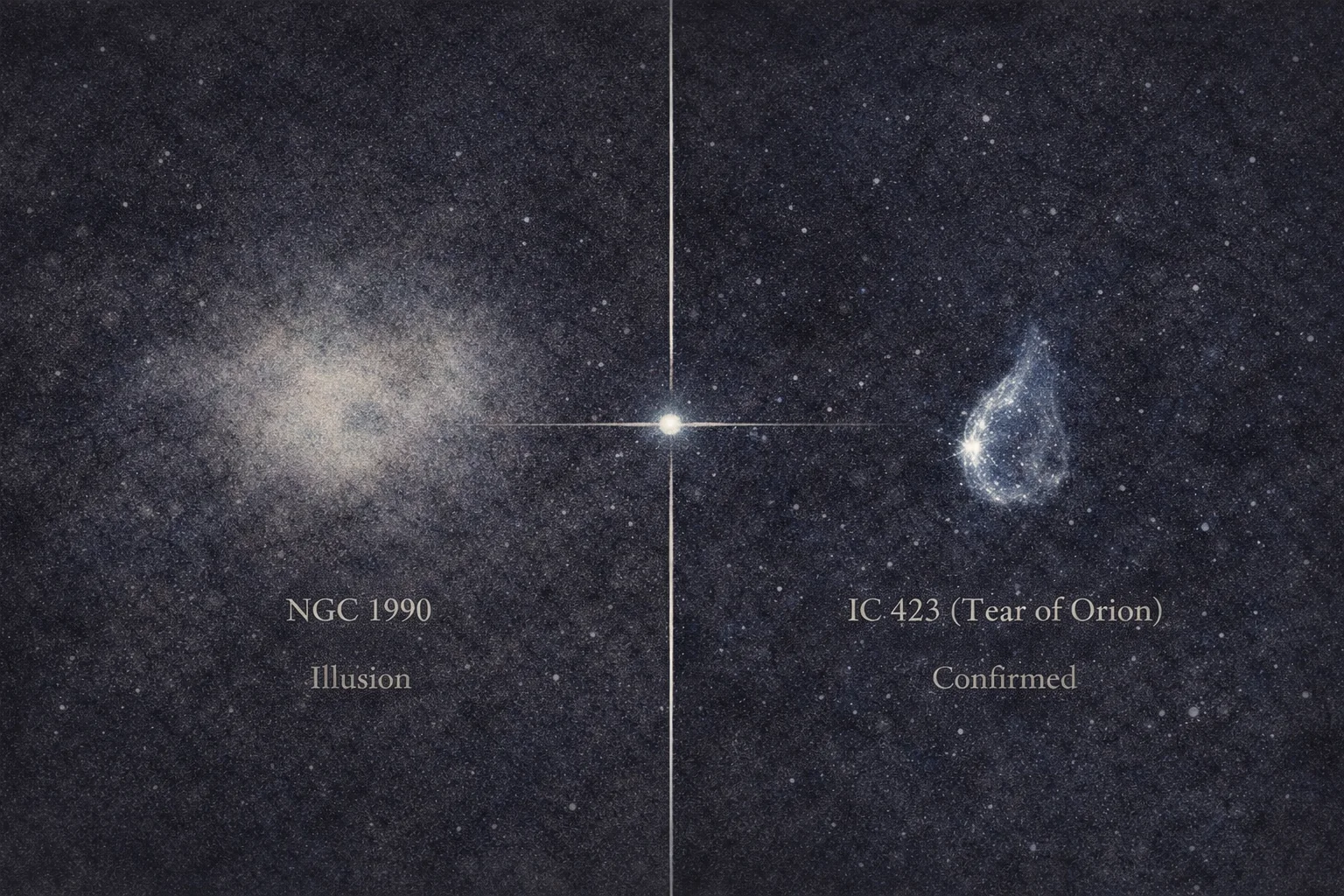
In 1786, William Herschel reported a faint nebula surrounding Alnilam, later cataloged as NGC 1990. John Herschel confirmed it. J.L.E. Dreyer included it in the New General Catalogue. Amateur observers have reported seeing it for over two centuries.
Modern photography cannot find it.
Despite being "observed" by some of history's greatest astronomers, "there is no trace of nebulosity on any photograph of the area," according to the NGC-IC Project. Careful imaging reveals no nebula. The glow observers reported appears to be an optical illusion, the star's brilliance creating a false impression of surrounding nebulosity, an artifact of Alnilam's overwhelming luminance tricking the eye into seeing more than is there.
NGC 1990 may be one of the most fascinating entries in the entire NGC catalog: a famous astronomical object that does not exist.
The lesson is precise: brilliance can create the illusion of legacy where none exists. Not everything that appears to surround a bright center is real.
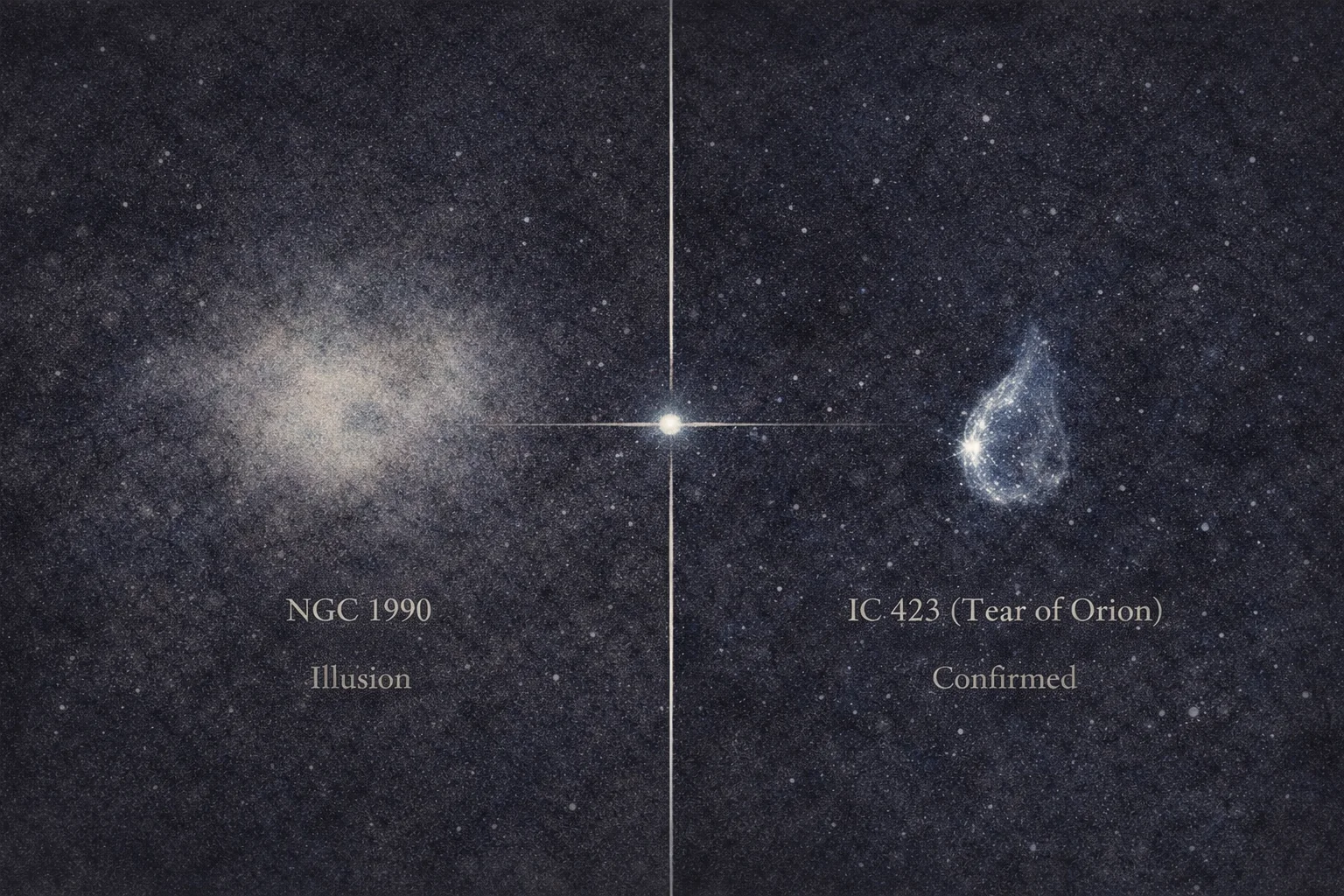
However, confirmed reflection nebulae do exist nearby. IC 423, discovered by Wilhelmina Fleming in 1888, is nicknamed the "Tear of Orion." IC 426 is also confirmed. These are real structures illuminated by Alnilam's light, real consequences of the star's luminosity.
The difference matters. Some of what you project into the world creates real, lasting structures. Some creates only the illusion of impact, a glow that disappears under scrutiny. Legacy requires honest assessment of which is which.
Does your work create real structures that persist independently? Or does it create an aura that vanishes when examined closely?
Historical Layers: Every Culture Saw the Center
Babylonian: The Shepherd's Staff
Four thousand years ago, Mesopotamian astronomers watched Orion rise and saw MULSIPA.ZI.AN.NA, the True Shepherd of Anu. The Belt was the shepherd's staff, the instrument through which divine authority contacted terrestrial reality. A staff has a center of balance. Hold it there and it becomes an extension of your will. Hold it anywhere else and it fights you.
The Babylonian omen texts noted celestial events near Orion with agricultural precision: if Venus approached the Shepherd, it meant diminished crops. The Belt stars were markers of seasonal change, their rising heralding planting time. The center of the Belt was the center of the agricultural calendar, the structural core of the cycle that fed civilizations.
Egyptian: The Path to Immortality
For the Egyptians, the stakes were higher than agriculture. They were building for eternity.
Sah, the god associated with Orion, was called the Father of the Gods and functioned as a divine guide assisting the deceased in ascending to the stars. The Belt stars formed the crown upon Sah's head, the center of his celestial authority. When Sah merged with Osiris, the god who died and was reconstituted by Isis, the Belt became the structural core of the afterlife journey.
The pharaoh traveled to Orion after death. The pyramids were the launch points. The air shafts pointed at the Belt. The entire Egyptian mortuary architecture, the most ambitious building project in human history to that point, was oriented toward three stars. Alnilam was the center target.
They built their most permanent structures pointed at the most visible center in the sky.
Hindu: The Lord of Creation
In the Rigveda, the constellation the Greeks called Orion was associated with Prajapati, the Lord of Creation. The Belt stars were part of the cosmic architecture through which creation was organized. The Hindu concept of dharma, the structural order that holds the universe together, finds celestial expression in the Belt's perfect alignment. The center holds the order.
Chinese: The Character That Means Three
The Chinese character 参 (Shen) originally meant the constellation Orion. The Shang dynasty version, over three thousand years old, contains at its top a representation of three stars atop a figure's head. The character itself is a pictogram of Orion's Belt. Alnilam, as the center star, is structurally embedded in one of the oldest writing systems on Earth.
In the Classic of Poetry (Shijing), the asterism Shen was paired with Antares as a metaphor for two people who could never unite: they exist on opposite sides of the sky and are never visible simultaneously. The Belt represented permanence of position, reliability, the thing you could count on being where you expected it to be.
Lakota: The Spine of the Bison
The Lakota Sioux saw the Belt stars as the spine of a bison. Not the legs (power, mobility) or the head (direction, intention) but the spine, the structural core without which the animal collapses. The three stars represent the vertebrae that hold the form together.
Alternatively, they are the footprints of the White Buffalo Calf Woman, the sacred figure who brought the pipe and taught the ways of peace and harmony. Footprints: what remains after someone has passed through. Legacy.
Navajo: As Above, So Below
The Navajo mapped three sacred mountains to the three Belt stars, creating a terrestrial mirror of the celestial pattern. What existed in the sky was built into the land. The principle of correspondence: legacy in heaven reflected in legacy on earth.
The Pawnee did the same, laying out homes, villages, and travel routes to mirror the night sky. The Belt's alignment became the alignment of human settlement.
Every culture that built for permanence looked at these three stars. Alnilam, at the center, was the point they built around.
The Medieval Astrological View
According to Ptolemy's classification, Alnilam carries the combined nature of Jupiter and Saturn, the same attribution given to Rigel. But the astrological tradition adds a distinctive quality to the center Belt star.
Vivian Robson, in The Fixed Stars and Constellations in Astrology (1923), describes Alnilam as conferring "fleeting public honors." Fame that comes and goes. The native is described as keen but headstrong, studious but rash, capable of sudden course changes when convenient.
Reinhold Ebertin echoed this: Alnilam brings honors that are short-lived, fame that does not hold.
Eric Morse described the ability to achieve great things with proper effort, but warned that without substance, Alnilam produces "useless bravado and show," combative displays that generate misfortune rather than lasting achievement.
The astrological tradition captures something real about the center position: the temptation of visible prominence without structural substance.
Alnilam is the most visible star in the most visible asterism in the sky. It occupies the most prominent position possible. The warning is that prominence without foundation produces fleeting honors. You can be at the center and still not endure. Position alone is not legacy.
The conjunction with the Ascendant promises a "splendid, illustrious life" and "prosperity from youth." The conjunction with the Midheaven promises "distinguished position" and "fame from many activities." But every promise comes with the qualifier: fleeting unless backed by substance.
The center holds only if the center is real.
The Lesson of Decan 34
You have created with volcanic power (Betelgeuse). You have grounded that power in manifested mastery (Rigel). You have deployed that mastery with strategic precision (Bellatrix). Now comes the question that determines whether all of it matters beyond this moment:
What continues?
Not what felt powerful. Not what demonstrated competence. Not what struck effectively. What endures after the power fades, after the mastery is forgotten, after the strategic moment passes?
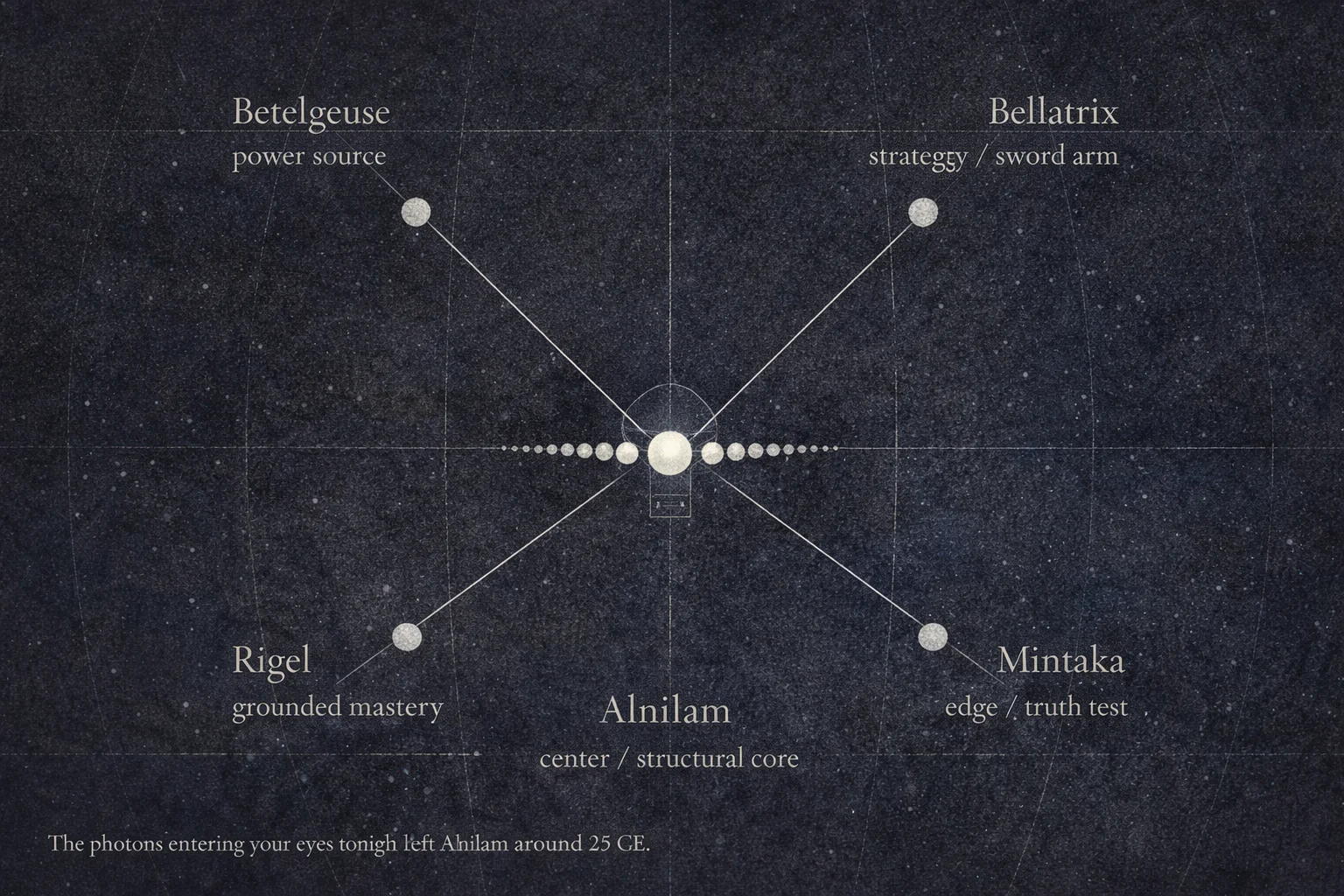
Alnilam sits at the center of the Belt. The center is the structural position. It is not the edge where innovation happens (Mintaka). It is not the origin point where power generates (Betelgeuse). It is not the stable footing where mastery grounds (Rigel). It is not the sword arm where strategy deploys (Bellatrix). It is the structural core that holds after everything else has done its work.
The Belt holds the Hunter together. Without the Belt, Orion is just scattered bright stars. With it, the constellation becomes the most recognizable pattern in the sky. The Belt is what makes the pattern cohere, and Alnilam is the center of the Belt.
Your legacy work this decan should similarly focus on structural coherence. Not creating more. Not mastering further. Not deploying new tactics. Building the center that holds everything you've already created, mastered, and deployed into a pattern that persists.
The star is 5.7 million years old and already shedding its mass at extraordinary rates. It will become a Wolf-Rayet star, then a supernova, then a black hole. Its individual existence is finite. But the heavy elements it sheds into space will seed future solar systems. The pattern it anchors in the sky has been recognized by every human civilization. Its spectrum defines how all stars of its type are measured.
Alnilam's legacy is not its continued existence. It is what it transmits.
What are you transmitting? What structures, what principles, what patterns are you establishing that will persist after your direct involvement ends? What have you shed into the environment that becomes essential to what follows?
The 25 CE institutions endure not because Rome still exists but because Roman legal principles were transmitted, adopted, adapted, and embedded into new systems. Christianity endures not because its founder survived but because the principles were transmitted through structures designed for continuity. The Eastern Han dynasty ended, but Chinese civilization incorporated what Liu Xiu built.
Legacy is not survival. Legacy is successful transmission.
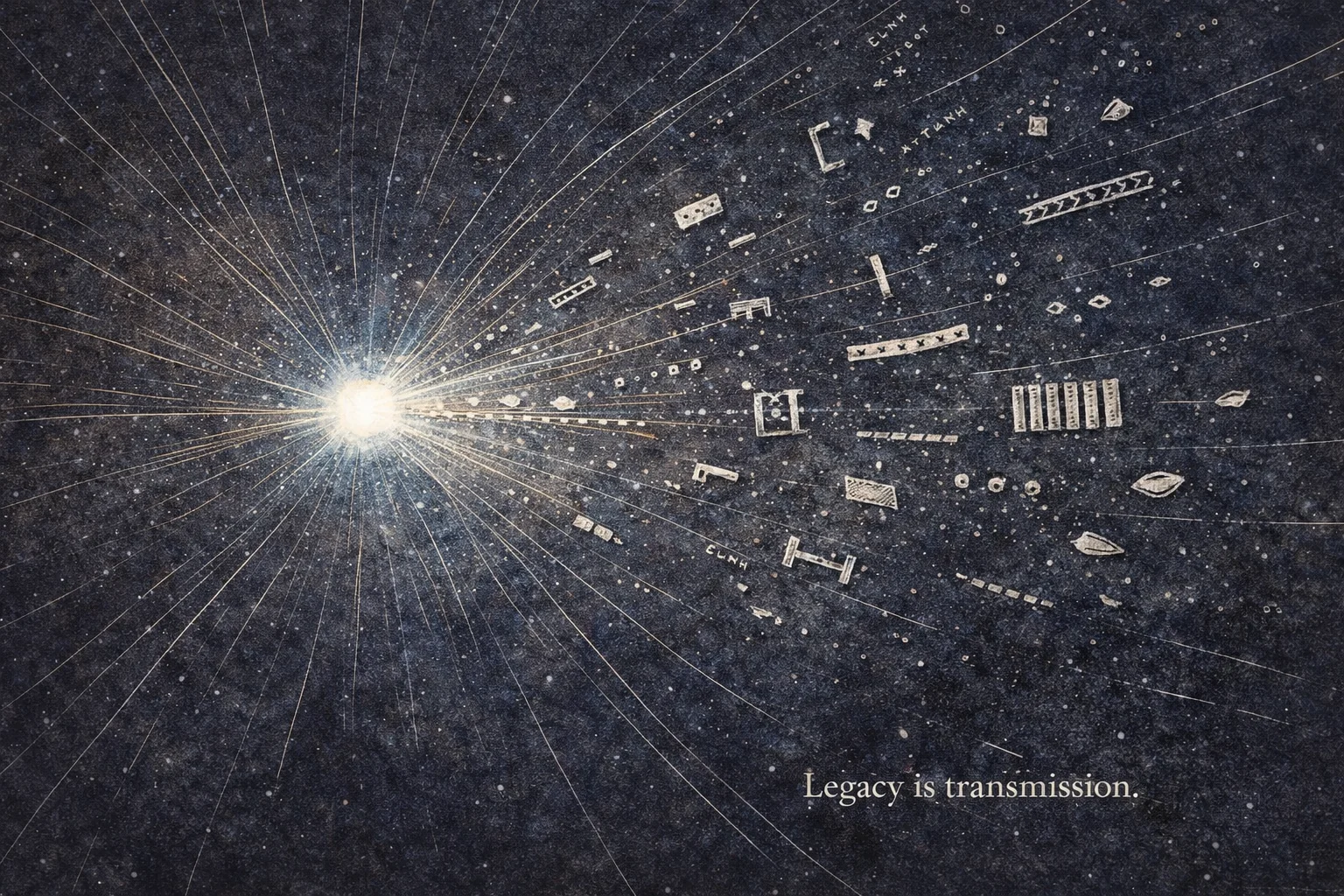
The center of the most recognized pattern in the human sky. Every culture saw it. Every culture named it. Babylonian shepherds, Egyptian pharaohs, Lakota bison hunters, Chinese astronomers, Polynesian navigators. They all looked up and saw three stars in a row, and Alnilam was the one in the middle. The center holds.
From Shoulder to Belt: The Structural Transition
Consider the anatomical journey through Orion.
Betelgeuse at the right shoulder: power source, creative engine.
Rigel at the left foot: stable stance, grounded mastery.
Bellatrix at the left shoulder: sword arm, tactical deployment.
Now: Alnilam at the Belt center.
The Belt is where the Hunter's body is held together. Above the Belt: the shoulders that generate and deploy force. Below the Belt: the feet that provide stability and stance. At the Belt: the structural center that connects upper body to lower body, power to foundation, action to stability.
Without a belt, the Hunter falls apart. The shoulders flail without connection to the legs. The feet ground without purpose if disconnected from the arms that aim. The Belt is the structural integrity of the entire figure.
Alnilam is the structural integrity of everything you've built across the previous three decans.
Your Betelgeuse creation means nothing if it is not connected to your Rigel mastery. Your Rigel mastery means nothing if not deployed through your Bellatrix strategy. And none of it means anything if it does not cohere into a structure that persists.
The photon that left Bellatrix in 1775 carried revolutionary strategic will. The photon that left Alnilam in 25 CE carried institutional permanence. From centuries to millennia. From tactical victory to civilizational continuity.
The shoulder connects to the belt. What you struck with precision must now be built to endure.
The Alpha Cygni Variation: The Heartbeat of Legacy
Alnilam is an Alpha Cygni variable, a class of hot evolved supergiants that exhibit subtle brightness changes due to non-radial pulsations. Some portions of the surface contract while others simultaneously expand. The amplitude is small, roughly 0.1 magnitude, and multiple pulsation frequencies superimpose to create irregular-looking variations.
The star breathes. Not with the dramatic dimming events of Betelgeuse or the wild swings of a Mira variable. Subtly. Steadily. A heartbeat at stellar scale, barely detectable without precise instruments.
Legacy does not announce itself. It persists quietly. The variations are small. The continuity is what matters.
The pulsations are driven by the kappa mechanism: variations in iron opacity within the star cause layers to alternately trap and release radiation, creating waves that ripple through the stellar body. The iron that will eventually be expelled in the stellar wind, the heavy element that will seed future planets, is right now driving the pulse of the star's continuing existence.
The same material that becomes your legacy is what keeps you alive in the present. The principles you transmit outward are the principles that structure your daily functioning.
There is no separation between what you live and what you leave. If your legacy contradicts your practice, neither endures.
The Three Phases
Phase 1: The Inventory of Structure (Days 1-3 | Feb 13-15)
You've spent thirty days in Orion: creating, mastering, striking. Before building legacy, you need to assess what you actually have.
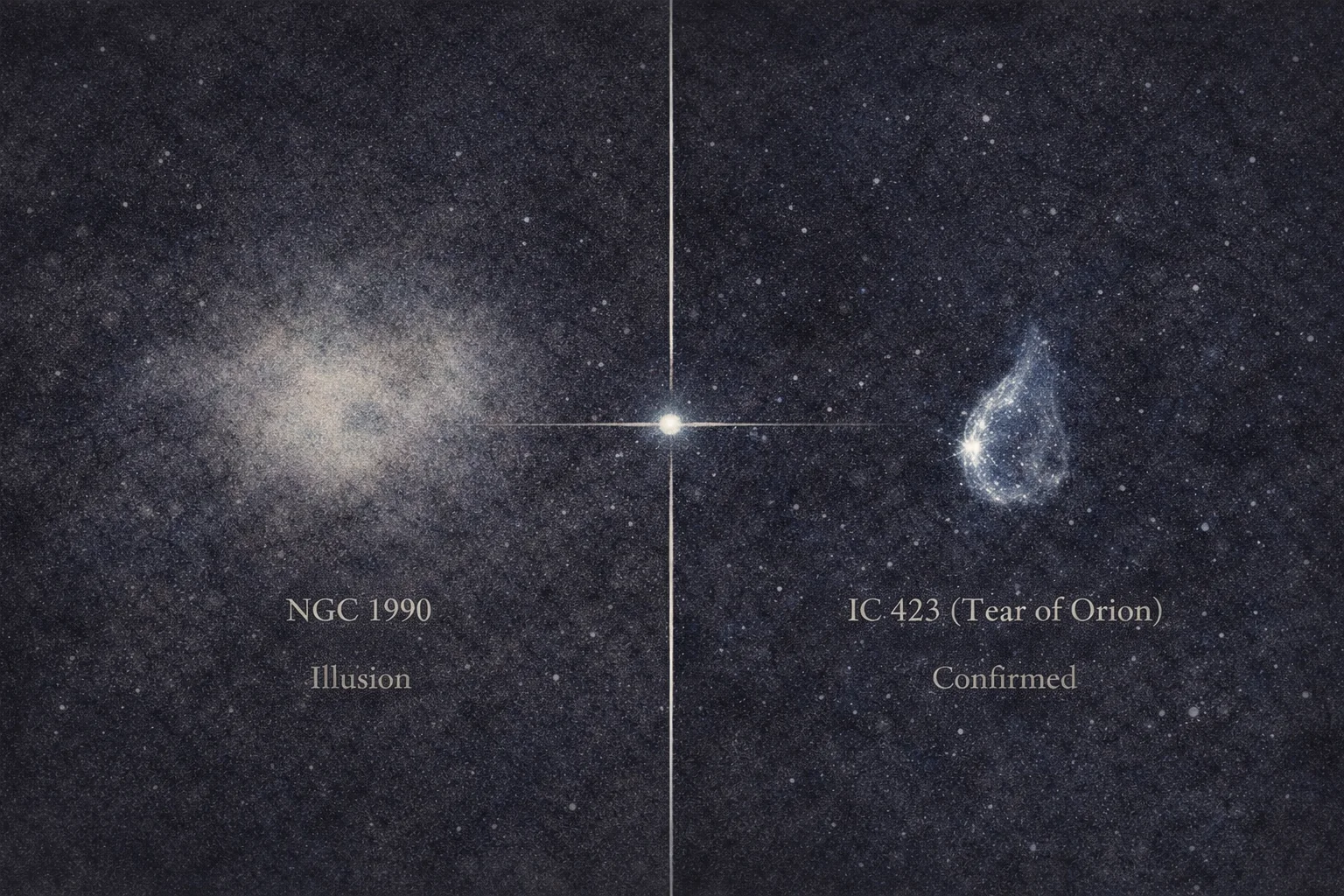
Days 1-3: The Inventory of Structure. What has survived the previous three decans? What is worth building to last?
These first three days ask: What survived your strategic deployment? Not everything you created at Betelgeuse was worth mastering. Not everything you mastered at Rigel was worth deploying. And not everything you deployed at Bellatrix produced lasting results. That is the physics of effort: most energy dissipates. Only structure endures.
Inventory honestly. What from the last thirty days of Orion work has produced something that could outlast the current moment? A system that runs without you. A relationship strengthened beyond dependency. A creative work that stands on its own. A habit embedded deeply enough that it has become automatic. A principle clarified so thoroughly that it no longer requires conscious application.
These are the seeds of legacy. Everything else was process, valuable for what it produced but not itself the enduring structure.
The Egyptian pharaohs did not point their pyramids at every star. They pointed at Orion's Belt. They chose the structural center. You similarly cannot build legacy from everything you have ever done. You must choose the center, the core element around which everything else organizes.
On the first night, go outside. Find Orion's Belt, three stars in a distinctive row cutting across the Hunter's waist. The center star, the brightest of the three, is Alnilam. Notice how it anchors the pattern. Notice that without it, the Belt would be two disconnected points rather than a line. The center creates the structure.
What is your center?
Phase 2: The Building of Continuity (Days 4-7 | Feb 16-19)
Now the structural work begins.
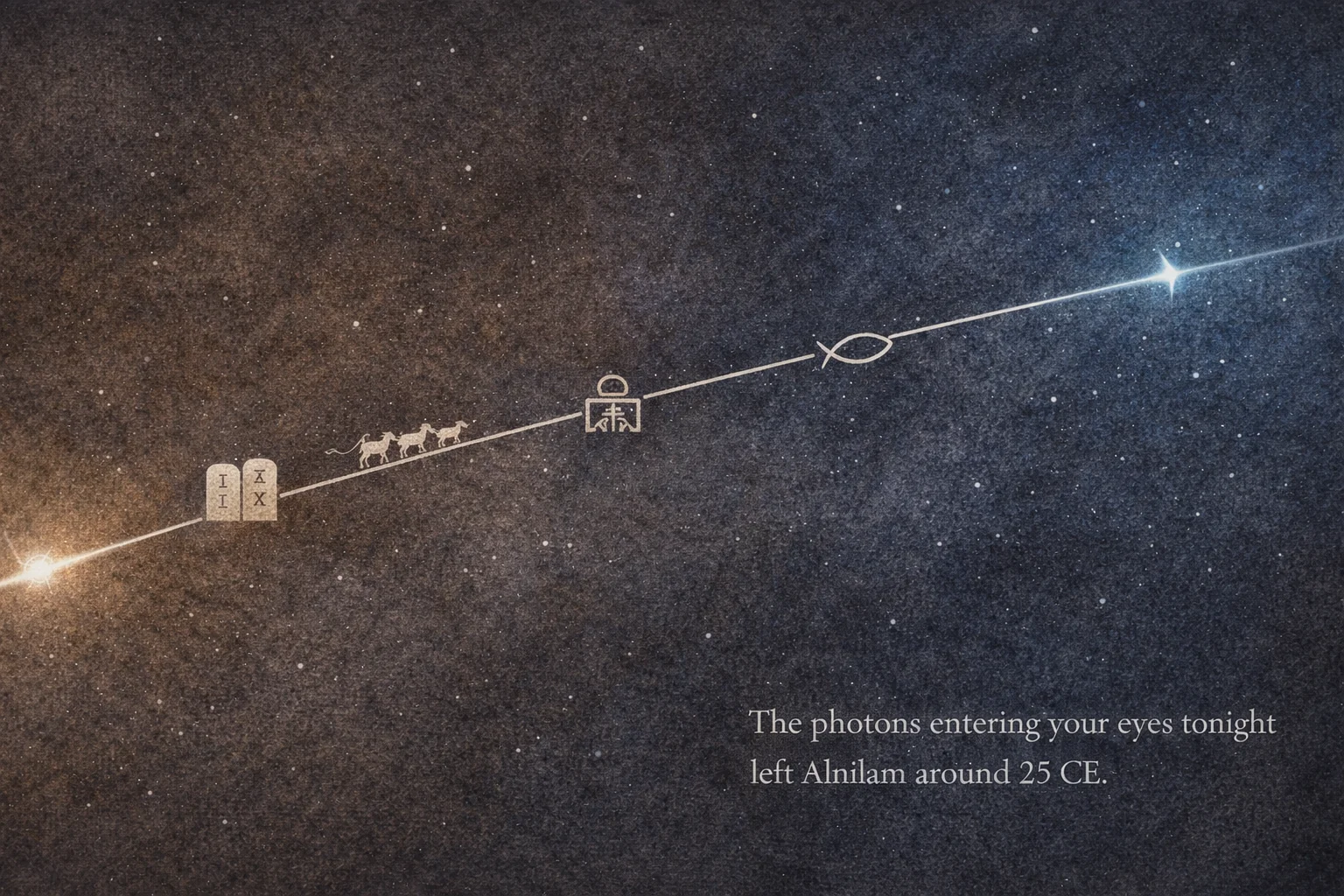
Days 4-7: The Building of Continuity. Not creating something new. Building what lasts from what exists.
This is not creation (that was Betelgeuse). This is not refinement (that was Rigel). This is not deployment (that was Bellatrix). This is systemization: taking what works and embedding it in structures that persist without your constant attention.
The Roman jurists of 25 CE did not invent the concept of justice. They systemized it. They wrote principles into codes that could be transmitted, taught, applied by others, adapted to new situations. The principles existed before the codes. The codes made them permanent.
Your work in this phase should similarly focus on transmission structures. How does what you know get passed on? How does what you have built continue to function? What documentation, what habit, what system, what relationship ensures that the work continues beyond your active involvement?
Consider Alnilam's stellar wind. The star does not hoard its heavy elements. It blasts them into space at 2,000 kilometers per second, enriching the interstellar medium, seeding future generations of stars and planets. The transmission is violent and continuous. The star loses itself in the process.
Legacy requires giving away what you have built. Not hoarding it. Not protecting it. Transmitting it into the environment where it can be incorporated by others.
Each night during this phase, observe Alnilam and contemplate: What am I embedding into structures that will persist? What am I transmitting outward? What principles am I encoding into systems that function without me?
The Jupiter-Saturn nature attributed by Ptolemy applies here: Jupiter expands, Saturn structures. The combination is disciplined growth, structured expansion. Not unlimited ambition (Jupiter alone) nor rigid preservation (Saturn alone), but the balanced building that knows when to extend and when to consolidate.
Phase 3: The Test of Endurance (Days 8-10 | Feb 20-22)
The final three days ask whether what you have built can hold.
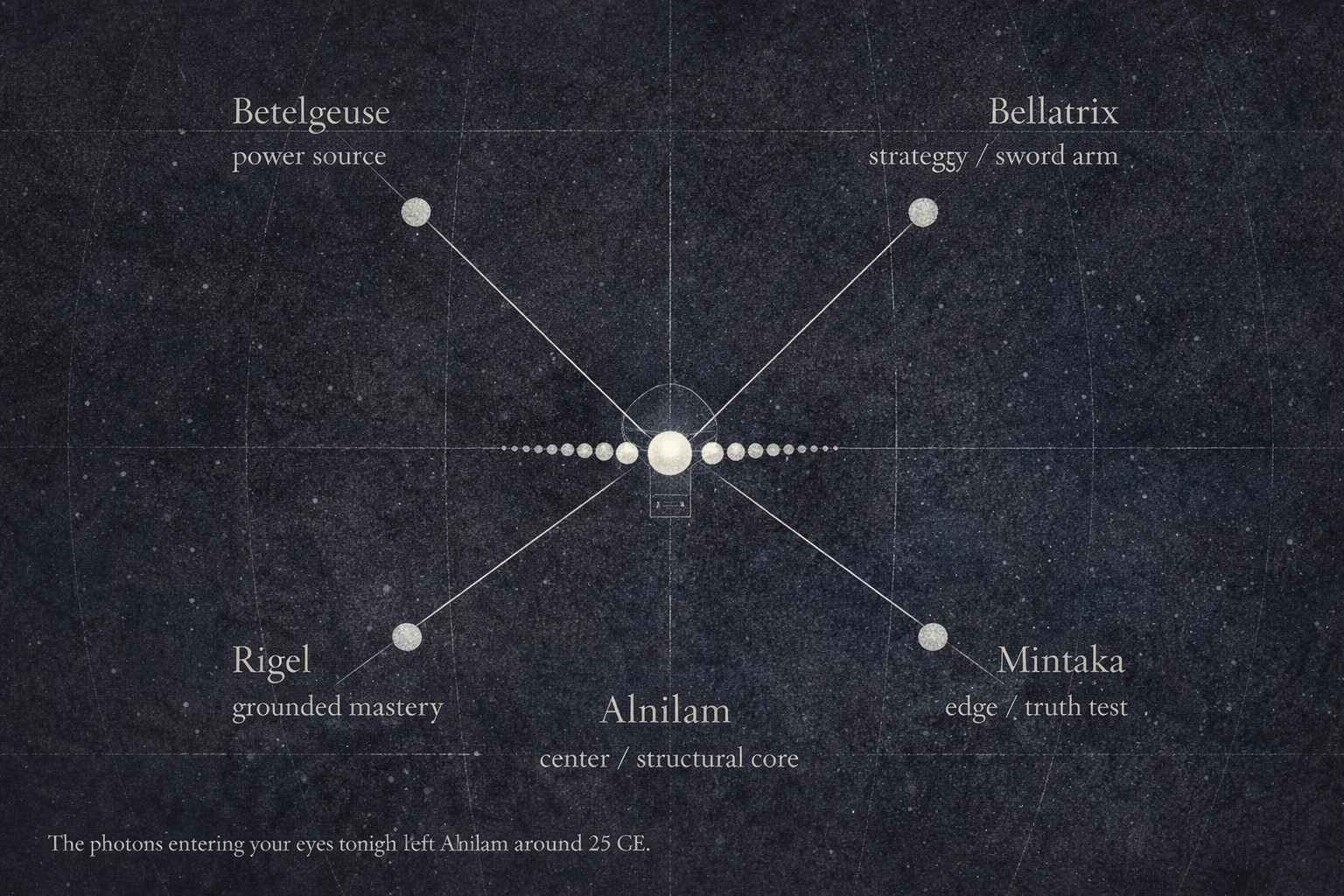
Days 8-10: The Test of Endurance. Can what you built survive your absence? Does the center hold without your hand on it?
Step back. Stop actively maintaining what you built in Phase 2. Let it run. Let it function. Watch whether the structure holds when you are not propping it up.
The institutions born in 25 CE were not maintained by their founders. Jesus was crucified within five years. Tiberius withdrew to Capri. Liu Xiu died in 57 CE. The institutions survived because they were structurally sound, not because the founders kept holding them up.
If your legacy requires your constant presence, it is not legacy. It is performance.
The test is uncomfortable. You want to intervene, to adjust, to improve. Resist. The center of Orion's Belt does not adjust its position. It burns. It sheds matter into space. It defines its spectral class for all other stars to be measured against. But it does not manage the Belt. It simply occupies the center, and the structure coheres around it.
On the last night of this decan, observe Alnilam knowing you have completed a legacy cycle. Consider the Robson warning: "fleeting public honors." Has what you built earned permanent structural significance, or only temporary prominence? Is it real, like IC 423, the Tear of Orion, confirmed and persisting? Or is it like NGC 1990, the nebula that generations of observers reported seeing but that modern cameras cannot find, an illusion of brilliance mistaken for substance?
Be honest. The center holds, or it does not.
Daily Tracking
Each night of this decan, spend a few minutes with your journal. Note what you built for continuity, not what you accomplished in the moment. Watch Alnilam when the sky permits, the center of the three Belt stars, and let it ask: Is what I built today something that will still function tomorrow? Next month? Next year? When I am not here to maintain it?
Track the structural work, not the heroic effort. Track what you transmitted outward, not what you held close. Track the systems, the documentation, the embedded habits, the relationships that carry knowledge independently.
Finding Alnilam: The Center Pearl of Orion's Belt
After sunset in mid-February, face south around 8-10 PM. Orion dominates the sky.
Find the Belt: three bright stars in a tight row, unmistakable, cutting diagonally across the Hunter's midsection. The middle star is Alnilam.
It is the brightest of the three. At magnitude 1.69, it slightly outshines Alnitak (1.74) to its left and distinctly outshines Mintaka (2.25) to its right. The center is the brightest. The center is the core.
Find Orion's Belt. The middle star, brightest of the three, is Alnilam. The center pearl. The structural core. Two thousand years of light, arriving tonight.
Notice the Belt's position in Orion's body. Above: the shoulders (Betelgeuse to the upper left, Bellatrix to the upper right). Below: the feet (Rigel to the lower right, Saiph to the lower left). The Belt connects them all. The center of the Belt is the center of the Hunter.
Spend a few minutes with Alnilam each night. Feel the distance: approximately two thousand light-years, meaning you see light from around 25 CE. The photons entering your eye tonight left when the Roman Empire was building legal structures you still live under, when Christianity's founder was alive, when the Eastern Han dynasty was being proclaimed, when the Silk Road connected civilizations.
Contemplate what you are building that connects to that scale of continuity.
End-of-Decan Review
On February 22, ask yourself:
About Continuity:
What have I built that functions without my active maintenance? What systems, habits, or structures did I embed during this decan? What is my equivalent of Roman law, the principle encoded into a form that others can apply?
About Legacy:
What am I transmitting outward? What heavy elements am I shedding into the environment that will seed what comes after? Am I hoarding or transmitting?
About the Center:
Have I identified my structural core, the single point around which everything else organizes? Or am I trying to make everything the center, which means nothing is?
About the Illusion:
Is my legacy real or illusory? Would it survive scrutiny, like IC 423? Or would it vanish under close examination, like NGC 1990?
About Observation:
How many nights did I observe Alnilam? What did the center of Orion's Belt evoke? What did two-thousand-year contemplation reveal about my relationship with permanence?
Looking Ahead to Mintaka:
My legacy has been built. Is it aligned with truth? Does it hold up at the edges, at the boundaries, under scrutiny?
Preparing for Mintaka
On February 23, Decan 35 begins. Mintaka, Delta Orionis, the western star of Orion's Belt, rises with the theme "Alignment & Truth."
The photons you will observe from Mintaka left in approximately 825 CE, during the Islamic Golden Age, when scholars at Baghdad's House of Wisdom were rigorously testing ancient Greek astronomy against observation, discarding what did not align with reality, preserving what did.
Mintaka sits almost exactly on the celestial equator, within a quarter of a degree. This means it rises due east and sets due west for every observer on Earth. It is one of the most geometrically aligned stars in the sky, a cosmic reference point for orientation.
You have built legacy (Alnilam). Now you will test it against truth (Mintaka).
The transition is from center to edge. Alnilam is the center of the Belt, the structural core. Mintaka is the edge of the Belt, the boundary where the Belt meets open sky. Moving from center to edge means moving from building to testing, from establishing to examining.
Does your legacy hold up at the boundaries?
The surface temperature shifts too: Mintaka burns at 29,500 K, even hotter than Alnilam's 27,000 K. The edge is more intense than the center. Truth-testing is more demanding than legacy-building. Anyone can claim to have built something lasting. Mintaka asks whether that claim survives examination.
Carry forward from Alnilam:
- The structural center, the core principle around which everything organizes
- The transmission mindset, shedding heavy elements into the environment
- Two-thousand-year thinking, the scale at which real legacy operates
- The full Orion arc: creation (Betelgeuse), mastery (Rigel), strategy (Bellatrix), legacy (Alnilam)
Leave behind:
- Legacy without examination (Alnilam built; Mintaka tests)
- Center without boundary (you established the core; now define the edges)
- Endurance as assumption (things can endure AND be misaligned, which is worse than not enduring at all)
- The illusion of NGC 1990 (let Mintaka's truth-testing reveal what is real)
Watch Alnilam at the center of the Belt and Mintaka at its western edge. The center built. The edge tests. Your legacy moves from the structural core to the boundary where truth demands alignment.
The Stellar Physics of Continuity & Legacy
Alnilam is hotter than any star you have observed in the Orion sequence except Mintaka.
At 27,000 K, it burns at a temperature that would vaporize any known material. Its luminosity of hundreds of thousands of suns pours from a surface of approximately 30 solar radii, compact by supergiant standards, concentrated in its output. The star was born only 5.7 million years ago, a cosmic infant, yet it is already in an advanced evolutionary stage because its extreme mass accelerates every process.
Recent interferometric observations suggest Alnilam may have formed from the merger of two stars in a binary system. If so, the singular center star that anchors the Belt's pattern was itself once two separate entities that fused into one. Duality becoming unity. Multiplicity becoming center. The structural core of the most recognized asterism in the sky may have been built from a merger.
Sometimes legacy requires combining what was separate into what endures as one.
The star's oblate shape, wider at the equator than at the poles, suggests rapid rotation close to breakup velocity. Even now, Alnilam spins at the edge of its own structural limits, testing how fast it can rotate without flying apart. The center holds, but not without internal tension. The legacy-building process involves operating near your limits, not comfortably within them.
And the final teaching of Alnilam's physics: the star will die as a supernova, likely leaving behind a black hole. The most visible star in the most visible pattern will become the most invisible thing in the universe, a point of gravity from which nothing escapes.
But the heavy elements it shed across its lifetime will persist in new stars, new planets, new forms of complexity. The black hole is not the legacy. The transmitted material is.
What you become after you stop does not define your legacy. What you transmitted while you were active does.
Further Reading
For Understanding Alnilam:
- Stars and Their Spectra by James B. Kaler (Cambridge) - Chapter on B-type supergiants
- The Life and Death of Stars by Kenneth R. Lang - Supergiant evolution and stellar endpoints
- Jim Kaler's stellar profile on Alnilam (University of Illinois)
For Continuity and Legacy:
- The Lessons of History by Will and Ariel Durant - Patterns of civilizational continuity
- Sapiens by Yuval Noah Harari - How institutions outlast individuals
- Antifragile by Nassim Nicholas Taleb - Building systems that strengthen under stress
For the 25 CE Context:
- The Rise of Rome by Anthony Everitt - Roman institutional architecture
- The Early Chinese Empires by Mark Edward Lewis (Harvard) - The Han Dynasty
- The Silk Roads by Peter Frankopan - Trade networks and civilizational exchange
For Egyptian-Orion Connections:
- The Orion Mystery by Robert Bauval and Adrian Gilbert - The pyramid-Belt correlation theory
- Death and Salvation in Ancient Egypt by Jan Assmann - Egyptian afterlife beliefs
Navigation
- Back to The Decan Log - Return to the complete decanal calendar
- Previous Chapter: Decan 33 - Bellatrix (Will & Strategy) - Feb 3-12, 2026
- Next Chapter: Decan 35 - Mintaka (Alignment & Truth) - Feb 23 - Mar 4, 2026
Go outside tonight. Find the center of Orion's Belt. Watch the star that has been the structural core of the most recognized pattern in every human sky, across every culture, for as long as people have looked up. Feel the two-thousand-year distance. Feel the light from an era when institutions were being built that still govern, still teach, still shape civilization.
Then ask yourself: What are you building that holds?
© 2026 Joshua Ayson. All rights reserved. Published by Organic Arts LLC.
This chapter is part of The Decan Log: A 10-Day Journaling System Aligned with the Stars. All content is protected by copyright. Personal use encouraged. Unauthorized commercial reproduction prohibited.