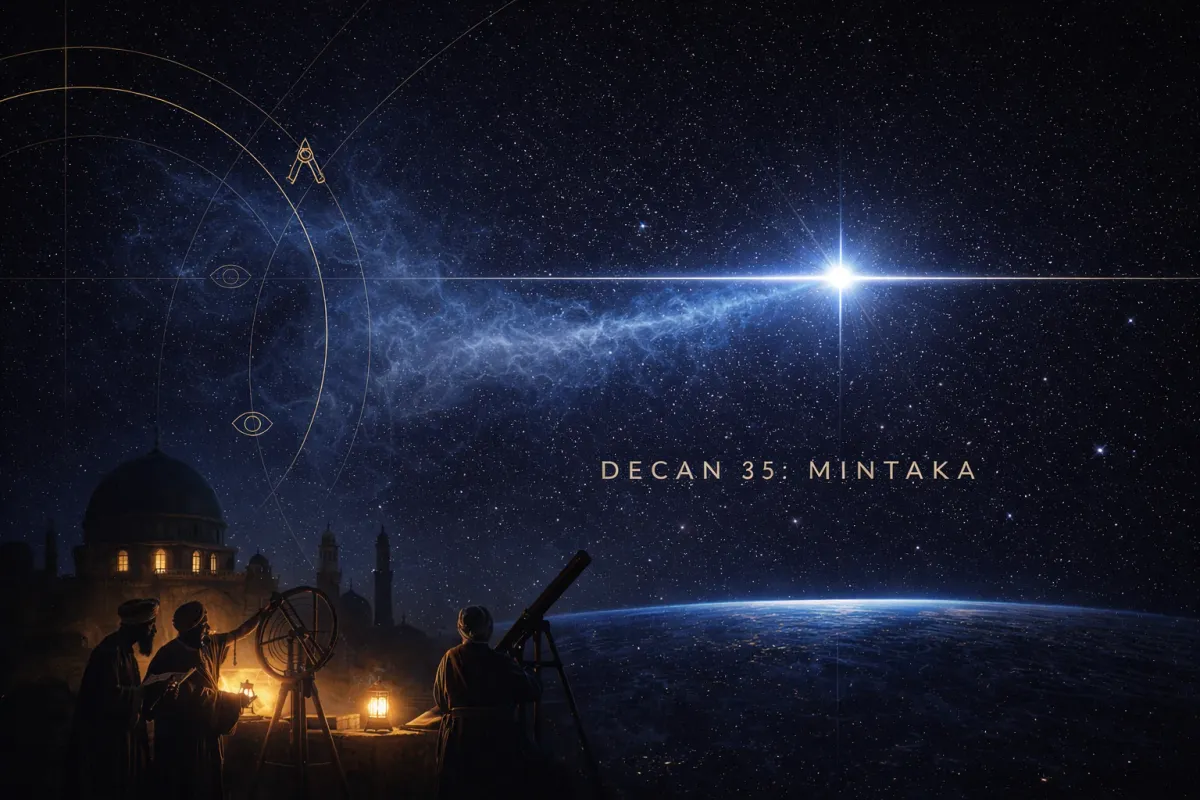
Mintaka: Decan 35 - Alignment & Truth
The Belt's Edge
The photons entering your eyes right now left Mintaka around 825 CE, from the reign of Caliph al-Ma'mun, who would soon order Baghdad's first astronomical observatory, when scholars at the House of Wisdom tested Ptolemy's ancient star tables against observed reality and found the Greek master wrong. 1,200 years that photon traveled, carrying a question across the void. Is what you have built actually aligned with truth?
New to The Decan Log? Start with the Introduction: Living by the Stars to understand the 10-day decanal system, how it works, and why ancient Egyptian timekeeping offers a better framework for personal growth than modern weeks.
Living this decan? For a personal account of ten days under this star, read the decan journal.
For ten days you built at the center with Alnilam, establishing the structural core that holds everything together. You found what endures and tested whether your legacy could stand without you propping it up. Now comes what every legacy must face, the edge, the question that determines whether what you built is real. Is it aligned with truth?
The Star That Defines the Edge
The photons entering your eyes tonight left Mintaka around 825 CE.
Plain physics. That blue-white light traveled approximately 1,200 years through the void. It left when Caliph al-Ma’mun sat on the Abbasid throne in Baghdad, the caliph who ordered the Shammasiyah observatory built in 828 to test Ptolemy’s tables, when Muhammad ibn Musa al-Khwarizmi, the father of algebra, was working at the House of Wisdom. Scholars there were doing something new in intellectual history, testing ancient Greek astronomy against the observed sky and finding the ancients wrong.
You are literally seeing the light of truth-testing, photons that left during a confrontation between inherited tradition and measured observation, arriving tonight with the question those astronomers asked.
Does what you inherited actually align with what you observe?
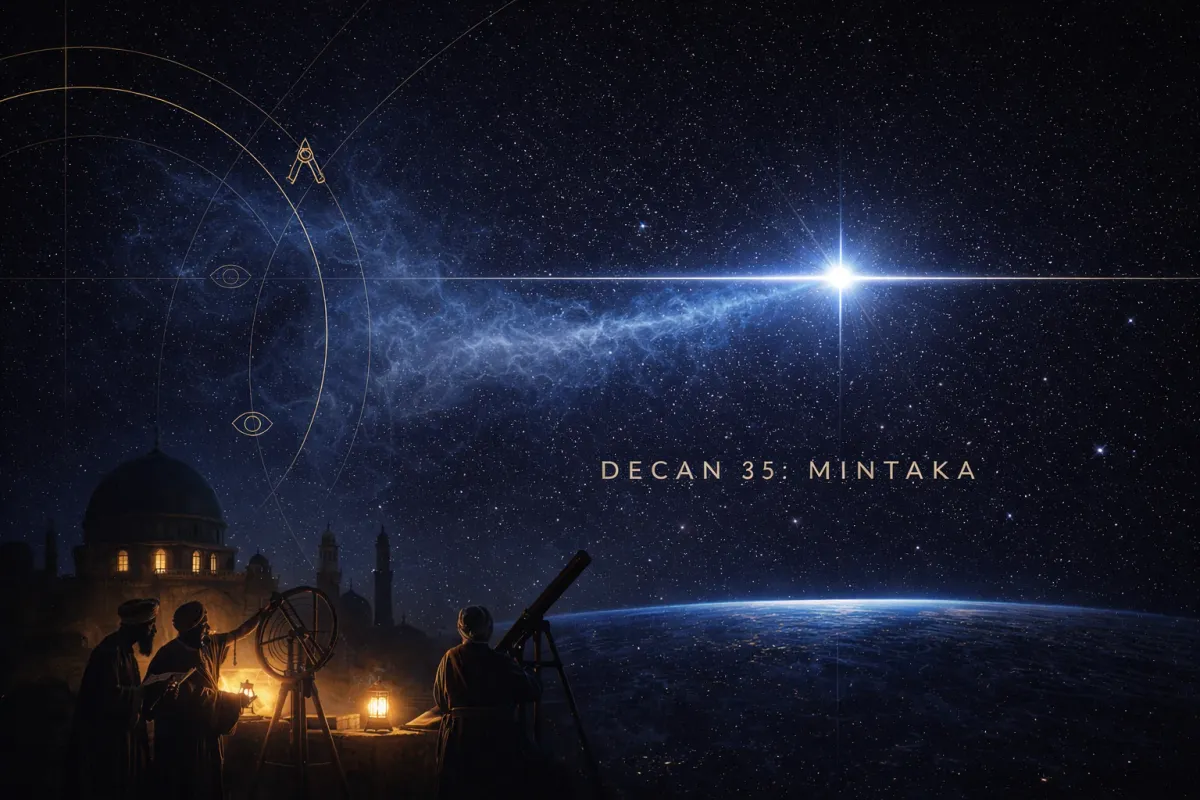 Mintaka sits at the western edge of Orion’s Belt: the boundary where the pattern meets open sky. Where Alnilam centers and Alnitak anchors, Mintaka defines the limit. The edge is where truth is tested.
And what you are seeing when that light arrives is the edge of Orion’s Belt.
Mintaka is the westernmost of the three Belt stars, the faintest of the three at apparent magnitude 2.25, and the one that sits slightly offset from the line formed by Alnitak and Alnilam. The center holds (Alnilam). The eastern anchor is strong (Alnitak). Mintaka, at the edge, is where the Belt meets sky, where the pattern either holds or dissolves.
The Star on the Line
Mintaka sits almost exactly on the celestial equator, within seventeen arcminutes of zero degrees declination.
The celestial equator is the projection of Earth’s equator onto the sky, the line that divides the celestial sphere into northern and southern hemispheres. Only stars sitting on or near this line share one property. They rise due east and set due west for every observer on Earth away from the poles, regardless of latitude.
Stand on the equator or in Oslo. Stand in Tokyo or Buenos Aires. Stand on any ship on any ocean. When Mintaka rises, it rises at exactly 090 degrees. When it sets, it sets at exactly 270 degrees. East and west, the two directions navigation starts from.
Mintaka is one of the most geometrically aligned stars in the sky.
This is why ancient navigators used it, and why Polynesian wayfinders, who memorized the rising and setting positions of over 150 stars as an internal compass, valued the Belt stars so highly. Mintaka told you where true east and true west were, no compass reading or estimate, the geometry of the cosmos made visible by a star sitting on the equatorial line.
Truth is like this. It holds from every vantage point.
Your legacy was built at Alnilam. Now Mintaka asks whether it is aligned with something as objective as east-west. Aligned with reality, with what every observer from every vantage point would confirm, rather than with your preferences or your inherited assumptions.
Is what you built true from every angle? Or only from the angle you happened to be standing at?
The Name: The Belt
The name Mintaka derives from the Arabic mantaqat al-jawza’ (منطقة الجوزاء), meaning “the belt of the central one.” The root word mantaqa carries the meaning of belt, girdle, zone, or region. Intriguingly, the Arabic trilateral root n-t-q relates to speech, logic, and rational boundaries.
The belt is the boundary that gives the body its shape.
Where Alnilam’s name (al-nizam, “the string of pearls”) describes arrangement and continuity, Mintaka’s name describes the constraint itself. The belt is the line that separates above from below, torso from legs.
A belt drawn too tight constricts. A belt drawn too loose fails to hold. The truth Mintaka stands for is the same kind of constraint, a boundary that defines without crushing and holds without strangling.
Where does your legacy need tighter boundaries? Where is it too loose?
The 825 CE Light: When Truth Was Tested Against Tradition
When the photons you see tonight left Mintaka, the world was witnessing something rare, scholars choosing observation over authority.
In Baghdad, Caliph al-Ma’mun (reigning 813-833 CE) had inherited the House of Wisdom, the Bayt al-Hikma, a library and intellectual center that had been translating the world’s knowledge into Arabic. Greek, Persian, Indian, and Chinese texts flowed through this institution. Ptolemy’s Almagest, the supreme work of ancient astronomy, had been translated and studied with reverence.
Then al-Ma’mun did something radical. He ordered the construction of the Shammasiyah observatory in Baghdad in 828 CE, three years after the photon you see tonight departed Mintaka. He told his astronomers to test Ptolemy. Observe the actual sky. See if the Greek master was right.
The results were humbling and revolutionary.
The astronomers produced the al-Zij al-Mumtahan, the “Tested Tables,” a set of astronomical measurements that systematically compared ancient Greek predictions against fresh observations. They found errors. Ptolemy and Hipparchus had held that the solar apogee was fixed relative to the vernal equinox. Baghdad’s observers showed it was not.
They tested Ptolemy. They kept what aligned with observation and corrected what did not.
That is the spirit Mintaka’s light carries, tradition tested against reality. The scholars at the House of Wisdom revered their Greek predecessors and translated every word with care, and reverence meant taking what the ancients said seriously enough to test it.
Al-Khwarizmi was working at the House of Wisdom during this period, synthesizing Indian and Greek mathematical traditions into his foundational texts on algebra and algorithms. The word “algorithm” derives from the Latinization of his name. The word “algebra” derives from the title of his book, al-Kitab al-mukhtasar fi hisab al-jabr wa-l-muqabala. The mathematics you use daily descends directly from this moment of synthesis and truth-testing.
What you see tonight is light from the years when the principle that truth must be tested was built into an institution.
 The light entering your eyes tonight departed when Baghdad’s House of Wisdom was testing Ptolemy against observed reality. 1,200 years of travel through the void. 1,200 years of the scientific method taking root in human civilization. Mintaka’s light carries the spirit of tested truth.
What the 825 CE Photon Passed Through
The photon traveling toward you for twelve centuries departed during the Islamic Golden Age and crossed through every subsequent era of intellectual alignment and misalignment:
825-1258: The Islamic Golden Age. Baghdad’s scholars preserved, translated, and corrected ancient knowledge. They tested. They measured. They aligned tradition with observation. 1165: The year Rigel’s light departed, when the first craft guilds were forming and Notre-Dame rose. European knowledge still largely inherited, not yet tested. 1258: The Mongol sack of Baghdad. The House of Wisdom destroyed. Books thrown into the Tigris, which ran black with ink then red with blood. Truth-testing interrupted. 1453: Constantinople fell, sending Greek manuscripts west, reigniting European interest in the classical knowledge that Islamic scholars had preserved and corrected. 1543: Copernicus published De revolutionibus, testing the Ptolemaic model against heliocentric observations. The alignment work begun in Baghdad reached Europe. 1609: Galileo turned his telescope toward the sky, testing inherited cosmology against direct observation. The Islamic precedent repeated. 1687: Newton published the Principia. Mathematical alignment of theory with observation reached unprecedented precision. 1775: The year Bellatrix’s light departed. Strategic will deployed in the American Revolution. 1905: Einstein published special relativity, testing classical physics against observed reality and finding it incomplete. 2026: The photon arrives. You observe it. The principle of testing truth against reality has become the foundation of all reliable knowledge.
From Baghdad to your retina, the journey of tested truth.
The Rarest Star You Can See
Mintaka’s primary star is classified O9.5 II, an O-type bright giant. O-type stars are the rarest and hottest and most massive in the classification system.
Of the estimated 200-400 billion stars in the Milky Way, approximately 20,000 are O-type. One in ten million. Of the 90 brightest stars visible to the naked eye, only four are O-type: Gamma Velorum, Alnitak, Zeta Puppis, and Mintaka.
When you observe Mintaka, you are seeing one of only four naked-eye examples of the rarest class of star in existence.
At 29,500 Kelvin, Mintaka’s primary burns hotter than any other star in your Orion sequence. Hotter than Alnilam (27,000 K), Bellatrix (22,000 K), Rigel (12,100 K) and Betelgeuse (3,500 K). The edge of the Belt is the hottest point.
Testing is more intense than building.
O-type stars live fast and die young. Their extreme mass drives nuclear fusion at rates that exhaust fuel in millions of years rather than billions. The Sun will burn for ten billion years. An O-type star might last five million. The intensity that makes them the most luminous objects in the galaxy also ensures they are the most temporary.
The brightest truths are the most demanding. They have to be acted on before the window closes.
The Sextuple System: Truth Is Not Simple
When you look at Mintaka, you see a single point of blue-white light. You are actually seeing at least six stars.
Mintaka Aa1: The O9.5 bright giant primary, 24 solar masses, 16.5 solar radii, 190,000 times the Sun’s luminosity. This is the dominant component.
Mintaka Aa2: A B1 main-sequence companion, 8.4 solar masses, orbiting the primary every 5.73 days. Together with Aa1, these form an eclipsing binary, periodically dimming as one passes in front of the other.
Mintaka Ab: A B0 subgiant, separated by 0.26 arcseconds, orbiting the inner pair with a period exceeding 400 years.
Mintaka C (HD 36485): A B-type main-sequence star at magnitude 6.85, which is itself a spectroscopic binary with a dim A-class companion orbiting every 30 days.
Six stars in nested orbits. What looked like a single point is a system of components at different scales.
Truth is not simple. It looks simple from a distance, and the closer you examine the more complexity you find. The single point of light becomes a sextuple system. The simple answer becomes a nested hierarchy of truths, each on its own timescale, 5.73 days, 30 days, 400 years.
Your legacy, tested against truth at Mintaka, will similarly reveal complexity you did not anticipate. What appeared as a single solid structure may contain components orbiting each other in relationships you had not examined. The question is whether the components are gravitationally bound, working together, or flying apart.
The Eclipsing Binary: Truth Dims Before It Clarifies
Every 5.73 days, Mintaka’s brightness drops.
The primary and secondary stars orbit each other in a plane nearly aligned with our line of sight. When the smaller star passes in front of the larger, it blocks some of the light, and the apparent magnitude dims from 2.23 to 2.35. When the larger passes in front of the smaller, a secondary eclipse occurs, dimming to 2.29.
Truth-testing periodically dims what you see. When you examine your legacy closely, some of its brightness will fade for a while. The examination blocks the light.
That is normal. That is the physics of alignment.
The eclipse does not destroy the star. It shows what the star is, a binary system, two components in relationship, each periodically blocking the other’s light. After the eclipse passes the full brightness returns, understood now.
When testing your legacy against truth dims it for a while, keep looking. The dimming reveals the structure.
Mintaka is one of the brightest eclipsing binary systems in the sky, though far from the closest; Algol, the Demon Star of Decan 28, sits more than ten times nearer. The universe placed this example of periodic truth-testing at the edge of the most recognized pattern in the sky.
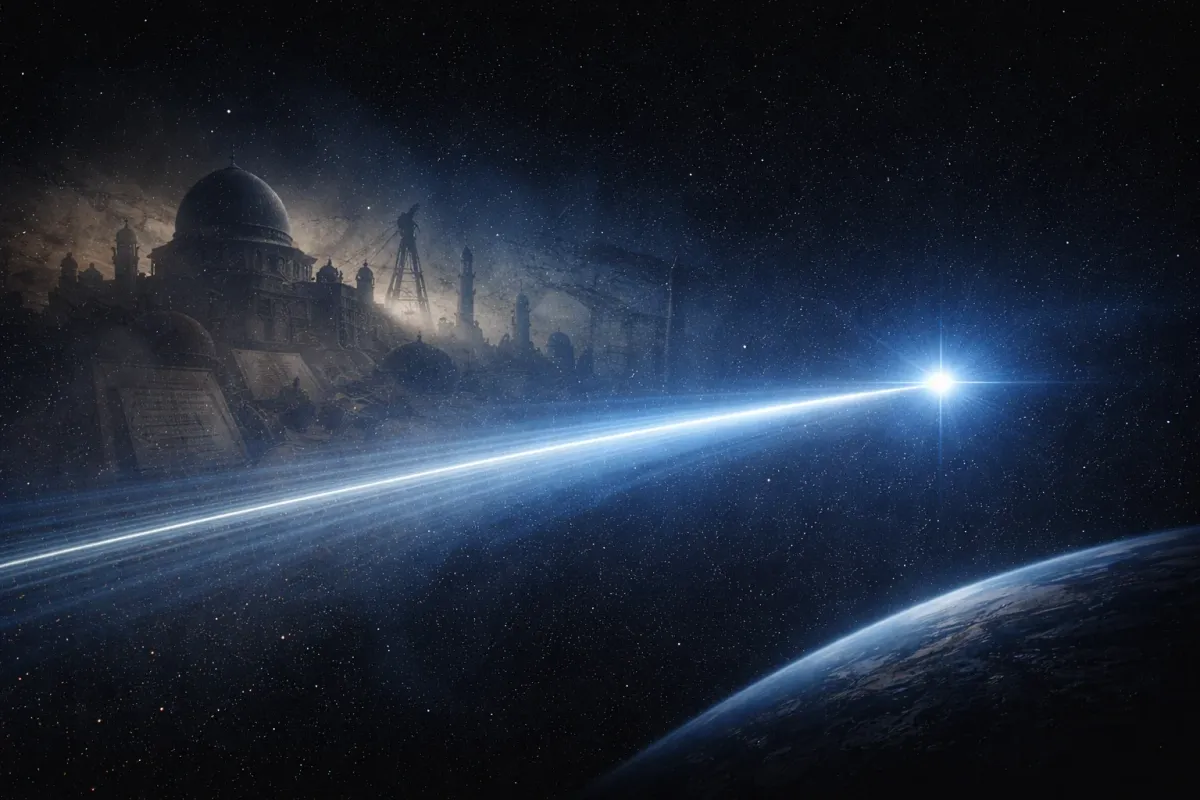 Every 5.73 days, Mintaka dims as one star eclipses the other. Truth-testing periodically reduces what you see. After the eclipse, full brightness returns, understood rather than merely observed. The dimming is not destruction. It is revelation.
The Slight Offset: Imperfect Alignment Is Real Alignment
Look carefully at Orion’s Belt. The three stars are not perfectly straight.
Mintaka sits slightly offset from the line formed by Alnitak and Alnilam. The three stars exist at different distances from Earth: Alnitak approximately 1,260 light-years, Alnilam approximately 1,200-2,000 light-years, and Mintaka approximately 1,200 light-years. Their three-dimensional positions, projected onto our two-dimensional sky, create a line that is almost but not quite perfectly straight.
The Orion Correlation Theory noted this offset. Robert Bauval observed that Menkaure’s pyramid at Giza is similarly offset from the line of the other two pyramids, and proposed the pyramids mirror the Belt stars. Whether or not the correlation is precise enough for astronomers, the observation shows something.
What looks aligned from one angle shows its imperfections from another. Mintaka’s offset does not undo the pattern. The Belt is still recognizable, still the most famous asterism in the sky. But the offset is real, visible to anyone who looks carefully.
Your legacy, examined at the edge, will show its imperfections too. Imperfections always exist. The question is whether the pattern holds despite them, whether the alignment is true enough to function without being mathematically perfect.
The Belt holds and the offset exists. That is real alignment.
The Discovery Between the Stars
In 1904, the German astronomer Johannes Hartmann was studying Mintaka’s spectral lines at the Potsdam Astrophysical Observatory. He expected to find what eclipsing binaries always show, absorption lines that shift back and forth as the two stars orbit each other, blueshifting on approach, redshifting on retreat.
He found that. But he also found something no one had expected.
A narrow calcium absorption line, the K-line at 3934 angstroms, refused to move. While Mintaka’s stellar lines shifted predictably with the binary orbit, this one line sat motionless, indifferent to the stars’ motion, as if it belonged to something else entirely.
It did. Hartmann had discovered the interstellar medium.
That stationary calcium line was not produced by Mintaka at all. It was produced by a thin cloud of gas drifting in the space between Earth and the star, absorbing a specific wavelength of light as the photons passed through on their 1,200-year journey. The space between stars, long assumed to be perfectly empty vacuum, contained matter.
By examining the edge, Hartmann discovered what existed in the space between.
This was one of the most consequential observations in the history of astrophysics. The interstellar medium, the thin gas and dust that permeates the galaxy, reddens starlight, weakens distant signals and provides the raw material new stars form from. Without it, no new stars and no new planets. The material that exists between things is what enables the next things.
And it was discovered through Mintaka, the edge star, the faintest Belt star, the one sitting on the celestial equator, the one an eye passes over on its way to Alnilam’s brilliance or Alnitak’s fire.
Your truth-testing during this decan may uncover something similar. Between the structures you have built, between the relationships you have defined, between the boundaries you have drawn, there exists material you never observed. You were focused on the stars and never looked at the space between them.
What exists between your commitments? Between your identity and your behavior? Between what you say and what you do? Hartmann found calcium and sodium drifting in the interstellar void, evidence that the universe is not as empty as it appears. What will you find drifting in the spaces you assumed were empty?
The interstellar medium was always there. It took examining the edge to see it.
Historical Layers: The Edge in Every Tradition
Babylonian: The Path of Anu
In the MUL.APIN compendium, compiled around 1000 BCE, the Babylonian astronomers organized stars into three paths: the northern path of Enlil, the southern path of Ea, and the central path of Anu. Anu’s path corresponded roughly to the celestial equator, the region where Mintaka sits.
Anu was the supreme sky god. His path was the middle way, the balanced region between northern and southern extremes. Stars on Anu’s path occupied a position of cosmic neutrality, belonging neither to one hemisphere nor the other.
Mintaka, sitting on the celestial equator, occupies Anu’s path, the middle line of the sky.
Egyptian: The Crown of Sah
The Egyptians saw Orion as Sah, the Father of the Gods. The Belt stars formed Sah’s crown, the mark of his celestial authority. Mintaka, at the Belt’s western edge, was the crown’s boundary, the point where divine authority met the ordinary sky.
Boundaries in Egyptian thought carried specific significance. The horizon, where sky met earth, was a place of transformation. The edge of Sah’s crown, where divine pattern met unstructured sky, would have carried similar meaning, the boundary where truth meets what lies beyond it.
Hindu: The Arrow of Rudra
In Vedic tradition, the Belt stars are associated with the arrow of Rudra (Shiva) that pierced Prajapati, the Lord of Creation, in the form of a deer. The Belt represents the arrow itself, the instrument of divine accountability. Prajapati had committed a transgression, and Rudra’s arrow was the truth-testing that followed.
Mintaka, at the arrow’s tip or edge, represents where the instrument of truth contacts its target. The arrow flies. The edge strikes. What is misaligned is corrected.
The Carolingian Renaissance
In Europe in 825 CE, the Carolingian Renaissance was underway. Einhard was writing his biography of Charlemagne, systematically recording the great emperor’s life for posterity. Monastic schools were preserving classical learning, copying manuscripts, maintaining the intellectual continuity that would eventually reunite with the Islamic preservation of Greek knowledge.
On both sides of the Mediterranean, 825 CE was an era of preservation and testing. In Baghdad, scholars tested what the ancients had written. In Europe, scholars preserved it. Both served truth in their own mode. Mintaka’s light left during this double effort.
Polynesian: The Star That Marks True East
Of all the stars the Polynesian wayfinders memorized, the Belt stars held particular authority. The navigators of the Pacific, who crossed thousands of miles of open ocean without instruments, built their star compasses from the rising and setting positions of over 150 stars, each assigned a specific bearing on the horizon.
Mintaka, sitting on the celestial equator, rises at almost exactly 090 degrees and sets at almost exactly 270 degrees. Due east, due west, for every observer on every island, in every season the star is visible. No other bright star offers that certainty of direction.
In Polynesian wayfinding, a kaveinga is a star path, the sequence of rising or setting stars a navigator steers by toward a destination. Equatorial stars like Mintaka rise near true east, so a navigator who could identify Mintaka’s rising point had east confirmed by the geometry of the cosmos itself.
The wayfinders did not need instruments because they had Mintaka. The star whose light left as Baghdad’s astronomers prepared to test Ptolemy’s tables marks the same east the Polynesian navigators steered by across the Pacific. Different civilizations and different oceans, the same east.
Universal truth works for the scholar and the sailor, for the observatory and the open ocean. It does not depend on your tradition or your theory. It depends on the celestial equator, and Mintaka sits on it.
Chinese: The Boundary of Shen
The Chinese asterism 参宿 (Shen Xiu) corresponds to Orion and forms one of the twenty-eight lunar mansions used for celestial timekeeping since at least the Han dynasty. Mintaka is 参宿三 (Shen Xiu San), the third star of the Shen mansion.
In the Classic of Poetry (Shijing), compiled around 600 BCE, the asterism Shen was paired with Antares (心宿, Xin Xiu) as a metaphor for eternal separation. The two asterisms occupy opposite sides of the sky and are never visible simultaneously. When Shen rises, Antares sets. When Antares climbs, Shen disappears. The poet Du Fu would later use this image to describe friends who could never meet.
Mintaka, as the westernmost star of Shen, is the first to set, the first to cross below the horizon as the constellation descends. It is the boundary star, the one that touches the horizon first, the point where the pattern begins its disappearance. In the Shen-Antares separation metaphor, Mintaka leads the departure.
The edge defines when the pattern ends. Mintaka descends first. What you built during the Orion arc will begin to set too, and the question is what it leaves behind as it crosses the boundary.
The Medieval Astrological View
Ptolemy classified the Belt stars, including Mintaka, with the combined nature of Jupiter and Saturn, the same attribution given to Alnilam and Rigel. The Jupiter-Saturn combination is structured expansion, ambition balanced with restraint.
For the Belt’s edge star specifically, the astrological tradition emphasizes boundary-awareness. Jupiter wants to expand beyond limits. Saturn wants to impose limits absolutely. The combination at the edge asks where the true limit is. Not the comfortable one you assumed or the rigid one you inherited, the boundary reality imposes.
The Belt stars collectively were associated with strength, endurance, and navigational reliability. As the faintest of the three, Mintaka represents the point where these qualities thin toward the boundary, where the pattern’s strength is most tested.
A pattern is weakest at its edges. If the edge holds, the pattern is real.
The Lesson of Decan 35
You have created with volcanic power (Betelgeuse). You have grounded that power in manifested mastery (Rigel). You have deployed that mastery with strategic precision (Bellatrix). You have built it into structures of continuity and legacy (Alnilam). Now comes the final test before completion.
Is it true?
Impressive and admired are different questions. Is it aligned with reality?
Mintaka sits on the celestial equator, the most geometrically objective line in the sky. It rises due east and sets due west for everyone, wherever they stand. Truth, like Mintaka’s east-west path, holds from any vantage point.
The scholars at the House of Wisdom revered Ptolemy and had spent years translating him with care. When they tested his predictions against the actual sky they found discrepancies, and they neither ignored them out of reverence nor threw Ptolemy out. They corrected what needed correcting and kept what held.
Your legacy deserves the same treatment. Test it, to align it. Find the discrepancies and correct them. Keep what holds up under scrutiny. The legacy that survives testing is stronger than the one that was never tested.
The eclipsing binary dims every 5.73 days. The testing process will temporarily reduce the brightness of what you have built. That dimming is the periodic revelation of structure, the eclipse that shows you what your system is actually made of.
Let it dim. Then watch it return to full brightness, understood.
 Mintaka sits within seventeen arcminutes of the celestial equator. It rises due east. It sets due west. For every observer on Earth. Truth is universal, not perspective-dependent. The edge of the Belt marks the line of cosmic alignment.
Completing the Hunter: The Final Star of Orion
Fifty days ago, you entered Orion at Betelgeuse.
The right shoulder. The boiling surface. The creative eruption that seeds space with matter it cannot contain. You made the mess and felt the convection. You dimmed yourself through your own creative force and watched the dust cloud clear.
Then you descended to Rigel, the stable foot. You grounded that volcanic power in mastered form. You learned that manifestation is better power, concentrated intensity. You burned clean.
Then Bellatrix. The left shoulder. The female warrior. Strategic precision, the arm that strikes, the deployment of everything you had built and mastered. You learned that power without strategy is spectacle.
Then Alnilam. The center of the Belt. The structural core. You built for legacy, for things that outlast you. You shed material like the star itself, giving away what would seed the future. You asked what will endure.
Now Mintaka. The edge. The final Orion star.
You have crossed the Hunter’s whole body, shoulder to foot to shoulder to belt-center to belt-edge. Power, mastery, strategy, legacy, truth. The five-decan arc that began with raw creation ends with the most demanding question. Is it real?
The temperature has climbed with each Belt star, Alnilam at 27,000 K, Mintaka at 29,500 K. The edge is hotter than the center. The rarest stellar classification, O-type, appears here at the boundary, as if the universe placed its most extreme physics where the pattern meets void.
After this decan, you leave Orion. Sothis awaits in Canis Major, the Dog Star, faithful companion to the Hunter. The light shifts from distant centuries to living memory. The temperature cools. The work changes from testing to transforming.
But first, these ten days at the edge. The last star of the constellation that has held you for fifty days.
Finish strong. The Hunter completes his arc.
The Three Phases
Phase 1: The Examination of Alignment (Days 1-3 | Feb 23-25)
You built legacy at Alnilam. Now examine it.
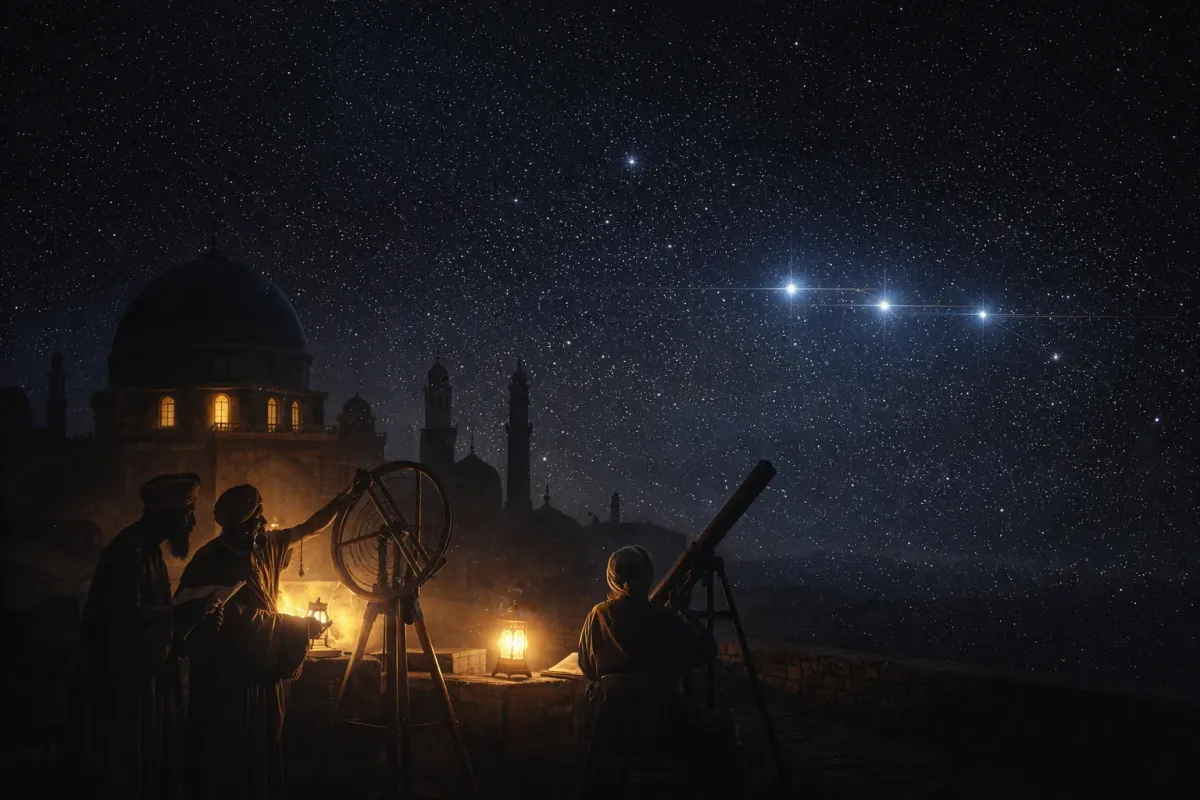 Days 1-3: The Examination of Alignment. Does what you built hold up when you test it from the edges?
These first three days ask one thing. Is your legacy aligned with truth? With what it actually does, measured against reality, more than with your hopes for it.
The Baghdad astronomers did not begin by assuming Ptolemy was wrong. They began by observing the sky, measuring positions and recording data. Then they compared.
Begin by observing. What does your legacy actually produce? What happens when you step back and measure, whatever you planned or hoped?
Then compare. Observed outcomes against intended ones, what you built against what you said you were building, what others experience against what you believe you are providing.
The discrepancies are data. They are the Mumtahan, the Tested Tables, the places where reality diverges from assumption.
On the first night, find Mintaka at the western edge of Orion’s Belt. It is the faintest of the three Belt stars. Notice that it sits slightly offset from the line of the other two. Notice that despite being faintest and slightly offset, the Belt still reads as a coherent pattern. The imperfection does not invalidate the structure.
Phase 2: The Correction of Alignment (Days 4-7 | Feb 26 - Mar 1)
Now correct what needs correcting.
 Days 4-7: The Correction of Alignment. Not destroying what you built. Aligning it with observed reality.
The House of Wisdom scholars did not burn the Almagest. They corrected it. They produced the Zij al-Mumtahan, the Tested Tables, which preserved Ptolemy’s framework while correcting specific errors. The solar apogee was not fixed. The precession rate needed updating. Specific star positions required recalculation.
Your correction work can be as precise. Not “start over.” Find the specific points of misalignment and correct them. The framework may be sound even if details are wrong.
Where does your legacy say something that observation contradicts? Where does it assume something that testing shows false? Where has it drifted through neglect or wishful thinking?
Each correction brings the system closer to the celestial equator, the truth that holds from every vantage point. Each one is uncomfortable, because it means admitting that what you built contained errors. The Baghdad astronomers had to admit that Ptolemy, the greatest astronomer in history, had gotten things wrong. That admission was the price of alignment.
Are you willing to pay that price?
Phase 3: The Boundary Defined (Days 8-10 | Mar 2-4)
The final three days ask what lies beyond the edge.
Mintaka marks where the Belt meets sky. Beyond Mintaka, the Belt pattern dissolves. The three-star asterism requires exactly three stars. Add a fourth and it becomes something else. Remove Mintaka and it becomes two disconnected points.
The edge defines the pattern as much as the center does.
Your legacy needs boundaries. Not everything you do is part of it, and not every project or commitment belongs inside the Belt. Some things sit beyond the boundary, in the open sky. Knowing what lies outside your pattern matters as much as building what lies inside.
During these final days, define what your legacy is NOT. What lies beyond the Belt? What have you been including that does not belong? What have you been building that is not aligned, that weakens the pattern rather than strengthening it?
The Belt is three stars. The boundary matters.
On the last night of this decan, observe Mintaka knowing you have completed a truth-testing cycle. Your legacy has been examined, corrected and bounded. What remains is what is real. What was removed was not, however much you wished it were.
Now comes what truth enables, completion and rebirth.
Daily Tracking
Each night of this decan, spend a few minutes with your journal. Note what you tested against truth. Note what aligned and what did not. Watch Mintaka when the sky permits, the faintest Belt star at the western edge, and sit with its question. Is what I built today aligned with reality? Or aligned with my comfortable assumptions about reality?
Track the corrections more than the confirmations, what you found misaligned, the boundary you defined.
Finding Mintaka: The Western Edge of Orion’s Belt
After sunset in late February, face south around 8-10 PM. Orion is well-placed in the sky.
Find the Belt, three stars in a row. The rightmost star (from the Northern Hemisphere) is Mintaka. It is the faintest of the three at magnitude 2.25, compared to Alnilam (1.69) and Alnitak (1.74). Notice the slight offset.
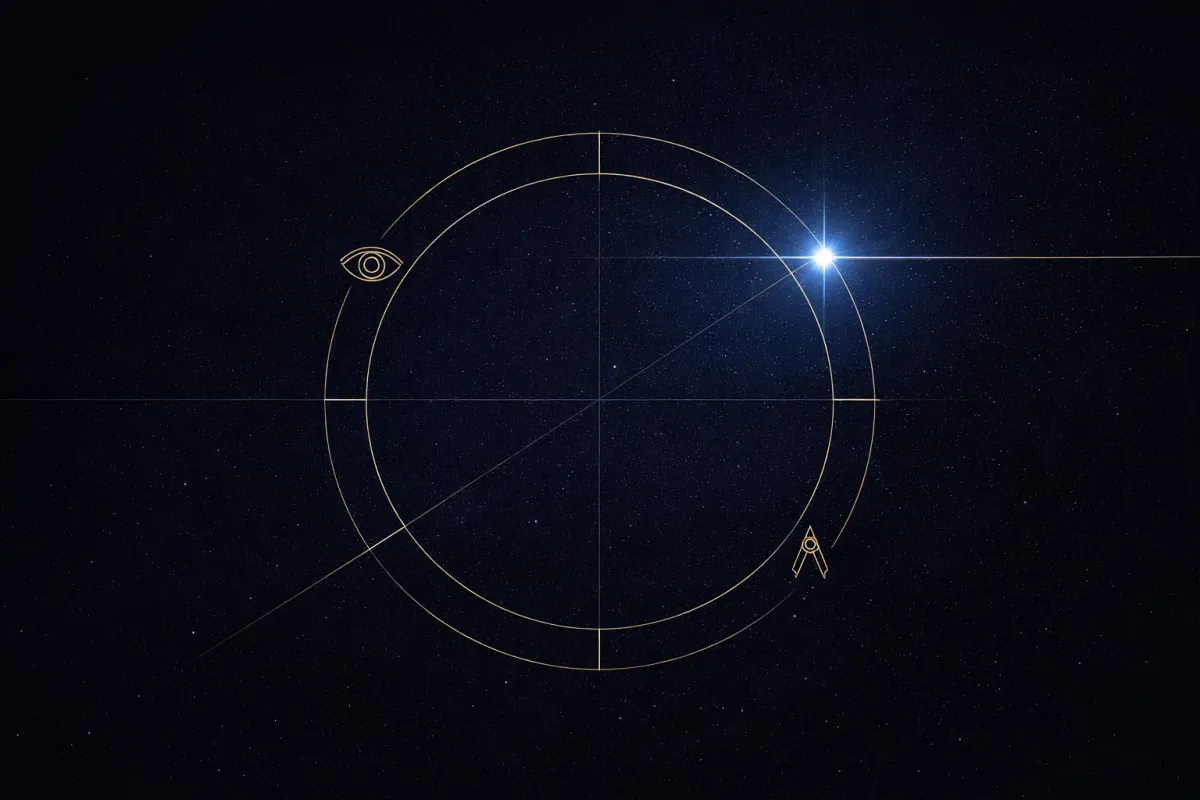 Find Orion’s Belt. The rightmost (westernmost) star, the faintest of three, slightly offset from the line, is Mintaka. The edge. The boundary. Sitting on the celestial equator, rising due east, setting due west.
Because Mintaka sits on the celestial equator, it rises almost exactly due east. If you observe early enough in the evening to watch it rise, you are seeing true east marked in starlight. No compass, no calculation. The geometry of the cosmos, made visible.
Spend a few minutes with Mintaka each night. Feel the distance, approximately 1,200 light-years, meaning you see light from around 825 CE. The photons entering your eye tonight left when al-Khwarizmi was at the House of Wisdom and the Tested Tables were being compiled, when even the greatest authorities were being checked against observation.
Contemplate what you are testing against reality. Contemplate the edge where your legacy meets the void.
End-of-Decan Review
On March 4, ask yourself:
About Alignment: Is my legacy aligned with truth, with observed reality rather than my hopes? Where did I find discrepancies? What corrections did I make?
About Truth-Testing: Did I have the courage to test what I built? Did I look at the data as it was? Where was I tempted to ignore evidence that contradicted my assumptions?
About Boundaries: Have I defined the edge of my legacy? Do I know what lies inside the Belt and what lies outside? What did I remove or exclude because it did not belong?
About the Eclipse: Did my truth-testing temporarily dim what I built? Did the brightness return, with deeper understanding? What did the eclipse reveal about the structure of what I had created?
About Observation: How many nights did I observe Mintaka? What did the faintest Belt star at the western edge evoke? What did 1,200-year contemplation reveal about my relationship with truth?
Looking Ahead to Sothis: My legacy has been built (Alnilam) and tested (Mintaka). What cycle is now complete? What is ready to be reborn?
Preparing for Sothis (Sirius)
On March 5, Decan 36 begins. Sothis, the Egyptian name for Sirius, Alpha Canis Majoris, the brightest star in the entire night sky, rises with the theme “Completion & Rebirth.”
The photons you will observe from Sirius left in approximately 2017, just eight years ago. Within your living memory. After months of observing light from centuries and millennia past, the final decan brings you face to face with recent light. Light from the year of the total solar eclipse that crossed America, the year the #MeToo movement emerged, the year the Cassini spacecraft made its final plunge into Saturn. Light from a world you remember.
Sirius was the most important star in ancient Egyptian civilization. Its heliacal rising, the first appearance at dawn after being hidden behind the Sun, marked the Egyptian New Year and predicted the annual Nile flood that renewed Egyptian agriculture. Sothis was the star of completion and rebirth, the cosmic signal that one cycle had ended and another was beginning.
This is the final decan of the 36-decan year. Everything you have built, mastered, strategized, tested, and aligned since Decan 1 reaches its culmination. The full Orion arc completes: creation (Betelgeuse), mastery (Rigel), strategy (Bellatrix), legacy (Alnilam), truth (Mintaka). Now, transformation.
Carry forward from Mintaka:
- Alignment with tested truth, not inherited assumption
- The edge-awareness that defines boundaries
- The corrected legacy, trimmed of what did not belong
- The full Belt journey: center (Alnilam) to edge (Mintaka)
Leave behind:
- Testing without transformation (Mintaka tested; Sothis changes)
- The Orion identity itself (you have been the Hunter for five decans; now become something new)
- Distant light (from millennia to years, from ancient history to living memory)
- The blue-white intensity of the Belt (Sirius is white, cooler, brilliant through proximity rather than intrinsic fury)
Watch Mintaka at the Belt’s edge and Sirius below Orion in Canis Major, unmistakably the brightest star in the sky. The dog follows the hunter. After testing comes transformation.
The Stellar Physics of Alignment & Truth
Mintaka is the hottest star in your Orion Belt sequence at 29,500 K, hotter even than Alnilam at 27,000 K. The edge burns more intensely than the center.
In stellar physics the O-type classification is the extreme, the hottest and rarest stars. Only one in ten million stars in the Milky Way is O-type. Mintaka’s primary is one of them. When you observe Mintaka, you are seeing one of the rarest stellar events visible to the unaided eye, a class of star so intense that it burns through its fuel in millions of years rather than billions.
Like Alnilam, Mintaka drives a powerful stellar wind, blasting material from its surface at hundreds of kilometers per second. The mass-loss rate for O-type stars is ferocious, orders of magnitude beyond what the Sun produces. That is the cost of burning at truth-testing temperatures. The star that burns hottest loses itself fastest. The O-type classification that makes Mintaka the rarest thing you can see with naked eyes is the same classification that ensures it will exhaust itself in a few million years.
Truth at this intensity cannot be held for long. It has to be acted on while the window is open.
The sextuple system, with its nested orbits and eclipsing binary, demonstrates that complexity can appear simple from a distance. Six stars look like one. The truth of the system only shows under close examination, through spectroscopy and timing studies, the patient work of observation that began in earnest at the House of Wisdom twelve centuries ago.
Further Reading
For Understanding Mintaka:
- Stars and Their Spectra by James B. Kaler (Cambridge) - Chapter on O-type stars
- NASA Chandra Blog: “More Than Meets the Eye: Delta Orionis in Orion’s Belt”
- Jim Kaler’s stellar profile on Mintaka (University of Illinois)
For Alignment and Truth:
- The Structure of Scientific Revolutions by Thomas Kuhn - How paradigms shift through truth-testing
- The Book of Optics by Ibn al-Haytham - The Islamic Golden Age approach to empirical testing
- Thinking, Fast and Slow by Daniel Kahneman - Cognitive biases that prevent alignment with truth
For the 825 CE Context:
- The House of Wisdom by Jim al-Khalili - Baghdad’s intellectual revolution
- Lost Enlightenment by S. Frederick Starr - Central Asian contributions to the Golden Age
- Pathfinders by Jim al-Khalili - The Islamic world’s scientific legacy
Navigation
Previous Chapter: Alnilam: Decan 34 - Continuity & Legacy
Next Chapter: Sothis: Decan 36 - Completion & Rebirth