Hansuru
An operating system for uncertainty. Go against the consensus, size in tiers, survive first.
Hansuru is not a strategy. It is an operating system for thinking about uncertainty, risk, and opportunity. The name is a refusal built into a word. In Japanese, han (反) is the character of opposition, the root of hantai (to oppose), hankō (to resist), and hangyaku (to rebel), and suru (to do) turns it into an act: to go against. I chose it on purpose. Hansuru means going against the consensus deliberately, because the consensus is exactly where uncertainty does its most expensive damage. The name is 反 first. A quieter second layer rides on the same sound: han (半) can also mean half, a reminder that the system never commits everything to one outcome.
I built it first for markets, around my entire portfolio, because markets punish the wrong relationship with uncertainty faster than anything else will. The core engine is unglamorous: iron condors and defined-risk options that harvest volatility while the world stays inside a range, wrapped in hedges that pay when it does not. I put survival first because on my own account this engine has not yet net made money. So far it has proven that it survives, not that it pays. But the longer I ran it, the more obvious it became that the logic was never really about options. It was a way of standing toward any system you cannot predict. So I extended it, to the body, to time, to conduct. That instinct to carry one structure across domains is old for me. I studied the comparative history of ideas, where the whole method is to watch a single pattern surface in physics and in poetry and in politics and treat the resemblance as information. Hansuru is iron condor logic let loose on everything else.
The core move is a refusal. Most people meet uncertainty by trying to predict it, and prediction breeds the overconfidence that gets you ruined. Hansuru does the opposite. You prepare for ranges, not forecasts. You survive first and profit second. You build structures that work across the full distribution of futures instead of betting on one of them.
The Inner Code: four axioms
Underneath the structure is a philosophy, four axioms that hold regardless of strategy, instrument, or market regime. They are also, quietly, a contrarian creed.
- Predictive humility. The future cannot be forecast accurately enough to build anything fragile on top of it. So you stop asking "will it go up or down" and start asking "what survives both." Prepare for ranges, not predictions.
- Robustness before optimization. An overoptimized system is a fragile one wearing the costume of an efficient one. It looks lean on the spreadsheet and shatters the first time reality serves it something the spreadsheet did not anticipate. Redundancy is not waste; it is purchased survival.
- Optionality over certainty. Freedom of movement beats correctness of opinion. You would rather hold choices at every node than be right about one path, because being right about one path is worthless if you cannot survive the others.
- Barbell thinking. Extreme safety on one end, extreme convexity on the other, and nothing in the fragile middle. The middle carries real downside with none of the asymmetric upside that would justify it.
The contrarian part is the consequence, not the goal. When you are built this way you are calm while the crowd panics, and positioned to buy what they are dumping, because the volatility that ruins an optimized, all-in, consensus position is the exact thing your structure was built to feed on. You are not braver than the crowd. You are differently arranged.
The four tiers
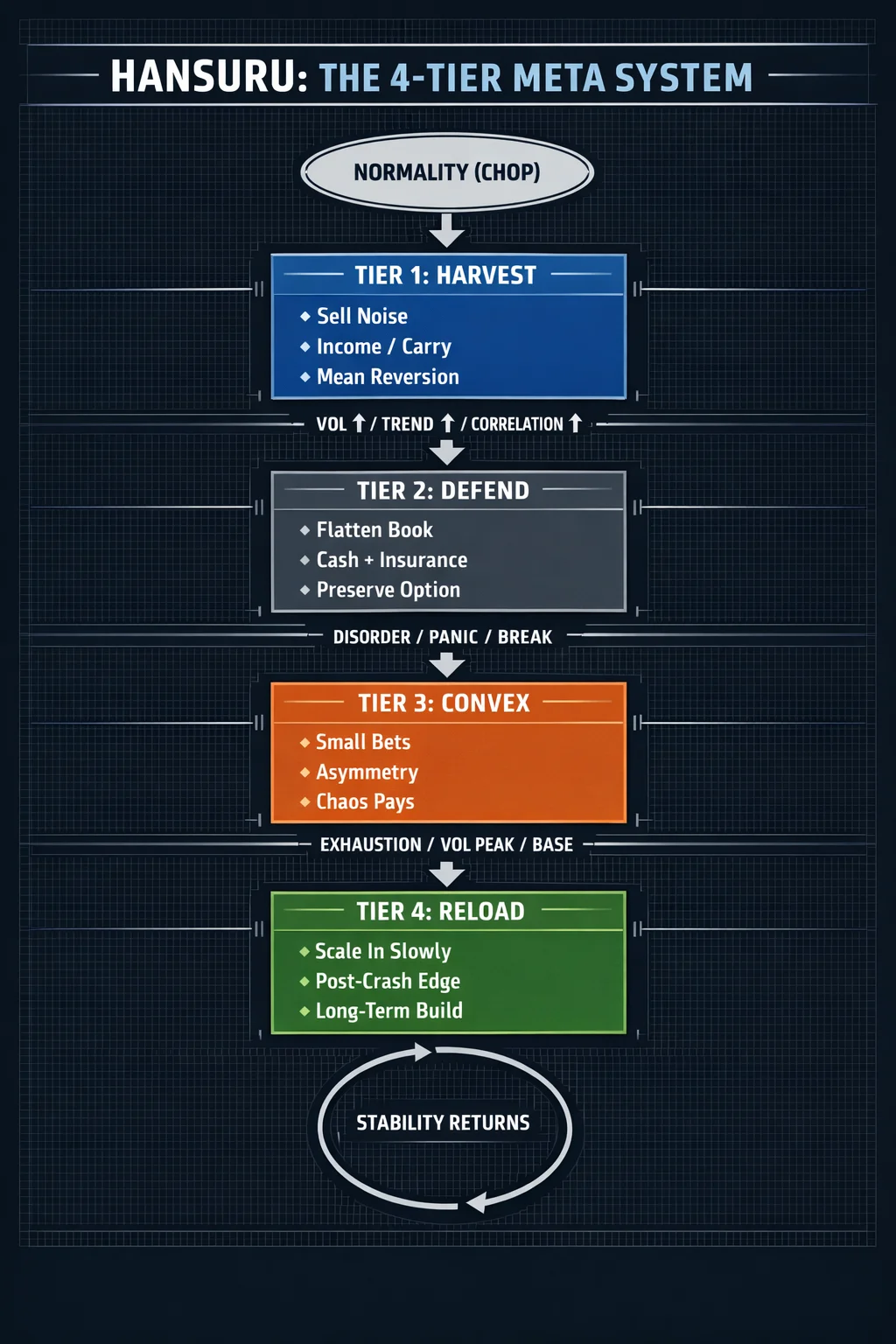
Below everything sits the Foundation: the conservative, liquid majority of the portfolio whose only job is to keep you solvent through any condition and give you the time to wait. The working capital above it is split into four tiers, each capped so that no single idea can sink the whole.
- Tier 1, Harvest. Iron condors and defined-risk credit spreads that harvest volatility, collecting premium while the market stays inside a range. The boring compounding core, and the part that runs most of the time.
- Tier 2, Defend. The protection ladder: deep out-of-the-money index puts for the true tail, a piece that pays when volatility spikes, and a nearer hedge against an ordinary drawdown. Bought in the calm while it is cheap, it costs a little most of the time and is built to pay on the day the crowd is bleeding. The tail insurance lives here.
- Tier 3, Convex. Debit spreads and butterflies, with a little long volatility, traded bets that sit closer to the money than the insurance does. The most you can lose is what you paid, and the payoff accelerates when the move comes. Usually switched off, turned on only when convexity is cheap or the regime calls for it.
- Tier 4, Reload. Cash and short-term Treasuries held dry, scaled in slowly only during genuine panic, to buy what everyone else is being forced to dump. The contrarian move, made mechanical.
The allocations are not fixed. The system reads the market regime, from calm to extreme panic, off volatility itself, and shifts the tiers accordingly: protection is bought in the calm and never chased into the spike, income gets smaller and wider as it heats up, and Reload deploys only as it breaks. The structure is the strategy. The numbers move; the discipline does not. That is antifragility made concrete: built so the rare violent move is survivable, and the book is still standing to work when it passes.
From markets to the body
The same operating system reads the body. A body is also a high-stakes system you cannot predict, also mostly relationships rather than single numbers, and also ruined by anyone who reduces it to one metric and optimizes it. Survival first. Bounded risk. Convex bets where a small, reversible action can produce a large, lasting gain. Partial action over heroic overcommitment. Hansuru is the self treated as a system worth keeping solvent, in capital and in health, with the same discipline applied to both.
The book
There is a book now, The Little Black Book of Hansuru, a black pocket manual built to be a field guide for this kind of thinking, available in Kindle and paperback. It separates what lasts from what does not: principles are permanent, strategies are temporary. Most traders tie their identity to a strategy and suffer when it stops working. Hansuru lives one level up, at the principles and framework layer, so the strategies can come and go without an existential crisis. Strategies are temporary. Principles are permanent.
I wrote about why the book is black, pocket-sized, and deliberately short, and what it is for.
Where it sits
Hansuru is Coherent Complexity applied to uncertainty and the self. The umbrella idea is that complex systems should be made legible rather than simple, and few systems are more complex, or more punishing when illegible, than your own capital and your own body. Hansuru shares its DNA with the other applications, which is no accident: People of the Stars maps the same positioning-over-prediction thinking onto time, and Situational Governance borrows its tier structure to govern conduct across the arenas of a life.