The Little Black Book of Hansuru
A book I wrote about selling options for income, built on one law: survive first. It shows a record most books would hide, and that is the reason it exists. Out now in Kindle and paperback.
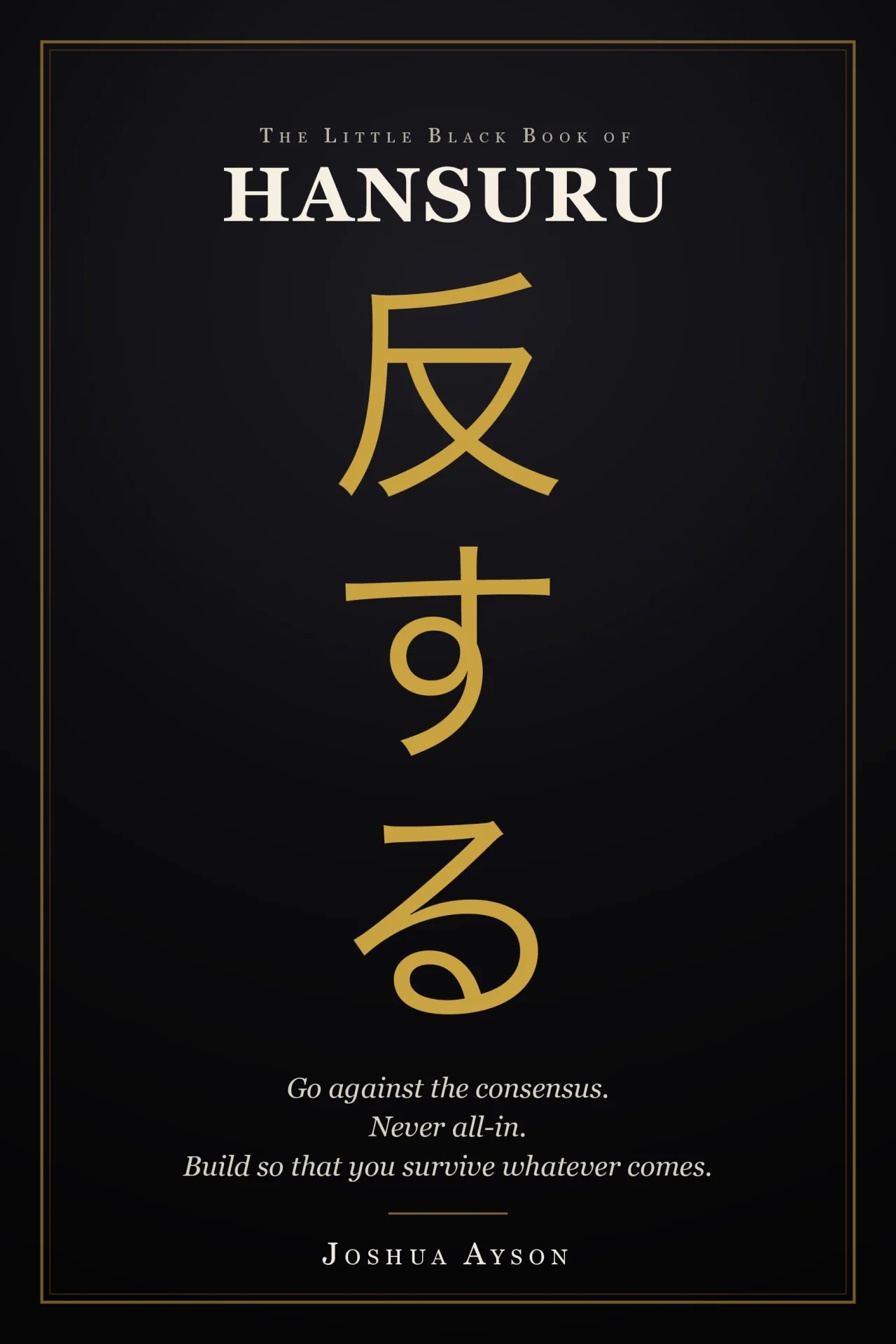
I wrote a book about money, which is not a thing I ever expected to do, because for most of my life money was the one subject I kept at arm's length. I knew my numbers cold. Income, expenses, every account and what was in each one. Past that I had buy and hold and a tidy-up once in a while, and no map at all.
Last October I read Taleb's Antifragile, and because I work in finance I could not read it as just a book. It was describing the ground I stand on all day. I came out of it wanting a hard domain to point my mapping at, and options was the one I chose. I loved the corner I walked into. Not the lottery-ticket side everyone talks about, the buying. The slow institutional side, the selling, where you collect a small steady payment for carrying someone else's risk and most days nothing happens and you keep it. It fit around the rest of a life. It did not ask me to watch a screen all day.
I did not find this corner alone. A friend, Michael Cecere, pushed me down the road that led here, first into agent-mode coding, then toward pointing it at markets, crypto before options. The book carries his name in the dedication for it.
The name is 反する. Said out loud, it is hansuru. It means to go against. There is a second meaning riding the same sound, half, never all in. So the whole name is one instruction. Go against the crowd, and never bet everything. That is the book in two characters.
The first move I ever made was the hedge. Before I sold a single option for income I bought protection for the day the bottom falls out, because that day was the one I actually feared. I have been through the bad stretches, more than a few, and every time all I could do was watch it happen and wait for it to pass. Something changed when the protection was on. A crash stopped being only a thing that happens to me. It became a time to act, another position, a part of the plan. When the market is up I have a move, when it chops along I have a move, and when the bottom falls out, for the first time in my life, I have a move there too. That is the feeling that started all of this.
As I write this, the working layer of the system has not yet net made money.
The income collected steadily for six calm months, and then one volatile month took it back and more. That is the exact failure mode the book spends chapters warning about, and I lived straight into it, on my own account, with my own money. That month I won two trades out of fourteen. I could have waited until the ledger turned green and written the book from the far side of a win. Most people do. But a record with no losing stretch is a sales page, and I did not want to write a sales page. I wanted to write the true thing.
The structure held. The Foundation, the boring safe majority I never touch, never flinched. Zero never got close. The account kept trading the next month. What the system has proven so far is that it survives. What it has not yet proven, on my own account, is that it pays. I am telling you that on purpose, because the reasons I still run it are the actual argument of the book.
I did not set out to write about trading. I set out to build a system and map a hard domain until it made sense, which is what I actually do, lately with AI in agent mode, the same build-and-map practice I run on a production system at work. I wrote everything down the whole way. Every trade, every reason, the feeling underneath the reason, what the news was doing and what the account held after taxes. The book grew out of the writing. The constant was never the strategy. It was the loop. Build, watch what happens, map it, adjust, watch again.
I am not telling anyone to trade options. I would not advise anyone into it. A small slip can cost real money and a real mistake can be devastating, and I mean that the plain way. Careful is not a nice-to-have here. Careful is the rule. The book is education and research, not advice. I share my own method and my own bruises (one of the bruises got its own post-mortem), and what you do with your money is yours.
If you have never traded an option in your life, the appendices build the instrument up from nothing, from a butcher's counter, with a first move sized so it cannot hurt you. If you already sell premium, the frame is the part I think is worth your time. The four jobs a book of trades has to do. The five regimes. Sizing that keeps a bad day from being the end. The hedge that bleeds all year on purpose and is supposed to.
This one is close to me. It came out of a real year, with real losses in it, and it says so on the first page. The bruises are the part I trust most.
The Little Black Book of Hansuru is out now, on Kindle and in paperback. There is more at hansuru.com, including my ongoing trade journal, kept in percentages.
反する.
This post contains affiliate links. If you purchase through these links, I may earn a small commission at no extra cost to you. Thank you for supporting this blog.