What Is Decanal Journaling? The 36-Star Calendar and the Practice
Decanal journaling runs the year in ten-day cycles, each named for a bright star, after the ancient Egyptian decans. Why ten days, what a cycle looks like on the page, and a table of all 36 stars.
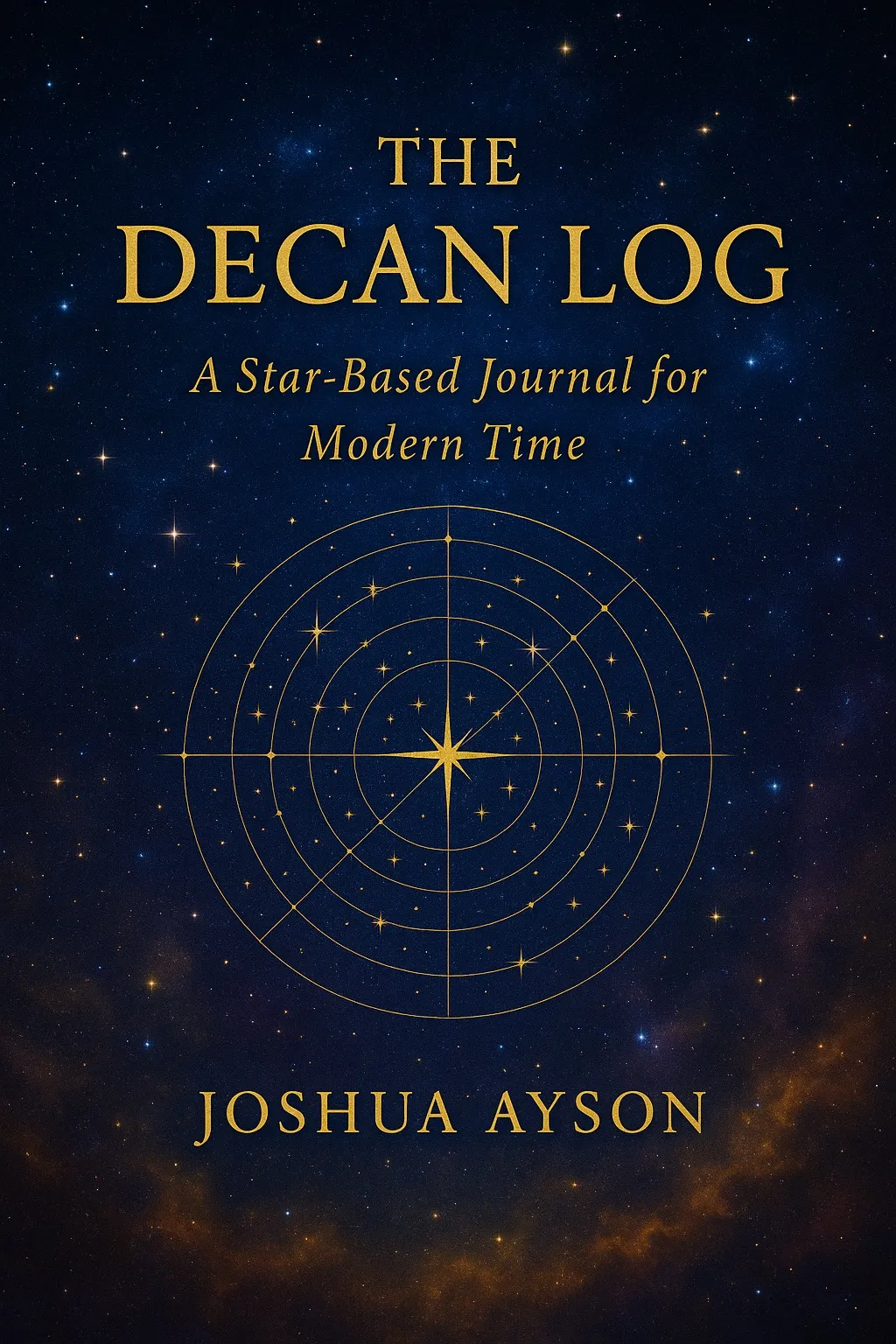
A decanal journal is a journal organized in 10-day cycles instead of 7-day weeks. Each cycle is anchored to a bright fixed star. There are 36 of them, plus five days outside the count, and together they cover the year.
The practice didn't start with me. It started in ancient Egypt, more than four thousand years ago, when priests divided the night sky into 36 strips and used the heliacal risings of bright stars to mark time. The stars were the clock. The clock was the calendar. The calendar was how you knew where you stood in the year.
I'm using the same skeleton, modernized. The book that documents it is The Decan Log. This page is the short version, written for someone who arrived here from a search and wants to know what "decanal journaling" means before deciding whether to keep reading.
The thirty-six stars
The year breaks cleanly into 36 ten-day cycles. Each cycle is named after a star you can actually observe in the sky. Hamal, the lead star of Aries, opens the year at the spring equinox, the way Aries does in the traditional zodiac. Sothis, the dog star, closes it.
The whole year, star by star. Each star links to its chapter in the book, and the last column links to the journal entry I wrote while living that decan.
| Decan | Star | Dates | Theme | Journal entry |
|---|---|---|---|---|
| 1 | Hamal | Mar 20-29 | Vital Spark and Rebirth | read |
| 2 | Aldebaran | Mar 30 to Apr 8 | Foundation and Endurance | read |
| 3 | Elnath | Apr 9-18 | Expansion and Boldness | read |
| 4 | Menkalinan | Apr 19-28 | Guidance and Structure | read |
| 5 | Capella | Apr 29 to May 8 | Protection and Renewal | read |
| 6 | Alhena | May 9-18 | Communication and Intellect | read |
| 7 | Pollux | May 19-28 | Duality and Relationship | read |
| 8 | Procyon | May 29 to Jun 7 | Loyalty and Courage | read |
| 9 | Sirius | Jun 8-17 | Power and Clarity | read |
| 10 | Canopus | Jun 18-27 | Navigation and Purpose | read |
| 11 | Regulus | Jun 28 to Jul 7 | Sovereignty and Heart | read |
| 12 | Denebola | Jul 8-17 | Reform and Intuition | read |
| 13 | Spica | Jul 18-27 | Artistry and Perfection | read |
| 14 | Arcturus | Jul 28 to Aug 6 | Wisdom and Guidance | read |
| 15 | Zubeneschamali | Aug 7-16 | Balance and Justice | not yet |
| 16 | Antares | Aug 17-26 | Transformation and Willpower | not yet |
| 17 | Shaula | Aug 27 to Sep 5 | Secrets and Depth | not yet |
| 18 | Nunki | Sep 6-15 | Knowledge and Direction | not yet |
| 19 | Altair | Sep 16-25 | Vision and Speed | not yet |
| 20 | Deneb | Sep 26 to Oct 5 | Creativity and Transcendence | not yet |
| 21 | Vega | Oct 6-15 | Harmony and Beauty | read |
| 22 | Fomalhaut | Oct 16-25 | Clarity and Renewal | read |
| 23 | Scheat | Oct 26 to Nov 4 | Innovation and Risk | read |
| 24 | Markab | Nov 5-14 | Foundation and Legacy | read |
| 25 | Enif | Nov 15-24 | Aspiration and Vision | read |
| 26 | Alpheratz | Nov 25 to Dec 4 | Liberation and Empathy | read |
| 27 | Mirach | Dec 5-14 | Reflection and Compassion | read |
| 28 | Algol | Dec 15-24 | Renewal through Challenge | read |
| 29 | Alderamin | Dec 25 to Jan 3 | Leadership Through Authority | read |
| 30 | Polaris | Jan 4-13 | True North | read |
| 31 | Betelgeuse | Jan 14-23 | Power and Creation | read |
| 32 | Rigel | Jan 24 to Feb 2 | Manifestation and Mastery | read |
| 33 | Bellatrix | Feb 3-12 | Will and Strategy | read |
| 34 | Alnilam | Feb 13-22 | Continuity and Legacy | read |
| 35 | Mintaka | Feb 23 to Mar 4 | Alignment and Truth | read |
| 36 | Sothis | Mar 5-14 | Completion and Rebirth | read |
| Epagomenal days | Mar 15-19 | Outside the count | read |
Dates are for a common year.
After Decan 36 come the five epagomenal days, the days that "fall outside the count." Egyptians treated them as outside-the-system time, neither part of the year that ended nor the one beginning. The book has its own chapter on them.
Thirty-six tens plus five gives 365. The arithmetic is older than every other calendar still in use.
Why ten days instead of seven
The seven-day week isn't aligned with anything physical. It comes from Babylonian astronomy assigning planets to days, and the pattern stuck because it was practical for trade. Useful, but arbitrary. Seven days isn't long enough for a theme to develop, integrate, and clear. By the time you've settled into a rhythm, the weekend resets it.
Ten days behaves differently. A decan has room for a beginning, a middle, and an end. You can run a small project across one. You can read most of a book inside one. You can let a question sit, work, and resolve.
The three-phase rhythm I use inside each decan is:
- Initiate (days 1–3): set the question, the project, the focus.
- Flow (days 4–7): do the work without re-litigating the choice.
- Reflect (days 8–10): write what happened, decide what carries.
It maps cleanly onto how attention actually moves. The work week / weekend split doesn't.
Why anchor to stars
You could divide the year into 10-day blocks and not name them after anything. That works as a schedule. It doesn't work as a frame.
Each star carries a real astronomical fact: a temperature, a distance in light-years, a stellar type, a position in a constellation. Denebola's photons left in 1989. Alpheratz is 97 light-years away. Hamal is an orange giant on the helium-burning side of its life. Those aren't metaphors. They're context. They give a decan a physical weight that a numbered calendar slot doesn't have.
The star also gives the decan a name you can remember. "Decan 11, Regulus" sticks in a way that "the fourth quarter of the third trimester" does not. The naming convention is part of what makes the practice durable.
This is not astrology. There's no claim that the star influences events on Earth, or that the decan's themes are predictions. The themes are reference frames. Hamal's "clean start" theme exists because Hamal leads Aries, the sign that traditionally opens the year at the spring equinox (precession has since carried the equinox sun into Pisces), not because the photons from a star 66 light-years away have causal power over your decision-making. Big distinction. Pale Blue Dot is the cosmic-perspective frame; this is the calendrical one.
What the practice actually looks like
The journal entry on the first day of a decan opens with:
- The star, its astronomical facts, its archetypal theme
- A question or focus for the ten days
- What the previous decan closed with that's still active
The middle days are normal journaling, but with the awareness that this decan has a shape and a name. The closing day or two:
- What happened
- What carried over
- What gets passed to the next star
You can see the pattern in real entries. Decan 23 Scheat, Decan 24 Markab, Decan 25 Enif. Same shape, different content, in sequence.
After a year of this, you have 36 short essays organized by star, plus the five outside-time days, plus whatever else accumulated in the freewriting pages. The structure does most of the work of remembering for you. Over a full turn of the wheel the entries stop being a diary and start being evidence, a map of the year you actually lived. My own run began mid-cycle, at Alderamin, and came around to Hamal.
What this is not
- Not astrology. No claim that stars cause anything. The stars are reference points.
- Not a productivity system. It doesn't optimize output. It frames attention.
- Not religious. The Egyptian origin is historical, not devotional.
- Not a replacement for the Gregorian calendar. Pay your bills on the calendar everyone else uses. The decanal cycle runs alongside, on top, underneath.
- Not new. It is more than four thousand years old. I'm relearning what was already known.
Where to begin
If you want the full framework, start with The Decan Log, the book. The introduction chapter (Living by the Stars) covers everything above in more depth, including the math, the history, and the practice.
If you'd rather sample first:
- The full journal feed is every decan entry in order. The table above shows which stars have one so far.
- The book's individual star chapters are at
/books/the-decan-log/<star>/. The clearest entry points are Hamal (the year-opening star), Sothis (the year-closing one), and Epagomenal Days (the five outside-time days at the end).
The Decan Log book pairs with People of the Stars, the broader temporal framework. POTS is about using astronomical time as a non-human clock for decision-making; decanal journaling is the daily practice that operates on top of that clock. Both sit under Coherent Complexity: the decan log is where the texture of a given day gets read and recorded instead of theorized.
Continue reading
- What Is People of the Stars?, the framework underneath the practice
- The Decan Log book, the full 36-chapter framework
- Decan 1: Hamal and a Clean Start, the first journal entry
- Epagomenal Days: Five Days Outside Time, the year's closing
- All decan journal entries, the running practice
Related reading: Naming and Nesting, the Decan Log chapter on how the cycle is named.