Decan 33: When the Sword Arm Strikes
Ten days under Bellatrix, the sword arm of Orion: a marathon of output, the family-of-origin domain found under pressure, a threshold crossed quietly, and a costly trade of information for convenience.
Part of The Decan Log: For the cosmology, astronomy, and journaling framework behind this decan, read the Bellatrix chapter. New to decanal journaling? Start with the Introduction.
Opening
Rigel taught me where to plant the foot. These ten days were about what you do once you're planted, which is strike. The question changed from "where do I stand to manifest this?" to "where do I hit, when is the moment, and at what angle?" I got answers, but not the clean way I expected. I got them through a stretch of overwork, one real tactical mistake, and a missing piece of my own system that only showed up because I was too tired to keep it hidden.
If you are new here, a decan is a ten-day reflection cycle tracked through The Decan Log.
The Star and the Signal
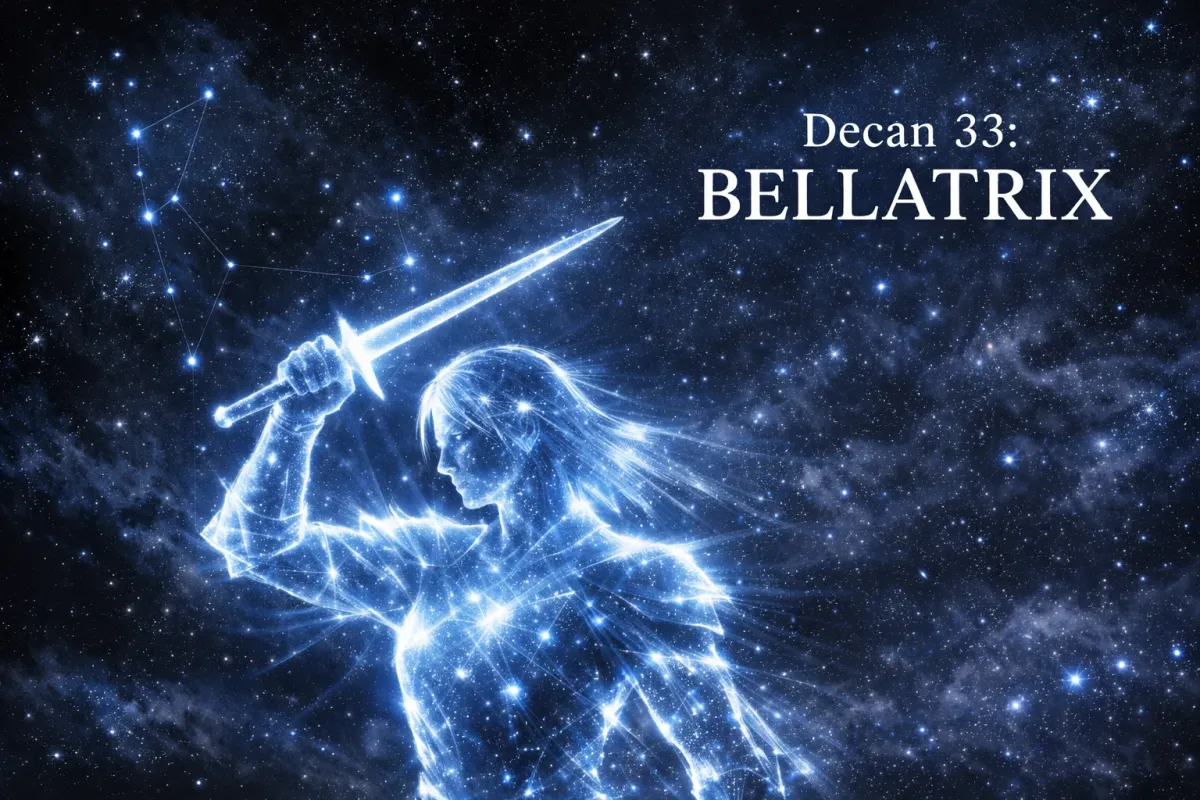
Bellatrix is Gamma Orionis, the third-brightest star in Orion, marking the Hunter's left shoulder. It's a blue-white giant about 250 light-years out, burning near 22,000 Kelvin, almost four times hotter than the Sun and nearly twice as hot as Rigel. It puts out thousands of times the Sun's light.
The number that stops me is the mass. It does that from about eight and a half solar masses. Not the biggest star, not even close. But output per unit of size, it's one of the most impressive things in the sky. Bellatrix doesn't win on size. It wins on concentration. It also spins far faster than the Sun, so it's ready from every angle at once. A few tens of millions of years old, still in its prime.
The Latin name is Bellatrix, the Female Warrior. The Amazon Star. The light reaching me tonight left around 1775, the start of the American Revolution, when outnumbered colonists beat the most powerful empire on earth without ever winning on raw force. They won on positioning, on terrain, on knowing when to retreat. Superior technique over superior firepower. That's the archetype I was carrying for ten days.
In the constellation, Bellatrix isn't the power source. That's Betelgeuse, the right shoulder. Bellatrix is where the power gets applied. The sword arm. The planetary read is Mars and Mercury together, courage married to intelligence, which is exactly the thing I either get right or get badly wrong depending on how tired I am.
The lesson I came in expecting was simple enough to write down: maximum effect comes from intelligent deployment, not from piling up more force. The sword arm doesn't make the power. It aims it. What I didn't expect was how fast the cost of running that hot would show up.
What Is a Decan?
I track consciousness in ten-day cycles aligned with stars, adapted from the ancient Egyptian calendar. Thirty-six decans of ten days make 360, and five days outside time close the year. Each decan has a ruling star, a theme, and three phases: Initiate, Flow, Reflect.
Decan 33 belongs to Bellatrix in Orion and centers on strategic deployment through precision. It ran February 3 to February 12, 2026, and it follows Betelgeuse (the shoulder drawing the bow) and Rigel (the foot planting for the release), with the belt still ahead.
Initiate: Concentrated Force (Days 1-3)

When efficiency demands everything at once
Day one started at 3am, not from insomnia, more like something needed to come out. What followed was a marathon. Three posts finalized with a word-by-word review, design fixes across several pages, four domains redeployed with new messaging, and trading positions managed through a rough market, two of them breaching and needing me to close the threatened leg while keeping the working leg open. Then sauna, then journaling by hand, then a crash at 8:30pm with my brain completely fried. Every piece of it was targeted, leg by leg, page by page. The fast-rotation thing was real, but I was rotating across too many fronts, and the toll was already starting.
Day two was a discipline call. A position had been making me nervous. On paper I could hold it longer for more profit. In practice the nervousness was information. I closed it for a solid gain, about a quarter of the maximum I might have squeezed out, and felt better the second it was off. The tools I'd built backed the read as sound. When a position makes you nervous, that's the data. Better to take some profit than to hold and find out you were right to be scared.
Day three I coded hard enough to hit rate limits on both of my dev environments. There's something oddly validating about the tools themselves telling you to slow down. But it was also a double shift, a full workday and then hours of personal project coding on top, and the toll there multiplies, it doesn't just add. Then a family obligation landed mid-exhaustion, and the call was easy even though it didn't feel good: protect the hours I had left, leave, hold the boundary, feel the guilt anyway. Both at once, no contradiction.
By the end of three days the pattern was clear. Concentration was pulling extraordinary output out of every front. But 22,000 Kelvin costs something, and the cost was stacking up faster than I could recover.
Flow: What Exhaustion Revealed (Days 4-7)

What comfort hid, exhaustion revealed
Day four I expected to bounce back and didn't. Decent sleep, still sluggish, body not recovering on schedule. The debt was deeper than one night could clear: emotional, physical, and decision fatigue all at once, the kind that takes days, not hours. I spent the day just getting through it, in survival mode, and tried not to be ashamed of that. Knowing when not to engage is part of the same skill as knowing when to strike.
Day five was the turn. A message came in from family carrying expectations I couldn't meet, and the answer was no, which I gave with too much guilt wrapped around it, implying a flexibility that isn't there. The real bind underneath: my current family and my family of origin pull in directions that can't both be fully served. That's not a problem you solve. It's a tension you manage.
And right there, in the middle of being overwhelmed, I saw a hole in the governance framework I'd been building. Family of origin was missing as its own domain. It had its own currencies and authorities and guilt structures, and I'd had it buried inside other categories where it stayed invisible. It wasn't missing during the easy stretches. It was just hidden then. The pressure is what made it visible. I wrote three response protocols and set a hierarchy: current family ranks above family of origin, not because origin doesn't matter but because the people who depend on me can't be sacrificed to filial guilt. I named "good enough" as the operating model, regular contact, support when I can, presence at the moments that count, honest about the limits. And I recognized the urge to disappear for what it is, an overwhelm signal, not a character flaw. Seventy minutes in the sauna before I answered anyone. Regulate first, respond second.
Day six I crossed a major life threshold. I marked the morning with ceremony instead of performance, a long sauna, permission to rest and just be present. The strategy was presence over performance, my partner as the focus, small ordinary decisions made together, where to eat, what to look at. Not spectacular and not a crisis. A threshold crossed quietly. What sat with me was the realization that I'm entering the phase where the people who shaped me start needing me back. That's why the missing domain surfaced now. The timing isn't an accident, it's where I am.
Day seven everything ran at once and it worked. Five domains going simultaneously. Professional complexity handled with frame control. A multi-hour stress test with a family member that I got through without breaking regulation, empathy without taking ownership, never matching escalation with escalation. On the trading side I cancelled a pending position and put protective hedges in instead, choosing protection over income when the tools showed it was the better spot. Family upkeep across several fronts, check-ins and cards and small gestures. Publishing kept moving, a chapter went out. And the ordinary baseline held too, bed made, garage cleaned, laundry done. Someone in the family noticed and asked if I was okay, not because something was wrong but because the calm itself was visible. When the person who usually brings the intensity becomes the steady one, people clock it. This was the day the whole thing was supposed to look like: not a sprint, a coordinated deployment, with the infrastructure holding me up instead of draining me.
Reflect: The Error and the Correction (Days 8-10)

Sometimes the lesson shows up as a mistake
Day eight is where the cost of the peak showed itself. I'd made a tactical error the day before and not logged it at the time. I'd traded something that should have stayed with me for the convenience of ending a conversation faster. Maybe fifteen minutes saved. The fallout: it came back around the way these things do, and it cost more than it saved. I also saw, in contrast, a cleaner model in someone else, tight-lipped, ambiguous where it helped, information flowing up only.
Put it in trading terms, which is how I actually understood it: I sold an option in an environment that rewards owning them. Fifteen minutes was the whole upside, capped. The political exposure was the downside, open-ended. A concave bet where the edge was convex. The correction was immediate and clear. Treat information as currency, never spend it on convenience, keep it flowing vertically, hold the silos. There was also a strange convergence that day. A separate temporal-intelligence system I'd been building flagged the same star as the dominant driver for this exact date. Two systems I'd built independently pointing at the same lesson on the same day. The read: what has to die is sharing laterally by default, what's being born is vertical discipline. The peak on day seven and the failure on day eight sat one day apart. At this rotation speed any lapse gets amplified, and the real skill isn't avoiding the slip, it's how fast you catch it.
Day nine I was drained from cleaning up day eight's mess, and the old instinct would say rest and retreat. Instead I recovered by building. The production tooling for my trading system came together in a single session, analysis feeding recommendation feeding dashboards, each tool building on the last. Same hours as the draining professional work, completely different energy on the other side. Building gives back what maintenance takes. Reflect doesn't have to mean stillness. Sometimes it just means aiming the same arm at a different target.
Day ten I dialed operations back and ran on automatic, clearing admin ahead of the transition coming up. A message arrived carrying several kinds of pressure at once, and I went through them one at a time, named each one, stripped the guilt, kept the love. Love is fuel, guilt is noise, both real, only one useful. Then I walked into a space carrying a lot of relational history and used the minimum effective force: present as a guest, watching more than performing, nothing to prove. Knowing when to sheathe the sword is its own kind of deployment. The warrior who knows when to stop has something the one still swinging doesn't.

Three of five complete. The sword arm rests. The belt awaits.
Closing
Bellatrix gave me four questions at the start: where do I strike, when is the moment, what's the angle, how fast can I rotate before something breaks. Ten days answered them. Strike where intelligence points, not where urgency screams. The moment is the window recovery opens, not the middle of depletion. The angle is the silo model, vertical flow, ambiguity where it helps, optionality kept open. And the rotation answer is the one I learned the hard way: five domains for a single day is possible, but day eight's sloppiness was the speed warning, and sustainable deployment needs recovery built in between the peaks.
The star didn't cause any of it. But measuring these ten days by a warrior's concentrated heat instead of by calendar urgency changed how the whole thing looked. Concentration pulls extraordinary output but the ledger is real. Systems show their gaps under pressure, not in comfort. Peak and failure can live a single rotation apart. Creation restores what maintenance drains. Information is currency and convenience is a bad rate for it. And strategic shutdown outranks sustained performance. The bow was drawn at Betelgeuse, the foot planted at Rigel, the sword arm struck here. Next the belt aligns at Alnilam.
Decan Navigation
Previous: Decan 32: When the Foot Plants for the Release.
Next: Decan 34: The Center Pearl That Holds.