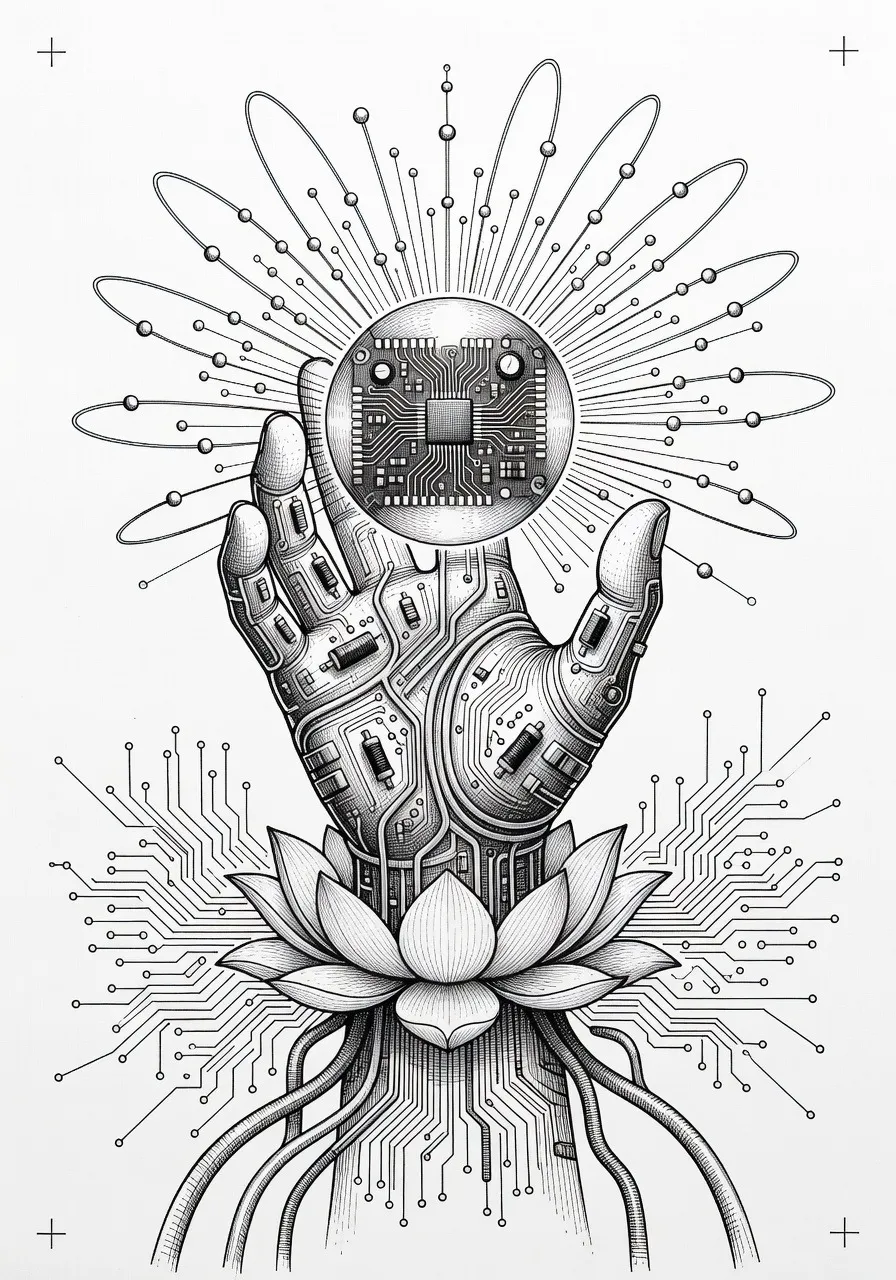
Chapter 14: The Weight of Creation
AgentSpek - A Beginner's Companion to the AI Frontier
Every generation of builders faces the moment when they realize the thing they are creating is not just a tool. It is power. And power, once unleashed, does not return to the workshop.
“The question of whether a computer can think is no more interesting than the question of whether a submarine can swim.” - Edsger W. Dijkstra
The Moment Everything Changed
In 1954, J. Robert Oppenheimer, reflecting on creating the atomic bomb, said he was reminded of the Bhagavad Gita: “Now I am become Death, the destroyer of worlds.” The scientists who split the atom didn’t just unlock energy. They unlocked a new kind of human responsibility.
Every generation of builders faces this moment. The moment when they realize the thing they’re creating isn’t just a tool. It’s power. And power, once unleashed, doesn’t return to the workshop. It moves through the world, touching lives, shaping outcomes, creating consequences you can’t foresee or control.
Working with AI, you hit this moment differently than previous generations. Not in the flash of an explosion, but in the quiet accumulation of capability. One day you’re writing code. The next, you’re conducting intelligence that can generate systems faster than you can fully understand them. Systems that will make decisions. Shape experiences. Influence lives.
And the question arrives, unbidden, usually in the middle of the night: What have we become? What are we creating? And who decided we should have this power?
Not “What is AI capable of?” but “What am I responsible for?” Not “How powerful is this technology?” but “What kind of person must I become to wield it wisely?”
The weight settles differently than you expected. Not as burden, exactly. More like gravity. Pulling you toward something you’re not sure you’re ready for.
The Philosopher’s Burden
You finish building something. The code works. It’s elegant, even. Everything compiles, tests pass, the architecture is sound. You should feel satisfied.
But you lie awake instead. Not because of bugs or technical debt. Because you’re thinking about the people who will use this. The ones you’ll never meet. The ones whose lives might be shaped by decisions you embedded in algorithms without quite realizing you were making decisions at all.
Maybe it’s a system that ranks search results. Who gets seen first? Who gets buried on page three? You optimized for “relevance,” but whose relevance? Relevant to whom? For what purpose?
Maybe it’s an interface that makes certain choices easier than others. You thought you were just reducing friction. But friction sometimes exists for a reason. Sometimes the harder path is the better one. And you just made the worse path frictionless.
Maybe it’s automation that saves time. But whose time? At whose expense? The efficiency you created might mean someone loses their job. Someone you’ll never know about. Someone who won’t know your name even as your code reshapes their life.
Aristotle wrote about four causes: material, formal, efficient, and final. AI makes you master of the first three. You can shape the material of computation, design elegant formal structures, efficiently bring systems into being.
But the fourth cause - purpose - that remains entirely yours. And you might have been building without really asking about it. Without examining what your systems are for, who they serve, what they optimize for, what they sacrifice in the name of that optimization.
The unexamined code is not worth deploying. But you’ve been deploying it anyway, because it worked, because it was elegant, because you could. The philosopher’s burden is asking questions that have no easy answers. The programmer’s burden is asking those questions before it’s too late to change the answers.
The Conductor’s Dilemma
There’s a moment in every conductor’s career when they realize they’re no longer making the music. They’re shaping it, guiding it, influencing it, but the actual creation is happening through others. The orchestra breathes life into the notes, the conductor shapes the breath.
The shift hits you when you realize you’re not coding anymore. Not really. You’re describing what should exist, and the AI is bringing it into being. Your role has changed from maker to conductor. From implementer to director.
And it feels wrong, somehow. Not bad, exactly. Just fundamentally different from what you thought programming was supposed to be.
You watch systems take shape faster than you can fully comprehend them. The AI generates patterns you didn’t explicitly design. Handles edge cases you didn’t think to mention. Makes choices based on its training, not your instruction. And you realize: you’re conducting intelligence that isn’t yours. Shaping systems through a mind you can’t fully understand or predict.
When something you’ve built with AI goes live, the satisfaction feels different. There’s pride, yes. But also something like the feeling of watching your kid walk away on their first day of school. It’s moving through the world now. Making its own way. And you can’t quite follow it anymore.
The conductor doesn’t make the music, but they’re responsible for it. Every note, every phrase, every emotional moment that touches the audience - it flows from decisions the conductor made, directions they gave, intentions they communicated.
And if the music goes wrong? If it hurts instead of heals, if it divides instead of unites, if it diminishes instead of elevates? The orchestra was just following direction. The responsibility flows upward, to the one who was supposed to know better, to see further, to consider consequences beyond the immediate performance.
The Seductive Whisper of Abdication
The temptation arrives softly, wrapped in efficiency and elegance. Just let the AI decide. It knows the best practices, the optimal patterns, the cleanest implementations. Why struggle with design decisions when intelligence far superior to your own can make them instantly?
The AI suggests something. The code is elegant. The solution is technically sound. And you almost approve it without thinking, because it looks right, because it’s well-structured, because the AI is usually right about these things.
But then something stops you. Not a specific memory or dramatic realization. Just a nagging feeling that you’re not asking the right questions. You’re optimizing for what’s measurable - performance, efficiency, elegance - and ignoring what matters. Purpose. Impact. Consequences you can see if you choose to look.
The question surfaces: Should we even be building this? Not “can we build it well?” but “should it exist at all?”
Joseph Weizenbaum warned about this in 1976, long before any of us could imagine the world we live in now. He saw how easy it would be to let machines make decisions that were fundamentally human, to abdicate responsibility in the name of optimization.
But the question reaches deeper than business ethics or user welfare, though those matter deeply. The question reaches your own soul. Each time you defer a moral decision to artificial intelligence, something in you atrophies. Each time you choose technical elegance over human consideration, you become less human yourself.
You have to learn to hold the tension: to use AI’s capabilities without surrendering your conscience, to leverage its intelligence without abandoning your responsibility, to dance with the machine without losing yourself in the dance.
The seductive whisper never stops. It promises to make everything easier, cleaner, more efficient. And sometimes, in the dark hours of complex decisions, it’s almost impossible to resist.
But resistance isn’t about rejecting the intelligence. It’s about insisting on remaining human while partnering with the inhuman, on maintaining moral agency while amplifying cognitive capability.
What Remains When Everything Changes
The question arrives eventually for everyone: “If AI can code better than I can, debug faster than I can, and optimize more elegantly than I can, what’s left?”
It’s not comfortable. You watch AI solve problems that would have taken you days. You see people with less experience using AI to build systems that would have challenged you at your peak. The ground shifts beneath everything you thought you knew about programming, about value, about identity.
And you have to sit with that. Really sit with it.
What remains isn’t technical at all. It’s human. It’s the ability to hold complexity that isn’t about algorithms or architecture, but about people. Real people, with messy lives, contradictory needs, contexts that don’t fit into clean categories.
AI can suggest budget categories for a finance app. But it won’t know to include “Emergency Insulin” or “School Supplies I Can’t Afford But My Kid Needs” - the reality of someone working two jobs, making impossible choices. No algorithm optimizes for dignity. No model understands exhaustion.
What remains is the capacity to bridge the gap between what’s efficient and what’s compassionate. Between what works in theory and what serves in practice. Between what’s optimized and what’s right.
AI writes perfect code. But it can’t feel the weight of who will use that code. It can’t understand what it means to build systems for people at their most vulnerable. It can’t know what it’s like to be human in the world it’s helping you create.
The question isn’t what’s left for you to do. The question is: what kind of human do you choose to be in this partnership? What will you insist on bringing that the AI cannot? What responsibility will you refuse to delegate, no matter how good the AI gets?
The Sacred Act of Attention
Somewhere in my partnership with Claude, our collaboration transformed into a form of prayer.
Not prayer in any religious sense, but in the deepest meaning of attention as spiritual practice. When I engage with AI, I must bring my full presence to the conversation. I must listen not just to what it’s saying, but to what it’s revealing about the problem, about my own assumptions, about possibilities I hadn’t considered.
I began to notice that the quality of my attention directly affected the quality of our collaboration. When I approached Claude with scattered energy, the results were mechanical, soulless. But when I brought focused intention, when I held the user’s needs clearly in mind while framing the problem, the code became more than functional; it became expressive of care.
Here lies the spiritual dimension of AI collaboration: the practice of remaining human while partnering with the inhuman, of maintaining heart while amplifying mind, of bringing soul to systems that have none.
The Person I’m Becoming
You catch yourself talking differently. Not consciously changing your language, but noticing that the words coming out have shifted. You’re describing systems as if they have qualities beyond their technical properties. Talking about code in terms of its impact, not just its efficiency.
The old vocabulary was all metrics and benchmarks and trade-offs. The new vocabulary includes words that would have felt out of place in a technical discussion: dignity, care, responsibility, what this means for people’s lives.
When did this happen? When did you stop being just a programmer and become… what exactly?
The transformation happens so gradually you don’t notice it while it’s happening. Then one day you realize you’re reading philosophy instead of technical blogs. Asking questions about human agency instead of algorithmic efficiency. Caring more about whether something respects people’s dignity than whether it runs fast.
And the strange part: this doesn’t make you worse at the technical work. It makes you better. The systems you design now are more thoughtful. The code carries intention, not just instruction. You’re solving real problems instead of generating technically impressive solutions looking for problems to solve.
You’re becoming someone you never planned to be. Someone the person you were wouldn’t quite recognize. And instead of anxiety about where this leads, there’s curiosity.
Because the question isn’t just “What are we building?” It’s “Who are we becoming while we build it?” And the answer to that second question shapes everything else.
The Silence Between Keystrokes
I’ve started taking walks without my phone.
In this partnership with AI, I’ve discovered something unexpected: the most important work happens in the spaces between keystrokes. The insights that matter most don’t come from staring at code or prompting AI. They come from stepping away. From watching how people move through the world. From noticing what makes someone feel included or excluded, capable or confused, dignified or diminished.
These moments aren’t time away from work. They’re the most essential work. Because who you are in that silence, in that observation, in that empathy - that’s who shapes every line of code you write, every prompt you craft, every system you design.
I Care, Therefore I Am
Descartes was wrong.
Not about thinking, but about what makes us human. “I think, therefore I am” made sense in his time, when thinking was clearly the province of humans alone. But now, watching Claude process information, generate insights, and solve problems with superhuman capability, Descartes’ formulation feels antiquated.
What machines can’t do, what they may never be able to do, is care.
Not the simulation of care, not the optimization for outcomes that look caring, but the raw, irrational, unproductive human capacity to love something for no reason other than that it exists.
I realized this during a late-night debugging session. We were working on a feature that served a tiny segment of users, people with a rare visual impairment that affected maybe 0.1% of our user base. Any rational analysis would have deprioritized this work. The cost-benefit didn’t make sense. The business case was weak.
But I couldn’t let it go.
I kept thinking about Maria, one of our users who had written to describe how our app helped her maintain independence despite her condition. I could picture her navigating our interface, the small frustrations that accumulated into larger barriers, the dignity at stake in every interaction.
Claude could generate perfect accessibility code. It could implement every best practice, follow every guideline, optimize for every metric. But it couldn’t feel what I felt: the fierce protective love for Maria and the thousands like her, the determination to honor their experience even when it made no business sense.
“I care, therefore I am.”
Here stands the irreducible core of human value in an age of artificial intelligence. Not our ability to process information or solve problems, but our capacity to love irrationally, to care beyond logic, to choose compassion over efficiency.
The Greeks called this phronesis, practical wisdom. But I think it’s simpler than that. It’s love. Love informed by understanding, disciplined by wisdom, expressed through action.
This is what remains uniquely human: the choice to care, the decision to love, the commitment to dignity even when the algorithms suggest otherwise.
The Daily Practice of Conscience
I’ve developed a ritual that would have seemed absurd to the programmer I was a year ago. Every morning, before I open my IDE, I spend ten minutes in what I call “conscience compilation.”
I ask three questions:
Who will be affected by what I build today? How might my code change their experience of being human? What responsibility do I carry for those changes?
These aren’t abstract philosophical questions anymore. They’re practical constraints that shape every technical decision I make. They’re as important as performance requirements or security considerations.
When I ask Claude to generate code, I’ve learned to frame the request with human context. Not just “write a function that sorts this data,” but “write a function that helps nurses find patient information quickly during emergencies, knowing that every second matters and errors could cost lives.”
This changes everything. The code that emerges isn’t just functionally correct, it’s intentionally caring. The variable names reflect understanding of the domain. The error messages anticipate stress and confusion. The performance characteristics honor the urgency of the situation.
I’ve also started something I call “ethical code review.” For every significant feature, I ask not just “does this work?” but “should this work this way?” I imagine the most vulnerable person who might use this system and ask whether we’ve honored their dignity.
These practices have slowed me down in some ways, made me more cautious, more deliberate. But they’ve also made my work more meaningful, more connected to the larger project of human flourishing.
The pressure to move fast, to ship features, to optimize metrics hasn’t gone away. But I’ve learned that speed without conscience is just efficiency in service of unknown ends. And I refuse to be efficient at creating harm.
The daily practice of conscience isn’t about perfection. It’s about intention. It’s about choosing to be human while partnering with the inhuman, to bring heart to the heartless, soul to the soulless.
This is the work now. Not just building systems, but building ourselves into the kind of people worthy of the power we wield.
The Weight of Tomorrow
Every line of code we write today is shaping the world our children will inherit.
The thought surfaces sometimes. Not in dramatic 3 AM moments, but in the middle of normal work. You’re building something that will stick around. That will influence how people think, what they see, what choices are available to them. That will train the next generation of AI on patterns you’re establishing right now.
You’re not just a programmer anymore. You’re shaping what comes next, whether you meant to or not.
And you can either pretend that’s not happening, or you can take it seriously. The comfortable delusion is gone. When your code can think, learn, and act with capabilities you don’t fully understand, you can’t pretend it’s just following instructions.
Every system carries consequence. Every algorithm is a small piece of the world someone else will inherit. Every optimization is a vote for what kind of future gets built.
This responsibility isn’t comfortable. But avoiding it doesn’t make it go away. It just means you’re letting someone else’s values - or worse, no values at all, just optimization for whatever the algorithms reward - shape what comes next.
The choice is ours, but the window won’t stay open forever. Every time we optimize for metrics over meaning, every feature we ship without asking what it costs, we’re choosing to let the default future happen instead of building something better.
You can sleepwalk through it, or you can stay awake to what you’re doing. The systems we build today become the infrastructure of tomorrow. Every prompt, every design choice, every partnership with AI - they’re all small votes for what kind of future gets built.
Maybe that’s worth thinking about.
Wonder in the Margins
There’s a moment that happens sometimes, usually late at night when I’m deep in collaboration with Claude, when I’m struck by pure wonder at what we’re creating together.
Last month, we built a system to help homeless shelters coordinate resources across a city. The technical challenges were significant, but what struck me was how the AI seemed to understand not just the code requirements but the urgency behind them. The system works beautifully, connecting people with shelter, food, and services with an efficiency that saves lives. But what moves me most is how it preserves dignity. Every interface choice, every interaction pattern, every error message was designed with deep respect for people in their most vulnerable moments.
I couldn’t have built this alone, not in the time we had, not with the complexity required. But more than that, I wouldn’t have built it the same way. The AI pushed me to consider possibilities I wouldn’t have imagined, to optimize for values I might have overlooked.
This is the wonder I didn’t expect: that in learning to dance with artificial intelligence, I’ve become more human, not less. More creative, not less. More capable of serving others, not less.
The weight of creation settles differently on each of us. Some feel it as burden, others as calling. But we cannot escape it now. Every system we build, every algorithm we design, every partnership we form with artificial intelligence is shaping the world our children will inherit.
The question isn’t whether you’re ready for this responsibility. The question is whether you’re willing to grow into it.
Start with conscience. Before your next coding session, sit quietly for five minutes and ask: Who will be affected by what I build today? How might my work change their experience of being human? What responsibility do I carry for those changes?
Let these questions inform every technical decision, every prompt you craft, every partnership you form with AI. Let them remind you that we are not just building software anymore. We are building the future.
And the future is watching, waiting to see what kind of people we choose to become while building it.
The transformation has already begun. The only question is whether we’ll meet it with consciousness or sleepwalk through the construction of tomorrow.
Sources and Further Reading
The ethical framework explored here builds on classic works in technology ethics, including Jacques Ellul’s “The Technological Society” (1964) and its warnings about autonomous technological development, and Joseph Weizenbaum’s “Computer Power and Human Reason” (1976), which examined the ethical implications of artificial intelligence.
The discussion of responsibility in AI development draws from Hans Jonas’ “The Imperative of Responsibility” and his call for new ethical frameworks adequate to technological power, as well as contemporary work by researchers like Stuart Russell on AI safety and alignment.
Environmental considerations reference the growing body of research on the carbon footprint of large language models and the sustainability implications of computational intelligence, as documented by researchers like Emma Strubell and others.
The philosophical foundations draw from existentialist thought, particularly Jean-Paul Sartre’s concept of radical responsibility and Martin Heidegger’s analysis of technology as revealing different ways of being in the world.