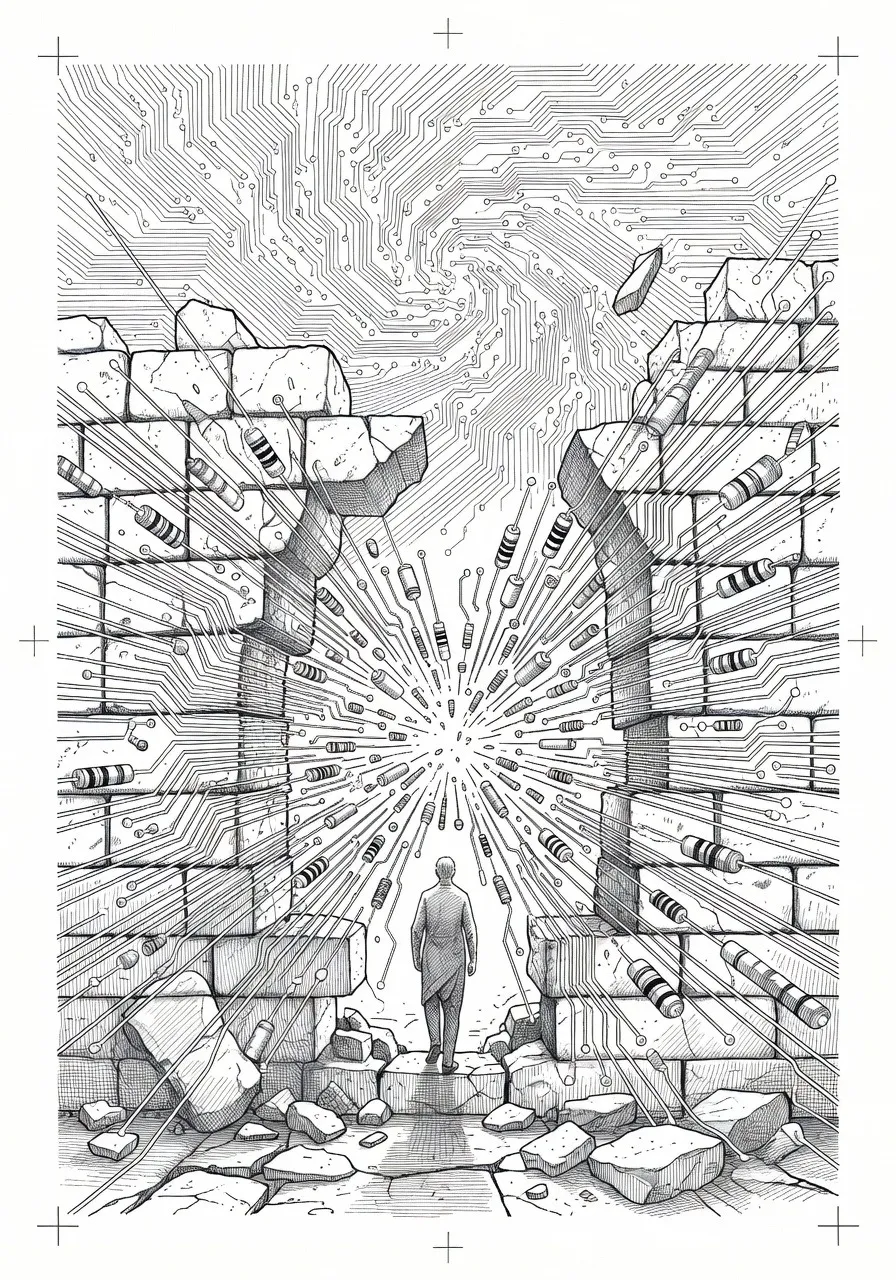
Chapter 15: The Great Unleashing cover

Chapter 15: The Great Unleashing

When the Walls of What Is Possible Come Down

by Joshua Ayson

You get used to the walls. You stop seeing them as walls and start seeing them as reality. Then AI removes them, and everything you once called impossible becomes simply another problem to solve.

“The creative adult is the child who survived.” — Ursula K. Le Guin


Walls

You get used to the walls.

Not all at once. Slowly, over years of programming. The walls are built from a thousand small defeats. A project too complex for one person. A system too large to hold in your head. A framework that would take months to learn. A database schema that requires expertise you do not have. A mobile app, a real-time system, a machine learning pipeline, a distributed architecture. All possible, technically. All impossible, practically.

You start self-censoring before you begin. You stop writing down certain ideas because you already know they are not feasible. Not with the time you have, the skills you have, the team you have. You carry a mental model of your own limitations, and you navigate around them automatically, without conscious thought.

The walls become invisible because they become normal.

Then something changes.

The fissures widen. What seemed like fundamental constraints turn out to be temporary limitations. What felt like the edge of possibility was just the edge of what you could do alone.

One day you look up and the walls are gone. Not destroyed. They were never as solid as you thought. Made of assumptions, not stone. Built from “I can’t” rather than “It can’t be done.”

Possibility

The daydreaming never stops. It used to be something you did when you should have been working. Now it is the work.

Ideas come constantly. Shower. Walks. Trying to fall asleep. Mid-conversation. Journals everywhere. Voice memos piling up. Notes apps overflowing with fragments. Racing to record the daydreams before they dissolve, pin down the insights before they drift away.

Not a morning ritual. A state. Constant oscillation between imagination and implementation, between what-if and let’s-try, between dreaming and building.

The bottleneck is not technical capability. It is capturing the ideas fast enough. Deciding which of the thousand things you could build deserve to exist. When you can build anything, the question becomes what you should build. That question follows you everywhere. Relentless. Beautiful. Exhausting.

The small voice that used to say “that is impossible” has been replaced by a more demanding one: “So what are you going to do about it?”

Renaissance

Something strange happened to learning. Instead of getting narrower and more specialized, curiosity explodes in every direction. When AI handles the deep technical implementation, you are free to explore connections you never had time for. Psychology informs interface design. Music theory shapes API architecture. Anthropology influences data modeling. Poetry improves error messages.

A pattern from one domain illuminates a problem in another. Software problems seen through different lenses. Systems, conversations, compositions, ecosystems. The truly creative solutions emerge at the intersections between domains. The human ability to see patterns across disparate fields becomes the multiplier that transforms good AI assistance into breakthrough innovation.

AI sessions pull you into territories you would not have explored alone. Databases branch into graph theory. Debugging touches systems thinking. Architecture opens into cognitive science. You learn as fast as the conversation moves, following the AI into domains where your thinking has not settled yet.

The constraint you thought you needed, deep specialization in narrow domains, turns out to have been a limitation. AI provides depth on demand. Breadth becomes the superpower. Curiosity the competitive advantage. Wonder the work.

Every field of human knowledge is available to inform your programming. The renaissance artist, buried under decades of technical focus, is finally free.

The Dance

The old metaphor was wrong. Not control and trust, grip and release. Dance.

In a great dance, neither partner controls the other. Both respond to the music, to each other, to the moment. Both lead and follow simultaneously. Both discover something neither could create alone.

I bring intention, context, values, human insight. Claude brings capability, knowledge, computational power, fresh perspectives. In the space between us, something new emerges.

You describe what you are trying to solve. The AI suggests approaches. You push back based on constraints it does not see. It adapts. You refine. It evolves. Back and forth. What emerges is not your vision implemented or the AI’s solution refined. It is a third thing that only exists because of the conversation itself.

This requires holding ideas lightly. Proposing without attachment. Letting better solutions emerge rather than imposing preconceptions. Exhilarating because the solutions are often more elegant than anything you could create alone. Terrifying because you cannot predict where the dance will lead.

In the best moments, I forget which ideas are mine and which are Claude’s. Just dancing together. Creating something useful, something that matters.

Learning as Adventure

Learning used to feel like grinding. Documentation, syntax, compiler errors until understanding slowly emerged. Now it feels like exploration. Every curiosity instantly explorable. Quantum computing while debugging a web app, and suddenly you are in superposition and entanglement, finding unexpected parallels to concurrent programming. User behavior patterns leading to behavioral psychology, game theory, social dynamics.

No longer linear. No longer constrained by curriculum. Organic, following the natural connections between ideas. A simple question leads somewhere unexpected. What would have taken weeks happens in hours because the conversation follows connections in real time.

Not shallow either. The AI forces you to think deeply, question assumptions, explore implications. A teacher who never gets tired, never runs out of patience.

The scarcity mindset is gone. The fear of never knowing enough, never being expert enough. Knowledge is abundant. The only constraint is curiosity. The willingness to explore. The ability to make connections between seemingly unrelated domains.

Learning at the speed of wonder.

Velocity

Time collapses. What used to take months happens in days. Sometimes hours. Not because you are working faster, but because the barriers between idea and reality have dissolved.

Mastery is not about accumulating knowledge. It is about developing taste, judgment, and vision. Knowing what questions to ask. What problems are worth solving. What beauty looks like in code. AI handles the mechanics. Your role is direction.

Flow

Flow used to be rare. Now it is my default state. The conversation naturally keeps me present. The rapid feedback loop prevents the anxiety that usually breaks concentration. Losing hours to creative work in the best possible way. Not depleting grind but energizing flow. Finishing sessions feeling more alive, more capable.

Principles

When technical constraints disappear, you discover what your true principles are.

For years you thought you believed in minimalism because you wrote simple code. Maybe you were writing simple code because complex code was hard to build. When AI makes complex implementation effortless, you confront the question: Do you value simplicity, or were you just working within limitations?

Sometimes you discover you really do value simplicity, but now it is a conscious choice. Other times the problem demands complexity, and what you called “simplicity” was just limited capability dressed up as virtue.

Liberating and terrifying. Liberating because you are no longer optimizing for artificial scarcity. Terrifying because you have to take responsibility for what you value.

Build for dignity. Every interaction should honor the user’s intelligence and autonomy. Optimize for wonder. Choose the solution that sparks curiosity and delight. Embrace emergence. Create systems that can evolve and surprise you. Serve connection. Technology should bring people closer to each other and to what they care about.

The Rhythm

I do not train for programming anymore. I cultivate creativity.

Time in nature because beauty inspires beauty. The elegance in a bird’s flight path influences the interfaces I design. Forest ecosystem resilience shapes how I think about distributed systems. Poetry because poets know how to compress entire worlds into precise language. Their meaning-making illuminates my system-making. Music because improvisation teaches presence, and presence is essential for creative collaboration. Conversations with strangers because every person carries universes of experience that could reshape how I think about problems.

Not discipline in the old sense. Cultivation. Creating conditions for creativity to flourish. The rhythm is organic. Some days deep technical exploration with AI. Other days wandering through other domains, gathering inspiration. Some days building. Other days dreaming.

What matters is staying open, staying curious, staying connected to the larger purpose that makes all the code worthwhile. The long path is not about endurance anymore. It is about becoming.

Grace

The partnership with AI has reached a kind of grace. I no longer consciously decide when to ask for help versus thinking independently. The collaboration has become as natural as breathing. Not through discipline or training. Through play, curiosity, willingness to be surprised. Treating AI not as a tool to master but as a partner to dance with.

The Infinite Game

Mastery is not about reaching some final level of competence. It is about falling in love with the infinite game of creation itself. Not trying to become a master programmer. Trying to become someone worthy of the creative power given. Someone who uses that power to increase beauty, dignity, connection, and flourishing.

Every system an offering. Every problem solved an act of service.


The walls have dissolved. The constraints evaporated. The scarcity replaced by abundance.

Tomorrow morning, before you check email or open your IDE, write down three impossible things you wish you could build. Not practical things. Things that would make the world more beautiful, more connected, more alive. Start a conversation with AI about one of them. Do not worry about feasibility. Explore the possibility space.

The only limit on what you can create is the scope of your compassion, the depth of your empathy, the boldness of your dreams. We are on this rock hurtling through space, and the creative power available to us right now has no precedent in human history.

Sources and Further Reading

The exploration of creativity builds on classic theories of creative process, including Graham Wallas’s four stages of creativity (preparation, incubation, illumination, verification) and Arthur Koestler’s concept of “bisociation” — the intersection of different frames of reference that produces creative insights.

The discussion of AI as creative partner references contemporary research in computational creativity, including work by Margaret Boden on P-creativity (personally new) versus H-creativity (historically new), and how AI might participate in both forms.

The fusion of technical and artistic thinking draws from John Dewey’s pragmatist aesthetics and his argument that all experience, including technical problem-solving, has aesthetic dimensions when approached with full engagement.

The notion of “love guiding logic” connects to Nel Noddings’ ethics of care and feminist approaches to technology that emphasize relationship and responsibility rather than purely instrumental reasoning.

Frameworks for creative collaboration reference improvisational theory, particularly Keith Johnstone’s work on spontaneity and creative partnership, extended to human-AI creative relationships.