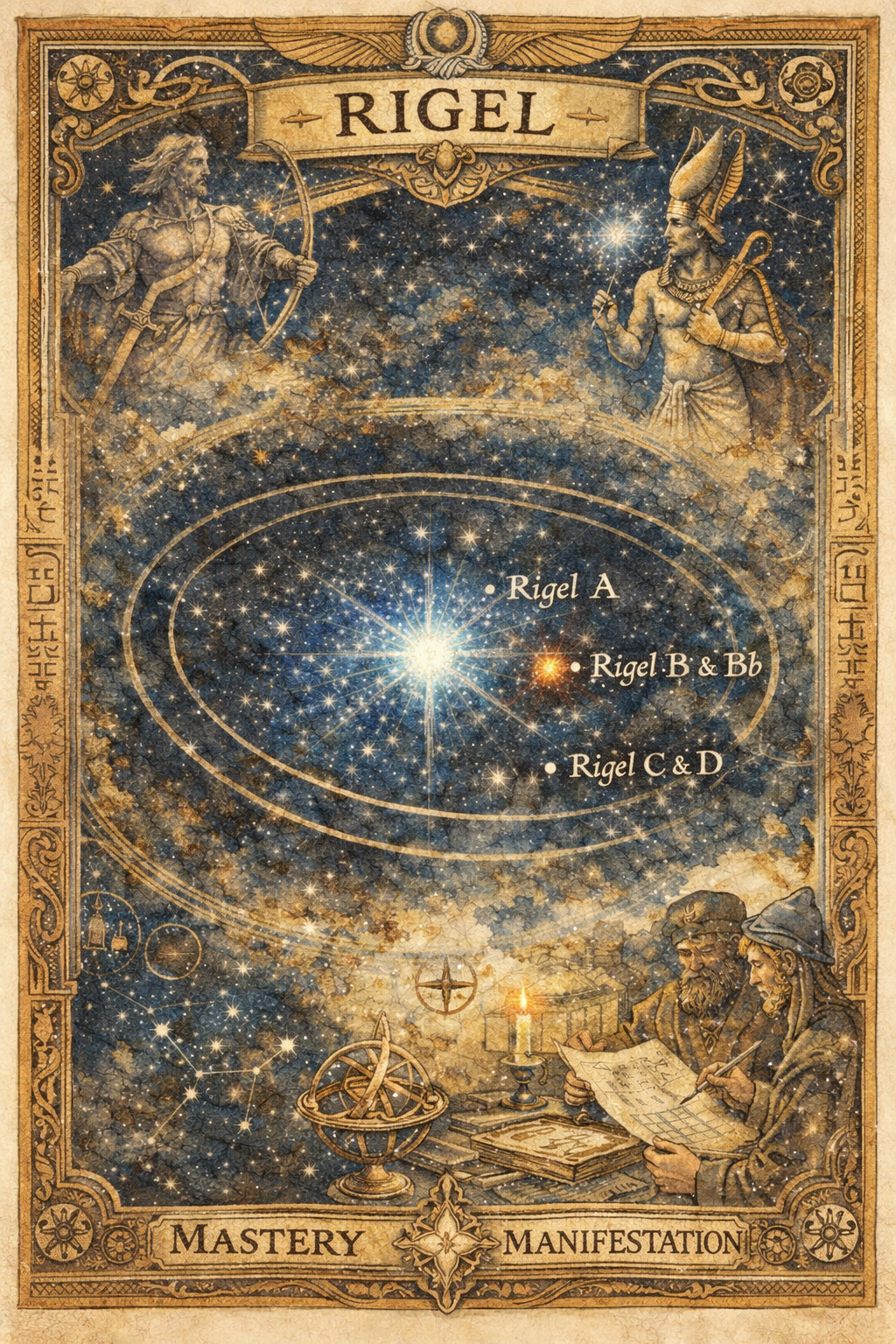
Rigel: Decan 32 - Manifestation & Mastery
The Grounded Foot of the Hunter
The photons entering your eyes right now left Rigel in 1165—from the year Notre-Dame de Paris rose stone by stone, when guild masters codified the path from apprentice to craftsman to master, when Chrétien de Troyes wrote the first Arthurian romances of chivalric excellence. 860 years that photon traveled, carrying a question across the void: What have you mastered that proves your readiness for what comes next?
New to The Decan Log? Start with the Introduction: Living by the Stars to understand the 10-day decanal system, how it works, and why ancient Egyptian timekeeping offers a better framework for personal growth than modern weeks.
Living this decan? For a personal account of ten days under this star, read the decan journal.
For ten days you wielded raw creative power with Betelgeuse—the red supergiant that boils and erupts and seeds space with matter it cannot contain. You felt the convection. You made the mess. Now comes what follows eruption: the grounded stance that transforms chaos into completed form. Not more power—mastered power. Not further creation—manifestation.
The Star That Burns Clean
The photons entering your eyes tonight left Rigel in 1165.
This is not metaphor. This is physics. That blue-white light traveled 860 years through the void—departing when Notre-Dame de Paris was rising stone by stone over the Seine, when Philip II Augustus was being born to unite France, when Ibn al-‘Arabi arrived in the world to systematize Sufi mysticism, when Chrétien de Troyes was writing the first Arthurian romances that taught Europe what mastery meant.
You are literally seeing medieval light. Photons that witnessed the codification of craftsmanship—the moment when humanity asked with institutional precision: What does it mean to truly master something?
And what you’re seeing when that light finally arrives—that brilliant blue-white beacon at Orion’s lower right foot—is not chaos. It’s not volatile. It’s not boiling with convection cells or erupting mass into space.
Rigel burns clean.
 Rigel marks Orion’s left foot (right foot from our perspective)—the stable stance that enables every aimed shot. Compare it to Betelgeuse’s red-orange glow at the shoulder. Blue mastery below, red power above. The Hunter needs both.
At 12,100 Kelvin, Rigel’s surface temperature runs more than twice as hot as our Sun’s 5,778K. It radiates with the luminosity of 120,000 suns. Yet unlike Betelgeuse—sprawling across 700+ solar radii, diffuse and dying—Rigel remains relatively compact at 74 solar radii. Hot and concentrated. Intense and efficient.
This is the difference between creation and mastery.
Betelgeuse achieves its brilliance through sheer size—a dying star swelling to fill the space between here and Jupiter’s orbit, spreading heat thin across impossible surface area. Rigel achieves its brilliance through temperature—a star still in its prime, burning with concentrated intensity, packing more power into less space.
You don’t manifest by doing more. You manifest by doing better.
The medieval guild masters understood this. An apprentice might work long hours, produce more quantity than anyone else, sprawl their effort across every available task. But the master worked differently—concentrated skill, deliberate precision, quality over volume. The journeyman who produced the masterpiece that proved their readiness wasn’t the one who made the most objects. They were the one who made the best object.
Rigel proves it at stellar scale: intensity matters more than size.
The Star: Rigel (Beta Orionis)
Rigel sits 860 light-years away, marking Orion’s left foot as seen from Earth—the stable stance of the Hunter, the grounded foundation from which every aimed action originates.
But here’s what most don’t know: Rigel is not one star.
It’s a system of at least four.
The brilliant blue-white point you see with naked eyes is Rigel A—a B8 supergiant, the dominant primary around which everything else orbits. But look closer with professional instruments and you find Rigel B, which is itself a spectroscopic binary: two stars (Ba and Bb) orbiting each other every 9.86 days. And orbiting that pair is Rigel C, completing its circuit every 63 years. Perhaps even a fourth component, Rigel D, associated at the same distance, would take 250,000 years to complete one orbit.
What appears as singular constancy is actually a hierarchical system in gravitational relationship.
The master governs an apprenticeship. The project organizes its dependencies. The completed work contains components that orbit each other in nested rhythms—daily tasks, weekly reviews, quarterly cycles, annual transformations. Mastery isn’t isolation. It’s orchestration.
Rigel A doesn’t shine alone. It governs a system where smaller units maintain their own orbits within larger structures, all bound by the primary’s gravitational dominance. Your manifestation may similarly require coordinating multiple elements—people, resources, timeframes—into coherent hierarchical organization. The master doesn’t do everything personally. The master orchestrates.
The 1165 Light: When Humanity Codified Mastery
When the photons you see tonight left Rigel, the world was asking a question it had never asked so precisely before: What does it mean to become a master?
In Paris, construction had begun on Notre-Dame just two years earlier. The cathedral represented mastery made visible—mathematical precision, engineering excellence, stone and glass transformed into prayer through craftsman skill. Each mason who worked those stones had walked a path: apprentice, then journeyman, then maître. The word we translate as “master” wasn’t a compliment. It was a certification. A recognized status proving you had demonstrated excellence sufficient to teach others.
In the same year, two children were born who would define mastery in their domains for centuries. Philip II Augustus would become one of France’s greatest kings—the one who unified the nation, established Paris as a true capital, demonstrated political mastery so complete that the French state traces its architecture to his reign. Ibn al-‘Arabi would become Islam’s defining mystic-philosopher, systematizing Sufi thought with such precision that all later mystical Islam reads through his lens.
Chrétien de Troyes was writing the first Arthurian romances—Erec et Enide, Cligès, works that created the literary conventions of chivalric excellence. What is a knight? One who proves worthiness through deeds. What makes a hero? Not birth, but demonstrated mastery. The Round Table wasn’t inherited—it was earned. Each seat represented a knight who had completed the quest, won the tournament, slain the dragon. Mastery as qualification for belonging.
The medieval guild system was consolidating across Europe. For the first time, paths of skill development were formalized with institutional weight. An apprentice served years learning fundamentals under a master’s supervision. A journeyman traveled, practiced with different masters, developed breadth. And when ready—only when ready—the journeyman produced a masterpiece: a work of such quality that the guild recognized it as proof of mastery, opening the door to establishing one’s own workshop and taking on apprentices.
The word “masterpiece” wasn’t artistic pretension. It was a literal requirement. You could not call yourself master until you had produced work that demonstrated mastery. Not claimed. Demonstrated.
The light that left during humanity’s codification of mastery arrives at your eyes NOW, during YOUR mastery work.
You are photonically connected to that moment across 860 years of travel through the void. The medieval world asked: What proves readiness? What distinguishes competence from excellence? What work demonstrates that you’ve moved from creating to mastering?
What’s YOUR masterpiece this decan?
The Lesson of Decan 32
Mastery is not size. Mastery is intensity.
You spent Decan 31 erupting—Betelgeuse’s convection rising through your surface, breaking through in mass ejections that temporarily dimmed you while seeding space with material. That was creation. Raw. Chaotic. Necessary.
Now comes what creation enables: the grounded stance that transforms explosive power into aimed action.
Rigel doesn’t boil. It doesn’t vary wildly like Betelgeuse, whose brightness swings from magnitude 0.0 to 1.6 depending on its pulsations and mass ejections. Rigel pulses subtly—Alpha Cygni variability, small non-radial oscillations that shift its brightness from 0.05 to 0.18 magnitude. You wouldn’t notice the change without precise instruments.
Mastery is reliable. Not rigid—Rigel varies slightly. But consistent—you know what you’re getting. Your mastered work should have similar reliability: not mechanical perfection, but dependable quality. When someone encounters your mastery, they should know what to expect—and be consistently satisfied.
The Witch Head Illumination
Forty light-years from Rigel, a ghostly blue nebula glows against the dark of space.
IC 2118—the Witch Head Nebula—produces no light of its own. It’s an ancient supernova remnant or interstellar gas cloud, invisible except for one thing: Rigel’s brilliance shines upon it from 40 light-years away, and the nebula reflects that light back toward Earth. The blue color comes from dust grains that scatter blue wavelengths more efficiently than red.
Mastery illuminates what surrounds it.
Your excellent work doesn’t just benefit you. It lights up the environment. It reveals shapes in the darkness that would otherwise remain invisible. It enables others’ creation—active star formation is occurring within the Witch Head Nebula, partly energized by Rigel’s distant light.
The master’s workshop trained apprentices. The cathedral’s construction employed generations of craftsmen who learned from its making. The masterpiece that proved one person’s mastery became the teaching object for the next generation.
What do you illuminate? What becomes visible because of your mastery? What creation elsewhere does your excellence enable?
The Witch Head Nebula only exists visually because Rigel shines upon it. Without the blue supergiant’s light, that cloud of gas would be invisible—dark matter against dark sky. Rigel makes visible what would otherwise remain hidden.
That’s what mastered work does. It illuminates.
The Foot of Orion: Mastery Requires Foundation
Consider where Rigel sits in the Hunter’s body.
Betelgeuse marks the shoulder—the origin point of power, where force begins before flowing through the arm that draws the bow. Bellatrix marks the opposite shoulder—the strategic striking arm. The Belt stars form the structural center, the alignment that holds everything together.
But Rigel? Rigel marks the foot.
You can’t shoot from an unstable stance. You can’t draw the bow if your legs are wobbling. The power that originates in the shoulder (Betelgeuse) must flow through the body to the grounded foot (Rigel) before it can express in aimed action. Without stability below, all the power above becomes thrashing.
Decan 31 gave you creative power. Decan 32 asks: where are you grounded? What foundation supports your manifestation?
The five Orion decans trace a journey: power (Betelgeuse) → grounded mastery (Rigel) → strategic will (Bellatrix) → cosmic continuity (Alnilam) → alignment with truth (Mintaka). Rigel is the stabilizing phase—where raw power becomes mastered form before strategic deployment.
When you observe Rigel, you’re not just seeing a star. You’re seeing the place where Orion contacts the ground. The point of stability that enables everything else. The foundation from which the Hunter operates.
The Orion Myth: Point of Grounding, Point of Vulnerability
In Greek mythology, Orion was a giant huntsman—son of Poseidon, legendary for strength, beauty, and skill. The death stories vary. In one, the goddess Artemis killed him accidentally, tricked by her jealous brother Apollo into shooting at a distant head bobbing in the waves, not knowing it was her beloved companion. In another, Orion boasted he could hunt every beast on Earth, and Gaia sent a scorpion to humble him with a sting that brought down the mighty hunter.
In a third version, the scorpion stings his foot.
Consider that. The place of grounding is also the place of vulnerability. Where you stand is where you can be struck. The stable stance that enables your mastery is the same stance that exposes you to what crawls beneath.
Rigel—the brilliant foot—represents the place where the Hunter was both stable AND mortal. Orion dies, and his foot becomes the brightest star in the constellation. What killed him becomes his glory.
Your mastery is grounded in what you commit to, and what you commit to can also unmake you. That’s the risk of manifestation.
You cannot create a masterpiece without committing to a form. But the form you commit to—the craft you practice, the relationship you deepen, the career you build—that commitment is also where you’re vulnerable. The generalist who touches everything and finishes nothing is never exposed because they never truly stand anywhere. The master who plants their foot on specific ground has achieved stability but also marked the place where they can be struck.
Orion’s eternal chase across the sky tells this truth: even masters fall. The giant huntsman whose shoulder blazes red with creative power, whose foot glows blue-white with grounded mastery—he was killed. He fell. His feet failed him.
And yet his constellation dominates the winter sky, more recognizable than any other pattern of stars humanity has named. The fall didn’t end his story. It transformed him into something visible for all time.
The grounding that enables mastery is also the grounding that exposes you to mortality. Both are true. Both are necessary.
Historical Layers
Babylonian: The True Shepherd
Four thousand years ago, the astronomers of Mesopotamia watched Orion rise over their ziggurats and saw not a hunter but MULSIPA.ZI.AN.NA—the True Shepherd of Anu. The supreme god of the heavens required a guardian, and this constellation stood watch over the celestial equator, staff in hand, authority absolute.
A shepherd must stand on solid ground. You cannot guide the flock if your feet slip. You cannot protect the vulnerable if you’re unbalanced. The foot of the Shepherd represents where divine authority contacts terrestrial reality—the point of connection between heaven’s guidance and earth’s necessity.
Before Orion drew a bow, he held a shepherd’s crook. Before mastery meant excellence in craft, it meant knowing where to graze, when to move, how to protect. Rigel as the foot of the True Shepherd represents practical wisdom grounded in earth—the place where celestial guidance meets terrestrial reality.
Arabic: The Precise Name
The name “Rigel” comes from the Arabic رجل الجوزاء (Rijl al-Jawzā’)—“The Foot of al-Jawzā’,” the central one. Unlike Betelgeuse’s corrupted etymology (where “yad” became “bed,” “hand” became “armpit” through manuscript errors), “Rigel” preserved its meaning relatively intact. Medieval European astronomers correctly identified it as the foot. The Alfonsine Tables of 1252 used “Rigel” consistently.
The name’s accuracy reflects the star’s nature: what you see is what it is. A foot. A foundation. A grounded point. No confusion about function.
Your mastery should similarly be unmistakable—clear in purpose, clean in execution, accurate in naming. When your work is truly mastered, there’s no ambiguity about what it is. The medieval master didn’t need to explain their status. The masterpiece spoke for itself. The craftsmanship was self-evident.
Egyptian: The Resurrection Point
To the Egyptians, Orion was associated with Sah, later syncretized with Osiris—the god who died, was dismembered by his brother Set, and was reconstituted by his sister-wife Isis. Some scholars argue that before Osiris was associated with the entire Orion constellation, the Egyptians may have equated him specifically with Rigel—the foot.
The foot that contacts the underworld. The boundary between life and death. The point where the divine figure touches the netherworld.
In Egyptian thought, Osiris represented mastery over death itself—the one who transformed mortality into resurrection, who turned ending into beginning, who proved that dying to one form enables rising in another.
Rigel as Osiris’s foot suggests the ground where resurrection begins—the stable point from which the return journey launches. Manifestation requires dying to one form to rise in another. The masterpiece you complete means the death of the work-in-progress. The career you establish means the death of all the alternative careers you didn’t choose. The relationship you commit to means the death of the possibilities that existed when commitment was still pending.
Where do you stand for that transformation? What foundation holds you as one form dies and another rises?
The Medieval Astrological View
According to Ptolemy and later astrologers like William Lilly, Rigel has the nature of Jupiter and Saturn combined.
Jupiter alone means expansion, abundance, prosperity—becoming MORE through opportunity and fortune. Saturn alone means structure, discipline, limitation—becoming more through effort and persistence.
But Jupiter and Saturn together?
Structured expansion. Disciplined growth. Not unlimited sprawl (Jupiter alone) nor rigid constraint (Saturn alone), but the balanced mastery that knows when to expand and when to consolidate. Rigel’s astrological nature captures exactly this: brilliant but controlled, expansive but grounded, ambitious but patient.
Medieval astrologers associated Rigel with strong and dignified nature, self-confidence and courage, prosperity especially through travel and trade, fame, honor, “kingly” attributes. This aligns with the Mastery theme: when you’ve truly mastered something, opportunities align. The world recognizes and rewards excellence.
But the warning remains: Rigel’s gifts can become vices. Self-confidence becomes arrogance. Dignified nature becomes contempt for others. Prosperity becomes greed. Mastery without humility corrupts.
The master who forgets they were once an apprentice becomes a tyrant in their workshop. The craftsman who scorns those still learning violates the chain of transmission that made their own mastery possible. Rigel’s light can illuminate the environment—or it can blind those who look directly at it, burning retinas instead of revealing paths.
Wield mastery carefully. It was given to you by those who came before. It obligates you to those who come after.
The Three Phases
Phase 1: The Foundation Sets (Days 1-3 | Jan 24-26)
You’ve spent ten days erupting with Betelgeuse. You felt the convection rise through your surface. You created—messy, chaotic, real. Mass ejected into space. The dust cloud may have temporarily obscured you.
Now the dust settles.
 Days 1-3: The Foundation Sets. Where do you actually stand? What supports your manifestation?
These first three days ask: What did you actually create? Not what you intended. Not what you hoped. What exists now that didn’t exist ten days ago? Be ruthless in your inventory. Some of what erupted during Betelgeuse was exploratory—experiments that failed, drafts that don’t work, mass ejections that became dust rather than future stars. That’s fine. That’s the physics of creation.
But some of what you created is worth bringing to mastery. Identify the 1-3 things genuinely worth finishing. Not everything needs to continue. The convection threw up a lot of material. Some seeds the future. Some dissipates.
Then audit your foundation. Where do you actually stand—not ideally, but really? What supports your work? Workspace, tools, resources—the physical foundation. Relationships, collaborators, communities—the social foundation. Skills, knowledge, energy—the internal foundation.
Rigel doesn’t shine alone. It governs a quadruple system where companions orbit at nested scales. Who are your companions for this mastery work? The collaborators who challenge you, the critics who improve you, the witnesses who hold you accountable to excellence?
On the first night, go outside. Find Orion dominating the southern sky. Look down and to the right from the Belt—that brilliant blue-white star is Rigel. Notice how different it looks from Betelgeuse’s red-orange glow up and to the left. Feel the contrast. Red chaos above, blue precision below. The Hunter needs both, but for these ten days, you’re working from the foot.
Phase 2: The Mastery Process (Days 4-7 | Jan 27-30)
Now the real transformation happens.
 Days 4-7: The Mastery Process. Not the burst of creation but the sustained work of refinement.
This is where you take raw creation and bring it to excellence. The medieval craftsman spent years as journeyman before producing the masterpiece that proved mastery. This phase is your compressed journeyman period—four days of dedicated work toward completion with quality.
Block time each day for mastery work. Not brainstorming, not ideation, not exploration—those were Betelgeuse work. This is finishing. Polishing. Refining. The passes that transform adequate into excellent. Protect this time fiercely. The world will try to interrupt your mastery process with urgent trivia. The trivial does not merit your Rigel hours.
Notice the Jupiter-Saturn balance. Where does expansion serve your work? Where does structure serve better? Some days need more Jupiter—trying new approaches, expanding scope appropriately, following where quality leads. Some days need more Saturn—imposing constraints, cutting excess, disciplining your attention to what actually matters.
Each day, ask: Is this getting better? Not different—better. Am I moving toward mastery or just spinning? What specific improvements did I make today that I can point to?
The photons entering your eyes each night left Rigel in 1165. While you observe the blue-white supergiant, consider: the medieval master craftsman who watched this same star was producing work that would last centuries. The stones of Notre-Dame are still standing. The Arthurian romances are still being read. What mastery are you bringing to completion that connects to that lineage?
And remember the Witch Head Nebula. How does your mastery work illuminate others? Who benefits beyond you? What becomes visible because of your excellence?
Phase 3: The Manifestation Complete (Days 8-10 | Jan 31 - Feb 2)
The masterpiece is finished—or this phase of it is.
 Days 8-10: Manifestation Complete. Not just stopping, but finishing. Excellence within your lifespan.
The medieval journey from journeyman to master culminated in a work that proved readiness. What have you manifested? Not just created (that was Betelgeuse) but MASTERED—brought to a level of excellence that stands on its own. A work you can point to and say: this demonstrates my mastery.
Be honest in your inventory. What exists now that didn’t exist on Day 1? What level of quality did you achieve? Did you manifest with mastery, or did you just complete without excellence? The distinction matters. Completion is showing up. Mastery is showing up with quality that proves you belong.
Consider the arc you’ve traced through Orion:
- Decan 31 (Betelgeuse): Power source. Creative eruption. The shoulder where force originates.
- Decan 32 (Rigel): Grounded mastery. Manifestation complete. The foot where stability enables aim.
- Decan 33 (Bellatrix): Strategic will. Coming next. The other shoulder where tactical deployment originates.
How does your manifested work prepare for strategic deployment? You’ve created with power and mastered with precision. Now you’ll be asked to use what you’ve made. To deploy it strategically. To wield it in the world.
On the last night of this phase, observe Rigel one final time. Watch it knowing you’ve completed a mastery cycle. The foot is planted. The stance is stable. The manifestation is grounded.
Rigel will supernova eventually—millions of years from now, but eventually. Even perfected work is finite. Your manifested work is also temporary: excellent within its lifespan, but not permanent. What does completion mean, knowing that all forms eventually transform?
The goal is not immortality but completion—finishing what you started with quality, knowing time is limited. The medieval cathedrals are crumbling. The Arthurian romances are slowly being forgotten. Even Notre-Dame burned, and required rebuilding. But within their lifespan, they achieved mastery. They manifested excellence. They illuminated their era.
What have you manifested that achieves the same within your era, your lifespan, your ten days?
Tomorrow, Bellatrix rises. Strategic will awaits. What you created with power and manifested with mastery, you’ll now be asked to wield with strategy.
Daily Tracking
Each night of this decan, spend a few minutes with your journal. Note what you mastered—not created, mastered. Watch Rigel when the sky permits—the blue-white glow serves as a kind of accountability partner, shining steadily across 860 years to ask: Did your work get better today?
Track the quality, not just the quantity. Track the foundation you’re standing on. Track the companions who witnessed your process.
Finding Rigel: The Blue-White Foot of Orion
After sunset in late January, face south around 8-10 PM. Orion dominates the sky—the most recognizable constellation visible to humans.
Start with the Belt. Three bright stars in a distinctive row: Alnitak, Alnilam, Mintaka from left to right. Once you find the Belt, everything else orients from there.
From the Belt, look down and to the right. The brilliant blue-white star is Rigel—magnitude 0.12, typically the seventh brightest star in the sky, brightest in Orion. If Betelgeuse dims during one of its variable phases, Rigel might even rival it for the title.
 Find Orion’s Belt, look down and right for the blue-white foot star. That’s Rigel. Look up and left for red Betelgeuse. The decanal transition embodied in the Hunter’s body.
Notice the color difference. Rigel is distinctly blue-white—even to the naked eye, it reads as “cold” compared to the “warm” stars. Betelgeuse, up and left from the Belt, glows red-orange. These two stars frame Orion as the contrast between mastery (Rigel) and creation (Betelgeuse).
Spend a few minutes with Rigel each night. Locate it in Orion’s foot. Feel the distance: 860 light-years, which means you’re seeing 1165 light. The photons entering your eye tonight left that star when the medieval guilds were codifying mastery, when Notre-Dame was rising, when Chrétien de Troyes was writing tales of chivalric excellence.
Contemplate what you’re mastering that connects to that moment of codification. The guild system did to craftsmanship what your mastery work does to raw creation: it transformed effort into excellence, practice into expertise, journeyman labor into masterwork.
End-of-Decan Review
On February 2, ask yourself:
About Manifestation: What have I actually manifested—concrete outputs with quality? What exists now that didn’t exist on Day 1? Did I achieve mastery, or just completion?
About Foundation: Where was I grounded? What foundation supported this work? What foundation was missing or unstable? How did foundation quality affect manifestation quality?
About the Process: Did my work get better (not just different) over the decan? Can I point to specific quality improvements? Where did I need Jupiter (expansion) and where did I need Saturn (structure)?
About Illumination: How did my mastery work illuminate others? What became visible because of my work? How did mastery extend beyond personal benefit?
About Companions: Did I involve companions in the mastery process? What feedback did I receive? Did collaboration improve the work?
About Observation: How many nights did I observe Rigel? What did the blue-white supergiant evoke? What did 860-year contemplation reveal? How did observing both Rigel and Betelgeuse illuminate the creation→mastery arc?
Looking Ahead to Bellatrix: How does my mastered work prepare for strategic deployment? What’s ready to be USED, not just admired?
Preparing for Bellatrix
On February 3, Decan 33 begins. Bellatrix—Gamma Orionis, the Female Warrior—rises in Orion’s right shoulder. The theme shifts from “Manifestation & Mastery” to “Will & Strategy.”
The name Bellatrix means “Female Warrior” in Latin. Medieval astronomers called it this because of its position on Orion’s sword-arm—the striking shoulder, the place from which strategic action originates.
You’ve created with power (Betelgeuse) and manifested with mastery (Rigel). Now you’ll be asked to deploy with strategy (Bellatrix)—to take your mastered work and use it tactically. From grounded mastery to strategic action. From stability to strike.
The photons you’ll observe from Bellatrix left in 1775—the American Revolution, when strategy and will overcame overwhelming force. The colonists didn’t have more power than Britain. They had better tactics. Bellatrix’s light carries that energy: the Female Warrior who wins not through brute force but through strategic will.
Watch Rigel set in the west as Bellatrix rises higher in Orion. The foot grounded. The shoulder strikes. What you’ve mastered becomes weapon.
The Stellar Physics of Mastery
Rigel is hotter than Betelgeuse despite being smaller.
Betelgeuse runs at approximately 3,500 K surface temperature, sprawled across roughly 764 solar radii—enormous but cool, achieving luminosity through sheer size.
Rigel runs at approximately 12,100 K surface temperature, concentrated in roughly 74 solar radii—smaller but hot, achieving luminosity through intensity.
Both produce around 100,000 times the Sun’s luminosity. But through entirely different mechanisms.
Betelgeuse creates through expansion; Rigel manifests through concentration.
Your mastery may similarly require concentration rather than expansion—doing fewer things with higher quality, rather than more things with scattered attention. The master doesn’t just work hard; the master works effectively. The masterpiece isn’t the longest work or the largest project. It’s the work that demonstrates excellence.
And remember: even Rigel will supernova eventually. The blue-white supergiant, compact and intense and stable, will one day exhaust its fuel and explode in a Type II supernova that briefly outshines its entire galaxy. Mastery doesn’t mean permanence. Even perfected work is finite.
But for now—for the next few million years, for your ten days—Rigel burns clean and bright. Steady. Reliable. The foot of the Hunter, the stance that enables every aimed shot, the foundation from which mastery manifests.
The photon that left Rigel in 1165 carried a question across 860 light-years:
“What have you mastered that proves your readiness for what comes next?”
Manifest it. Complete it. Ground it in excellence.
Further Reading
For Understanding Rigel:
- Stars and Their Spectra by James B. Kaler (Cambridge) - Chapter on blue supergiants
- The Life and Death of Stars by Kenneth R. Lang - Supergiant evolution and stellar endpoints
- Wikipedia: “Rigel” (detailed, regularly updated with recent observations)
For Mastery:
- Mastery by Robert Greene - The path to mastery through apprenticeship and practice
- The Craftsman by Richard Sennett - Craftsmanship and quality work
- Peak: Secrets from the New Science of Expertise by Anders Ericsson - Deliberate practice and expert performance
For Medieval Mastery (1165 Context):
- Cathedral, Forge, and Waterwheel by Frances and Joseph Gies - Medieval technology and mastery
- A World Lit Only by Fire by William Manchester - Medieval world and craftsmanship
- Chrétien de Troyes: Arthurian Romances - Original texts on chivalric mastery
For Completion:
- The War of Art by Steven Pressfield - Resistance vs. completion
- Finish by Jon Acuff - Actually completing what you start
- Deep Work by Cal Newport - Focused work for quality output
Navigation
- Back to The Decan Log - Return to the complete decanal calendar
- Previous Chapter: Decan 31 - Betelgeuse (Power & Creation) - Jan 14-23, 2026
- Next Chapter: Decan 33 - Bellatrix (Will & Strategy) - Feb 3-12, 2026
Go outside tonight. Find the foot of the Hunter. Watch the blue-white star that has burned steady for 860 years of photon travel, arriving now to illuminate your mastery work. Feel the stability. Feel the grounding. Feel the difference between creation and manifestation.
Then ask yourself: What have I mastered?
© 2026 Joshua Ayson. All rights reserved. Published by Organic Arts LLC.
This chapter is part of The Decan Log: A 10-Day Journaling System Aligned with the Stars. All content is protected by copyright. Personal use encouraged. Unauthorized commercial reproduction prohibited.