Algol: Decan 28 - Renewal through Challenge (December 15-24)
The photons entering your eyes right now left Algol in 1932. For three thousand years called cursed, this eclipsing binary star reveals how challenges follow rhythms and obstacles become fuel. December 15-24: face what blocks your light, consume its mass, emerge brighter.

New to The Decan Log? Start with the Introduction: Living by the Stars to understand the 10-day decanal system, how it works, and why ancient Egyptian timekeeping offers a better framework for personal growth than modern weeks.
Living this decan? For a personal account of ten days under this star, read the decan journal.
For three thousand years, Algol was called the Demon Star. Then an 18-year-old deaf astronomer discovered it wasn't cursed at all. It was systematic.
The Star That Winks
The photons entering your eyes right now left Algol in 1932. You're literally seeing light from the Great Depression—from a star that taught humanity one of its most important astronomical lessons.
For three thousand years, this star terrified observers. Babylonians associated it with demons. Arabs called it "Ra's al-Ghūl"—the Ghoul's Head. Medieval astrologers marked it as the most malefic star in the heavens, an omen of beheading and violent death.
The unpredictable dimming seemed like cosmic malevolence.
Then John Goodricke, in 1783, discovered the truth. The dimming wasn't unpredictable at all. It followed a perfect pattern. Algol was an eclipsing binary—two stars orbiting each other, one periodically passing in front of the other from our perspective.
Every 2.867 days, like clockwork.
The "demon" operated on a schedule.
What appeared cursed was actually teaching us how binary star systems work.
This is the lesson of Decan 28
What eclipses you is part of your system.
The Star: Algol (Beta Persei)
Algol sits 93 light-years away in the constellation Perseus, marking the eye of Medusa's severed head. It's the brightest star in a triple system, but what makes it extraordinary isn't its luminosity—it's what happens every 2.867 days.
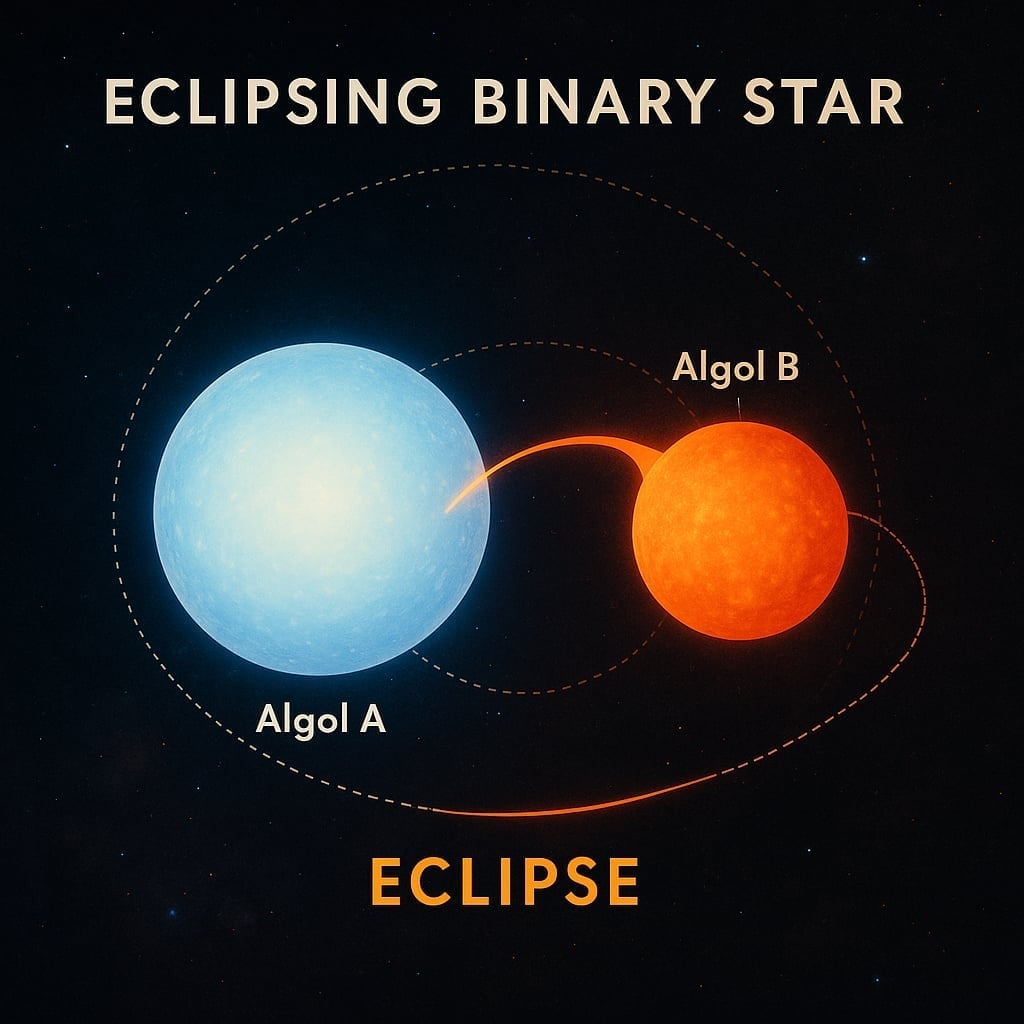
Algol's eclipsing binary: every 2.867 days, Algol B passes in front of Algol A, dimming the system for exactly 10 hours. The "Demon Star" operates on a schedule.
The star dims. For exactly 10 hours, its magnitude drops from 2.1 to 3.4, falling to half its normal brightness. You can watch this happen with your naked eye. Then, just as predictably, it brightens again.
The Algol Paradox
But Algol had a deeper secret. In the 1950s, astronomers realized something impossible: the companion star (Algol B) that eclipses the primary (Algol A) is less massive but more evolved. This shouldn't happen. More massive stars evolve faster—they burn their fuel quicker and die younger.
How could the less massive star already be in its subgiant phase while the more massive one was still on the main sequence?
The answer revolutionized stellar evolution theory: mass transfer.
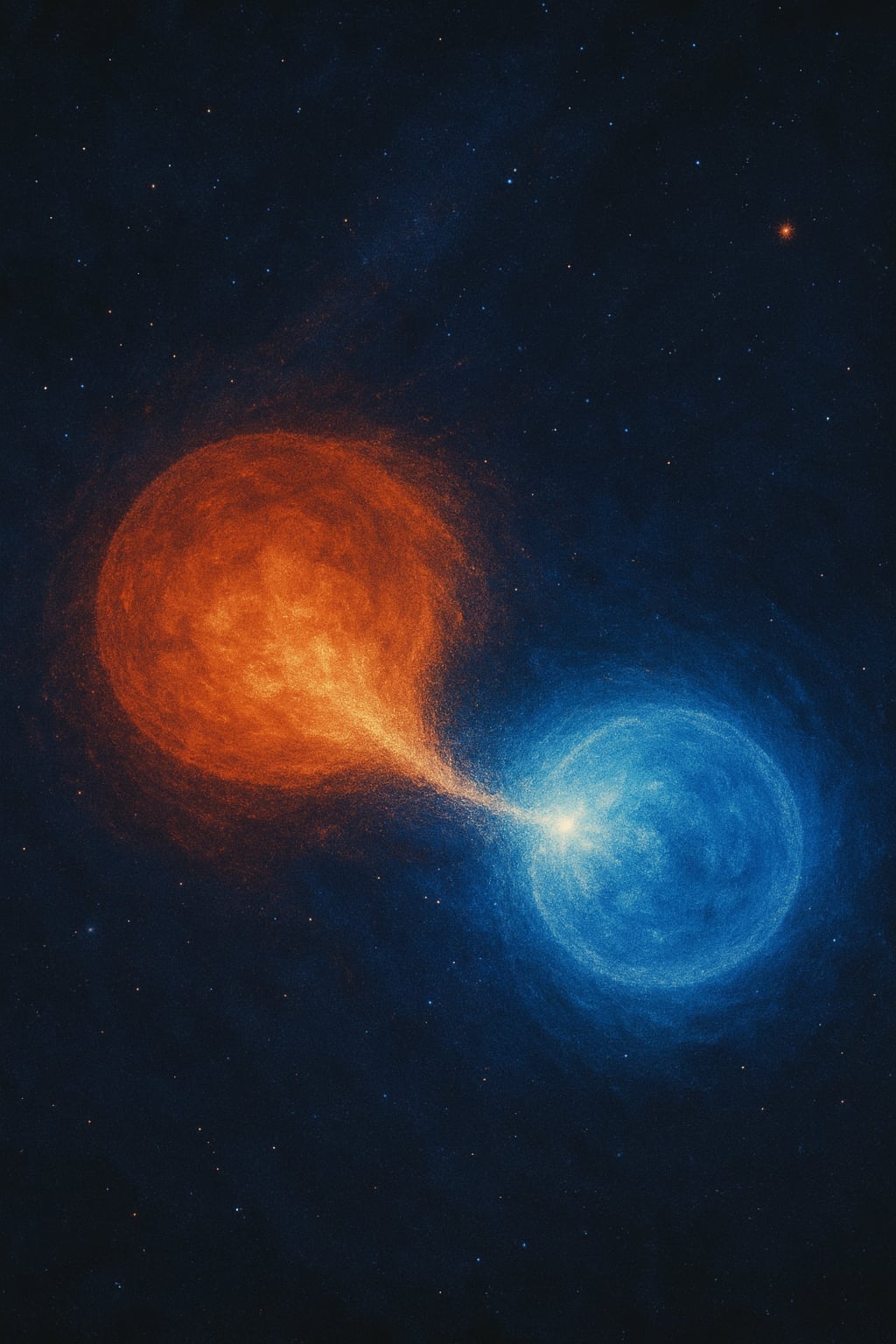
The Algol Paradox solved: Algol B was originally more massive, evolved first, and spilled its atmosphere onto Algol A. What eclipses you can become what feeds you.
Originally, Algol B was more massive—perhaps 3-5 times the Sun. It evolved first, swelling into a subgiant. As it expanded, its outer layers reached beyond its gravitational boundary and spilled onto Algol A. Over millions of years, Algol B shed roughly 70% of its mass to its companion.
Algol A consumed what eclipsed it.
The companion that blocks its light every 2.867 days is the same companion that fed it mass, that made it brighter, that renewed it through confrontation.
The challenge and the feeding are inseparable.
This is the physics of renewal through challenge: what eclipses you can only do so because you're in gravitational relationship with it. And if you're close enough for it to block your light, you're close enough to consume its mass.
Perseus and Medusa
Algol marks the eye of Medusa's severed head in the constellation Perseus. The mythology is precise:
Perseus needed to kill Medusa—a Gorgon whose gaze turned people to stone—but couldn't look directly at her. Athena gave him a polished shield. He used it as a mirror, approached Medusa while she slept, and beheaded her with one stroke.
He kept the head. It remained powerful. He used it as a weapon—turned the sea monster Cetus to stone to save Andromeda, turned King Polydectes to stone when the king who'd sent him on the suicide mission tried to claim his mother. Eventually, he gave the head to Athena, who mounted it on her aegis.
The monster he faced became the power he wielded.
And there's more: from Medusa's severed neck sprang Pegasus, the winged horse. From horror came mobility. From confrontation with what petrifies came the capacity for flight.
Medusa herself has a darker story. She wasn't born a Gorgon. She was a beautiful mortal woman whom Poseidon raped in Athena's temple. Athena, enraged but blaming the victim, cursed her—turned her hair to snakes, made her gaze petrifying, transformed beauty into horror.
The monster Perseus had to kill was created by violation and unjust punishment.
Sometimes the challenge that blocks your light was created by systemic injustice. Sometimes renewal requires confronting horrors that should never have existed. The severed head you carry may hold weight you didn't create but must now wield.
Historical Layers
Ancient Near East
Babylonian astronomers tracked Algol as part of the constellation they called "The Old Man." They noticed its variability across generations—the way it sometimes appeared dimmer than expected. They didn't understand eclipsing binaries, but they knew: this star changes.
They called it an evil omen. But they kept watching.
By the medieval Arabic period, the star had its definitive name: Ra's al-Ghūl, the Demon's Head. A ghoul in Arabic folklore is a corpse-eating creature that lurks in graveyards and deserts, a shapeshifter that lures travelers to their deaths. Specifically: a beheaded demon, a severed head that retains its power.
The name entered English through this tradition. "Ghoul" comes from "ghūl." Algol carries that etymology—the monster that feeds on death but has itself been defeated, beheaded, rendered into a tool rather than a threat.
Medieval and Renaissance Astrology
Medieval astrologers classified Algol as the most malefic star—worse than Mars, worse than Saturn. Its nature was said to combine Saturn's restriction and death with Jupiter's expansion, creating a signature of transformation through crisis.
If Algol was prominent in your chart, you would face violent reversals, beheadings (literal or metaphorical), sudden losses of position.
But astrologers also noticed a pattern: military commanders often had Algol prominent. So did surgeons. So did revolutionaries. Those who "cut" to heal, who "behead" old orders, who face death to lead others through it—these were Algol natives.
The star didn't promise safety. It promised transformation through necessary confrontation.
By the Renaissance, as astronomy advanced, some astrologers began questioning whether Algol's "evil" was truly chaotic. If the dimming happened on a precise schedule, if the demon operated with mathematical regularity, was it still a curse?
Or was it a lawful challenge—a scheduled initiation rather than random destruction?
The teaching shifted: not "this star is cursed," but "this star will eclipse you predictably, and if you prepare, you can survive the darkness and emerge transformed."
The Three Phases
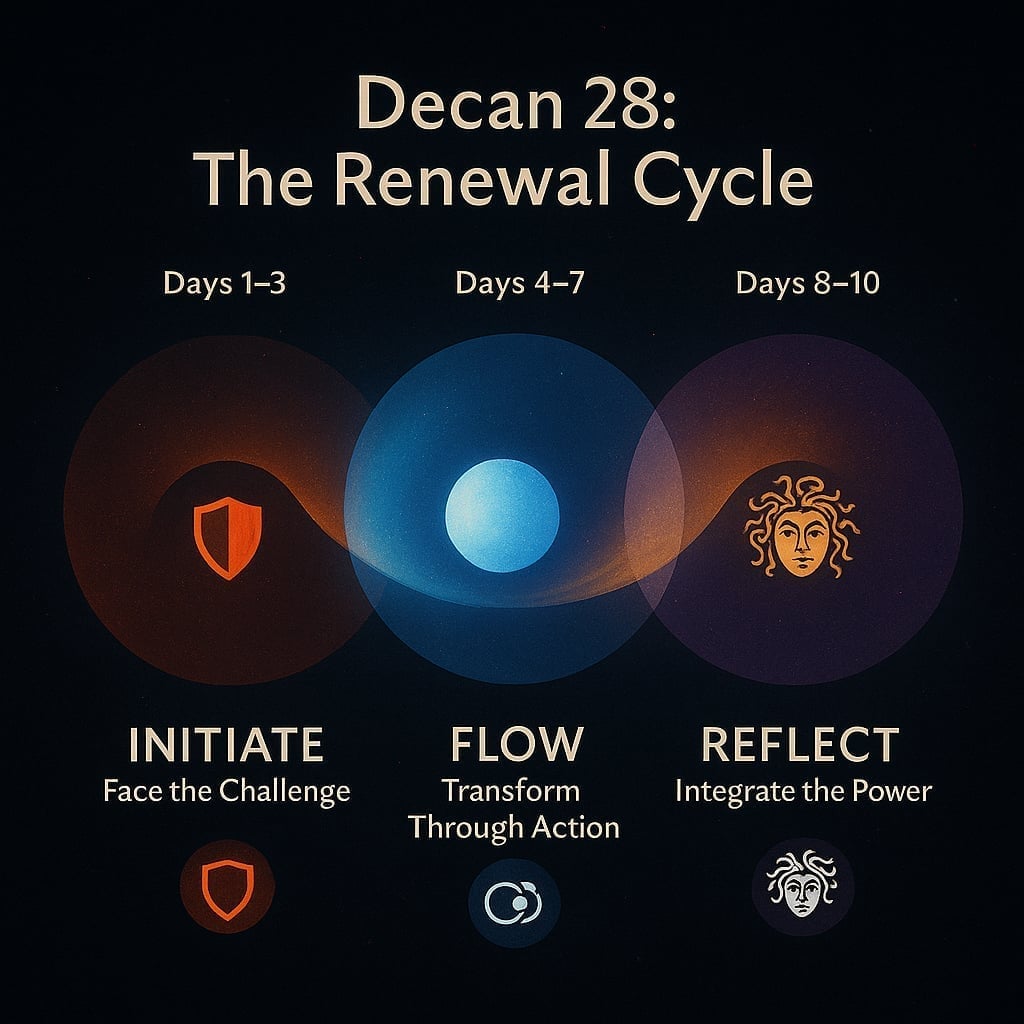
The 10-day rhythm: Initiate (Days 1-3) → Flow (Days 4-7) → Reflect (Days 8-10). Each phase has its practices, its energy, its purpose.
Phase 1: Face the Challenge (Days 1-3)
The first nights, Algol rises in the northeast. You locate it—the eye of Medusa's severed head. You watch for the eclipse. You name what's blocking your light.
This is confrontation and recognition. Like Perseus approaching Medusa with shield raised, you're aware the danger is present but not yet engaged. The challenge announces itself. You feel the orbital mechanics begin.
The practices are preparatory:
- Write down what's eclipsing you. Be specific. Project, relationship, pattern, fear—name it.
- Study the rhythm. Does this challenge appear cyclically? Can you map when it returns?
- Gather your tools. Perseus didn't face Medusa with bare hands. What do you need? (Time, support, knowledge, the equivalent of a polished shield)
- Define your method of indirect observation. What lets you look at this problem without being petrified?
Watch Algol dim (likely December 16). See the predictable eclipse. Understand: the challenge isn't random. It follows a schedule.
Phase 2: Transform Through Action (Days 4-7)
You engage directly. The beheading. The mass transfer.
Like Algol B spilling its atmosphere onto Algol A over millions of years, you're in the process of consuming the challenge, integrating its power. This is the work. The sword strikes. The head severs. The blood creates Pegasus.
The practices are active:
- Execute the decisive action you've been avoiding. (Conversation, decision, commitment—the thing that requires you to swing the sword)
- Contain what you've cut off. Don't destroy it; transform it. Perseus put the head in a bag. You need your equivalent—a way to hold the danger without being consumed by it.
- Track what you're gaining. Strength? Clarity? Boundaries? Notice the mass transfer happening.
- Watch multiple eclipse cycles (December 19, 22). Each one teaches rhythm. The pattern becomes internalized.
- Identify the new mobility. What wings are emerging from this confrontation's blood?
This is when you realize: the challenge and you are gravitationally bound. You orbit each other. What diminishes you also feeds you.
Phase 3: Integrate the Power (Days 8-10)
Perseus holds Medusa's head aloft. What petrified you now protects you.
The challenge has become your weapon. You carry it differently—not as burden but as tool. The severed head still has power, but now it's yours. You've completed the mass transfer. You're brighter for what you consumed.
The practices are consolidating:
- Inventory your gains. List what you possess now that you didn't 10 days ago. (Skills, boundaries, clarity, power)
- Test the weapon. Use your new capability in a small way. Turn an obstacle to stone—metaphorically.
- Honor the monster. Medusa was a victim before she was a threat. Sometimes challenges emerge from injustice.
- Observe Algol one last time (December 22 or 24). Watch with gratitude for what this star taught you.
- Prepare for transition. Alderamin—Leadership through Service—begins December 25. How does wielded power prepare you to serve?
You've watched the full cycle multiple times. The pattern is internalized. Algol isn't cursed. It's teaching binary dynamics, mass exchange, renewal through challenge.
Like Algol returning to magnitude 2.1 after each eclipse, you emerge bright again.
Daily Tracking
For each day of this decan, track:
Renewal through Challenge Actions:
- Named what's eclipsing me / identified the pattern
- Took decisive action toward confrontation
- Noticed what I'm gaining from this challenge
- Practiced seeing obstacle as part of my system (not external enemy)
- Used new power/tool gained from previous challenges
Algol Observation:
- Observed tonight: Yes / No / Cloudy
- Subjective experience: (How did Algol feel to observe?)
Theme Resonance (1-10):
- Score: __/10
- Notes: (How much did today resonate with Renewal through Challenge?)
Finding Algol
After sunset, face northeast. Find Cassiopeia—the distinctive "W" shape made of five bright stars, high in the sky. From the rightmost star, draw an imaginary line downward. You'll encounter Perseus, a loose cluster of moderately bright stars.
Algol is in the middle of Perseus, marking the eye of Medusa's head. Normally it shines at magnitude 2.1, similar to Polaris. If you observe it and find it noticeably dimmer (magnitude 3.4), you're witnessing an eclipse.
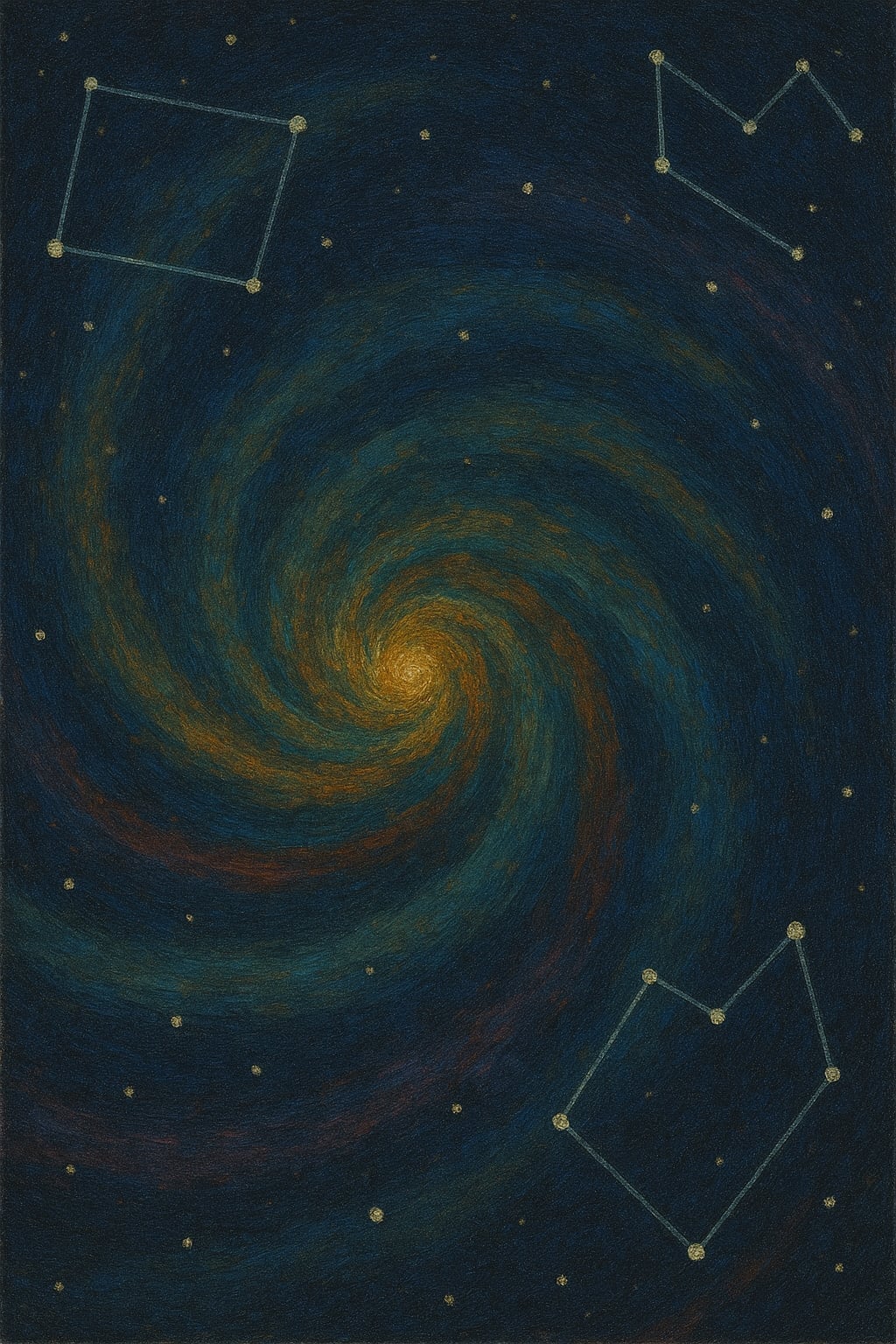
Locate Cassiopeia's "W" in the northeast, draw a line downward to Perseus. Algol marks Medusa's eye—the middle star of the constellation.
Three eclipses occur during this decan (approximately December 16, 19, and 22). Each lasts about 10 hours. The pattern is predictable. Check AAVSO predictions for precise times.
When you observe, contemplate this: What eclipses me is part of my system. What challenges me has made me what I am. This dimming is predictable. This darkness ends.
If you catch an eclipse, watch the "Demon Star" wink. Remember: it will brighten again. It always does.
End-of-Decan Review
On December 24, ask:
About the Challenge:
- What eclipsed my light during these 10 days? Name it specifically.
- What action did I take? (Conversation? Decision? Boundary?)
- What observable changes occurred? (New capability? Shifted relationship? Dissolved fear?)
- What did I gain from confrontation? (List specific strengths, tools, insights)
- Did I wield what I feared? (The Perseus moment—severed head as weapon)
About the Pattern:
- Did this challenge follow a rhythm like Algol's 2.867-day cycle?
- Did viewing the obstacle as part of my system (not external enemy) change anything?
- Did I experience "feeding on what eclipses me"? How?
About the Observation:
- How many nights did I observe Algol? (Target: 5-7)
- Did I witness an eclipse?
- What did the nightly ritual add that journaling alone wouldn't provide?
Confirmation Bias Check:
- How much was genuine transformation versus seeing what I wanted to see?
From Decan 27 (Mirach):
- How did compassionate reflection prepare me to face challenge?
To Decan 29 (Alderamin):
- How does wielded power enable service to others?
Preparing for Alderamin
On December 25, Decan 29 begins. Alderamin—Alpha Cephei, the brightest star in Cepheus—marks the shoulder of the King. The theme shifts from "Renewal through Challenge" to "Leadership through Service."
Perseus holds Medusa's head. Cepheus wears the crown.
From wielding power to serving with it. From confrontation to stewardship. From proving yourself to demonstrating what that power is for.
Ask on Day 1 of the next decan:
- "The challenge I faced gave me [power/tool/insight]. Who needs this now?"
- "Perseus served Andromeda by wielding Medusa's head. Who is my Andromeda? What is my Cetus?"
- "What are my duties?"
Watch Perseus set in the west as Cepheus rises in the north. The constellation wheel turns. Your power has purpose.
The Stellar Physics
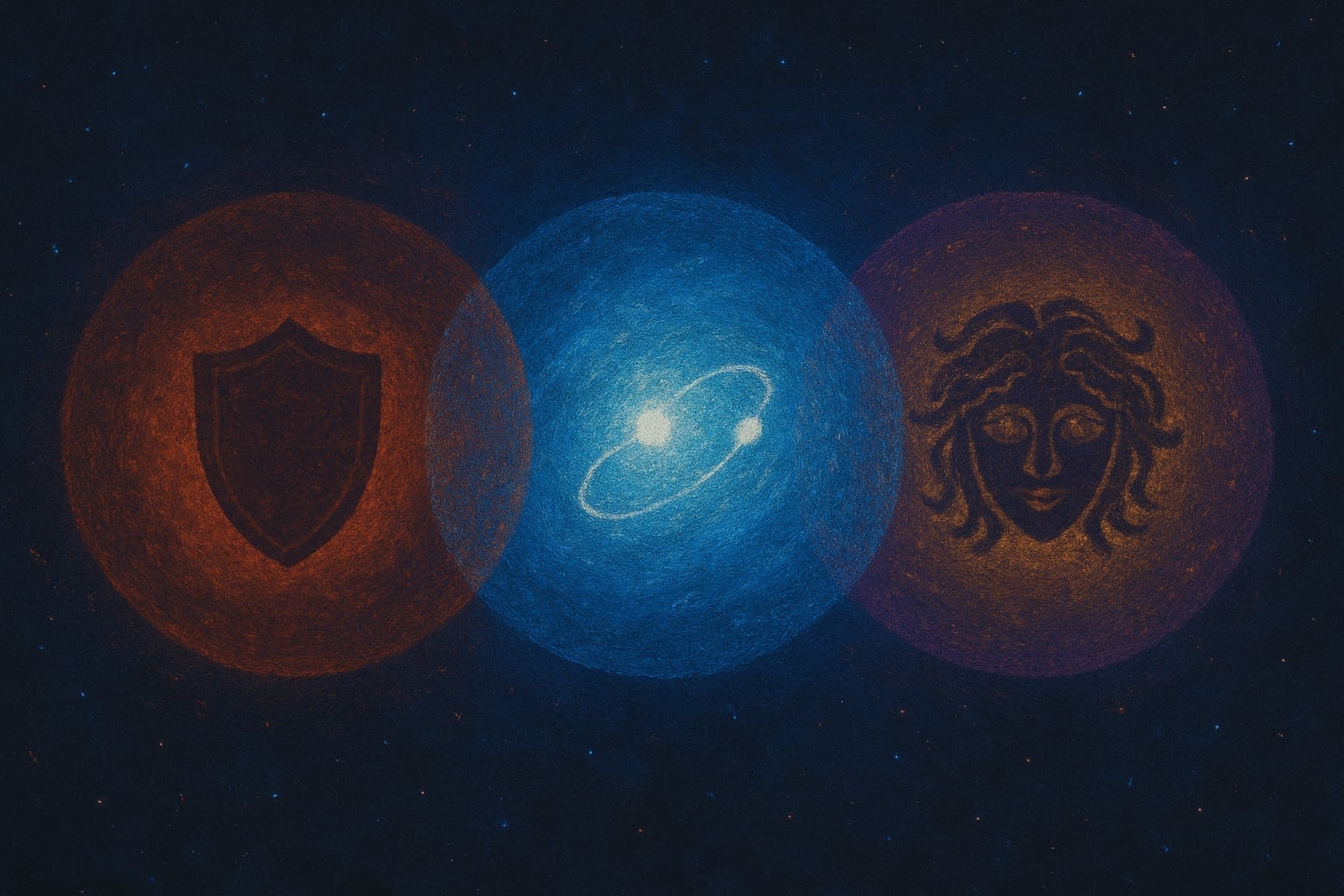
Algol A (3.17 solar masses, young) and Algol B (0.70 solar masses, old) shouldn't exist this way—unless mass was transferred. The paradox reveals the feeding.
Algol A (the bright primary): 3.17 solar masses, still on main sequence, young phase.
Algol B (the dim companion): 0.70 solar masses, already a subgiant, old phase.
This shouldn't be possible. More massive stars evolve faster. Algol A should be older, not younger.
The solution: mass transfer. Originally, Algol B was more massive. It evolved first, swelled into a subgiant, reached beyond its gravitational boundary. Its atmosphere spilled onto Algol A. Over millions of years, it shed ~70% of its mass to its companion.
Now Algol B is stripped, dim, evolved—the challenge that was faced.
And Algol A is bright, massive, rejuvenated—the self fed by the challenge.
The companion that eclipses Algol's light is the same companion that fed it mass.
The eclipse and the feeding are inseparable. You can't have one without the other.
This is not metaphor. This is physics.
The challenge that eclipses you can only do so because you're in gravitational relationship with it. If you weren't, it would just be a distant star, irrelevant to your system. The fact that it blocks your light means you're close enough to eventually consume its mass.
Every 2.867 days, Algol dims for exactly 10 hours. Predictable. Cyclical. Temporary.
The dimming is not random—it follows orbital mechanics. The darkness is not permanent—10 hours, then brightness returns. The pattern reveals the system.
The dimming is not random—it follows orbital mechanics.
The darkness is not permanent—10 hours, then brightness returns.
The pattern reveals the system—two stars in gravitational dance, not one star cursed.
For three thousand years, humans called this the Demon Star. They saw unpredictable dimming and called it evil. They didn't understand eclipsing binaries. They didn't understand mass transfer. They saw challenge as enemy.
John Goodricke discovered the truth: the dimming is predictable. The "demon" operates on a schedule. What appears cursed is actually systematic.
Renewal through challenge means recognizing your obstacles follow rhythms, are part of your system, and feed you power if you're in gravitational relationship with them.
Algol proves it: the monster that eclipses you can become the mass that makes you brighter.
Resources
For Understanding Algol:
- AAVSO Variable Star of the Month archives (search "Algol")
- Richard Hinckley Allen, Star Names: Their Lore and Meaning (1899)
- Wikipedia: "Algol" and "Algol Paradox"
For Observing:
- Stellarium (free planetarium software)
- AAVSO Light Curve Generator (eclipse predictions)
- Sky & Telescope articles on Perseus
- Clear Outside app (astronomy weather forecasting)
For Renewal Through Challenge:
- Viktor Frankl, Man's Search for Meaning
- Ryan Holiday, The Obstacle Is the Way
- Nassim Nicholas Taleb, Antifragile
- Joseph Campbell, The Hero with a Thousand Faces
- Pema Chödrön, When Things Fall Apart
For Perseus/Medusa Mythology:
- Ovid, Metamorphoses (Book IV)
- Robert Graves, The Greek Myths
Your obstacles follow rhythms. They return on schedules you can map. They're not external enemies—they're part of your system, your orbit.
If you confront them with Perseus's tools—the polished shield, the winged sandals, the bag to contain the severed head, the unbreakable sword—you can behead the monster and wield its head.
The next 10 days will eclipse you. Something will block your light. Watch for it. Track when it appears. Study its rhythm. Then face it.
Remember: What challenges you has made you what you are. What eclipses you can become what feeds you.
Algol proves it. Every 2.867 days, the demon winks. Every time, the brightness returns.
Previous Chapter: Decan 30: Polaris - True North (From the previous cycle)
Next Chapter: Chapter 29: Alderamin - Leadership Through Authority
© 2025 Joshua Ayson. All rights reserved. Published by Organic Arts LLC.
This chapter is part of The Decan Log: A 10-Day Journaling System Aligned with the Stars. All content is protected by copyright. Personal use encouraged. Unauthorized commercial reproduction prohibited.