Decan 28: The Demon Star Teaches Renewal Through Its Eclipse
Ten days under Algol, the eclipsing Demon Star. The hard days came back like its dimming, and I used the star as a frame: this part does not get easier, but I get more prepared for it.
Part of The Decan Log: For the cosmology, astronomy, and journaling framework behind this decan, read the Algol chapter. New to decanal journaling? Start with the Introduction.
Opening
These ten days were not a smooth cycle, and I knew going in they would not be. I came into Algol off a stretch that had me run down, and the star I was tracking is the one the ancients called a demon. That turned out to be the right backdrop. Some weeks you do not get to fix what is happening. You get to weather it, and then you get to understand it afterward.
What Algol gave me was a frame for that. The star does not break the rules of the night sky. It dims, then it brightens, then it dims again, on a clock you can set your watch to. Learning that the dimming was a pattern and not a verdict changed how I sat inside the hard days.
If you are new here, a decan is a ten-day reflection cycle tracked through The Decan Log.
The Star and the Signal
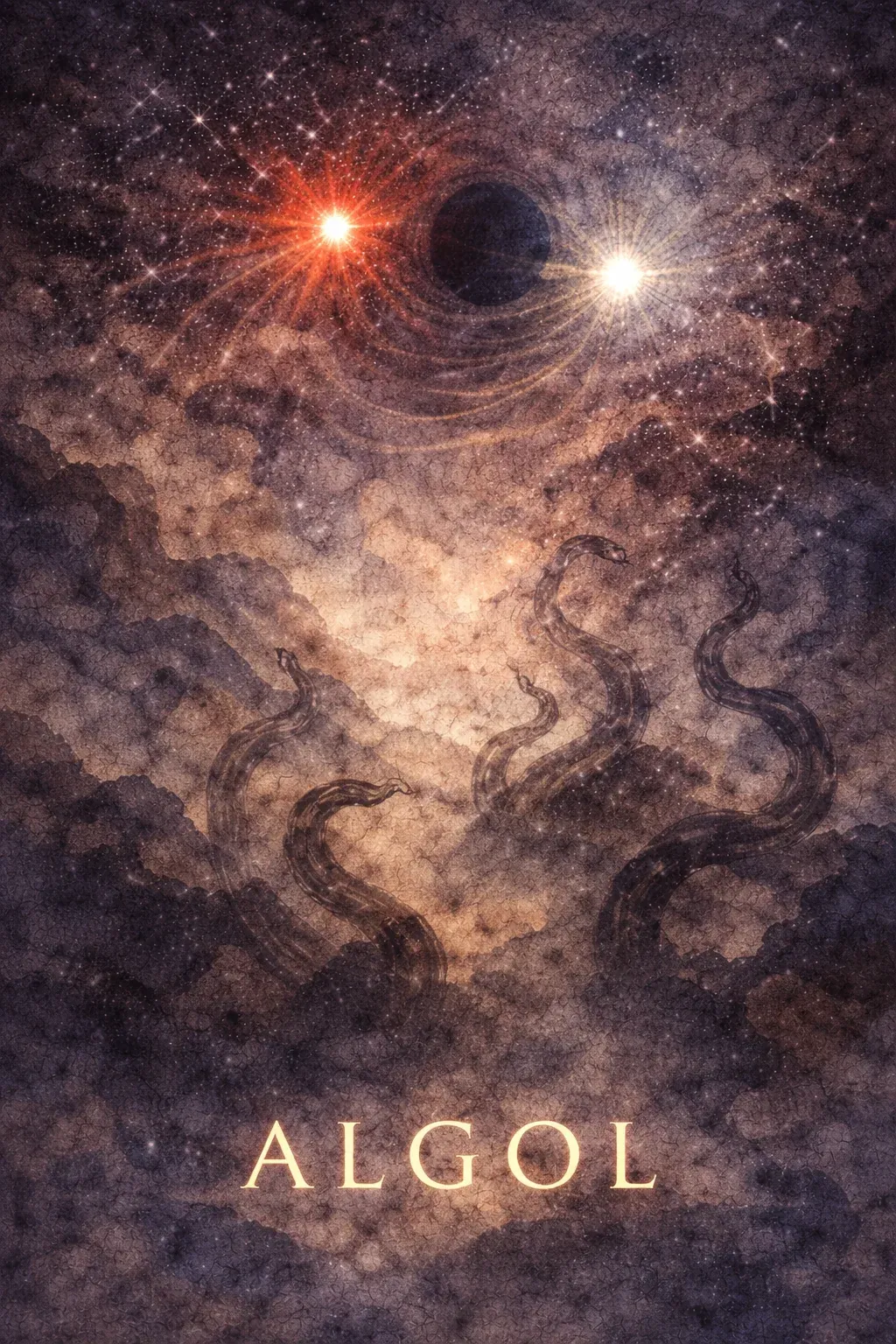
Algol is Beta Persei, and it is the most famous variable star in the sky. Its brightness drops from magnitude 2.1 to 3.4 and climbs back, every 2.867 days, on a loop. The star itself is not changing. Algol is two stars orbiting each other, and when the dimmer one passes in front of the brighter one, we watch the light fall for about ten hours and then return. That is all the demon ever was. A wink.
The name comes from the Arabic al-ghul, the ghoul or the demon. The Chinese called it the fifth star of the great mausoleum. The Hebrews called it the head of Satan. Every culture that watched the sky long enough flagged this one as wrong, because everyone believed the stars were fixed and eternal, and here was one that kept dimming. They were not wrong to notice. They were wrong about the cause. Nothing is broken in Algol. It is just a clock you can see.
In the constellation, the star marks the eye of Medusa's severed head, the one Perseus carries. That mapping stuck with me all cycle. What turns you to stone if you look at it directly is the same thing Perseus later uses as a weapon. The gaze that petrifies becomes the tool that protects. The eclipse that terrifies is also the pattern that, once you know it, you can survive on schedule.
Over these ten days our part of the universe kept moving toward the Great Attractor. The cosmos does not stop to let you recover, and neither did the orbit I was sitting inside. Challenges came back on a period. That is not weakness. That is mechanics.
What Is a Decan?
I track consciousness in ten-day cycles aligned with stars, adapted from the ancient Egyptian calendar. Thirty-six decans of ten days make 360, and five days outside time close the year. Each decan has a ruling star, a theme, and three phases: Initiate, Flow, Reflect.
Decan 28 belongs to Algol and centers on renewal through challenge. December 15 to December 24, 2025. The star does not summon the hard days. But watching for the pattern turned the suffering into something I could read.
Initiate: Discipline Before Action (Days 1-3)
The cycle opened by asking me to wait. Not every opening is one you take. Better to hold for the right conditions than force a bad entry and pay for it. Perseus did not charge Medusa. He waited for the polished shield first.
So the first days were about structure before anything else. The smallest version of that is the bed made in the morning, the one task finished before the day gets a vote. I have written about Admiral McRaven's Make Your Bed idea before, and the reason it matters here is timing. When the eclipse hit on Day 2, the foundation I had built in those first days was what I stood on.
Then the dimming came, right on schedule. Sleep fragmented. Energy dropped. My mood soured without a reason I could point to, and my tolerance for noise and advice and questions went to nothing. There was nothing to solve. There was only the day to get through. That is the binary star in my own week. The companion crosses, the light falls, and you wait it out rather than fight it.
The thing the physics gave me was the longer view. Over millions of years, the star that now dims Algol is the same one that fed it mass. What eclipses the brighter star is what made it bright in the first place. The source of the dimming was also the source of the strength. I held onto that on the worst day.
By Day 3 the energy came back, the way the light always does. The eclipse passed on schedule, and knowing which phase I was in changed how I had experienced the whole thing. The bad day stopped feeling like a random ambush and started feeling like a point on a curve I could see.
Flow: The Pattern Repeats (Days 4-7)
The middle of the cycle was the dimming and the brightness trading off, the way Algol trades them. Day 4 was off again, energy moderate, focus scattered. Day 5 came back to full brightness, flow state, sharp work. Day 6 the writing kept moving and I started preparing for the next decan while still sitting inside this one, Perseus already walking with the head in the bag before the next fight. The strain showed up in the systems connected to me, though. The eclipse does not stay personal. It ripples outward into everything attached to you.
Day 7 was the long eclipse. Low energy, drained, scattered, and it ran longer than the ten hours Algol takes. That is the part of the lesson that matters most. Some binary systems orbit in days, and some orbit in weeks or months or years. Sleep and mood run on a short clock. Deeper patterns run on a long one. Same physics, different period, both predictable if you track them long enough.
That was the day I wrote this down:
⊕ "This part doesn't get easier but I get more prepared and resilient."
That is the whole star in one line. The eclipse is going to return. The companion is going to cross again. You do not solve orbital mechanics, you learn them, and the learning is the resilience. I kept tending what mattered through the drain instead of waiting for the drain to lift first. That is the thing Algol actually builds.
Reflect: Integration and the Polished Shield (Days 8-10)
Day 8 was quiet, the kind of integration that happens with no output to show for it. The eclipse keeps its clock whether you are watching or not.
Day 9 turned toward what was next:
⊕ Stepping into new territory.
Larger work, different risks. Renewal through challenge turned out to mean upgrading the approach rather than holding it steady. I set boundaries for the transition and shifted roles deliberately, Perseus setting down the sword and picking up different tools, the head still in the bag while he walks toward the next thing.
Day 10 closed the way it opened, with the sleep disrupted again, the same dip I had on Day 2 and Day 4 and Day 7. The pattern completed on the final day. But this time there was something on top of the dimming:
⊕ "It was very helpful to have the backdrop of Algol and the framework of the decans to help guide my ship through tough waters."
That is the part worth keeping. The decanal system itself worked like Athena's polished shield. Perseus could not look at Medusa directly without turning to stone, so he watched her reflection in the shield and struck from that. I could not always look at the hard week head on, but I could look at it through the star and the myth, and that gave me enough distance to keep moving. The framework did not remove the challenge. It let me see it sideways instead of raw.
The myth holds the rest of it. Medusa was a victim first, assaulted and then punished for it, turned monstrous for something done to her. The pattern of being punished for being harmed is an old one and a real one. Reading the week through that story instead of through plain overwhelm was the shield doing its job.
Closing
Algol was not a soft cycle. It was a survivable one, which is different.
The star taught by winking. The light dropped, the light came back, the pattern held. I did not fight the orbit. I learned it, prepared for it, sat through it, and came out the other side renewed, not because the hard part disappeared but because I finally understood the rhythm it ran on. What petrifies you can become what protects you, if you survive the eclipse long enough to learn the pattern. That is renewal through challenge. That is Algol.
Next the crown replaces the severed head. Perseus proved he could survive the monster. Cepheus has to prove he can serve with the power afterward. The work turns from enduring the challenge to using what the challenge gave you, for someone other than yourself.
From the notebook during this decan: The Raw Thoughts of a Biological LLM, four days of freewriting, December 17 to 21.
Decan Navigation
Previous: Decan 27: Mirach / Sustained Warmth.
Next: Decan 29: Alderamin / When Crown Replaces Severed Head.