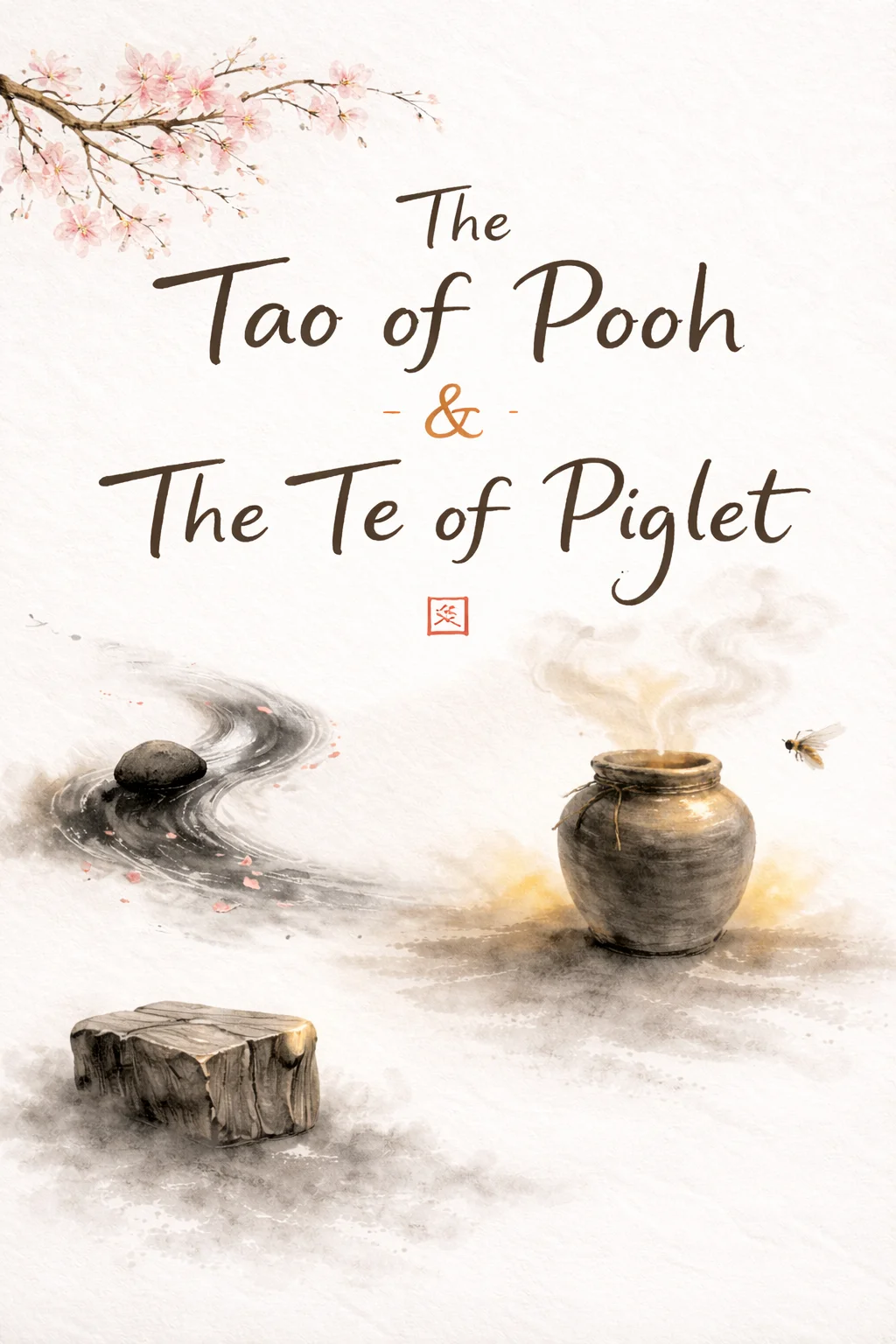
The Tao of Pooh & The Te of Piglet: Eastern Wisdom Through the Hundred Acre Wood
Benjamin Hoff uses Winnie-the-Pooh and Piglet to explain Taoism in a way that actually sticks. The Tao of Pooh introduces wu wei (effortless action) and pu (the uncarved block), while The Te of Piglet explores inner virtue and the power of the small. Together in one volume, these books offer an accessible, charming introduction to Eastern philosophy that has stayed with me for years.
Introduction: Philosophy That Actually Sticks
I first encountered The Tao of Pooh years ago, and it changed how I think about Eastern philosophy. Where academic texts made Taoism feel distant and abstract, Benjamin Hoff made it immediate and personal by using characters I already knew: Winnie-the-Pooh, Piglet, Eeyore, Owl, and Rabbit.
The combined edition brings both books together: The Tao of Pooh (1982), which spent 49 weeks on the New York Times bestseller list, and its companion The Te of Piglet (1992). Having them in one volume makes sense because they complement each other perfectly. The first introduces Taoist principles through Pooh's effortless simplicity; the second explores inner virtue through Piglet's quiet courage.
Why this combined edition works:
Complete philosophy: Tao (the Way) and Te (Virtue/Power) are inseparable concepts in Taoism. Reading them together gives you the full picture.
Different perspectives: Pooh embodies wu wei (effortless action); Piglet embodies the power of the small and humble.
432 pages of wisdom: More content than buying separately, beautifully illustrated by E.H. Shepard.
One book, one journey: No hunting for the companion volume later.
For anyone curious about Taoism, seeking more presence and simplicity, or just wanting a thoughtful read that doesn't take itself too seriously, this combined edition is the way to go. (Buy on Amazon)
Book Details at a Glance
| Feature | Details |
|---|---|
| Title | The Tao of Pooh & The Te of Piglet |
| Author | Benjamin Hoff |
| Illustrator | E.H. Shepard |
| Publisher | Egmont (Combined Edition) |
| Publication Year | 2019 (Combined Edition); Original: 1982 / 1992 |
| Genre | Philosophy, Taoism, Eastern Wisdom, Spirituality |
| Length | 432 pages |
| Main Themes | Wu wei, simplicity, inner virtue, effortless action, the power of smallness |
| Key Concepts | Tao (the Way), Te (Virtue/Power), Pu (the Uncarved Block), Tz'u (Compassion) |
| Relevance Today | Essential reading for anyone overwhelmed by complexity and seeking simplicity |
| Readability | Accessible, playful, yet genuinely profound |
| Who Should Read? | Philosophy enthusiasts, mindfulness seekers, anyone drawn to Eastern wisdom, Pooh fans |
The Tao of Pooh: Effortless Being
The first book opens with the famous painting of the Vinegar Tasters: Confucius, Buddha, and Laozi each tasting vinegar. Confucius finds it sour, Buddha finds it bitter, but Laozi finds it satisfying. This sets up Hoff's central point: Taoism accepts life as it is rather than fighting against its nature.
Key concepts from The Tao of Pooh:
Wu Wei (Effortless Action): Pooh doesn't overthink. He doesn't strategize. He simply does what needs doing, when it needs doing. This isn't laziness; it's alignment with natural flow. Owl overcomplicates with knowledge, Rabbit overplans with schemes, but Pooh just acts.
Pu (The Uncarved Block): Things in their natural state, before being shaped by expectations and conditioning. Pooh's simplemindedness isn't stupidity; it's openness. He experiences things as they are, unburdened by what they should be.
The Bisy Backson: Hoff's term for the frantic modern person always rushing somewhere else, never present. We're all Bisy Backsons sometimes, convinced that happiness lies in the next achievement rather than this moment.
What I love about this book is how it uses characters I associate with childhood to explain concepts I struggle with as an adult. When Hoff shows Pooh stumbling into solutions while Rabbit's elaborate plans fail, I see my own tendency to overcomplicate.
The Te of Piglet: The Power of Small
If The Tao of Pooh is about being, The Te of Piglet is about becoming. Piglet, the small and often frightened character, becomes a symbol of inner virtue that doesn't require size or bravado.
Key concepts from The Te of Piglet:
Te (Inner Virtue/Power): Not power over others, but power from within. Piglet's strength isn't in his size but in his heart. He shows up for his friends despite his fears. That's Te.
The Virtue of the Small: In a culture that glorifies bigness, loud voices, and aggressive assertion, Piglet offers an alternative. Small actions, quiet presence, gentle persistence. These matter more than grand gestures.
Tz'u (Compassion): One of Taoism's Three Treasures. Piglet embodies caring that doesn't need recognition. He helps because helping is what you do, not for praise.
The book also examines how other characters obstruct harmony: Tigger's manic energy that exhausts everyone, Eeyore's pessimism that drains vitality, Owl's knowledge that impresses but doesn't help, Rabbit's organizing that controls rather than supports.
Why These Books Still Matter
I return to these books regularly because they address something our culture struggles with: the belief that effort, struggle, and force are the only paths to achievement. Taoism, as Hoff presents it, suggests another way.
Relevance for modern life:
Productivity culture: We're drowning in optimization, life hacks, and hustle. Pooh's effortless approach isn't anti-productivity; it's a reminder that straining doesn't always produce results. Interestingly, this creates fascinating counterpoint to disciplined approaches like Admiral McRaven's Make Your Bed—both work, but for different contexts. Use Pooh's wu wei when executing from mastery, McRaven's discipline when building foundations.
Imposter syndrome: Piglet feels small and inadequate, yet his contributions matter enormously. Te isn't about feeling powerful; it's about acting from integrity regardless of feelings.
Information overload: Owl knows everything and helps no one. Knowledge without wisdom is noise. These books advocate for understanding over accumulation.
Mindfulness movement: Before mindfulness became an industry, Hoff was writing about presence, acceptance, and natural flow using a bear who loves honey.
The combined edition is particularly valuable because Tao and Te belong together. The Way without Virtue is directionless; Virtue without the Way has no ground. Having both in one volume lets you see the complete philosophy.
Personal Takeaways
Reading these books, I'm struck by how often I'm Rabbit: organizing, planning, trying to control outcomes. Or Owl: accumulating knowledge I never apply. Or Eeyore: convinced things will go wrong so why bother.
The invitation is to be more Pooh: present, simple, trusting the process. And to be more Piglet: small but showing up, afraid but acting anyway.
Quotes that stay with me:
"While Eeyore frets and Piglet hesitates and Rabbit calculates and Owl pontificates, Pooh just is."
"It's hard to be brave when you're only a Very Small Animal." And yet Piglet is brave, because bravery isn't the absence of fear.
These aren't books I finished and put away. They're books I keep returning to, each time finding something I missed.
Final Thoughts & Where to Buy
⭐ Rating: 4.8/5
This combined edition offers something rare: philosophy that's genuinely accessible without being dumbed down. Hoff respects both Taoism and his readers, using beloved characters not as gimmicks but as genuine vehicles for understanding.
Who should read this:
- Anyone curious about Taoism but intimidated by primary texts
- Readers seeking more simplicity and presence
- People who overthink, overplan, or over-worry
- Parents looking for philosophy to share with older children
- Anyone who loved Pooh as a child and wants to revisit with new eyes
Who might skip this:
- Readers wanting rigorous academic treatment of Taoism
- Those seeking practical step-by-step guides
- Anyone who finds whimsy annoying
The beauty of this book is that it doesn't try to convince you of anything. It simply presents a way of being and lets you recognize whether it resonates. For me, it does.
📖 Buy The Tao of Pooh & The Te of Piglet on Amazon
You Might Also Enjoy
If The Tao of Pooh & The Te of Piglet resonated with you, explore these related reads:
Make Your Bed by Admiral McRaven - Fascinating counterpoint: where Pooh embodies wu wei (effortless action), McRaven teaches disciplined structure. Both approaches work—use discipline when building foundations, flow when executing from mastery.
Shoe Dog by Phil Knight - Knight's Nike memoir is the antithesis of wu wei—years of grinding, cash flow stress, and relentless effort. Yet there's wisdom here: sometimes you need the grind before you can flow. Build the foundation through discipline, then let mastery become effortless.
What I Talk About When I Talk About Running - Murakami's running memoir perfectly embodies wu wei. The state of "no-mind" (mushin) where running becomes effortless action. Not forcing, not striving, just being present with the movement. The Taoist approach to endurance.
Peace in Every Breath by Thich Nhat Hanh - Another accessible introduction to Eastern philosophy, this time through Buddhist mindfulness practices.
The Alchemist by Paulo Coelho - A parable about following your personal legend that shares Hoff's gift for making wisdom accessible.
The Stranger by Albert Camus - Where Taoism embraces acceptance, existentialism wrestles with it. An interesting counterpoint.
Antifragile by Nassim Nicholas Taleb - Modern philosophy on embracing what you can't control, echoing Taoist principles of wu wei.
Handwriting as Meditation - My own exploration of effortless flow through the practice of daily freewriting.
This post contains affiliate links. If you purchase through these links, I may earn a small commission at no extra cost to you. Thank you for supporting this blog!