Pre by Tom Jordan: The Runner Who Turned Every Race Into Art
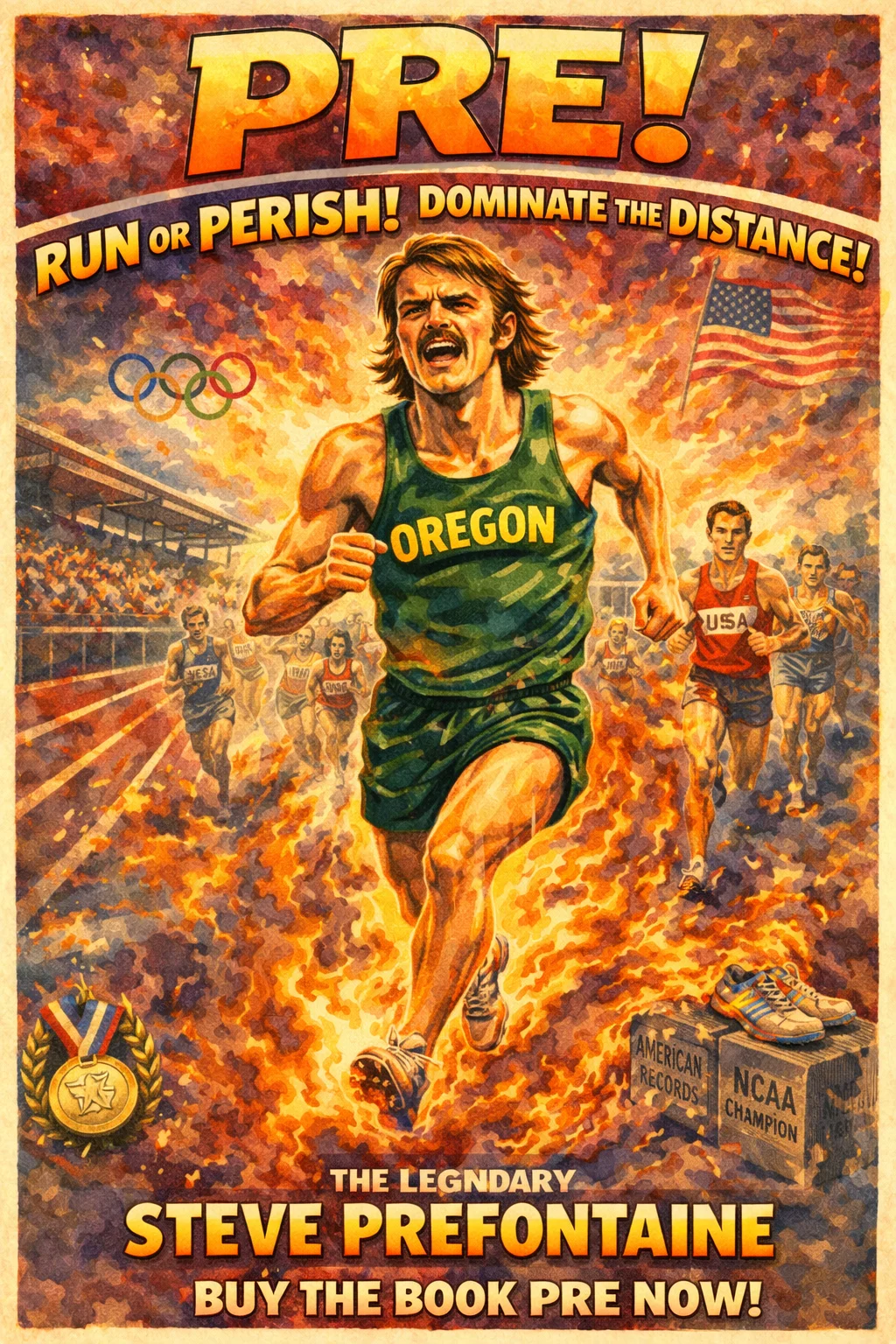
Steve Prefontaine ran every race from the front. He never sat back. He never waited. He believed racing was a creative act, that it meant making something beautiful happen on the track, and for five years no American could beat him at any distance over a mile. Then he died at 24. Tom Jordan's biography captures the full blaze.
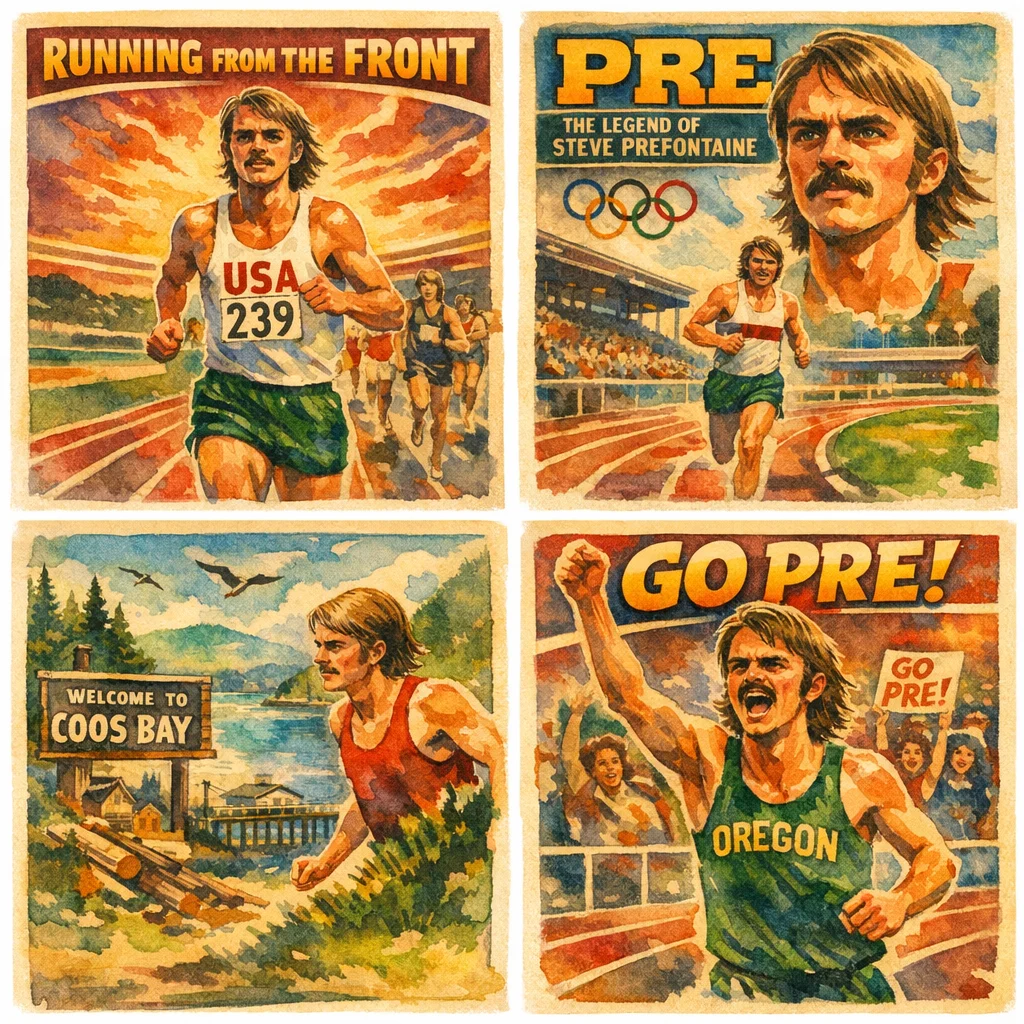
Running From the Front
There is a strategy in distance running called "sitting and kicking." You tuck into the pack, conserve energy, let someone else set the pace, and then sprint past them in the final lap. It is efficient. It is rational. It wins races.
Steve Prefontaine refused to do it.
Pre ran from the front. Every race. He took the lead early and dared people to keep up. When they did keep up, he ran harder. When his body told him to slow down, he told his body to shut up. His racing style was not a tactic. It was a declaration: I am going to show you exactly what I can do, and if you can beat that, you deserve to win.
For five years, nobody could beat it. Not at a mile. Not at two miles. Not at three miles, 5,000 meters, or 10,000 meters. From 1970 through 1975, Steve Prefontaine held every American record from 2,000 to 10,000 meters and won four consecutive NCAA titles in the three-mile run. No American distance runner had dominated like that before. Arguably none has since.
Tom Jordan's Pre tells the story of that dominance, and the life that produced it, and the night in Eugene when it ended.
Coos Bay
Prefontaine grew up in Coos Bay, Oregon, a logging town on the coast. It is the kind of place people leave. The economy depended on timber. The terrain was wet and hilly. Nothing about it suggested it would produce one of the most famous athletes in American history.
But Coos Bay had something: a high school cross-country coach named Walt McClure who recognized what Pre had. Not talent exactly, though talent was there. What Pre had was a willingness to suffer that went beyond normal teenage toughness into something almost pathological. He would run himself into the ground and then get up and be angry that the ground had stopped him.
| Feature | Details |
|---|---|
| Title | Pre: The Story of America's Greatest Running Legend, Steve Prefontaine |
| Author | Tom Jordan |
| Publication Year | 1997 (Paperback) |
| Genre | Biography, Sports, Running, American History |
| Length | ~240 pages |
| Main Themes | Excellence as creative expression, amateur athletics, front-running courage, Oregon running culture |
| Key Concept | "Running is art. It's doing something better than anyone else. It's being creative." |
| Who Should Read | Runners, competitors, anyone who believes in doing things with style and conviction |
Jordan's account of Pre's high school years is effective because he does not mythologize them. Pre was not a prodigy. He was a kid who worked harder than everyone else and had enough raw ability to make that work pay off. By the time he graduated, he was the best high school distance runner in the country. Bill Bowerman, the legendary track coach at the University of Oregon, recruited him to Eugene.
That combination, Bowerman and Prefontaine, would change American distance running.
Bowerman and the Oregon Tradition
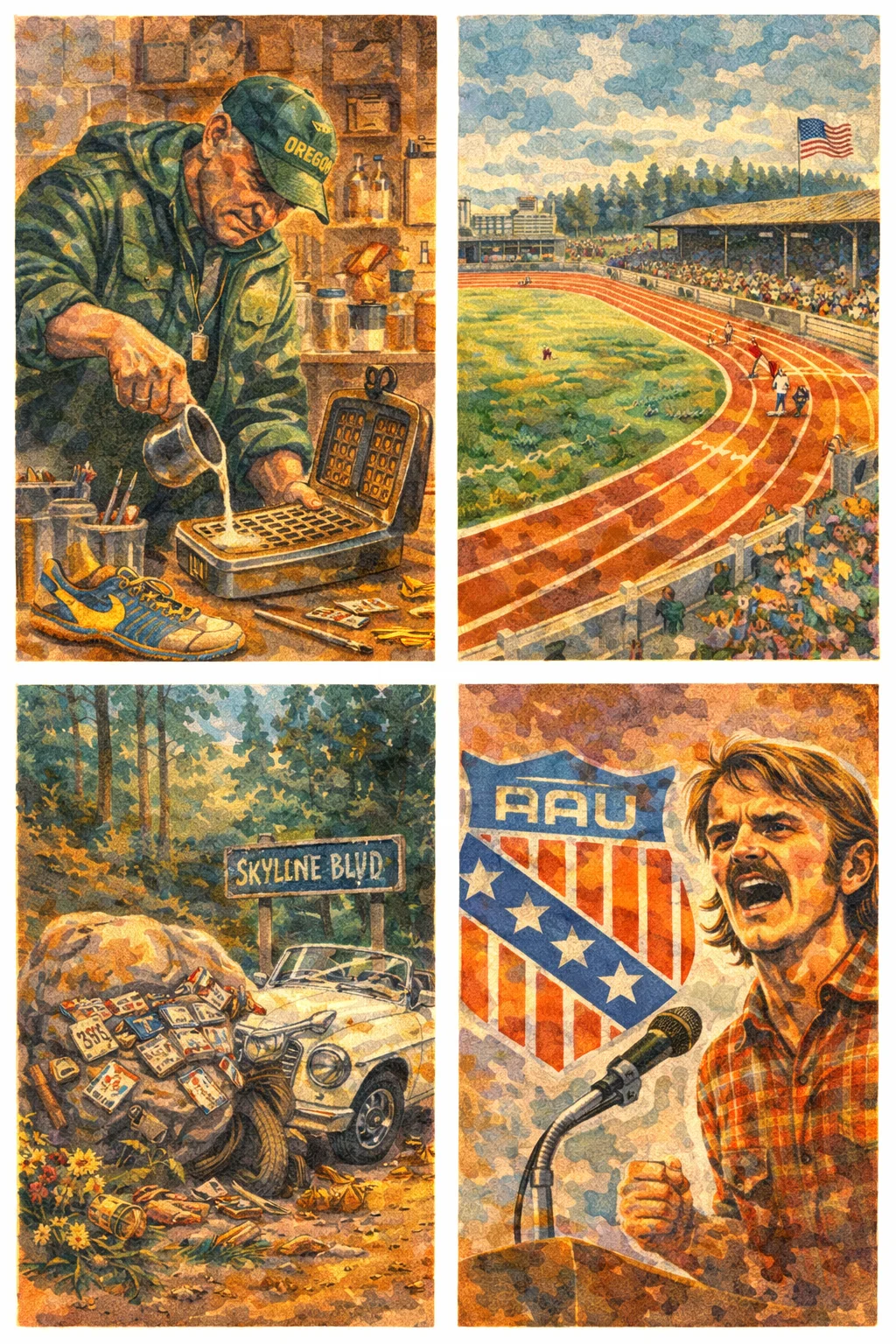
If you have read Shoe Dog, you already know Bill Bowerman. He was Phil Knight's track coach at Oregon before they co-founded Nike. He was famous for two things: training runners by holding them back rather than pushing them harder (the "hard/easy" method that is now standard), and experimenting obsessively with running shoes, pouring rubber on his wife's waffle iron to create better outsoles.
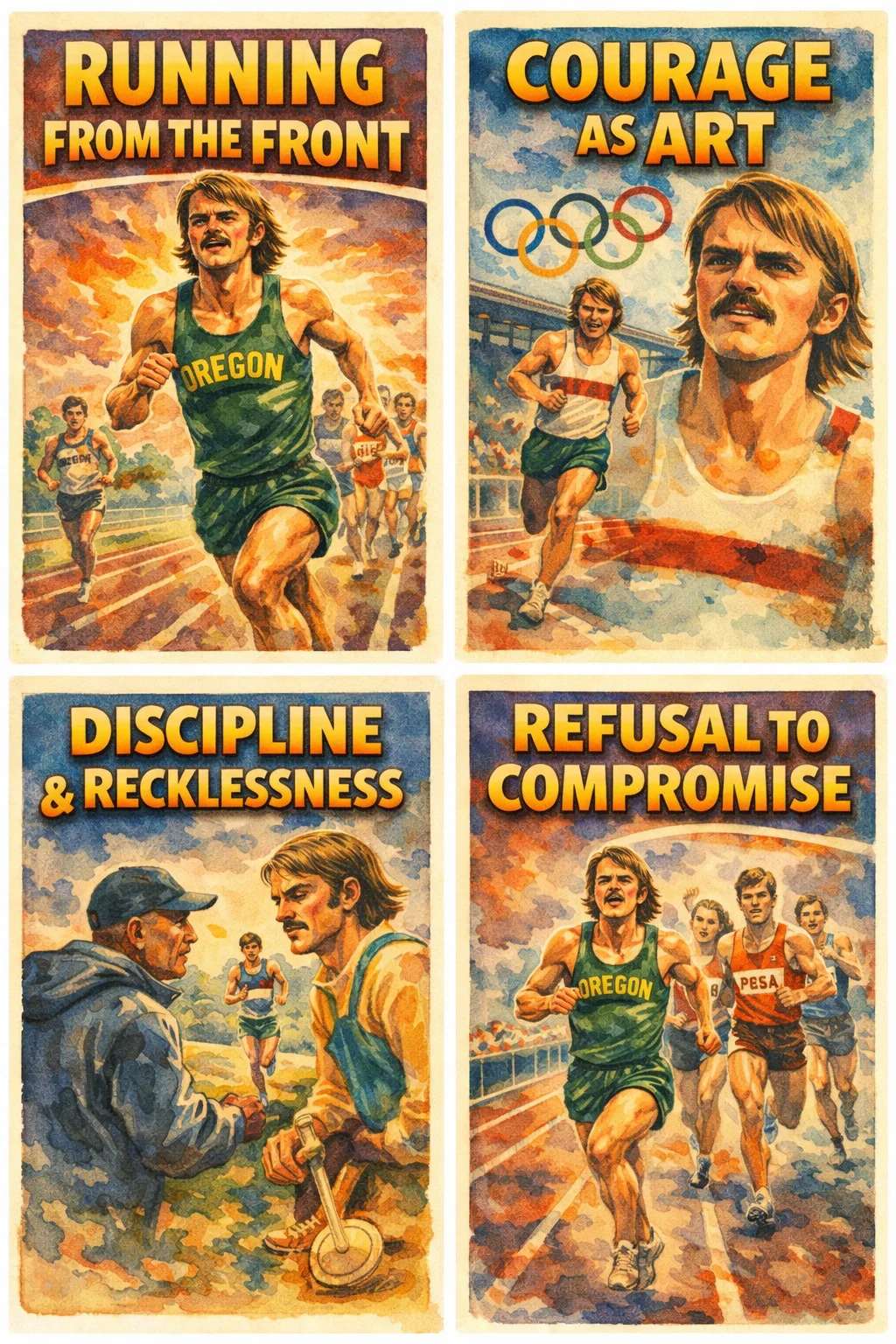
Pre and Bowerman were a perfect and impossible pairing. Bowerman believed in restraint, in keeping athletes fresh, in peaking for the right race. Pre believed in running as hard as possible every single time he stepped on a track. They argued constantly. Bowerman would design a conservative race plan. Pre would ignore it and go to the front. They respected each other deeply and drove each other crazy.
Jordan captures this dynamic with care. He does not reduce it to a simple mentor-student story. Bowerman made Pre better. Pre challenged Bowerman's assumptions about what a runner could endure. Both were right about different things, and the tension between their philosophies produced results neither could have achieved alone.
This reminded me of something I have noticed in my own creative work, and I think it applies to running too. The best results come from tension between discipline and recklessness. You need a plan. You also need the courage to abandon the plan when the moment demands it. Pre had the courage. Bowerman had the plan. Together, they were extraordinary.
Running as Creative Act
The quote that defines Prefontaine, the one that appears on T-shirts and posters and the wall of the Nike building named after him, is this:
"Some people create with words or with music or with a brush and paints. I like to make something beautiful when I run. I like to make people stop and say, 'I've never seen anyone run like that before.' It's more than just a race, it's style. It's doing something better than anyone else. It's being creative."
I have read this quote a hundred times and it still gets me.
Because he meant it. Pre did not talk about running in terms of split times and VO2 max. He talked about it in terms of beauty and style and creativity. He understood, intuitively, that there is an aesthetic dimension to competitive running that has nothing to do with the clock. Two runners can run the same time. Only one of them makes you hold your breath.
This is what I try to remember on my own runs. Not every run is a race. Most runs are just movement, just time on feet, just the trail unwinding under you in the morning light. But some runs become something more. Some days you fall into a rhythm where the effort disappears and the running becomes its own purpose. When that happens, I think of Pre. Not because I am fast. I am not fast. But because the experience of running at the edge of your ability, whatever that ability is, has a quality that transcends fitness categories.
Pre was describing flow before anyone called it that.
The Munich Olympics and What Was Taken
In 1972, Prefontaine went to the Munich Olympics as the favorite in the 5,000 meters. He was 21 years old and at the peak of his ability. He ran his typical race: front from the start, daring the field to follow.
This time, the field included Lasse Viren of Finland, who would become the greatest Olympic distance runner of his era. Viren sat back. He waited. In the final lap, he kicked past Pre and won.
Pre finished fourth. No medal.
Jordan handles this section of the book with precision. He does not make excuses for Pre. Fourth place at the Olympics is an extraordinary achievement for a 21-year-old. But Pre did not experience it as extraordinary. He experienced it as failure. He had run his race, run it from the front, and lost.
The question that haunted him afterward was whether he should change his style. Sit and kick like everyone else. Race tactically. Win the medal.
Pre chose not to. He decided that compromising his racing style to win a medal would be a worse failure than losing while running honestly. He would rather be beaten running from the front than win running from behind.
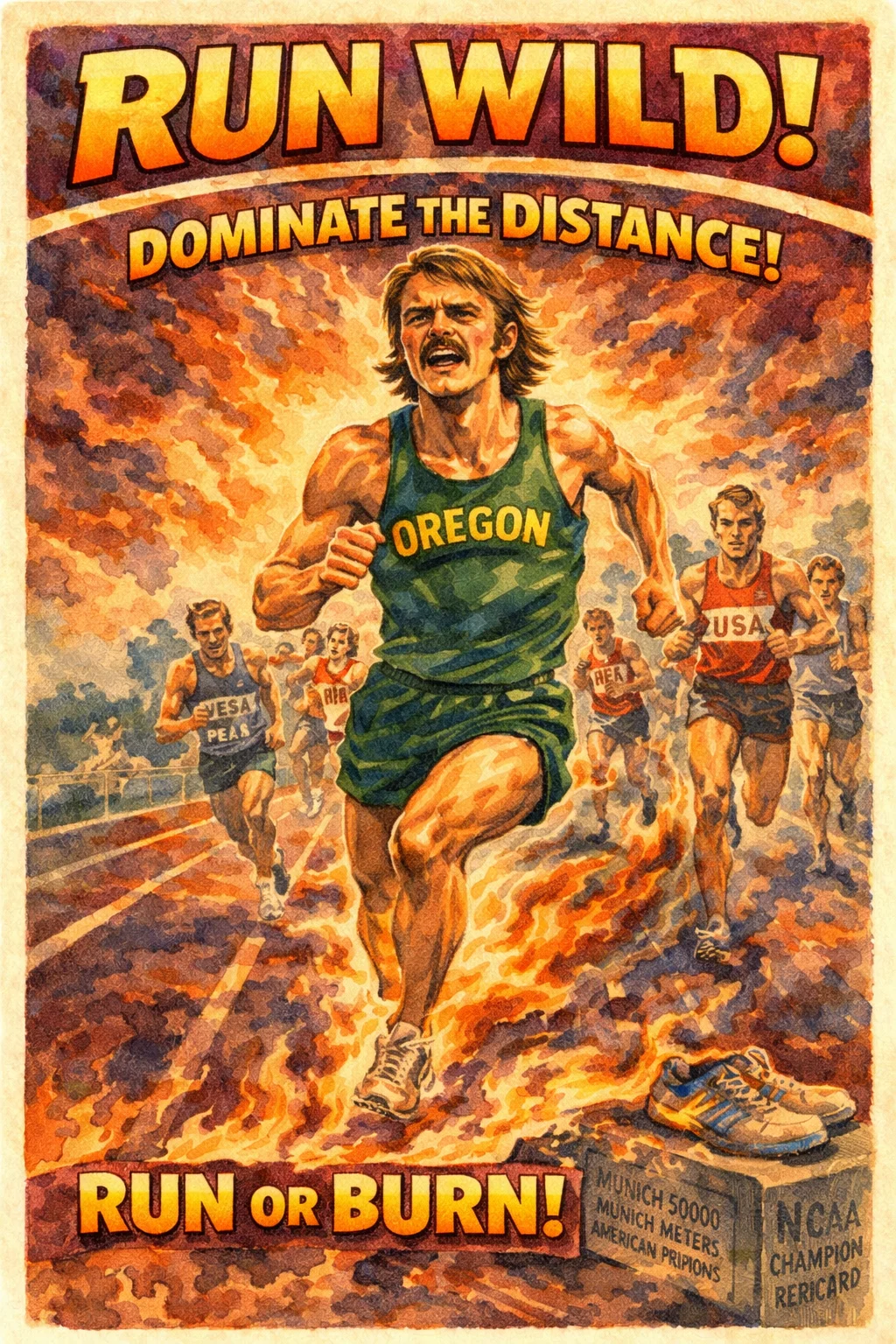
There is something in this that goes beyond sports. It is about integrity of method. It is the same principle that applies to writing, to business, to any craft: you can optimize for results, or you can commit to doing the work the way you believe it should be done. Sometimes those paths converge. Sometimes they do not. Pre chose the path of conviction.
The Fight for Amateur Athletes
The least dramatic but most important thread in the book is Pre's fight against the Amateur Athletic Union.
In the early 1970s, American track and field was governed by the AAU, which enforced strict amateur rules. Athletes could not accept prize money or endorsement deals. International meets were controlled by bureaucrats who selected athletes based on politics as much as performance. Training support was minimal.
Pre was vocal about this. He argued publicly that amateur athletes deserved better funding, better support, and more control over their competitive schedules. He hosted foreign runners in his home when the AAU would not arrange proper accommodations. He gave talks about athlete rights.
This was not a popular position. The AAU had power, and Pre was challenging it directly. But his arguments were sound, and his fame gave them reach. The reforms he pushed for (including many that were eventually enacted through the Athletics Congress and later USA Track and Field) improved conditions for generations of American athletes.
Phil Knight, who knew Pre personally and was deeply affected by his death, would later channel that same athlete-first philosophy into Nike's approach to athlete sponsorship. The line from Pre's advocacy to Nike's athlete support infrastructure is direct and documented. Knight writes about it in Shoe Dog, and reading both books together makes the connection vivid.
May 30, 1975
Pre died on May 30, 1975. He was driving home from a party at a teammate's house in Eugene. His MGB convertible went off Skyline Boulevard and flipped. He was pinned underneath it. He was 24 years old.
Jordan handles this section with restraint. He presents what is known, which is not much beyond the facts of the crash. There was no other vehicle involved. Pre had been drinking, though accounts vary on how much. The road was familiar to him. The night was clear.
The running community lost more than an athlete that night. They lost the person who was going to carry American distance running forward, who was going to go back to the Olympics in Montreal in 1976 and settle the question of whether his front-running style could win gold. They lost the voice that was fighting for amateur athletes. They lost someone who made people care about distance running who had never cared about it before.
There is a rock at the site of the crash. Runners still leave offerings there. Shoes, medals, race bibs, notes. Nearly fifty years later, they still come.
What Pre Teaches Runners
I run on the open BLM land in Nevada. Miles and miles of rolling hills where the rocks look ancient and alien, maybe transformed by countless lightning strikes. The vastness, the openness, the sheer beauty of being out there with nothing but sky above you.
I am not a competitive runner. I do not race. I run because it is the purest form of physical expression I know, because it clears my mind in ways nothing else does, because after thirty minutes of sustained effort out there in those Nevada hills, the world makes more sense.
But Pre's philosophy reaches me anyway. The idea that how you run matters as much as whether you run. The commitment to doing the thing fully, with style, without holding back. The belief that running is not suffering to be endured but beauty to be created.
Every runner has a version of this. Your pace does not matter. Your distance does not matter. What matters is whether you are present, whether you are giving it what you have, whether the running itself is good.
Pre ran every race that way. He never jogged. He never coasted. He never saved something for later.
Rating and Recommendation
4.5/5. Tom Jordan wrote a biography that matches its subject: direct, honest, and without unnecessary decoration. The prose does not try to be literary. It tries to be accurate, and in doing so it lets Pre's life speak for itself.
The book is strongest in its coverage of Pre's competitive years and his rivalry with the European distance runners who dominated the early 1970s. It is weakest in the early Coos Bay chapters, which occasionally read more like journalism than narrative. But the Munich sections, the Bowerman chapters, and the final night in Eugene are as good as sports biography gets.
If you love running, Pre is essential. If you love stories about people who refused to compromise, this is one of the best.
Buy Pre on Amazon (Affiliate Link)
Related Reading: The Running Book Quartet
This review is part of a four-book series exploring different dimensions of running:
Part 1: The Philosophical Runner
What I Talk About When I Talk About Running by Haruki Murakami. Running as meditation, creativity, and self-discovery.
Part 2: The Scientific Adventure
Born to Run by Christopher McDougall. Evolutionary running science, the Tarahumara tribe, and the barefoot movement.
Part 3: The Competitive Legend (This Post)
Pre: Steve Prefontaine's Story by Tom Jordan. Running as art, amateur athletics, and the relentless pursuit of excellence.
Part 4: The Business of Running
Shoe Dog by Phil Knight. How a love of running built one of the most recognizable brands on the planet.
Together, these four books cover the mind (Murakami), body (Born to Run), spirit (Pre), and business (Shoe Dog) of running. Read one or read all four. Each stands on its own, and together they form the best education in the culture, science, and soul of running that I know of.
This post contains affiliate links. If you purchase through these links, I may earn a small commission at no extra cost to you. Thank you for supporting this blog.