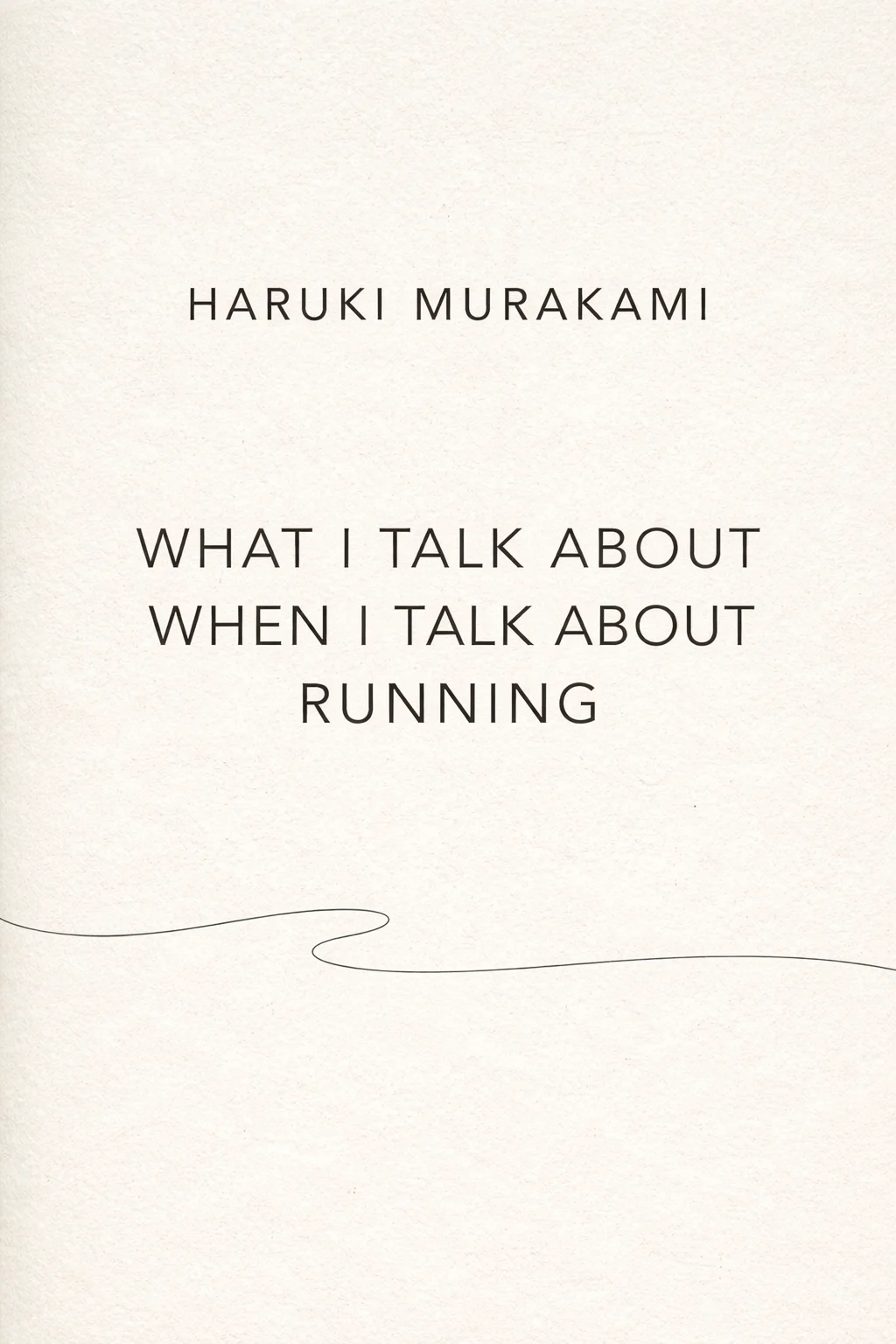
What I Talk About When I Talk About Running by Haruki Murakami
Murakami writes about running the way runners think about running: not as exercise, not as training, but as the thing itself. The rhythm of feet on pavement becomes a metaphor for the rhythm of writing, and both become metaphors for the rhythm of a life lived with intention.
The Book That Understands What Running Actually Is
Most people think running is about fitness. About heart rate zones and VO2 max and training plans. Murakami knows better. Running is about the conversation you have with yourself when there is nothing left to distract you. It is about what surfaces when the only sound is your breathing and the only sensation is your feet hitting the ground, mile after mile after mile.

I run on the open BLM land in Nevada. Miles and miles of rolling hills, rocks that look ancient and alien, vastness and openness that stretches to the horizon. On the best days, when the light is right and my legs feel like they could go forever, something happens that is difficult to explain to people who do not run. The thinking stops. Not in a blank, meditative way, but in a way where thought and movement become the same thing. You are not thinking about running. You are not thinking about anything. You are just there, fully, right there with the sky, in a way that the rest of life rarely allows.
Murakami captures this feeling better than any writer I have read. What I Talk About When I Talk About Running is not a book about running technique or race strategy. It is a memoir about what happens to a person's mind and spirit when they commit to the discipline of putting one foot in front of the other, day after day, year after year.
The Running Writer, the Writing Runner
Murakami became a runner around the same time he became a serious novelist. This is not a coincidence, and the book makes the case that the two disciplines share a deep structural similarity.

Writing a novel requires you to sit down every day and produce pages whether you feel inspired or not. Running requires you to lace up and get out the door whether your body wants to or not. Both are fundamentally about consistency over intensity. Both reward the person who shows up when it is hard more than the person who shows up only when conditions are perfect.
| Feature | Details |
|---|---|
| Title | What I Talk About When I Talk About Running |
| Author | Haruki Murakami |
| Publication Year | 2007 (English translation 2008) |
| Genre | Memoir, Personal Essay, Philosophy |
| Length | ~180 pages |
| Main Themes | Running as meditation, the creative process, discipline, aging, persistence |
| Key Concept | Running and writing share the same essential discipline: showing up, enduring, trusting the process |
| Who Should Read | Runners, writers, anyone interested in how physical practice shapes creative work and inner life |
This parallel rings true in my own life. I keep a daily freewriting journal, pages of handwritten stream of consciousness that I produce whether the words are flowing or not. The practice is not about quality on any given day. It is about building the habit so deeply that the work becomes part of who you are, not something you decide to do. Running works the same way. I do not decide to run each morning. I just run. The decision was made years ago.
Murakami puts it simply: "I just run. I run in a void. Or maybe I should put it the other way: I run in order to acquire a void." That sentence contains more truth about why runners run than most entire books on the subject.
Pain, Aging, and the Long Decline

The most honest sections of the book deal with Murakami's aging body. He was writing this in his late fifties, and he does not pretend that running at fifty-eight feels the same as running at thirty-three. Times get slower. Recovery takes longer. Injuries that would have healed in a week now linger for months.
Most running literature treats this as a problem to solve. Murakami treats it as something to observe and accept. The body changes. The commitment does not have to.
This resonates for anyone who has been running long enough to feel the difference between younger legs and older ones. I have felt it. The trails I used to fly through now require more deliberate effort. But the joy has not diminished. If anything, it has deepened, because the running now carries the weight of all the years behind it. Every run contains every run before it.
Murakami captures this feeling in a passage about crossing a finish line after a difficult marathon: the body is finished, the legs barely function, but there is something inside that is profoundly satisfied. Not in the way of accomplishing a goal, but in the way of having kept a promise to yourself.
What Murakami Gets Right That Others Miss
Most memoirs about running focus on achievement. Personal records, finish lines, trophies, the external markers of success. Murakami barely mentions his race times. He cares about the experience of running itself, not what it produces.
This matters because it describes the actual interior life of a real runner. We do not run for medals. We do not run for health statistics. We run because something inside requires it. Because without it, the days feel incomplete. Because the person we become when we run regularly is different from, and better than, the person we become when we stop.
There is a passage where Murakami describes running along a road in Greece, retracing the original Marathon route. He talks about the heat, the landscape, the simplicity of moving through an ancient place on foot. No sports watch, no pace targets. Just a man and a road and the Mediterranean sun.
I have had those runs. Not in Greece, but on the open Nevada hills near Reno, where the sheer beauty and vastness make you feel small and infinite at the same time. The feeling is the same regardless of the landscape: you are alive, you are moving, and for this moment nothing else matters.
The Void and What Fills It

Murakami writes: "I'm often asked what I think about as I run. Usually the people who ask this have never run long distances themselves."
His answer is essentially: nothing. And everything. The thoughts come and go like weather. Sometimes a problem from work surfaces and resolves itself without conscious effort. Sometimes a memory appears from decades ago, vivid and unexplained. Sometimes there is only the sound of breathing.
This is the part of running that attracts writers and artists and people who make things. It is unstructured mental time. No screens, no notifications, no input. Just the brain doing what brains do when you stop forcing them to be productive. Some of my best ideas have arrived on runs, not because I was trying to think, but because I was not trying at all.
The Japanese have a word, mushin, that roughly translates to "no mind" or "empty mind." It describes the state of total absorption in an activity where self-consciousness disappears. Murakami never uses the word in the book, but he describes the state on nearly every page.
Talent, Focus, and Endurance
Early in the book, Murakami lists what he believes a novelist needs: talent, focus, and endurance. Talent, he says, you either have or you do not. But focus and endurance can be trained. Running is how he trains them.
This is practical philosophy. Not the kind that lives in academic journals, but the kind that gets you through a Tuesday afternoon when the work is hard and the results are uncertain. The argument is simple: if you can train your body to endure discomfort and maintain focus over long periods of physical effort, those capacities transfer to creative work. The discipline is transferable.
I believe this. The days when I run in the morning are the days when the writing comes easier, when the focus holds longer, when the tedious parts of building something feel manageable rather than crushing. There is a direct line between the miles and the work.
What the Book Does Not Do
This is not a training manual. If you want interval workouts and marathon plans, look elsewhere. Murakami does not care about your splits.
It is also not a spiritual text, despite what some reviewers claim. Murakami is a novelist, not a guru. His observations about running and life are offered with humility and a kind of quiet humor. He is aware of his limitations. He makes no grand claims about running being the path to enlightenment.
What it does is something rarer and more valuable: it tells the truth about what running means to someone who has been doing it for decades and has thought carefully about why.
Rating and Recommendation

4.5/5. This is the best book I have read about the interior experience of being a runner. Not the fastest, not the toughest, not the most accomplished. Just a person who runs because running is who they are.
If you run, read this book. It will articulate things you have felt but never put into words.
If you are a writer or any kind of creative person, read this book. The parallels between running and creative work are not just metaphorical; they are structural and practical.
If you love Murakami's fiction, read this book. It reveals the discipline behind the art in a way his novels never do.
Buy What I Talk About When I Talk About Running on Amazon (Affiliate Link)
Related Reading: The Running Book Quartet
This review is part of a four-book series exploring different dimensions of running:
Part 1: The Philosophical Runner (This Post)
What I Talk About When I Talk About Running by Haruki Murakami. Running as meditation, creativity, and self-discovery.
Part 2: The Scientific Adventure
Born to Run by Christopher McDougall. Evolutionary running science, the Tarahumara tribe, and the barefoot movement.
Part 3: The Competitive Legend
Pre: Steve Prefontaine's Story by Tom Jordan. Running as art, amateur athletics, and the relentless pursuit of excellence.
Part 4: The Business of Running
Shoe Dog by Phil Knight. How a love of running built one of the most recognizable brands on the planet.
Together, these four books cover the mind (Murakami), body (Born to Run), spirit (Pre), and business (Shoe Dog) of running. Read one or read all four. Each stands on its own, and together they form the best education in the culture, science, and soul of running that I know of.
This post contains affiliate links. If you purchase through these links, I may earn a small commission at no extra cost to you. Thank you for supporting this blog.