Decan 35: The Edge That Held
The fifth and final Orion decan closes the Hunter's arc: ten days of truth-testing under maximum institutional pressure that confirmed every competence, clarified every boundary, and revealed that alignment with reality is more valuable than approval. The belt holds at its edge.

Part of The Decan Log — For the cosmology, astronomy, and journaling framework behind this decan, read the Mintaka chapter. New to decanal journaling? Start with the Introduction.
Opening
What happens when the pressure comes and everything you built holds? What does it mean when the rating is wrong but the work is true? Where does alignment live when institutions drift and the body stays calibrated?
Mintaka asked. Ten days at the edge answered.
The Star on the Celestial Equator
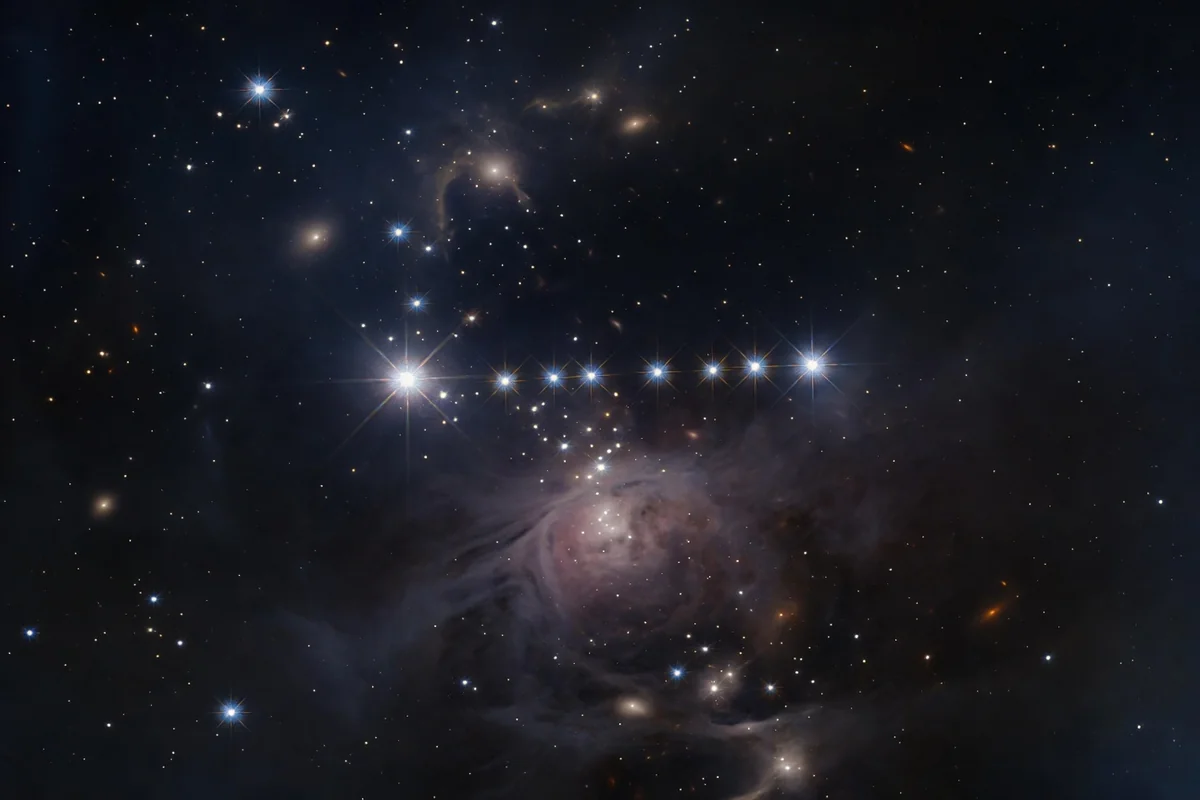
Six stars in complex harmony, precisely on the universal line
Mintaka (Delta Orionis) sits at the western edge of Orion's Belt: the faintest of the three Belt stars at apparent magnitude 2.23, and the one positioned almost exactly on the celestial equator, within seventeen arcminutes of zero degrees declination.
That position is the critical fact. The celestial equator is the projection of Earth's equator onto the sky, the line dividing the celestial sphere into northern and southern hemispheres. Only stars sitting on or near this line share one remarkable property: they rise due east and set due west for every observer on Earth, regardless of latitude. Stand in Tokyo or Buenos Aires, at the North Pole or the equator, and Mintaka rises at exactly 090 degrees. True east. Universal. Not perspective-dependent.
The photons entering your eyes during this decan left Mintaka around 825 CE, when Caliph al-Ma'mun ordered the construction of Baghdad's Shammasiyah observatory and commissioned scholars to test Ptolemy's star tables against the actual sky. They found the ancient master wrong in specific, correctable ways. They did not burn the Almagest. They corrected it. They produced the Zij al-Mumtahan, the Tested Tables: preservation of what held, correction of what had drifted.
Truth-testing as the highest form of respect.
Mintaka is also an O9.5-type bright giant: the rarest stellar classification in existence, one in ten million stars. Of the 90 brightest stars visible to the naked eye, only four are O-type. When you observed Mintaka, you were seeing one of four naked-eye examples of the rarest stars in the galaxy. And it sits on the celestial equator. The universe placed its most extreme physics at the most geometrically universal position.
Everything you built through Betelgeuse (creative eruption), Rigel (grounded mastery), Bellatrix (strategic precision), and Alnilam (structural legacy) now faced its final examination: not whether it impressed, not whether it was admired, but whether it was true. Does it align with what every observer, from every vantage point, would independently confirm?
What Is a Decan?
The decanal year divides the sky into thirty-six ten-day cycles, each aligned with a star rising before the Sun. Ancient Egyptians used this as their calendar: 36 decans of ten days, plus five epagomenal days, totaling 365. Each decan carries the character of its star. Living by the cycles pulls attention toward what the star embodies, and the journal becomes a record of how that teaching met your actual life.
Decan 35 runs from February 23 through March 4. It is the last decan of the Orion sequence, the fifth and final star in the Hunter's body.
After this, Sothis.
(The full Orion arc: Decan 31: Betelgeuse, Decan 32: Rigel, Decan 33: Bellatrix, Decan 34: Alnilam, Decan 35: Mintaka.)
The Ten Days
Initiate: Days 1-3 (February 23-25)
The pressure started on Day 1.
At lunch, in a quiet restaurant, something settled. Not a decision or a strategy but a recognition: the way I had been thinking about work anxiety, about institutional pressure, about the tension between what I knew and what I was being told, mapped exactly onto territory I had arrived at through a completely different route. The same destination as Alan Watts. "You arrived at the same territory through your own pathless land." No teacher, no course, no prescribed path. The conclusions matched because they were both true.
That is what alignment feels like from the inside. Not agreement with authority. Not validation from approval. Recognition that what you observed matches what observed reality confirms, regardless of where you started.
Day 2: institutional work completed cleanly. The hard conversations and the collaborative ones navigated in a single day, without losing the thread of either. A personal learning system validated and in motion. A call to aging parents: brief, tender, weighted with the particular intimacy of distance and time passing. Some calls are less about what is said and more about the showing up.
Day 3: The Bellatrix blog post shipped. An idea surfaced for a new technical architecture: a contained environment for safe experimentation without touching production. Creative output running parallel to institutional pressure, not suppressed by it.
The initiation phase of Mintaka asked whether alignment was real or aspirational. The first three days answered by demonstrating both: internal truth matched observable behavior, and creative work continued under load.
Expand: Days 4-7 (February 26 - March 1)
What is observable, testable, universal holds against what narrative claims
Day 4 held the central teaching of the decan.
An institutional signal arrived. Not what the surface suggested. The governance response was immediate: read the signal accurately, not personally. What the institution communicated about itself was more informative than what it communicated about the work. The year's output (releases delivered, systems rebuilt, people developed, independent work running in parallel) remained true regardless of how it was classified. Misclassification is data. Data is usable.
The POTS readout that morning had read Convex Edge, which is Mintaka's own classification in the symbol system: limited downside, possible asymmetric upside, the position of someone holding the edge of the Belt while the fog clears. The reading arrived before the institutional signal. The star described the shape of the day before the day showed itself.
A mapping exercise surfaced: rendering the institutional landscape knowable, not for advantage but for clarity. The dynamics, the communication styles, the unspoken structures, made visible instead of merely felt.
Day 5: A release executed cleanly despite complexity upstream. Delivery complete. Creative and strategic work continued in parallel.
Day 6 was rest. Family. Recovery. A deliberate pause. Governance is not only action; it is recognizing when action has been sufficient and withdrawal becomes the right move.
Day 7: Domestic reset, cleanup, donations alongside my partner. The home systems tended. The decan asked for truth-testing in every arena, not only institutional.
Reflect: Days 8-10 (March 2-4)
Day 8: I went outside after dark and found Orion. The Belt was clear. I looked at Mintaka, the western edge, faintest of the three, the one sitting on the equator.
The love reflection came first. I was thinking about my partner, about the weight of the previous two weeks and what sustained through them, and then I looked up and the star was there. The personal truth arrived before the sky confirmed it. Mintaka aligned: due east, due west, universal. What was closest and most intimate was the orienting truth all along.
Day 9: A quieter day. Some fog. Ships already in the water needed no new launches. The institutional mapping continued, the landscape taking shape.
Day 10: The close of fifty days in Orion. The Hunter complete.
Closing the Hunter's Arc

Fifty days. Five stars. One Hunter. The arc completes at the edge.
Fifty days ago, at Betelgeuse, the arc began.
The right shoulder: creative eruption that could not contain itself, the red supergiant burning convective material into the surrounding nebula. Direction came later.
Then Rigel: the stable foot, the clean blue-white burn, manifestation through precision. Form gave the force somewhere to land.
Then Bellatrix: the female warrior, the left shoulder, strategic deployment. The arm that learned to aim.
Then Alnilam: the center pearl, structural legacy, the string that holds the arrangement. The force became continuous.
Now Mintaka: the edge. Not the loudest, not the largest, not the hottest of the visible stars. The one that sits on the universal line. The one whose position every navigator, from every civilization, from every ocean, used to confirm true east.
Five decans. One Hunter. The arc is not about achieving more and more; it is about arriving at truth. Each decan stripped something. Betelgeuse: raw diffusion. Rigel: imprecision. Bellatrix: hesitation. Alnilam: what could not be systematized. Mintaka: everything that could not survive contact with observed reality.
What remains is aligned.
The Polynesian wayfinders crossed thousands of miles of open ocean without instruments because they had Mintaka. True east confirmed by the geometry of the cosmos itself, not a compass reading or an estimation but the actual universal truth made visible by a star sitting exactly where it needed to sit.
The Baghdad scholars corrected Ptolemy not because they rejected him but because they respected him enough to test him. The legacy that survives truth-testing is stronger than the legacy that was never tested.
Both practices were running during this decan, at my desk and in my sky.
The Hunter completes his arc. The edge held. The pattern was real. The aligned thing, tested against universal truth, returned to full brightness.
Tomorrow, Sothis rises. The brightest star in the sky. The companion who followed the Hunt the entire time.
Exit Orion. Enter the light you remember.