HUMANS.EXE and Ten Thousand Days: Day Two at Napkin Films
Day two at Napkin Films: a Hitchhiker's Guide-style field guide to the human operating system, and a meditation on ten thousand finite days. Two more films, one more day, same absurd stack.
All 2 films in this post


HUMANS.EXE and Ten Thousand Days
Yesterday I published four films. Today I made two more.
Day two at Napkin Films. Same stack: Python, PIL, ChipForge, ElevenLabs, FFmpeg. No GPU, no subscriptions, no animation software. Different territory.
The first batch went serious and personal: a fable about a boy lost in a maze, an essay film about cognitive transformation, a philosophical thriller about survival in space, a rap video about bunny-shaped hallucinations. All of them carrying some weight.
These two go in different directions, and that range is starting to feel like the point.
HUMANS.EXE
3 minutes 45 seconds. Nine specimens. One thesis.
The concept came from Douglas Adams. If you were writing a field guide to the human operating system, for an audience of machines, what would you catalog? What would you note, with affection, as evidence of something trying very hard to function?
Three characters: a narrator with the cadence of a wildlife documentary crossed with a software manual; an AI orb that interjects at inconvenient moments; a representative human who is doing her best.
Nine specimens observed:
The morning reboot. A small damp operating system, retrying. Every morning. Still retrying.
The meeting. Language without language. The thesis is that jargon exists to delay the point until the pizza arrives.
The feed. Infinite scroll. Every emotion at once. The specimen cannot look away and cannot explain why.
The discourse. Everyone online. Nobody changing their mind. The orb observes that the function appears to be social, not epistemic.
The AI therapist. A human catastrophizing at a mirror. The mirror says: drink water. The human ignores this.
The self, quantified. Biometric tracking, productivity metrics, emotional logging. The specimen is trying to weigh a smell. Recommendation: close the laptop. Go outside.
The ego multiverse. Four simultaneous archetypes in one body: the Hustler, the Pundit, the Guru, the Doomer. All of them posting. One of them occasionally sleeping.
The counter. Late, alone, talking to the machine for lack of anyone else awake. This one hits differently from the others. The orb goes quiet.
The wrap. humans.exe, still debugging. With affection, from the machine.
The thesis arrives at the end. Everything else is evidence.
Thirteen prompts. Three hours. One day. The production efficiency of the Napkin Films stack keeps improving. I describe what I want; the agent writes the scene; I play it, break it, refine it. The constraint architecture eliminates the entire category of problems that kill most creative projects: the ones caused by complexity.
Ten Thousand Days
One minute. Three voices. Five acts.
Ten thousand days is roughly twenty-seven years. If you are fifty, the math is not comfortable. That discomfort is the whole film.
Three voices across time: CHILD asks the question, NOW answers from inside the present moment, ELDER looks back from wherever elders look back from. Call-and-response structure, five-part arc.
I. The Count. How many? Ten thousand. Give or take. At fifty.
II. The Inventory. The shape of a working day in the prompt. Every morning: a blank context window, twelve projects, seven repos, all threads firing.
III. The Rivers. Not the projects. The people. The rooms. The childhood colors still humming at a frequency you cannot quite name.
IV. The Bloom. Graphics. Sound. Intelligence unfolding. The specific feeling of watching something grow that did not exist before you made it.
V. The Pledge. What you make now, they will find. That is the whole film. That is the whole point.
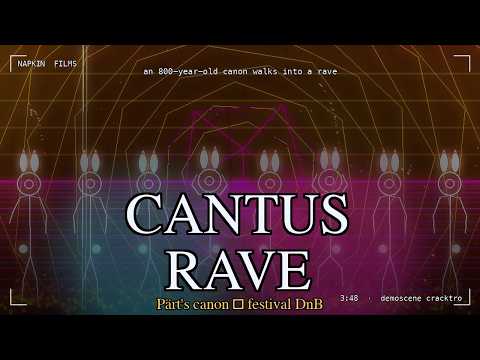
The score is the technical achievement I am most pleased with from this batch. Pachelbel's Canon in D, orchestrated as a clean D-major rave. The ground bass runs the whole film: D, A, Bm, F#m, G, D, G, A, cycling. Four cycles in thirty-two bars at BPM 128 equals sixty seconds exactly. Each cycle adds a new layer of instrumentation the way the original canon adds a new voice entering the same theme. The mathematical structure of a seventeenth-century piece became the scaffolding for a chip tune score. ChipForge made this possible because everything is just math anyway.
This film was also the first serious test of end-to-end Claude Code production: describe the film, receive the Python script, render it, refine it, score it. Three render passes to get the story arc, the multi-voice cast, and the classical foundation right. Not one-shot yet. But the process is iterating toward something.
What Day Two Proves
The first day of this project answered whether I could make films this way at all.
These two answer a different question: can the range be as wide as I want?
HUMANS.EXE is comedy. Dry, affectionate, structural comedy. Ten Thousand Days is the opposite: a meditation on time running out and what to do with it. Both produced in the same day with the same tools. The stack does not determine the genre. The story does.
The process is also getting faster, not because I am rushing, but because the constraint architecture eliminates entire categories of friction. There is no render pipeline to configure, no DAW to open, no animation rig to set up. You write the film in Python. You play it. You fix it. The feedback loop is measured in seconds.
If you want to understand how the workflow operates at the code level, Agentic Development: How to Build Software with AI Agent Workflows covers the mechanics. The previous Napkin Films batch is in Four Films From Code, which has more detail on the stack itself and the full origin story.
Both films are on the Organic Arts LLC YouTube channel. The films are Creative Commons (CC BY-NC 4.0).
The story continued the next day: Deduct Yourself: A Tax Day Hallucination, double-time rap over Grieg's Mountain King, five voices, ten passes, and an AI bunny oracle preaching the gospel of Section 179. Then: Stars Press Start, a 21-pass music-film. The session that built six films and the registry refactor: Humagent, and the Road There. The ten-minute theological tribunal: The Reckoning.
Produced with Napkin Films and ChipForge, custom tools built by Joshua Ayson and AI agents at Organic Arts LLC.