AGENTSPEK Is Live on Amazon
I wrote a book about coding with AI using AI to write it. Now it is on Amazon. Here is what that process taught me, and why I think this is the beginning, not the destination.
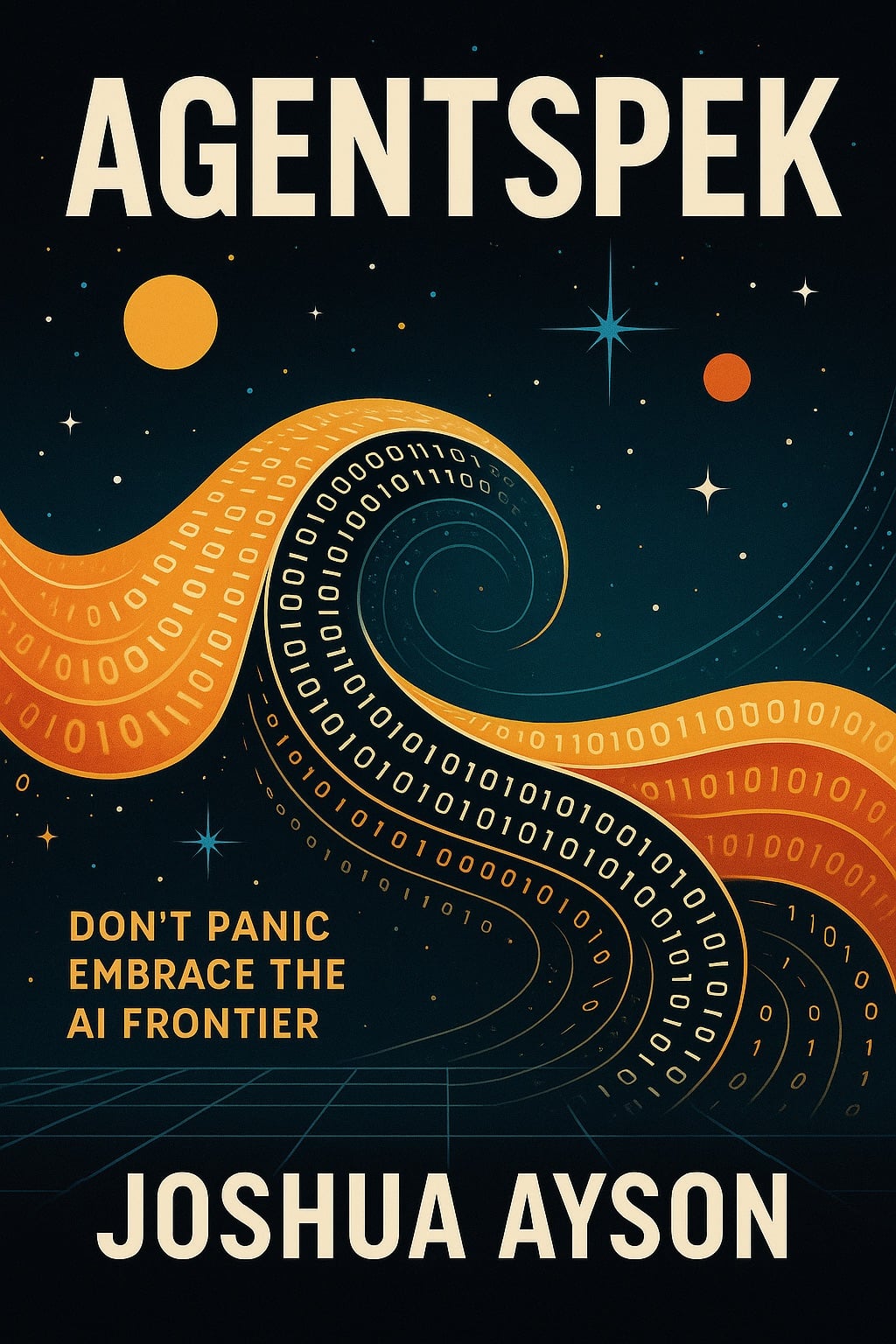
The book is out.
AGENTSPEK: A Beginner's Companion to the AI Frontier is now available on Amazon, Kindle and paperback. You can also start reading here for free, beginning with Chapter 1: the opening chapters are posted in full, and the rest are in the book.
I want to tell you what this was actually like to build.
How It Started
I had been writing the AI Development Revolution series here since July 2025. Seven long essays tracking what it felt like to work at machine speed, to use agent mode as a daily development partner, to watch the shape of software creation change in real time.
At some point I realized: this is a book. Not a collection of blog posts. A book. Something with a spine and a cover and a through-line that takes a person from wherever they are now to somewhere new.
So I started writing one.
The Recursion
Here is the part that still makes me smile.
I wrote a book about coding with AI using AI to write it. Claude in agent mode, mostly. I would talk through a chapter's structure out loud, then write. I would get stuck and talk to the AI about where it was stuck. The AI would surface things I had not quite articulated yet.
It was not the AI writing the book. It was more like having a very fast, very patient editor who had read everything and could keep all the threads in the air simultaneously while I found the next sentence.
The voice in AGENTSPEK is mine. Every idea in it came from living this work. But the process of getting those ideas onto the page, of staying unstuck and moving forward: that is exactly what the book is about. I was demonstrating the thesis while writing the argument.
I do not think you can really understand agent-mode development from the outside. You have to feel the gear shift. The book is my best attempt at a translation.
What Is in It
Eighteen chapters. About 57,000 words. It starts at the very beginning, what is an LLM, what is a token, why does any of this matter, and ends somewhere near the edge of what is coming next.
The middle is where I spent the most time. The chapters on agent mode, on prompting not as a trick but as a skill, on building a working mental model of how these systems think. On what changes in your development practice when you stop treating the AI as a search engine and start treating it as a collaborator.
It is a beginner's companion. I wrote it for my past self, the version of me who showed up to this in 2024 with no map. I tried to hand him the map I eventually found.
Why Amazon Too
I published it here first and kept it free. That was always the intention. If you want to read it without spending anything, start here.
But people asked about a physical copy. And there is something about holding a book in your hands that changes how you read it. The paperback is real. I held the proof copy and felt something I did not expect: this is a finished thing.
The Kindle version is the cheapest entry point if you just want to read it outside the browser. The paperback is for the kind of person who annotates margins and goes back.
What Comes Next
The world this book describes is already moving. Agent mode in 2024 is not agent mode in 2026. Models are faster. Context windows are vast. The things that felt like edge cases are now standard workflows.
I am watching this carefully. At some point there will be a second edition, or a sequel, or both. I am not sure what shape it takes yet.
What I do know: this is the most complete thing I have made. A full arc. Start to finish. Published and in the world.
That is not nothing.
If you have been reading this site for a while, the essays, the journals, the freewriting, and the book sounds like something you want to read properly, the Kindle edition is the easy way in. If you want something physical to hold, the paperback is there. Either way, thank you for being here.
Joshua