What I'm Building Right Now: May 2026
A transparent look at the active workstreams in May 2026: trading systems, animated films, music synthesis, a published book, and an AWS cert study track. All of it agent-directed.
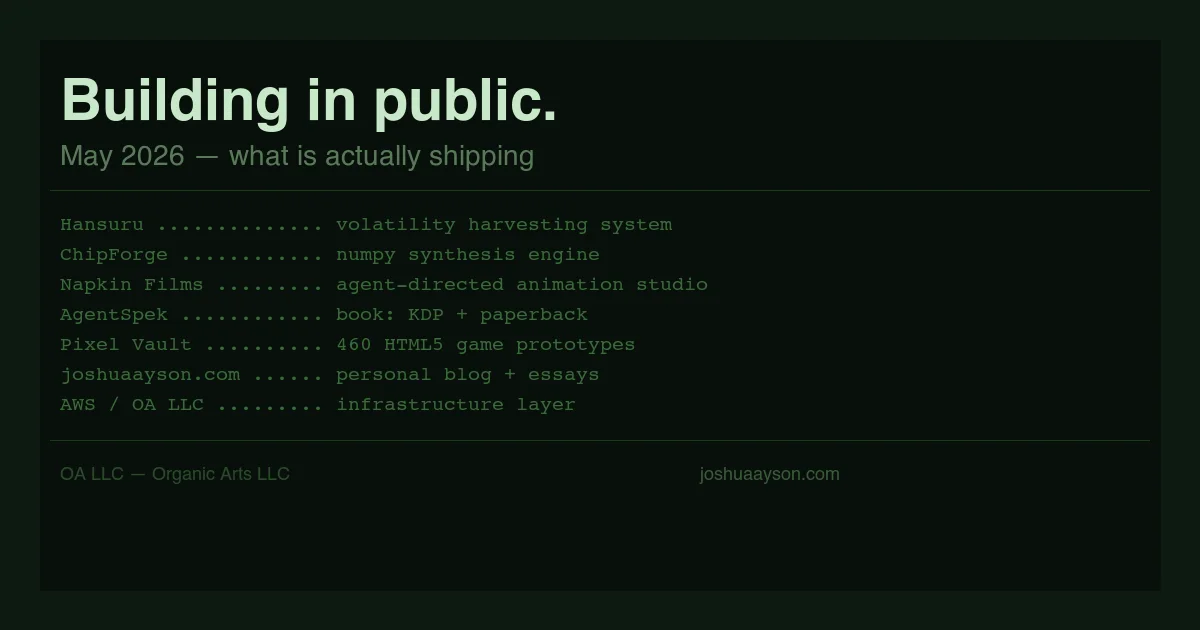
I try to write one of these every few months. Here is what is actually running right now, not aspirationally, but in practice. What gets opened on a given Tuesday.
Hansuru: Volatility Harvesting System
The daily driver. The core idea is simple: volatility oscillates. Markets move between calm and chaos, and the transitions are somewhat predictable if you watch the right signals. The system is built to harvest that oscillation from both sides, not just one.
When conditions are quiet, you collect premium. When conditions are elevated, you hedge and wait. When they get extreme, you reload. The tiers do not change. The sizing does, based on what the regime is doing.
The engine is Python, built on top of the broker API, containerized and running headless. Every morning a classifier runs before I touch anything. It answers one question: what kind of market are we in right now. The answer shapes every decision that follows.
Recent work: made the options picker regime-aware across multiple instruments, so it adapts spread width and target parameters automatically as conditions shift. Added a module for crypto futures volatility as a separate signal source.
A big part of why I built this is because it is a genuinely complex domain. Financial markets are a good place to learn with AI because the system has real constraints, real feedback, and no tolerance for vague thinking. You either understand what you are doing or the results tell you. I use agent mode here the same way I use it everywhere else: not to shortcut the learning, but to accelerate my ability to move through it. Build the tool, understand what the tool is doing, find where the edge actually lives.
This is the one that pays for everything else.
Napkin Films: Animated Shorts
The creative outlet that generates the most concrete evidence that the methodology works. Stick figure characters, 854x480, 12fps, fully synthesized audio, entirely from code and agents.
The latest film is The Intruder, a three-and-a-half-minute animated rap battle about a Plan 9 stick figure hacking through AWS Cost Explorer. It went through twelve production passes. The prior film was Throne Protocol, a coronation scene in F minor at 145 BPM, built around a ChipForge orchestration of Bodzin's production style.
The pipeline: Python/Pillow for animation frames, ElevenLabs for character voices, ChipForge for music, FFmpeg for final assembly. Every film is one Python file plus one HTML5 scene file. No Premiere. No Logic. No GPU.
What I am actually doing next: starting a longer one. Working title is "The 50-Year Song" (five minutes, ten sections, one per decade of life, each in a different genre). Germany to Nevada in chip tune.
ChipForge: Music Synthesis Engine
The music engine that powers the Napkin Films scores. Pure numpy synthesis, no samples, no external audio libraries. 168 instrument presets, 20 DSP effects, six historical tuning temperaments.
Recent additions: an autotune pipeline built on rubberband, per-instrument filter envelopes, multi-layer supersaw voices, a full pro-grade mastering chain with sidechain compression and multiband EQ. The Cantus Rave score (Arvo Pärt's "Cantus in Memory of Benjamin Britten" reimagined as festival DnB) is a good demonstration of what the engine can do with orchestral material.
The thing I keep coming back to: the constraint is generative. Working in numpy only, writing every effect from scratch, means I understand exactly what every knob does. There is no plugin to blame.
AgentSpek: The Book
AgentSpek: A Beginner's Companion to the AI Frontier is finished and published. 57,000 words, 18 chapters, available on Amazon. Written entirely in agent mode, with the AI as a collaborator and me as the director and final editor.
What I am doing now: getting it in front of readers. The cornerstone essay I published today, AI-Assisted Development Is Not Vibe Coding, is the clearest public argument for the methodology the book teaches. If you land there and want more, the book goes deeper.
The book does not require any prior programming experience. It is for people who want to understand what the shift actually is, before picking up a specific tool.
AWS Solutions Architect: Study Track
I am in the middle of a structured study plan for the AWS SAA-C03 certification. Not because I need the badge, but because the IaC work I do for OA LLC benefits from understanding the full service surface area. The OA LLC infrastructure runs on EC2 spot instances, CloudFront, S3 and a custom VPC. Knowing where the seams are matters.
The study plan is running in my personal life repo, week by week, with the Cantrill course as the spine and a test date target of late June. I will write about what I find useful after the exam.
The blog itself
This is infrastructure too. The goal: coherence. Every page should make sense as part of a larger picture. The trading system informs the risk philosophy in the essays. The animated films demonstrate the AI development methodology in action. The book explains the framework that connects it all.
If you want a navigation map for all of it, start here.
If you want to see what the production output looks like, the projects section is the right place.
This is a living snapshot. Updated when things change meaningfully, not on a fixed schedule.