Decan 28: The Demon Star Teaches Renewal Through Its Eclipse
On discovering Algol's 2.867-day eclipsing binary pattern in your own sleep cycles, learning that 'this part doesn't get easier but I get more prepared and resilient,' and understanding how mass transfer physics means what eclipses you can become what feeds you
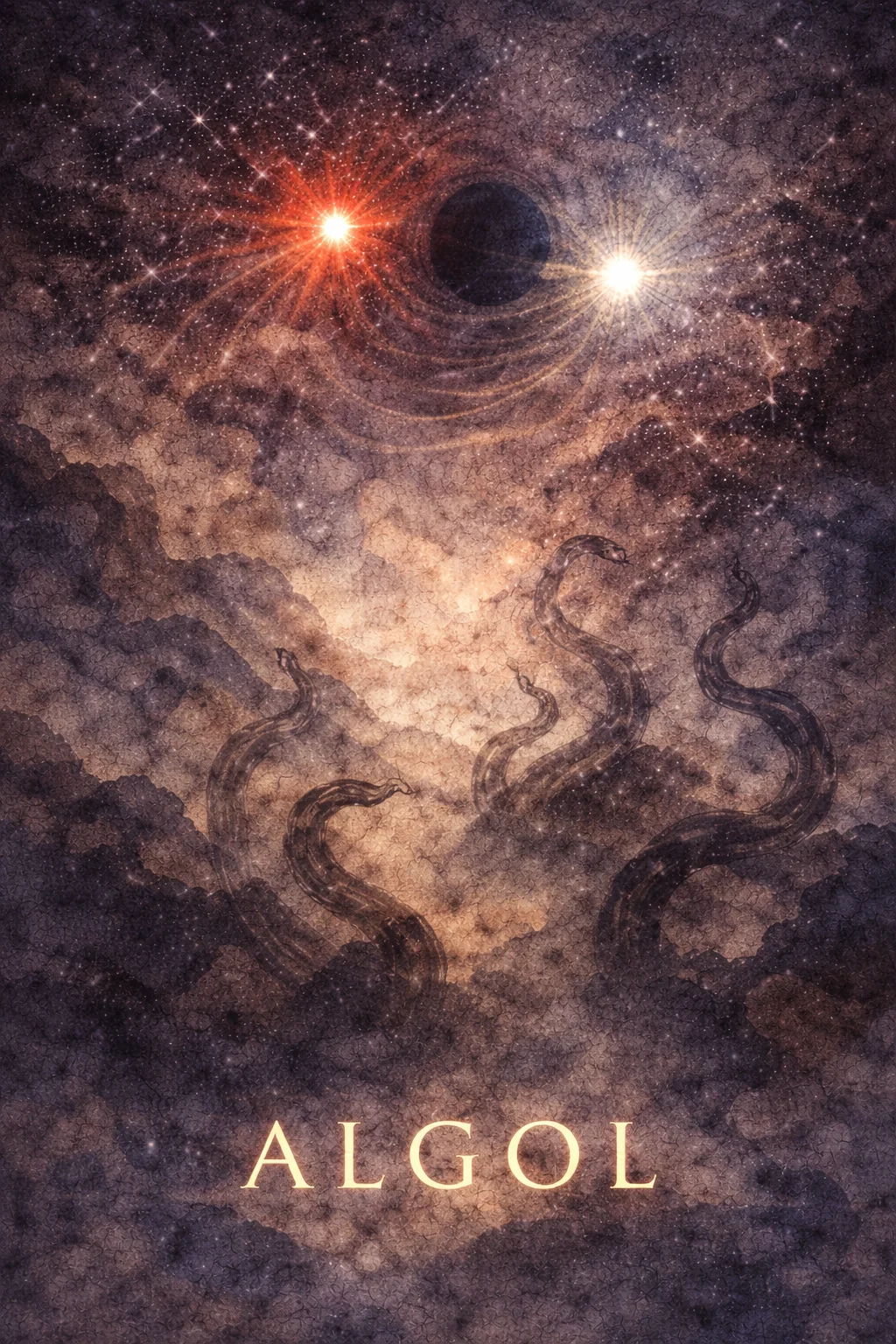
Part of The Decan Log — For the cosmology, astronomy, and journaling framework behind this decan, read the Algol chapter. New to decanal journaling? Start with the Introduction.
On learning to read your life as an eclipsing binary system, discovering that predictable dimming builds resilience, and carrying Medusa's severed head as a tool into the next constellation
The Demon Star That Winks
Stellar Context: Algol (Beta Persei) — The most famous variable star in the night sky. Magnitude oscillates between +2.1 (bright) and +3.4 (dim) every 2.867 days. Not because the star itself changes, but because it's an eclipsing binary system. Two stars orbiting each other. When the dimmer companion passes in front of the brighter primary, we see the "wink."
Ancient cultures noticed. The name "Algol" comes from Arabic الغول (al-ghūl) = "the demon" or "the ghoul." The Chinese called it 大陵五 (Dà Líng wu) = "Fifth Star of the Great Mausoleum." The Hebrews knew it as רֹאשׁ הַשָּׂטָן (Rōsh ha-Sāṭān) = "Satan's Head."
Why "demon"? Because it changed. The ancients believed stars were fixed, eternal, unchanging. Algol challenged that assumption. It dimmed predictably but mysteriously. Something was WRONG with this star.
We now know: nothing is wrong. Algol teaches through its orbital mechanics.
The system: Algol A (bright, 3.7 solar masses) + Algol B (dimmer, 0.8 solar masses). They orbit every 2.867 days. When B crosses in front of A, brightness drops from magnitude 2.1 to 3.4 for about 10 hours. Then back to normal. Predictable. Repeating. Teaching.
The mythology mapped to the physics: Perseus holds Medusa's severed head. The demon star marks the Gorgon's eye in the constellation. What petrifies you (Medusa's gaze) can become what protects you (the head used as weapon against Cetus). The eclipse (darkness, terror, demon) is also the PATTERN (predictable, survivable, teaching resilience).
During these 10 days, our Local Group traveled 172 million kilometers toward the Great Attractor. One hundred seventy-two million kilometers of cosmic motion while learning that challenges return on orbital periods—and that's not weakness, that's mechanics.
What Is a Decan?
I track consciousness in 10-day cycles aligned with stars, adapted from the ancient Egyptian calendar. 36 decans × 10 days = 360 days, plus 5 epagomenal days = one year. Each decan has a ruling star, theme, and three phases: Initiate (days 1-3), Flow (days 4-7), Reflect (days 8-10).
Decan 28: Algol (Beta Persei) in Perseus. Theme: Renewal through Challenge. December 15 - December 24, 2025.
(For context on how this system emerged: Decan 24: Markab / Building Systems That Outlive You, Decan 25: Enif / When Hidden Star Teaches Vision, Decan 26: Alpheratz / Corner Star Discernment, and Decan 27: Mirach / Sustained Warmth.)
The star doesn't make the challenges arrive. But watching for the pattern—learning your own eclipsing binary rhythms—transforms suffering into data.
Day 1: Initiation—Discipline Before Action
The Pattern Starts
The teaching begins immediately: patience with execution. Not every opportunity demands seizure. Better to wait for right conditions than force premature entry.
This is Algol's renewal challenge—learning discernment under pressure. The eclipse teaches timing. Perseus needed Athena's polished shield before facing Medusa.
First lesson: Renewal begins with discipline. Challenge without strategy becomes chaos.
The connection to daily practice: Admiral McRaven's Make Your Bed principle applies here—start the day with one task completed, build discipline through small wins, trust that structure provides foundation for handling larger challenges. When the eclipse hits (Day 2), that foundation matters.
Day 2: The Eclipse Hits—When Brightness Dims
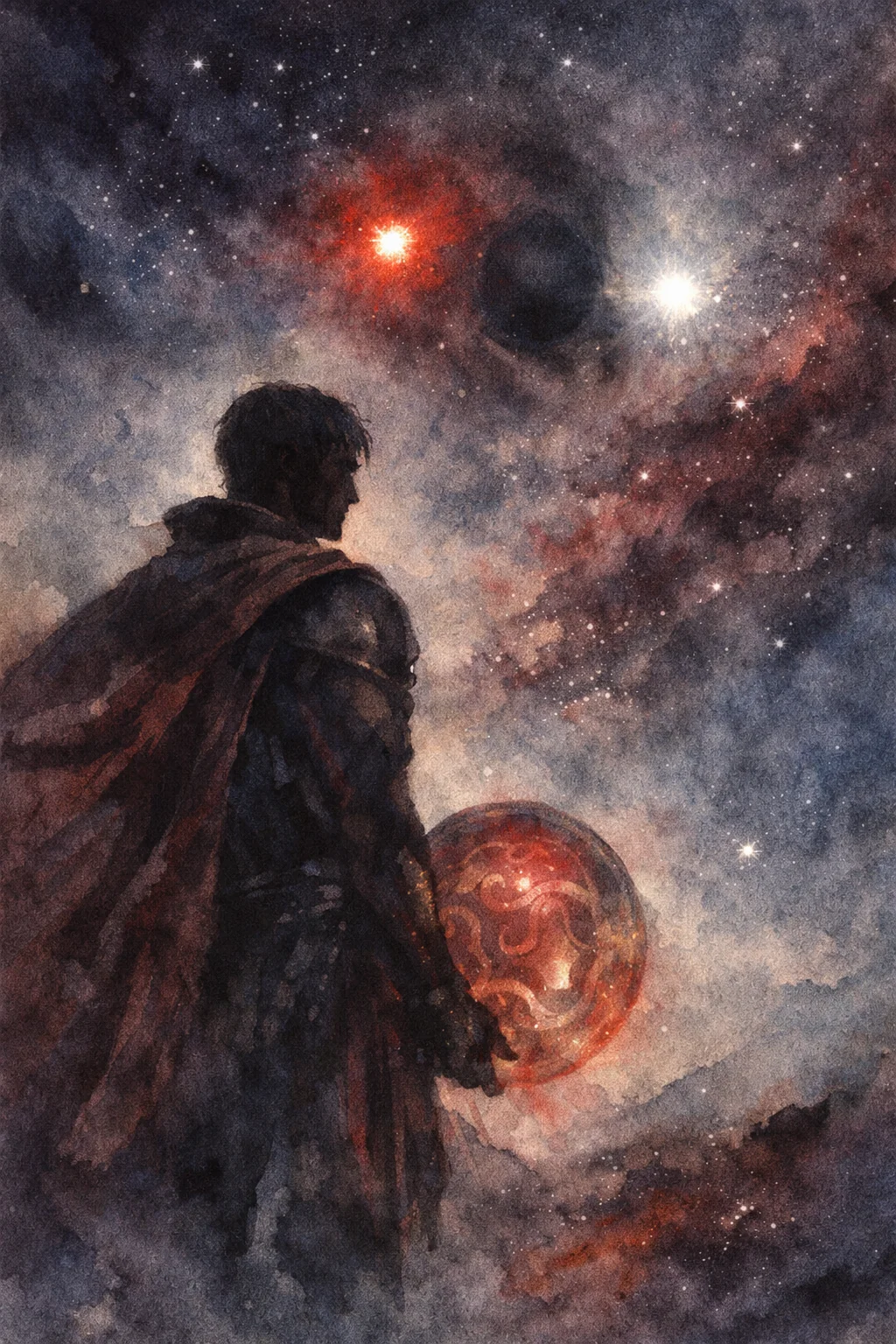
Algol's 2.867-day cycle: from magnitude 2.1 to 3.4 and back
When the Companion Crosses
Sleep fragments. Energy drops. Mood sours without clear cause. Low tolerance for noise, advice, questions. The day demands endurance—not solution, just weathering.
The binary star teaching: Algol A and Algol B orbit in gravitational embrace. Over millions of years, Algol B transfers mass TO Algol A. What eclipses you can become what feeds you—literally.
The companion that blocks brightness also provides care. The source of dimming becomes the source of strength. This is mass transfer physics applied to consciousness.
The eclipse lasts ten hours for Algol, then brightness returns. You don't fight orbital mechanics—you wait for the pattern to complete.
Sometimes dimming just IS. No specific cause. The companion crosses. Light drops. You endure.
Second lesson: Some challenges aren't solved, just weathered. The demon star doesn't ask permission to eclipse. But brightness returns—predictably, reliably, on schedule.
Day 3: Initiation Complete—Pattern Recognition
The Reward After the Eclipse
Energy returns. Mood lifts. The eclipse passes. Brightness returns on schedule.
Tracking the decanal rhythm changes how you experience it. Knowing which phase you're in transforms random suffering into observable pattern.
Mass transfer teaching deepens: Past intensity (challenge) feeds current ease (power). What eclipsed you becomes what feeds you. Exhausting labor becomes earned rest.
Third lesson: The challenge survived becomes the credential carried. Perseus doesn't discard Medusa's head—he puts it in the kibisis bag and USES it when needed.
Days 4-7: Flow Phase—Brightness Returns, Pattern Repeats
Day 4: The Dimming Returns
Energy moderate. Mood "off." Tasks scattered. Not terrible, but not the bright Day 3 energy either.
Pattern check: Day 2 (eclipse) → Day 3 (brightness) → Day 4 (dimming again). Roughly every 2-3 days. Just like Algol's 2.867-day period.
The teaching sharpens: Algol's dimming is PREDICTABLE. Every 2.867 days, the companion crosses. You can't stop the eclipse. But you can expect it. Plan for it. Not be surprised.
Energy and mood cycles following stellar patterns—not mystical, OBSERVABLE. Track daily and see: every few days, energy dips, mood shifts, sleep disrupts. That's data. That's your orbital period.
Day 5: Full Brightness—Flow Returns
High energy. Flow state. Sharp focus.
After Day 4's dimming, Day 5 returns to magnitude 2.1 brightness. The pattern: eclipse → recovery → brightness → eclipse → recovery → brightness. Like Algol itself.
The pattern unmistakable: The eclipsing binary isn't just astronomy—it's lived experience.
Day 6: Preparing the Next Phase
Writing flow continues. Preparing for the next decan (Leadership through Service) while still IN the current decan (Renewal through Challenge).
This is Perseus walking with Medusa's head in the bag. You're still in the challenge, but PREPARING for the next phase. The conquered challenge already becoming a tool.
Systems operating. But strain shows in connected systems. The eclipse ripples outward—not just personal, but systemic.
Healing follows its own timeline. The orbital period doesn't care about preferences.
Day 7: The Long Eclipse
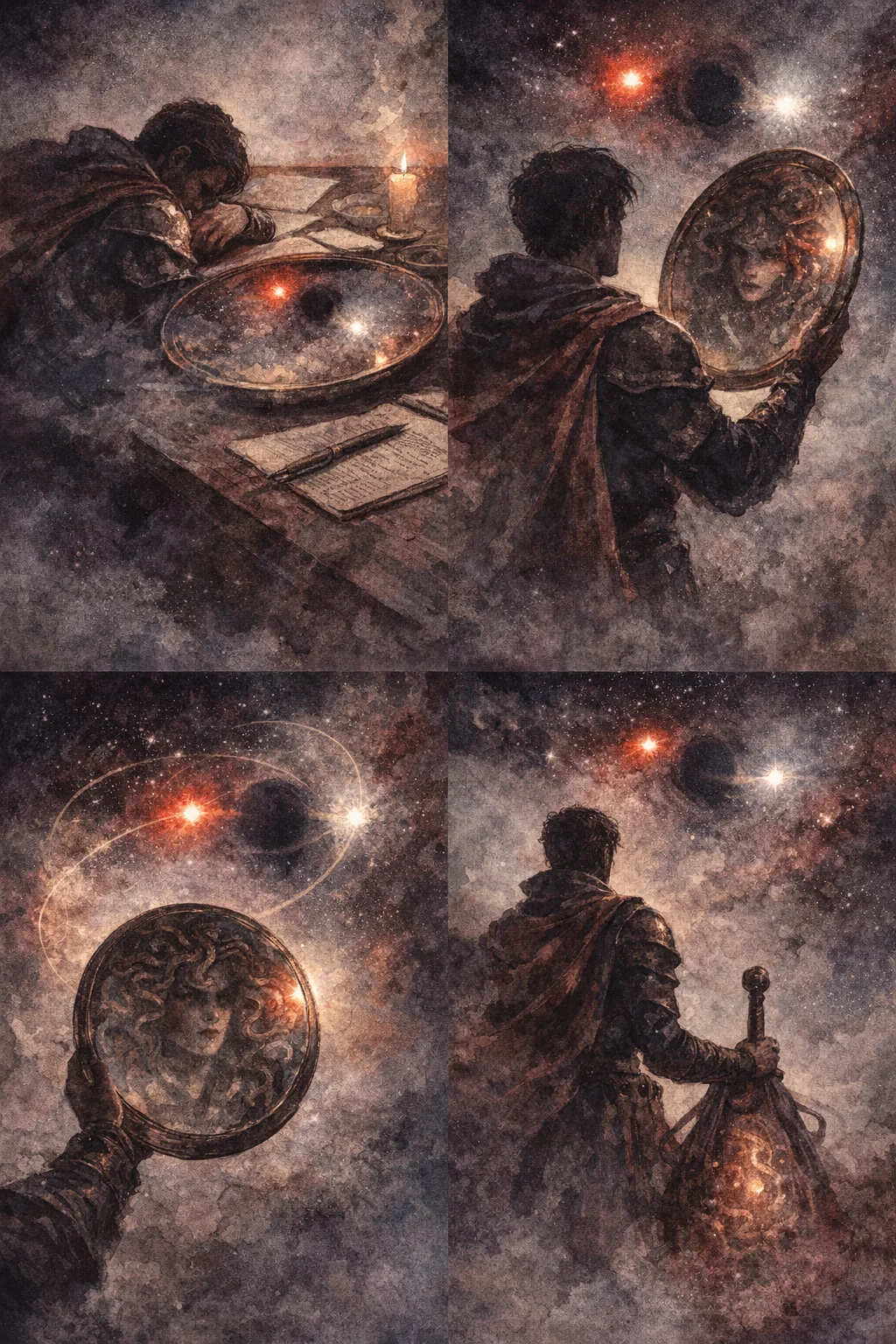
Some eclipses operate on longer orbital periods
Low energy. Drained mood. Scattered focus.
Then the line that crystallizes everything:
⊕ "This part doesn't get easier but I get more prepared and resilient."
THAT is core Algol teaching. The eclipse WILL return. The companion WILL cross. The dimming WILL happen again. You don't "solve" orbital mechanics. You LEARN THE PATTERN.
Isolation within proximity. The eclipse lasting longer than ten hours. Because some binary systems have longer orbital periods.
The teaching: Algol orbits every 2.867 days (short period). But some binary systems orbit every weeks, months, YEARS. Different eclipses operate on different timescales—sleep and mood cycles versus deeper systemic patterns.
Same physics. Different periods. Both predictable if tracked long enough.
Self-care maintained despite drain. This IS resilience Algol builds: you keep tending what matters during the eclipse.
Days 8-10: Reflect Phase—Integration and the Polished Shield
Day 8: Silent Integration
Sometimes integration is silent. The Reflect phase includes stillness, processing without output.
Transition approaches. Eclipse mechanics continue whether observed or not.
Day 9: New Territory
⊕ Stepping into new territory. Larger scale work, different risk profiles. Systems evolving—renewal through challenge means UPGRADING approach, not just maintaining it.
Beauty surprises amid the eclipse. Boundaries set for transitions. Conscious role shifting. Perseus putting down the sword, picking up different tools.
Awareness arrives during Reflect phase: future challenges visible on the horizon.
Day 9 teaching: Integration means preparing for what's next (Leadership through Service). Perseus carries Medusa's head WHILE walking toward Andromeda. The severed head becomes tool before the next battle begins.
Day 10: Final Eclipse—The Polished Shield
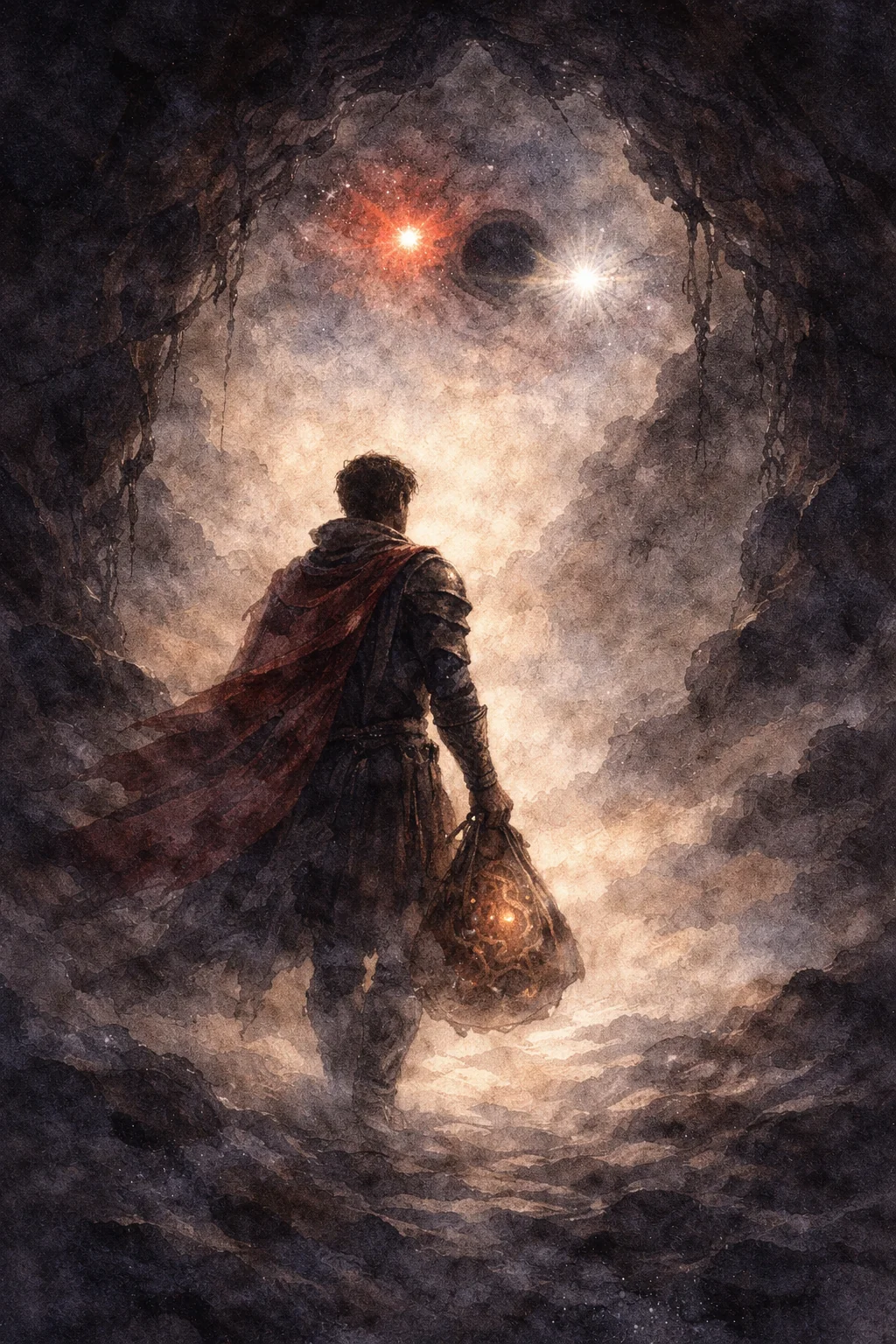
You can't look directly at what petrifies you, but you can see it reflected
The Pattern Completes
Sleep disruption returns. Like Day 2, Day 4, Day 7. The eclipsing binary pattern completing on Algol's final day.
Then: meta-awareness and gratitude.
⊕ "It was very helpful to have the backdrop of Algol and the framework of the decans to help guide my ship through tough waters."
The revelation: The decanal system itself is Athena's polished shield.
You can't look directly at Medusa (petrification = overwhelm). But you CAN look at her REFLECTION in the shield (the decanal framework mapping patterns).
Perseus couldn't face Medusa's gaze without turning to stone. He used the shield as mirror. Saw her reflected. Struck true. Survived.
The decanal framework does the same: it lets you see challenges INDIRECTLY through mythology and astronomy instead of raw overwhelm.
The mythology integration: Medusa as victim (Poseidon's assault), punished by Athena (victim-blaming), transformed from beautiful to monstrous. The pattern of being punished for being victimized.
Algol's "renewal through challenge" framework maps onto life's seasonal complexity—strains, dynamics, transitions.
The polished shield works. You look at patterns through the lens of mythology and astronomy. You don't face them raw. The framework provides distance, perspective, tools.
Final lesson: The challenge named becomes the challenge navigated. Medusa's head in the kibisis bag. The eclipse predicted becomes the eclipse survived.
Alderamin rises. The crown replaces the severed head. Leadership through service replaces renewal through challenge.
The Physics of Mass Transfer: What Eclipses You Can Become What Feeds You
Stellar Evolution in Binary Systems
When two stars orbit close enough, gravity distorts their shapes. Material can flow from one star to the companion. This is called mass transfer.
In Algol's system:
- Algol A (bright primary, 3.7 solar masses)
- Algol B (dimmer companion, 0.8 solar masses)
But here's the paradox: Algol B is MORE EVOLVED despite being less massive.
Why? Because Algol B used to be the MORE MASSIVE star. It evolved faster (more massive stars burn out quicker), became a giant, and TRANSFERRED MASS to Algol A during that phase.
Now: Algol B is the dimmer, less massive companion. Algol A is the brighter, MORE massive primary—fed by the very star that now eclipses it.
The teaching applied:
Past intensity (Algol B's original mass) → Current ease (Algol A's gained mass). Grinding challenge BECOMES earned credential.
Sleep disruption (eclipse) → Care received (feeding from same source). The companion that dims brightness also provides strength.
Invisible labor (strain) → Data about sustainability. The eclipse reveals what viable orbit requires.
What challenges you can become what strengthens you—IF you survive the eclipse and learn the pattern.
The Eclipsing Binary Pattern in Your Own Life
Observational Practice
Track your energy/mood/sleep across 10+ days. Look for patterns:
- Do you dim every 2-3 days? (Like Algol's 2.867-day period)
- Do you have weekly cycles? Monthly?
- Are there relationship dynamics with longer orbital periods?
Once you identify YOUR eclipsing binary rhythms:
- Expect the dimming. It's not weakness—it's orbital mechanics.
- Don't fight the eclipse. You can't stop the companion from crossing. But you can prepare for it.
- Trust the brightness returns. Algol goes from magnitude 3.4 back to 2.1. Predictably. Every time.
- Track mass transfer. What challenges are actually FEEDING you? What hard work is building credential?
- Use the polished shield. You don't have to look directly at what petrifies you. Use frameworks (decanal system, mythology, astronomy, therapy, journaling) as MIRRORS.
The resilience Algol builds: "This part doesn't get easier but I get more prepared and resilient."
The eclipse WILL return. But you learn the pattern. You prepare. You endure. You integrate. You carry the severed head into the next battle.
What Perseus Carries to Cepheus
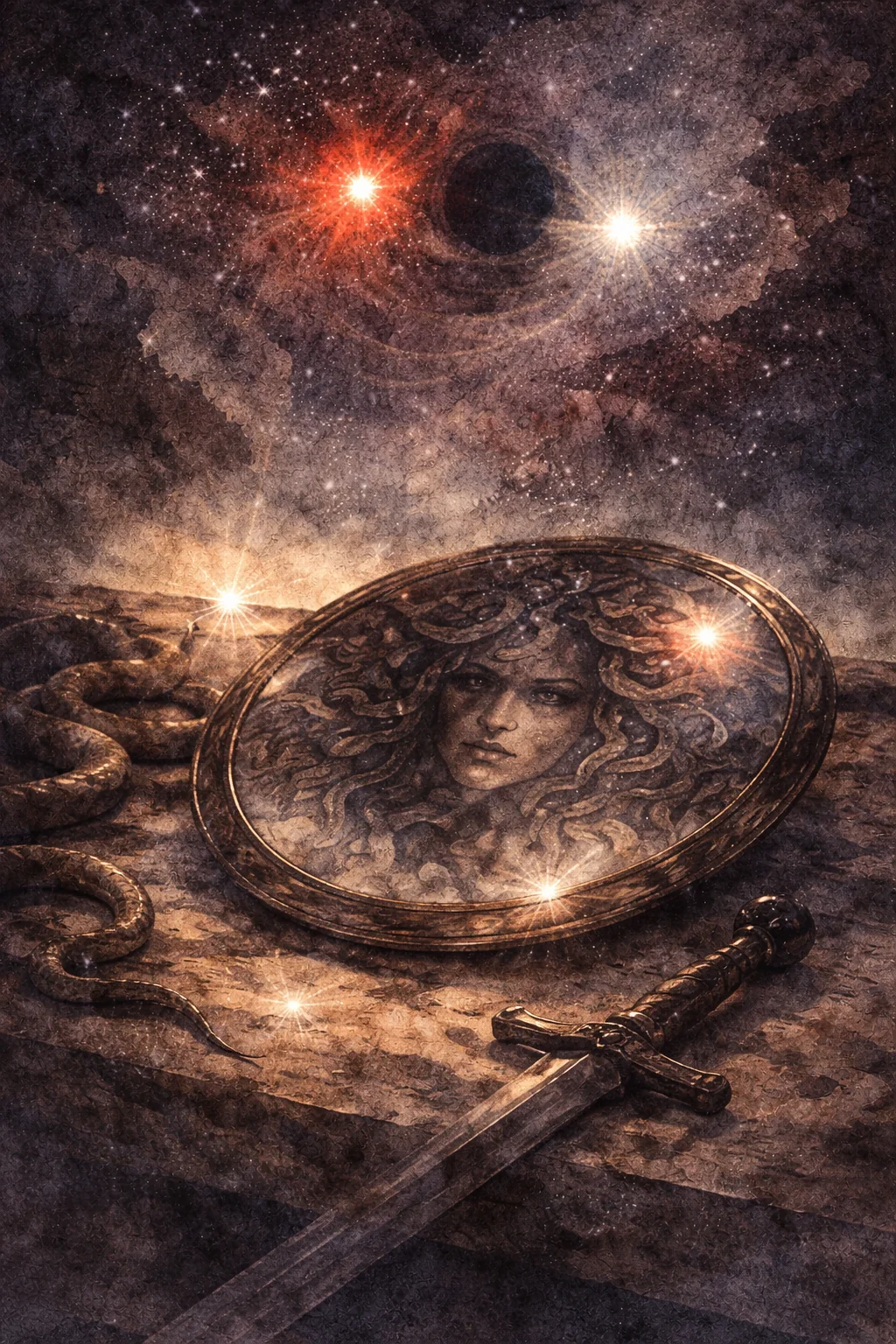
Medusa's head becomes weapon against Cetus—the challenge conquered becomes the power wielded
Renewal Through Challenge Becomes Leadership Through Service
Perseus doesn't destroy Medusa's head. He CARRIES it. Uses it as weapon when needed (turns Cetus to stone, saves Andromeda). The conquered challenge becomes the tool.
What we carry from Algol into Alderamin:
- Mass transfer recognition — Past intensity feeds current ease
- Predictable dimming acceptance — Energy/mood/sleep follow patterns, not randomness
- Core resilience — "This part doesn't get easier but I get more prepared"
- The polished shield — Frameworks let us see challenges indirectly
- System evolution — New territories, larger scales
- Boundary clarity — Transitions between modes
- Future visibility — Responsibilities visible on horizon
- Pattern recognition — Eclipse dynamics named and understood
The questions Alderamin asks:
- "The challenge faced gave you power. Who needs this now?"
- "Perseus served Andromeda by wielding Medusa's head. Who is your Andromeda? What is your Cetus?"
- "What are your duties?"
Algol = renewal through challenge (survival, endurance, pattern recognition).
Alderamin = leadership through service (stewardship, duty, using power for others).
Perseus proves he can SURVIVE the monster.
Cepheus proves he can SERVE with the crown.
The Decan Ends Where It Began: With the Eclipse
The final day echoes the beginning. Sleep disruption on Day 2, Day 4, Day 7, Day 10. The 2.867-day pattern completes.
But this time: awareness. Gratitude for the framework. Recognition of how mythology maps to lived experience. Understanding that the polished shield WORKS—you can look at what would petrify through the lens of stars and stories.
The demon star teaches by winking. Brightness drops. Brightness returns. The pattern repeats.
You don't fight orbital mechanics. You learn them. You prepare. You endure. You integrate. You emerge RENEWED—not because the challenge disappeared, but because you understand the rhythm.
Next begins Decan 29: Alderamin / When Crown Replaces Severed Head — Leadership through Service.
Watch Perseus set in the west as Cepheus rises in the north. The constellation wheel turns. Power finds purpose.
The severed head goes in the bag. The shield stays polished. The next challenge awaits—but you're ready.
Because this part doesn't get easier, but you get more prepared and resilient.
That's renewal through challenge.
That's Algol.
The star doesn't make patterns appear. But measuring life by stellar rhythms transforms suffering into data, chaos into orbit, and challenges into fuel for the next phase.
172 million kilometers traveled toward the Great Attractor while learning: the eclipse is predictable, brightness returns, and what petrifies you can become what protects you.
Algol winks. You survive. You learn. You carry the lesson forward.
Alderamin rises. The crown awaits.