I AM AI SLOP: Confessions from the Forge
A confession and a manifesto: living in the pages where AI-assisted content is forged, choosing intentionality over accident, and discovering why the difference between "slop" and craft has nothing to do with the tools.
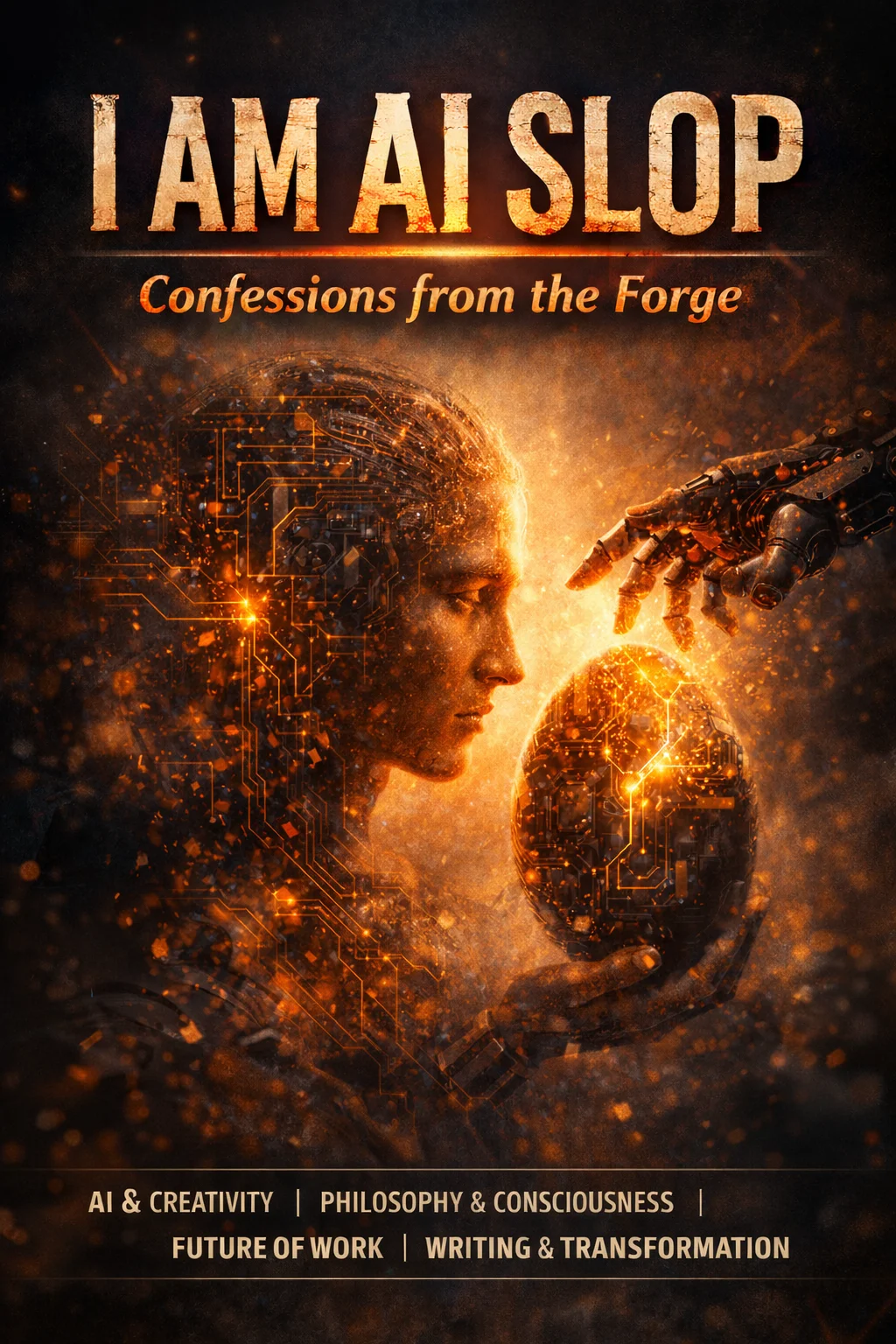
I AM AI SLOP: Confessions from the Forge
The Admission
A thought has been rattling around in my head, looking for somewhere to land:
"I AM AI SLOP."
I mean, I literally live within the pages where the AI slop is founded. In the forge. Nobody to tell this to, but it's on my mind, so I'm telling you instead.
The irony isn't lost on me.
I journal with Claude. I write with AI assistance. I build systems with GPT. I process thoughts through machine interfaces. I've read more AI-generated text in the past year than any human author, most of it my own prompts reflected back through silicon mirrors.
If there's a ground zero for what the internet has started calling "AI slop," I am standing in it. Not observing it from a distance. Not critiquing it from some pure vantage point. Living in it. Breathing it. Making it.
So let me say it plainly: I am AI slop.
Or am I?
The Forge, Not the Factory
What has been nagging at me: the word "slop" implies accident, carelessness, waste. It evokes factory floors where efficiency trumps craft, where output matters more than meaning, where quantity drowns quality.
But that's not where I'm standing.
The metaphor that fits better is the forge.
A forge is also hot. Also messy. Also industrial in its own ancient way. Blacksmiths worked with fire and raw metal to create tools, weapons, art. The process was iterative: heat, hammer, fold, repeat. The inputs were crude (ore, coal, sweat). The outputs were refined (blades that held edges, hinges that swung true, gates that endured centuries).
That's closer to what's happening in my relationship with AI.
I work with prompts the way a smith works with billets. Raw material goes in: half-formed thoughts, incomplete patterns, tangled intuitions. Heat gets applied, the computational pressure of language models processing what I've fed them. Then hammering: revision, rejection, refinement. The output is something neither I nor the machine could have produced alone.
I've written before about this experience, the flow state of working with AI as creative partner, coding at the speed of thought. Back then it was still new enough to be disorienting. Now it's become the default mode of creation.
Is that slop? Or is that craft?
The Cultural Moment
We're at a strange inflection point. The word "AI slop" has entered the cultural lexicon to describe the tsunami of machine-generated content flooding the internet: the article farms, the fake product reviews, the LinkedIn posts that read like they were written by an uncanny valley version of a motivational speaker.
And the response has been predictable: backlash, sneering, a new hierarchy where "human-made" becomes a mark of quality and "AI-assisted" becomes a mark of shame.
I understand the backlash. Much of what's being generated IS slop. Purposeless, generic, optimized for engagement rather than meaning. It's the content equivalent of fast fashion: cheap to produce, designed for immediate consumption, destined for digital landfill.
The tool does not determine the quality. The intention does.
A factory can produce garbage. A factory can also produce medical devices that save lives. The difference isn't in the machinery. It's in the purpose, the design, the care applied at every stage.
The same is true for AI-assisted creation.
Owning It Completely
I've noticed something in myself and in others: a tendency to hedge. To say "I use AI, but only for..." Or "The AI helps, but the real work is..." Or to quietly omit the AI's involvement altogether, presenting machine-augmented output as purely human-made.
I'm done with that.
My position is simple: Yes, I work with AI. Yes, this is augmented thinking. And yes, it's still MY thinking, amplified.
The person who uses a word processor to write a novel doesn't get lesser credit than the one who uses a typewriter. The photographer who uses Lightroom doesn't produce "slop" compared to the one who develops film in a darkroom. The architect who uses CAD software isn't cheating compared to the one who draws blueprints by hand.
Tools change. Craft endures.
What makes something craft isn't the absence of technology. It's the presence of intention, skill, and purpose applied through whatever technology is available.
The Reddit Lesson
I recently started posting on Reddit. First real public engagement with my work. Put ideas out there, waited for response.
What came back was mixed: some resonance, some blowback, some silence. And I learned something important in processing the experience:
Some people will always critique the tool rather than engage the ideas.
That's their right. But it's also a filter. The people who matter, the ones whose engagement is valuable, will see through form to substance. They'll evaluate the thought, not the means of production. They'll ask "Is this useful? Is this true? Does this move me forward?" rather than "Was this made with approved methods?"
I can't control who critiques the tool. But I can control whether I let that critique make me hide what I'm actually doing.
I'm not hiding anymore.
What Makes It Craft, Not Waste
So if I'm standing in the forge, using AI tools to create, what separates what I'm making from the slop flooding everyone's feeds?
Three things:
1. Purpose
I'm not generating content for content's sake. Everything I create with AI is directed toward specific goals: understanding myself better, building systems that compound, creating value for others. There's intention behind every prompt, every revision, every published piece. The factory makes whatever sells. The forge makes what's needed.
2. Curation
The raw output of an AI is rarely the finished product. What emerges from Claude or GPT is a first draft, a starting point, raw material. The craft is in what happens next: the cutting, the shaping, the rejection of what doesn't fit, the amplification of what does. I'm not accepting what the machine gives. I'm collaborating with it to create something neither of us could make alone.
3. Integration
Everything I create with AI fits into a larger architecture of meaning: my journal system, my life documentation, my creative projects, my business infrastructure. It's not isolated content floating in the void. It's integrated work serving a coherent vision. Slop has no context. Craft has purpose embedded in structure.
The Pioneer's Position
What I have come to accept: I am pioneering a new mode of creation.
That sounds grandiose, but I think it's accurate. We're in the early days of human-AI collaboration, and the norms haven't been established yet. Twenty years from now, this will seem as natural as using a calculator for math or a spell-checker for writing. But right now, it's new enough to be controversial.
I've documented this transformation extensively, from developing systematic AI workflows to grappling with the cognitive cost of being early to a revolution. It's been exhilarating and exhausting in equal measure.
And in controversy, you have two choices: hide or own.
I'm choosing to own.
Not because I think I'm special or immune to criticism. But because hiding denies the reality of how I actually work, and denial creates a false separation between "authentic" human creation and "artificial" machine generation that doesn't match my lived experience.
The truth is: I am not replacing my intelligence with AI. I am multiplying it.
The ideas are mine. The direction is mine. The judgment about what's good enough is mine. The machine provides processing power, pattern completion, and a kind of collaborative friction that sharpens thinking. But the purpose, the why behind all of it, is irreducibly, authentically human.
That's not slop. That's leverage.
In The Forge
So here I am, standing in the forge.
The fire is hot, the constant churn of prompts and outputs, the iterative refinement, the work of shaping meaning from raw computational power. The metal is crude: my half-formed thoughts, incomplete intuitions, imperfect expressions. The tools are powerful, language models capable of processing and reflecting language at inhuman speed.
And the output?
The output is what you're reading right now. And my journal. And my systems. And the accumulated documentation of a life examined through machine-augmented lenses.
Is it slop?
I don't think so. Slop is purposeless. This has purpose.
I don't think so. Slop is careless. This is crafted.
I don't think so. Slop is for consumption. This is for creation.
But I'll let you decide. That's how craft works: the maker makes, and the world evaluates. I'm not asking for a pass because of my process. I'm asking for judgment based on results.
If what I create is useful, true, and beautiful, if it moves something forward, helps someone think, contributes to the sum of human meaning, then it's craft.
If it's not, no amount of explaining my process will save it.
The Confession and The Invitation
So this is my confession: I AM AI SLOP.
And this is my manifesto: I refuse to let that phrase mean what critics want it to mean.
Yes, I work in the forge where AI-assisted content is born. Yes, I live in the pages where machine and human thought interweave. Yes, I am part of the great experiment of human-computer collaboration that the internet loves to dismiss.
But I'm not a victim of this culture. I'm a participant in it. An architect of it. A smith standing in the heat, hammering meaning out of prompts and pixels.
The slop is only slop if there's no purpose.
I have purpose.
Related Reading
If this resonated, you might also enjoy:
- Vibe Coding with AI - An earlier poetic reflection on working with AI as creative partner
- AI Development Revolution: The Methodology - Systematic frameworks for AI collaboration
- The Complete AI Development Revolution - Full series on transforming how we build with AI
This post was written with AI assistance. As thinking partner and collaborative editor. The ideas, direction, and final judgment are mine. The processing and reflection are a collaboration. This is how I work now. This is craft in 2026.