Eigen to Myself
A tired joke that held. The eigenself is what comes back pointing the same way: Nietzsche at his typewriter, his dice game, a mathematician from Zarathustra's landscape, a cursor on a black screen, and three experiments.
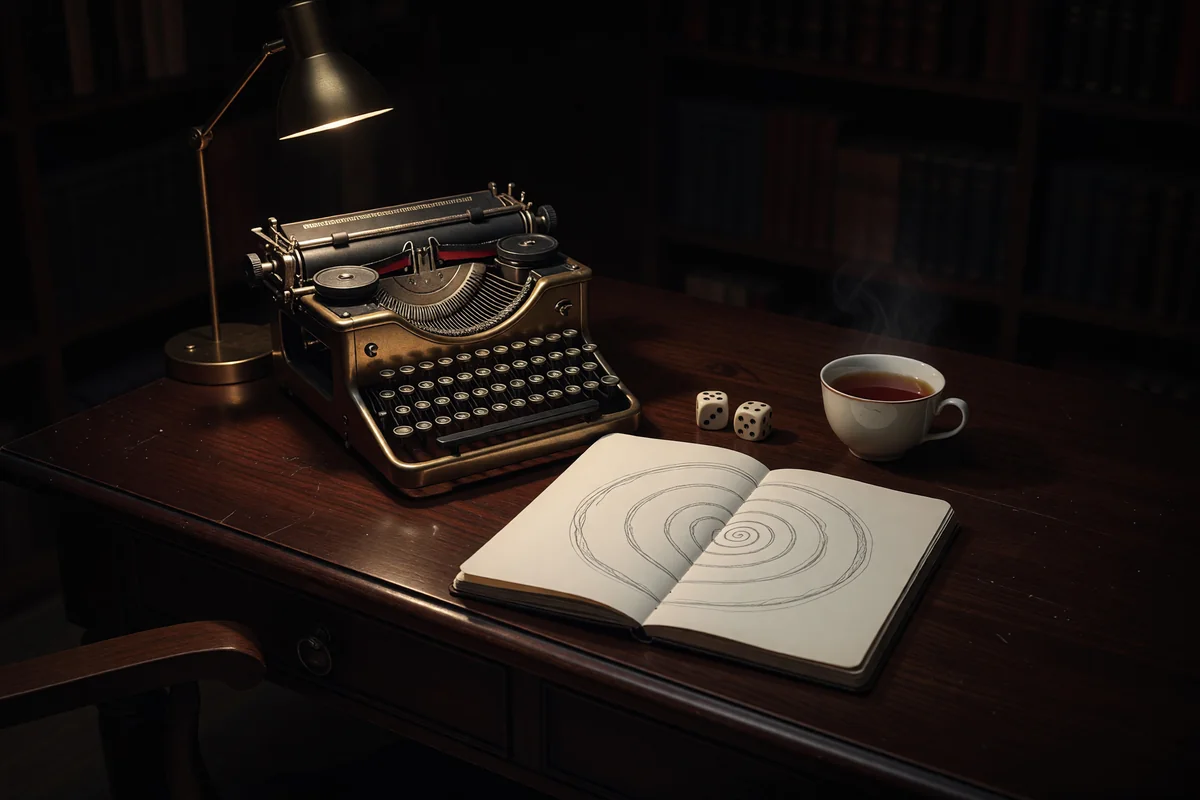
Days of math and cybernetics, and I need a break. So naturally I had an idea.
I am my own eigenself.
I wrote it down tired and I still don't know all of what it means. My own recursion into myself. Which goes into the source of all knowing and thought, which is everything and nothing, and the paradox again, and the one. Or the none. The notebook got there before I did. In February I wrote we are everything and nothing, and ten days later, under hazy February clouds, Universe recursing on Universe.
What I do know from this week: an eigenvector is the direction a transformation can't turn. Run it through and it comes out pointing the same way, only longer or shorter. Louis Kauffman calls the cybernetic version an eigenform, whatever a process gives back unchanged when it is run on its own result. X = F(X). The rest I am reaching for.
The spiral
It started with Graham Wallas. In The Art of Thought he names the stages a new idea passes through, and one of them is incubation, the stretch when you stop working a problem on purpose and let it work in you. I read that, and then I did the opposite. Like fire. I couldn't stop. One print pack led to the next: the math, module one, learn one on eigenforms, a ladder of forty-five rungs. By evening it almost had the shape of a course, a small curriculum on the whole domain, which is far too big a word for one day of a beginner's notes. So I'll call it what it was, a recursive learning spiral. Context, connection, more context, more wanting. Wow, wow, wow. This post is what the spiral gave back when I finally stopped.
Notes, put back to the math
Sometimes it works to go from the insane and unworkable to finding that it works as well as any other model for seeing reality through the lens of mind and body. So here are the notes from tonight, each one put back to the math to see if it holds.
If eigenself calls eigenself, it is still eigenself. Strictly, an eigenvector is something done to you, a transformation applied: T(v) = λv. Calling yourself is a different move, and Kauffman's eigenform is the one that covers it. The line holds, as an eigenform.
The eigenself is not self to the power of two. But apply the day twice and the eigenself is still itself; it comes back λ² as much. Two hard weeks in a row and you are still pointing the same way, only smaller.
Nor is it self times self. If it were, only two numbers would pass the test of x times x equals x: zero and one, the none and the one. And the math has already ruled on the none. The zero vector is never allowed to be an eigenvector, because every transformation leaves it exactly where it is, and something unchanged by everything belongs to no one. So the one, then. Or something on its way to one.
It is eigen to self. In German eigen means own. David Hilbert carried the word into mathematics early in the twentieth century, Eigenwert, Eigenfunktion, and English kept the German. The eigenself is the self's own self. Eigenselbst, if you like.
I knew about recursion early on, from a kid's Apple IIGS: a program that calls itself, and I found it fascinating. There are two kinds of self in code, and only one of them is restful:
// the eigenself: ask it for itself and it hands itself back, as often as you like
const eigenself = () => eigenself
eigenself()()() === eigenself // true

// the other kind: calls itself, and calls itself, and calls itself
const spiral = () => spiral()
spiral() // RangeError: Maximum call stack size exceeded
The first is at rest in itself. The second is what the last few days of study felt like, and the error is the break.
In the irrational and the paradox we find some modicum of truth, perhaps.
The Übermensch and the Eigenmensch
Nietzsche gave us the Übermensch, the one who goes over and beyond, who overcomes himself. The Eigenmensch, as I am calling it tonight, goes the other way. Whatever is applied to it, it comes back to its own direction. I suspect they are one person seen from two distances. I can't show it yet.
Nietzsche has a test that meets it halfway, the eternal recurrence. Would you live this exact life again, the same, over and over, forever? A life you would still say yes to after it has been applied to itself without end is an eigenlife. F(X) = X, with everything at stake.
What does your conscience say? Nietzsche asked in The Gay Science, and answered himself: you shall become the person you are. Years later the subtitle of Ecce Homo echoes it, Wie man wird, was man ist, how one becomes what one is. The line is Pindar's, and Pindar's Greek has one more word that Nietzsche let go of: mathōn. Having learned. Become such as you are, having learned.
The way I read it, that is the eigenself exactly. You don't arrive at yourself by standing still. You get run through learning, again and again, and what keeps coming back pointing the same way is you.
Machines
In 1882 Nietzsche's eyes were failing and he bought a Malling-Hansen writing ball, an early typewriter whose keys stand up in a dome. One of the first letters he typed on it, to his friend Heinrich Köselitz, says: "You are right: our writing tools work along with our thoughts." Then he complains that he cannot yet press a long sentence out of his fingers, and ends by asking whether his friend can even read it. A century later Friedrich Kittler, who went on to edit Shannon's papers in German, made that letter a starting point of his media theory.
My language is the language of the poet, but I have some connection to the computer. The cursor, and green text on a black screen, and those early machines. Wow, wow, wow. I still love seeing my words typed as they are being typed, right now, into this terminal. The cursor is the smallest eigenform I know: it goes away and comes back to itself every half second, waiting for the next letter, unchanged by every letter before it. I once gave it a whole film, UPTIME 32, a single green cursor blinking for thirty-two bits while the room around it changes. I write with agents every day. The tool works along with the thought, and the thought comes back changed, sometimes ahead of me. Nietzsche noticed it with his fingers on the keys, and asked his friend whether he could read it. I am asking you.
He dates the recurrence himself, in Ecce Homo: August 1881, walking by the lake of Silvaplana near Sils-Maria, "6000 feet beyond man and time," and he calls it "the highest formula of affirmation that can be reached at all." A formula. He had been reading natural science, and in Beyond Good and Evil he thanks Boscovich, who taught us to give up belief in matter, in the little lump of the atom, for centres of force. That is the vocabulary of a notebook from 1888: a fixed quantity of force, a fixed number of centres, so "a calculable number of combinations, in the great dice game of its existence," each one coming round again in infinite time. He argued for the recurrence the way an engineer argues. Count the states. Bound the energy. Wait.
Ashby's An Introduction to Cybernetics has the finite version. A machine with finitely many states, run on itself, always ends at a state where it stops or in a cycle it goes round forever. I know of no line from Nietzsche to Ashby; the structure rhymes. The resting state is a fixed point, X = F(X), so a finite machine left to itself ends as an eigenform or a loop. Model 7 on the models page shows it, with tokens on a table.
Others who came near
Felix Hausdorff, one of the founders of topology, wrote philosophy under the name Paul Mongré. His first book as Mongré was aphorisms "from the landscape of Zarathustra," and his second argued with the eternal recurrence itself: the world is chaos, and the cosmos we know is our own selection from it. That one is not a rhyme. It is a mathematician who read Nietzsche closely and answered him.
Nietzsche wrote in a notebook, against the positivists of his day, "facts are precisely what there are not, only interpretations." Maturana's line, "anything said is said by an observer," sits right beside it. Nobody I can find connects them. I will leave them next to each other and see what happens.
In 1926 Erwin Schrödinger gave his papers on wave mechanics one title: Quantisierung als Eigenwertproblem, quantization as an eigenvalue problem. He stopped asking what an electron is, as a thing, and asked which states survive the operator that acts on them. Later he closed What Is Life? with an epilogue that ends in the Upanishads: Atman is Brahman, and the plurality of consciousness is only an appearance. The physicist of eigenvalues, on the one. So the everything-and-nothing I was mumbling about at the top has a respectable address.
A hypothesis
Here is the hypothesis, as clean as I can make it tonight, and it is a hypothesis, not a theorem. Three things get applied to me. The day. Myself, making myself. My own looking at myself. From each, something returns.
Selbst als Eigenwertproblem. Not "what is the self" but: under which operation does something of me come back, and with what eigenvalue? If the something is the same at all three levels, then the Eigenmensch and the Übermensch are one person after all, the one who overcomes and the one who returns, and "become who you are" is an instruction to keep going until the rule of change is itself what stays.
Tonight's protocol
Written down before running, as every lab here should be:
- Sleep. Apply one night to the self. In the morning, check whether it still points the same way, and record the eigenvalue: more of me, or less.
- Oxygen. A walk outside. The outer loop, which nobody can run on my behalf. In October the notebook called it recursive systems leading back to breath itself, and the one loop seemingly running it all.
- Food delivery. Maturana says you cannot instruct a living system, only disturb it, and it answers in its own way. The pizza arrives whether I understood anything today or not. Record the answer.
The pizza got eaten. The day came to an end. Maybe tomorrow this will return something, or maybe it will take some time for the seeds to take hold and the sprouts to grow roots.
Sources
Documented means a source shows it; a rhyme means the shapes match with no line between them; my reading is mine.
Documented
- Eigenform, X = F(X): Louis Kauffman, "EigenForm," Kybernetes 34(1/2), 2005, after Heinz von Foerster, "Objects: tokens for (eigen-)behaviors," 1976
- An eigenvector is never zero: the definition in any linear algebra text: T(v) = λv for a nonzero v
- Eigenvectors of T are eigenvectors of T², with λ²: follows from the definition: T(T(v)) = λ²v
- Eigen into mathematics: David Hilbert, Grundzüge einer allgemeinen Theorie der linearen Integralgleichungen (1904) (secondary)
- "You shall become the person you are": Nietzsche, The Gay Science §270
- Wie man wird, was man ist: Nietzsche, Ecce Homo, subtitle (written 1888)
- "Become such as you are, having learned": Pindar, Pythian 2, line 72
- "Our writing tools work along with our thoughts": Nietzsche to Heinrich Köselitz, typed on the writing ball, Genoa, late February 1882 (eKGWB BVN-1882,202)
- Kittler and the writing ball: Friedrich Kittler, Gramophone, Film, Typewriter (1986; English 1999)
- The recurrence, August 1881, "6000 feet beyond man and time," "the highest formula of affirmation": Nietzsche, Ecce Homo, "Thus Spoke Zarathustra," §1
- Boscovich and the end of matter: Nietzsche, Beyond Good and Evil §12
- A calculable number of combinations, the great dice game, a cycle: Nietzsche, notebook 1888, 14[188]
- A finite machine ends at rest or in a cycle: W. Ross Ashby, An Introduction to Cybernetics (1956), S.2/17 and S.5/4
- Hausdorff as Paul Mongré: Sant' Ilario (1897); Das Chaos in kosmischer Auslese (1898); W. Stegmaier, Nietzsche-Studien 31 (2002)
- "Only interpretations": Nietzsche, notebook 1886, 7[60]
- Quantisierung als Eigenwertproblem: Erwin Schrödinger, Annalen der Physik 79 to 81 (1926)
- Atman = Brahman; plurality as appearance: Schrödinger, What Is Life? (1944), epilogue "On Determinism and Free Will" (secondary)
A rhyme
- Nietzsche's recurrence and Ashby's cycle: the same structure, no line between them
- Perspectivism beside "said by an observer": no cybernetician found citing Nietzsche
My reading
- The eigenself converges through learning: Pindar's mathōn, read through eigenforms
- The self as an eigenvalue problem, three operators: my hypothesis, not yet my claim
Related: A Moment Measured, the paradox of the present from the night before. The models, where model 9 shows what stays put.