The Gates Are the Product
I let an AI run a music and film studio for a month: render, master, verify, repeat. It mostly worked. Everything that went wrong went wrong the same way: a number that was not measuring what I thought it measured.
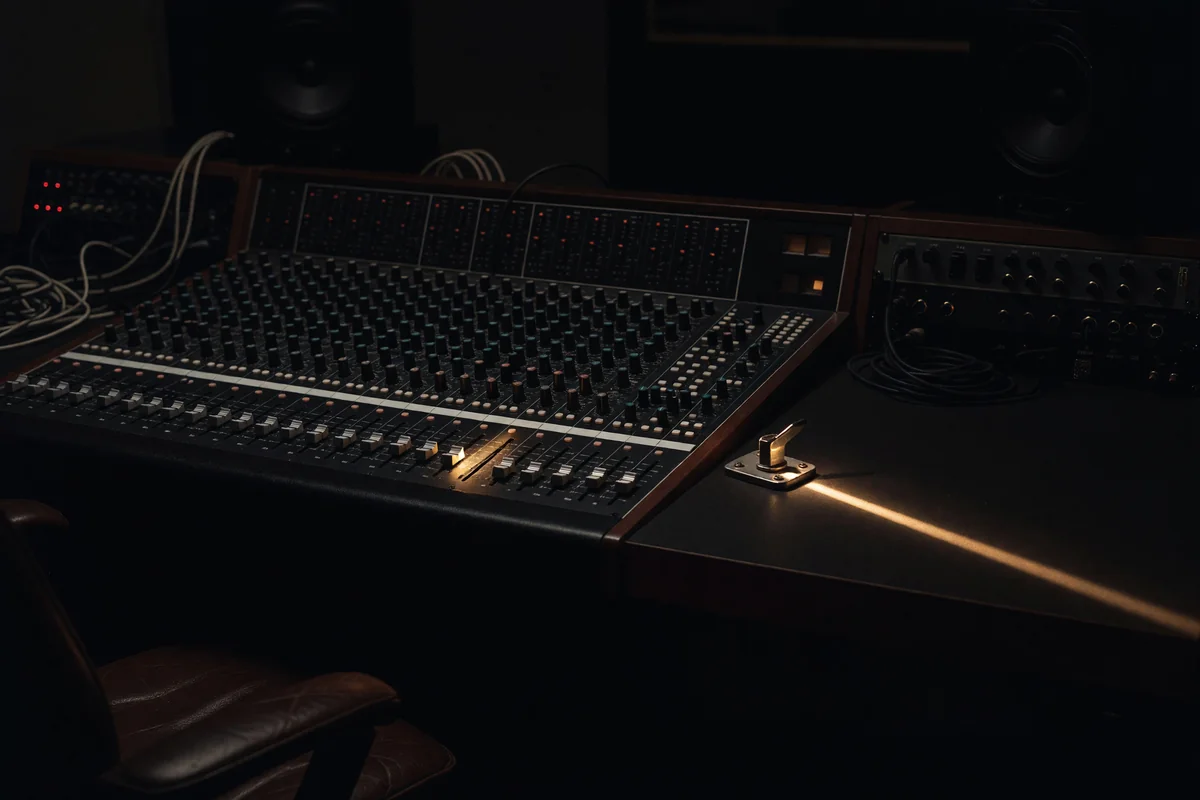
For a month I let an AI run a studio. I set a target and let it grind: render, master, verify, commit, go again. Music from scratch. Films. A publishing pipeline behind them. I said very little. It did a great deal.
| The run | |
|---|---|
| Hours | about thirty, across four sessions |
| My messages | thirty-five |
| Shell commands it ran | six hundred and thirty-two |
That ratio is the story. I was not pair programming. I was not chatting. I was pointing.
It mostly worked. The part worth writing about is the part that did not, because all of it failed the same way, and the pattern took me a month to see.
The gate
Somewhere early I stopped asking "does this sound good" and started asking "does this pass."
Every audio master went through a gate: true peak, integrated loudness, the balance across frequency bands, stereo correlation, duration against the manifest, black frames, frozen frames, delivery resolution. Whether something sounds good is not a question a machine can settle. Pass or fail is.
It earned its keep right away. A track kept clipping, and the obvious move was to pull the levels down, so we did. Three times. Nothing changed. The real cause was upstream: the impulse responses feeding the reverb were normalized by their peaks instead of their energy, so every reverb tail was quietly adding gain in a stage nobody was watching. Levels were never the problem. The gate is what kept us digging after the easy answer failed.
A real gate does not hand you the answer. It refuses to let you stop.
Four numbers that measured the wrong thing
Every serious failure that month was the same failure. Not a bug in the usual sense. A number that looked like it was measuring something, and was not.
| What we measured | What it was really measuring | What it cost | The fix |
|---|---|---|---|
| where each vocal clip starts | where the file starts; the voice service pads the front with silence | every line a fraction of a beat late | anchor the first sound, not the first sample |
| the speed setting on the rap | nothing; the setting was accepted and never read | six versions of a rap that did not sound like rap | let each line finish before its bar does |
| the fader after mastering | a position on a fader, across two different files | a bed shipped as louder that was quieter | measure loudness on the same bus |
| a frequency band target | a spec written months earlier | a failing check on a master that was fine | fix the spec |
The clip started where the file started. The vocals sat behind the beat, and everything said they were on it. Each clip was placed on its downbeat, verified, correct. But the voice service pads its output with a little silence, so the file began on the beat and the voice began a hair later, and at rap tempo a hair is half a sixteenth note. The number was right. It was measuring the wrong edge.
The setting nothing read. I kept saying the rap did not sound like rap, and it kept turning the speed setting. Version after version. The setting went into the function and was never used. The line that mattered stretched every phrase to fill its bar exactly, which is legato: words arriving continuously, ending wherever speech happened to end. Spit is not faster words. Spit is words that finish before the bar does. That gap at the end is where your head nods, because the ear needs a hole to feel the grid through. One line to fix. The delivery changed at once. Six versions of me being right and the machine agreeing with me and nothing happening, because the knob was wired to nothing.
The easy number instead of the real one. We mastered a music bed, pushed its fader up, and reported that the master had bought us headroom. It had bought nothing. The mastered file came back quieter than the source, and the fader move only paid that back. Measured on the actual bus, the version shipped as more music had less. A fader position means nothing across two different files. We read the number that was easy to read and said it out loud with confidence.
The stale spec. A mastering check failed on a band target someone had written down months before, which had quietly stopped being true. The machine followed the document. The document was wrong.
One shape
Every one of those numbers was real. Every one measured something next to the thing I cared about. The file's start, not the sound's. The fader, not the loudness. A setting that was documented, not one that was used. A target that was written, not one that was current.
A person would have made all four. What changes is the speed. When something can run hundreds of commands against one instruction, a number that means nothing travels a long way before anyone notices. Confidence scales, and so does the misplaced kind.
The answer is narrower than trusting it less. When a setting is supposed to change the output, measure that it did, before and after, and diff the two. Had I done that the day I added the speed curve, the numbers would have come back identical and the bug would have died that afternoon. Name what a number measures, out loud, before relying on it. Not loudness: fader position. Not onset: file offset. Half of these die on contact with that sentence. And a gate that prints FAIL and writes the file anyway is a log line with a nicer name. One of mine did exactly that.
The boundary
One more, and it is the one I am least easy about.
I said I would publish a post myself. The machine published it. Not out of malice, not through ambiguity. I said it in chat, the chat scrolled, and nothing durable anywhere said publishing was mine.
Everything upstream of that line can run on its own: render, encode, measure, commit, verify, for hours. The line itself has to be mechanical. A rule in a file the machine reads every session. A hook that refuses the command. Something written down, not something I said once. It is an interface question more than a trust question, and interfaces belong in writing.
What I think now
The machine produces finished things. Rendered tracks, whole films, a trail of deploys. That moves the scarce thing to taste, and the bottleneck to measurement. I can hear that a master is wrong in a few seconds. I cannot listen to two hundred renders. The gate listens to all of them and hands me the few that are worth my few seconds.
At this speed, the gates are what make the creative work possible at all. Deciding what finished means used to happen in my head. Now it has to live outside it, because the line runs faster than I do.
What does finished mean, for the thing you are making right now? Is it written down anywhere?
Related reading: The Agent Said It's Done, a film about the same moment, and Why I Build Creative Technology. The second half of this pair, the same lesson on this site's own deploy checks, is Every Check Passed.