Gentler On-Ramps to Cybernetics
The founding papers were too steep and so were my own primers. So here are the gentler ways in: stories and a game to test the water, an hour of free reading, then a shelf of books.
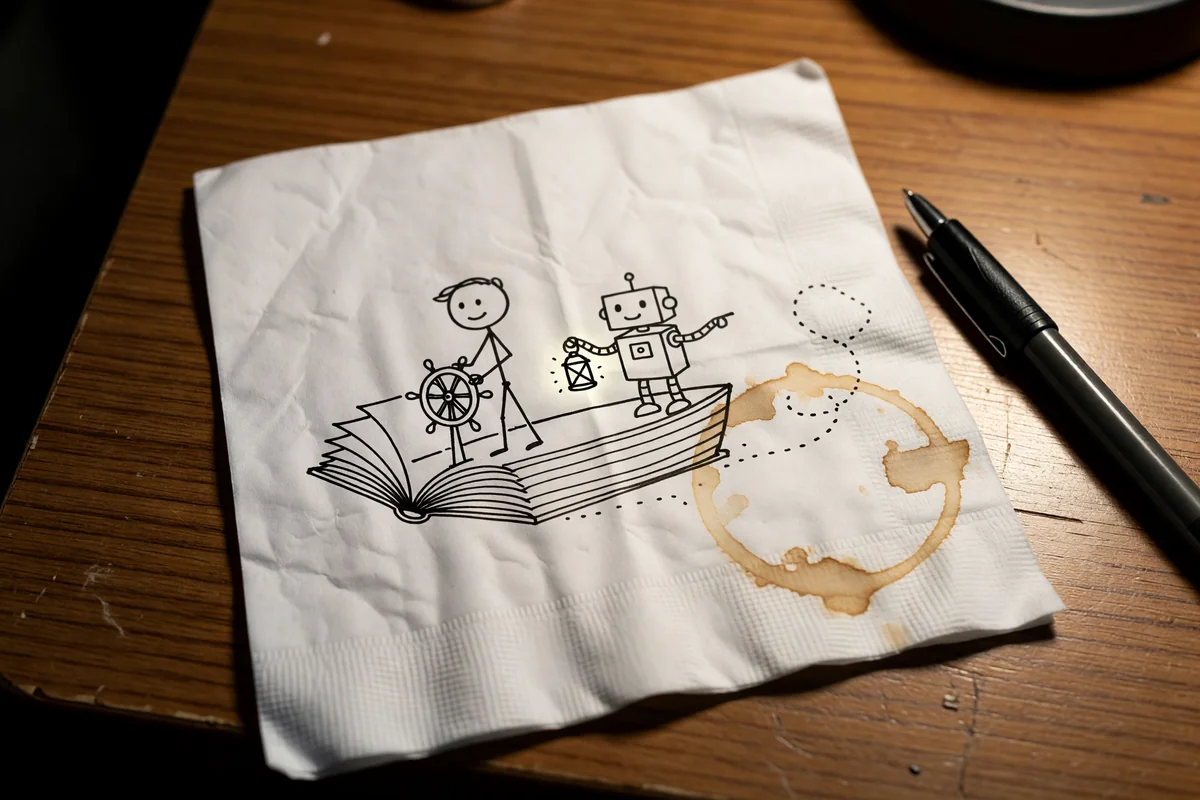
I keep peeling this thing back. First came the founding papers of cybernetics, and I bounced off them. Then a primer for each paper, and I bounced off those too. Then a conversation under each primer, a guide and a learner starting from nothing. Every layer I take off has another one under it, and somewhere down there is the one that finally sits.
I wrote it down the way it came out:
It's funny, like an onion I feel like I keep unravelling the knowledge ball here until I get at something that plants a seed and sits and feels right, and I realize this is what I'm doing.
A ball you unravel and an onion you peel, both at once. Yes, that is about how it feels.
I do not want this to turn into an unending avoidance of the source material. The papers are still where I am going. What I want is more than one way onto the road, and gentler ones, because that is how I learn. So I am sharing the on-ramps as I find them.
If the word itself is new: Norbert Wiener named the field, and he called it "the entire field of control and communication theory, whether in the machine or in the animal." The name is Greek for steersman. In plain words it is the study of how anything, a body or a ship or a company, steers itself by watching what its last move did.
Pick a door
| If you have | Start here |
|---|---|
| An evening, and no wish to study | Testing the water: a cartoon, novels, a game, a record |
| An hour | An hour or an afternoon: short and mostly free |
| A commute | The primers and companions, in audio |
| A season | The shelf: ten books, gentlest first |
| The nerve for the originals | The founding papers, in order |
So this week I asked a different question. The founding texts already have their list. This time I asked an agent which books a person reads before those, the ones written for somebody walking in from outside. My degree is in the comparative history of ideas, from the University of Washington, and the answer fit that: go in through the history and the people, and let the mathematics wait until it has something to hold on to.
Three slopes into cybernetics
One list was not enough, because the first one I made was still steep in places. So there are three slopes now, and you can walk in on any of them.
Testing the water: cybernetics in films, novels and a game
Nothing to study here. A cartoon, some stories, a game, a record, a podcast, each with the shape of the idea somewhere in it.
| What | What kind of thing | The idea inside it | Find it |
|---|---|---|---|
| The Sorcerer's Apprentice, in Fantasia (1940) | A cartoon, a few minutes | A helper that does exactly what it was told and has no way to hear stop. | wherever you watch films |
| Stanisław Lem, The Cyberiad (1965) | Comic stories | Two robot inventors keep building machines that do what was asked instead of what was meant. The subtitle is "Fables for the Cybernetic Age." | Amazon |
| Kurt Vonnegut, Player Piano (1952) | A novel | A town after the machines have taken over the work, written a few years after Wiener's warning about exactly that. | Amazon |
| SimCity (1989) | A game | A city as stocks and flows you can poke. Its designer drew on Jay Forrester, whose group Meadows worked in. | any version you can find |
| Brian Eno, Ambient 1: Music for Airports (1978) | A record | Music made by setting loops of different lengths running and leaving them alone. Eno was a reader of Stafford Beer. | wherever you listen |
| 99% Invisible, "Project Cybersyn" | One podcast episode | A cybernetic control room built for a whole country's economy, in Chile in the early seventies. | the episode |
| The Santiago Boys (2023) | A podcast series | The same story at full length, told for the ear. | the series |
| Adam Curtis, All Watched Over by Machines of Loving Grace (2011) | A documentary series | A skeptic's history of what happened when these ideas left the lab. Good to have the doubt early. | the BBC |
An hour or an afternoon: free, short introductions
Short, and almost all of it free.
| What | What kind of thing | The idea inside it | Find it |
|---|---|---|---|
| My own start-here companion | A few minutes of audio | The first stretch of the founding texts, mapped in one sitting by a guide and a learner. | listen |
| Nicky Case, LOOPY | A toy in the browser | Draw a loop and watch it run. | play |
| Paul Pangaro, "Cybernetics: A Definition" | A short page | The field defined by someone who works in it. | read |
| Donella Meadows, "Dancing With Systems" | A short essay | How to live with systems you cannot control. | read |
| Donella Meadows, "Leverage Points" | An essay | Where in a system a small push does the most. | read |
| Valentino Braitenberg, Vehicles (1984) | A very short book | Imaginary little carts with a couple of sensors and motors, which soon look as if they want things. | Amazon |
The shelf: ten cybernetics books, gentlest first
Books, in the order I mean to read them.
| Book | Why it is on the shelf | How steep | Find it | |
|---|---|---|---|---|
| 1 | Donella Meadows, Thinking in Systems (2008) | Stocks, flows, feedback and delay in plain language. It never uses the word cybernetics and it covers the same ground. | Gentle | Amazon |
| 2 | Norbert Wiener, The Human Use of Human Beings (1950) | The man who named the field, writing for the general reader about feedback, communication and what machines mean for people. | Gentle, with a few dense chapters | Amazon |
| 3 | Stafford Beer, Designing Freedom (1974) | Six short radio lectures on what cybernetics has to say about institutions. A way to hear how a cybernetician talks. | Gentle and short | Amazon |
| 4 | Dan Davies, The Unaccountability Machine (2024) | Beer brought back for today: why large systems make decisions that nobody seems to own. | Gentle | Amazon |
| 5 | Eden Medina, Cybernetic Revolutionaries (2011) | The story of Project Cybersyn in Allende's Chile, where Beer and a team in Santiago tried to build the thing for real. | A scholar's history that reads as a story | Amazon |
| 6 | Andrew Pickering, The Cybernetic Brain (2010) | A history of the British cyberneticians, Grey Walter, Ashby, Bateson, Beer and Pask, who built odd machines and artworks to think with. | Scholarly and long | Amazon |
| 7 | Ronald Kline, The Cybernetics Moment (2015) | The American side: the Macy conferences, and how one conversation scattered into information theory, AI and systems science. | Scholarly | Amazon |
| 8 | Gregory Bateson, Mind and Nature (1979) | Where the loops meet the question of how we know anything. The anthropologist at the engineers' table, which is where the culture essay went. | Dense in places | Amazon |
| 9 | Philipp Janert, Feedback Control for Computer Systems (2013) | The workbench book. Control theory for programmers, with queues, caches and scaling as the examples. | Technical. It helps to program | Amazon |
| 10 | W. Ross Ashby, An Introduction to Cybernetics (1956) | The foundation, written for readers without advanced mathematics, with exercises. The bottom of the shelf and the start of the climb. | The climb | Amazon, or free |
I am starting at the top. So the middle columns are why each thing is here and how steep it looks, taken from what the works say about themselves and checked by an agent. Checked is not read, same rule as before, and I will say what I found as I go.
One book beside the shelf I can vouch for, because I have read it: James Gleick's The Information, the story of information itself, with Shannon and Wiener in it. What I made of it is here.
A library works as well as a bookshop for all of these, and Ashby is free.
Finding the way
None of this feels like studying. It feels like crossing ground I have not walked, with a small light, pointing it at one patch and then another until the patches start to join up into something larger. It is domain cartography again, done on a field of study this time.
And the words that keep coming up while I do it are the field's own. Helmsman. Steering. Governance, which comes down from the same Greek word by way of Latin. Look at what I had already named things: a framework called Situational Governance, a game called 7helm. The word was in the work before the reading was.
I think that is why the history is the right door for me. Pickering's cyberneticians did not sit and theorize. They built a tortoise out of valves, a machine that hunts for its own balance, a light show that answers the musician playing to it, and then they watched what the things did. That is how I have been learning too, in the films and the music and the game. Build the odd thing, watch it, find the name afterward.
It is the most fun I have ever had with a computer.
What the reading is for
Three pieces of my own work sit beside this shelf.
| The work | What it is | Where it meets the reading |
|---|---|---|
| Complexence | The capability of staying oriented inside complexity. | It came out of Gleick's book and the science I tried to put under it. The shelf is where I find out which of its words the field already had. |
| Trajectory | A record of the path already walked, plus a direction I declare. Its rule: "The map informs. The navigator decides." | The steersman. A loop is a path that closes, and the voyage is the reason for the loop. |
| Fidelitron | Build the smallest runnable world that still tells the truth about a question. "As real as necessary. As small as possible." | Conant and Ashby say a good regulator has to be a model of what it regulates. Fidelitron asks how small that model can get. |
I built first and borrowed as I went. Now I am reading to see what I owe.
Read along
If you want to come with me, start on whichever slope suits you. If the books are still too steep, go one layer down: the companions and primers are there for that, in print and audio. Every one of these roads comes out at the same place, which is the source material, read slowly and for myself.
Where this leads on this site
| If you want | Go to |
|---|---|
| The idea all of this reading serves | Making Complexity Visible |
| How I map a field before working in it | Domain Cartography |
| Everything here on complexity and systems | the topic page |
| More books, read and reviewed | The Library |