Culture Is the Oldest Information Technology
I once wrote that our minds run on the same hardware as every other animal and that something rewrote the software. I think the software is culture, the oldest information technology we have.
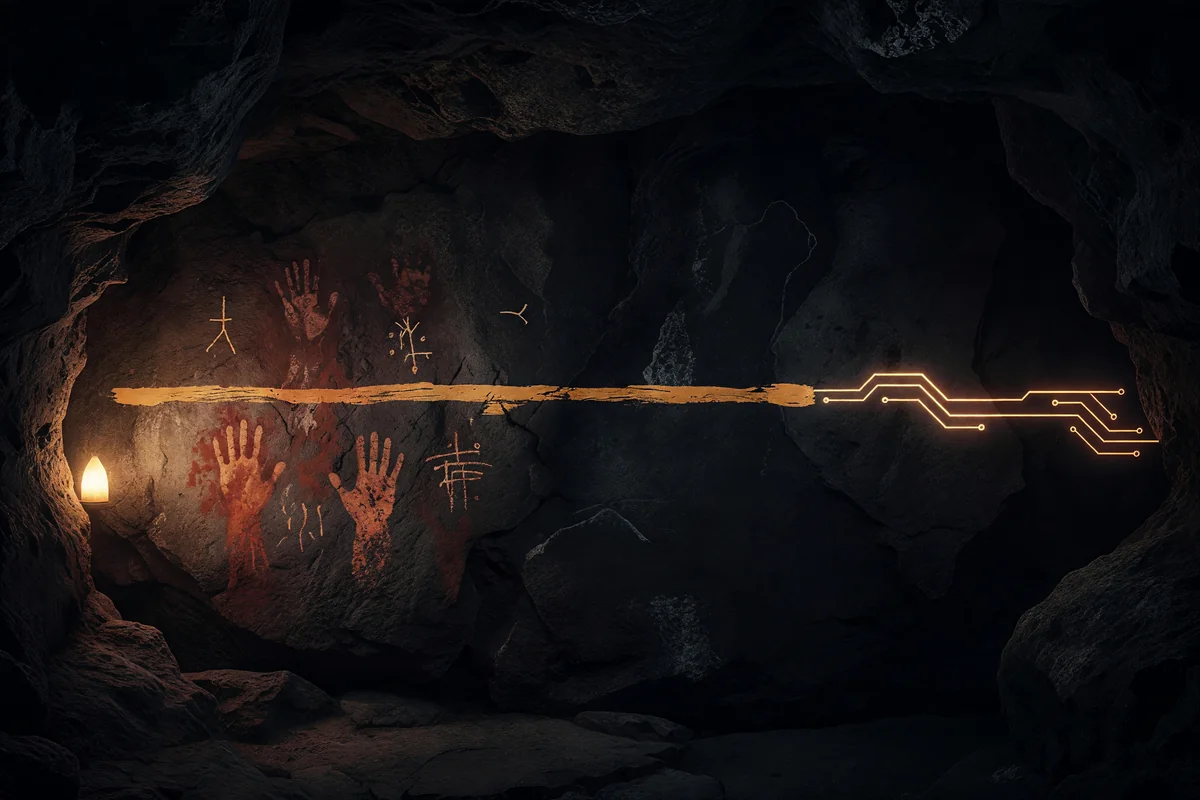
In my notebook, in January of last year, I wrote this:
Somehow our evolution made our minds different than other creatures. But although it's the same hardware, it seems the software was re-written. Or some piece was unlocked.
A few lines on I was still turning it over. "Even through dissecting DNA and our analysis of the body, nothing and no one can detect or explain what makes us human the way we are, with our sounds and language, emotions and tools, and views of time." I did not answer it. The page moved on to something else, the way the pages do.
The whole entry is a question I keep carrying around, and this week it came back in a different form.
Wrong, and then less wrong
I had been noticing how many animals look like other animals, the way a seal looks like a dog, the way a bat's wing is a hand. And I asked a machine, half thinking out loud, whether humans might be the end of evolution, the place all of it was heading, which would explain why we are so different and still so obviously animal.
It told me no, politely. Evolution is a tree, not a ladder. We are one twig still alive on it, beside the chimps and the whales and the oaks, and nothing on the tree is the destination. The resemblance I was seeing comes from two places. Shared ancestry, the same old arm modified a hundred ways. And convergence, unrelated branches arriving at the same answer because they faced the same problem.
So I pushed. Not the end of all animals, then, but something like their sum. A dolphin is brilliant and will never build a city, and that is not a failure of brains. It has no hands, no fire, nothing it can leave lying around for the next dolphin to pick up. We are not the best at anything. A cheetah is faster, an eagle sees farther, a dog smells a world I will never know. But the combination is rare, and at some point it started feeding itself. Better hands made tools worth more. Better tools rewarded better brains. Language let the tools travel.
It kept that part and threw out the rest. Fair.
The software
Then I said the thing I actually believe. Culture is a technology. Maybe the first one.
A hunting ritual carries when to go, where the herd moves, who stands where, what not to kill, how the meat gets shared. Nobody in the circle needs to understand all of that for it to work. The ritual holds it for them. That is software. It runs on people, and it outlives every one of them.
Lay a few of the old forms next to what I work with every day and the match gets uncomfortable.
| Culture | Works like |
|---|---|
| a ritual | an algorithm |
| a norm | a protocol |
| a story | compression |
| an institution | persistent state |
| language | an encoding |
| teaching | replication |
| reputation | feedback |
| writing | external storage |
Which turns my old question around. Maybe nothing in the hardware got unlocked at all. Maybe what changed is that one generation could start where the last one stopped, and the thing that made that possible lives outside the body.
Information leaving the body
Carl Sagan got here first. In The Dragons of Eden he wrote about knowledge that is extragenetic, held in brains instead of genes, and then extrasomatic, held outside the body altogether, with writing as the great example. Genes change slowly. Past a point, he argued, anything more we need to know would have to live somewhere else.
Line it up and it reads like a trajectory, each step loosening information from whatever held it before.
| Where the information lives | What it gains |
|---|---|
| in genes | it survives the generation |
| in a brain | it can change within a life |
| between brains | it can be taught |
| in culture and language | it survives the person |
| in writing and institutions | it survives memory |
| in machines | it can be worked on without us |
Each step is faster than the one before. Biology takes forever. Culture takes generations. Software, an afternoon.
Put the first appearance of each home on one line and the speed-up stops being a claim. The scale below is logarithmic, so every step to the left goes ten times further back, and still the points crowd toward the right edge.
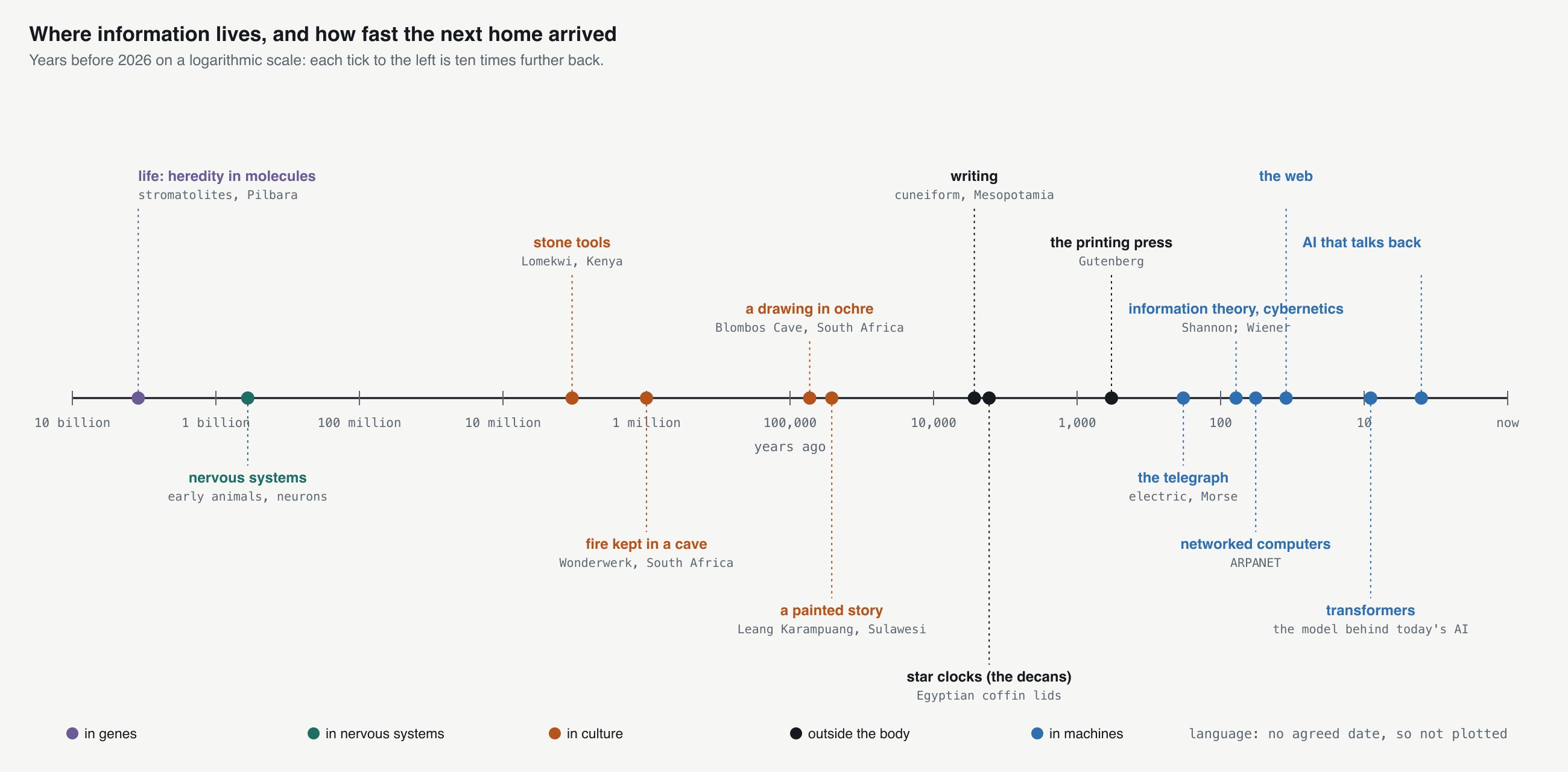
Click the diagram to open it full size. Each date is the earliest well-dated evidence, which is a floor, not a birthday: the Dresser Formation stromatolites, Pilbara, Western Australia; Harmand and others, Nature 2015 (Lomekwi); Berna and others, PNAS 2012 (Wonderwerk); Henshilwood and others, Nature 2018 (Blombos); Oktaviana and others, Nature 2024 (Leang Karampuang); the decan tables on Middle Kingdom coffin lids. The rest are matters of record.
I made the mistake, talking it through, of saying culture came out of information theory. It is the other way around, and I should have known it, because I wrote about exactly this in my review of Gleick's The Information. Shannon gave us the bit and the channel and the noise in the middle of the last century. People had been building channels and fighting noise for a very long time before that. The theory came from a species that was already doing it. And Shannon, to make information measurable, set meaning aside on purpose. Culture is the part of the story where meaning is the whole point.
Where the animal met the machine
The book of Norbert Wiener's I picked up as a teenager, and put down because I did not understand it, has a subtitle I did not think much about then: Control and Communication in the Animal and the Machine. The animal and the machine, in one breath.
The people who built that field met through the late forties and into the fifties at a run of meetings now called the Macy conferences. Wiener was there, and Warren McCulloch, and John von Neumann, and Shannon. So were Margaret Mead and Gregory Bateson, who had spent their lives studying how cultures hold together. The anthropologists and the engineers at one table, working out feedback and communication together. Bateson later defined the unit of information as "a difference which makes a difference," in a 1970 lecture collected in Steps to an Ecology of Mind. I cannot think of a better one-line description of what a culture does.
That table is what Paul Pangaro is trying to set again with his #NewMacy work, and I wrote about him earlier this month. Cybernetics has been out of the public light for a long time. It has the words for exactly this, for loops and memory and steering, in animals and in machines and in the space between them. We are building machines now that take a goal, act, read the result and correct. I build them, and I am only now going back to the field that described them first.
My own rungs
I look at the things I spend my hours on and they keep turning up on that ladder.
The Decan Log is a calendar the old Egyptians drew from the stars, still running a practice in my week. A calendar is culture as storage if anything is. My notebooks are writing, memory outside the body, and the pipeline that reads them is two machines doing the reading I used to do by hand. The music engine writes a canon as a list of notes and lets the code play it forever. The arcade game records every run and replays it to the bit, a whole act of play turned into something that outlives the playing. Even this site is a small institution: an atlas of what I have thought, kept outside my head so I can find it again.
None of that was planned as a theory. It is just where my attention kept going.
The last rung
The conversation that sharpened all of this was with a machine. Twice it returned the standard account, and twice the standard account was right. That is the newest step on the ladder, information outside the body that I can now put questions to. I do not know yet what to make of it. It is not a person and it is not nothing.
So, back to the notebook. Same hardware, rewritten software, some piece unlocked. I think the software is culture, and the piece that got unlocked was the ability to keep it. What I still cannot answer is the part I wrote down that day and left alone: where did the first piece come from?
Related reading: Are Humans Natural or Alien?, an earlier pass at the same question; The Raw Thoughts of a Biological LLM, a December notebook entry that goes looking for where new thoughts come from; and the Loops and Legibility series.