The Information by James Gleick: The Book That Sent Me Looking for Meaning
James Gleick's The Information is the clearest history we have of how the world learned to measure the signal. It is also the book that showed me, by drawing the boundary so cleanly, the one thing the science of information set aside on purpose: meaning. This review is the origin story of the work I have been doing since I closed it.
The Book That Started a Field for Me
Here is the kind of reader I was, because it changes the review. I did not come to The Information as a historian of science or a casual browser. I came to it as a builder, someone who spends his days moving ideas between a human head and a machine and watching how much of the idea survives the trip. I closed the book and could not stop thinking, and within a week I had written a formal essay, invented a notation, and started a repository for a science I did not have a name for when I opened it. So this is not a neutral review. This is the origin story of the work I have been doing since, and James Gleick lit the fuse.
What the Book Actually Is
The Information: A History, a Theory, a Flood is exactly those three things, in that order. Gleick, who also wrote Chaos and Genius, traces how humanity learned to handle the most abstract thing there is, and he does it with a storyteller's patience.
It opens with African talking drums, drummers who could send a message across miles by encoding speech in tone and rhythm, and who had already discovered, without the math, that you fight noise with redundancy, that you say a thing twice in different words so the meaning gets through. From there the history runs through the written word and the first dictionaries, through Charles Babbage and his unbuilt mechanical computers, through Ada Lovelace writing the first program for a machine that did not exist, through the telegraph teaching a whole civilization to compress language into clicks.
And then it arrives at the man at the center of the whole thing: Claude Shannon, a quiet engineer at Bell Labs who in 1948 published a paper called A Mathematical Theory of Communication and, almost as a side effect, invented the modern world. Shannon gave us the bit, the binary digit, the smallest possible unit of information, a single answer to a single yes-or-no question. He defined information as the resolution of uncertainty, a clean idea that says the more surprised you are by a message, the more information it carried. He borrowed the word entropy from thermodynamics to measure that surprise, worked out how much a channel can carry before it chokes, and proved you can claw a clean signal back out of a noisy one if you build in the right redundancy. Every video call, every saved file, every bar of signal on your phone runs on what Shannon worked out on paper in one decade.
The last third, the flood, is Gleick widening the lens until information looks like the substance of everything: the genetic code as a message, Richard Dawkins's memes as information that copies itself through culture, quantum bits, the physicist John Wheeler's line that reality itself is it from bit, and finally the modern deluge we are all drowning in. It is a lot of book. It sprawls. The middle chapters on logic and the telegraph drag if you came for the punchline, and Gleick sometimes loves a tangent more than the through-line. But the sweep is the point, and almost no one else could have held it together.
The Sentence That Wouldn't Leave Me Alone
Here is the thing that turned a good read into a year of work.
Shannon, to make information measurable, had to throw something away on purpose. He said it plainly, and Gleick puts the moment right at the center of the book: the meaning of a message is irrelevant to the engineering problem. Shannon did not care whether the bits spelled a love letter or a stock price or pure noise dressed up to look like sense. He measured the amount, never the meaning, and that single act of leaving meaning out the side door is exactly what made the theory work. You cannot do clean math on something as slippery as what a thing means. So he set it aside, and the entire information age was built on the part that was left.
I read that and could not unsee the hole it left. We have a rigorous, beautiful, world-building science of the signal. We have nothing of the kind for the meaning. We can tell you to the bit how much got sent and almost nothing about whether it was understood. And for someone whose actual daily problem is whether an idea survives being moved from a head into a model into code into an agent and back, the missing science was not academic. It was the whole job.
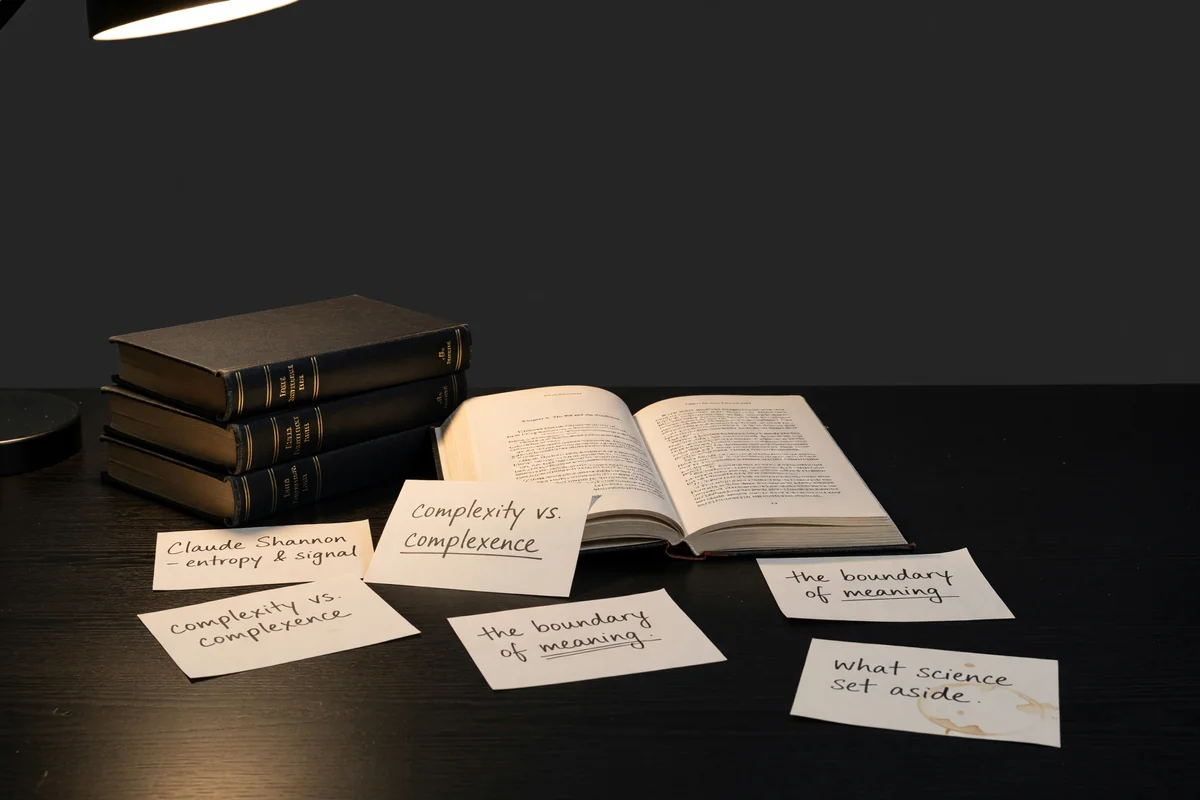
That gap is the field I fell into. My own essay leans on Shannon directly, on bandwidth and noise and channel capacity, and the reason it does is that I got all of it here, from Gleick. But where Shannon measured the signal and bracketed the meaning, the work I started is an attempt to pick the meaning back up: to ask what stays constant when an idea changes form, and to call that the thing worth measuring. Gleick's book did not just inform the essay. It provoked it, by drawing the boundary of information so cleanly that the unclaimed country on the other side became impossible to ignore.
Book Details at a Glance
- Title: The Information: A History, a Theory, a Flood
- Author: James Gleick
- Genre: Science, history of ideas, information theory
- Best for: Builders, engineers, and anyone who wants to understand the substance their whole life now runs on
- The one idea to take: We learned to measure the message and chose, on purpose, not to measure its meaning.
👉 Buy The Information on Amazon
Who Should Read It
Read it if you build things with information, which now means almost everyone. Read it if you want to know where the bit came from and why your phone works. Be ready for a long, dense, generous book that rewards patience and occasionally tests it. And read it, especially, if you have ever had the feeling that we are extraordinarily good at moving messages around and strangely bad at making sure anything actually gets through. That feeling has a history, and Gleick tells it better than anyone. He also, without meaning to, hands you the exact place where the next work begins.
Where This Goes Next
This is the book under The Science of Complexence, the essay it set off, and the open research I have been building in the open ever since. Gleick gave me the science of the signal. The thing I am chasing is the science of what survives.
Gleick starts with drums that talk. I went further back, to culture as the first information technology and the long practice of fighting noise before anyone had a theory of it, in Culture Is the Oldest Information Technology.
And if Gleick leaves you wanting the other half of the story, the loops and the steering that grew up beside Shannon's signal, the books I am reading next are on a gentler shelf of cybernetics.