The Book: On the Taboo Against Knowing Who You Are by Alan Watts
Alan Watts dismantles the illusion of the separate self in 150 pages of crystalline prose. Not for Buddhists or philosophers, for anyone who's ever suspected that who they think they are might be a story they're telling themselves. Playful, radical, and quietly devastating to ego.
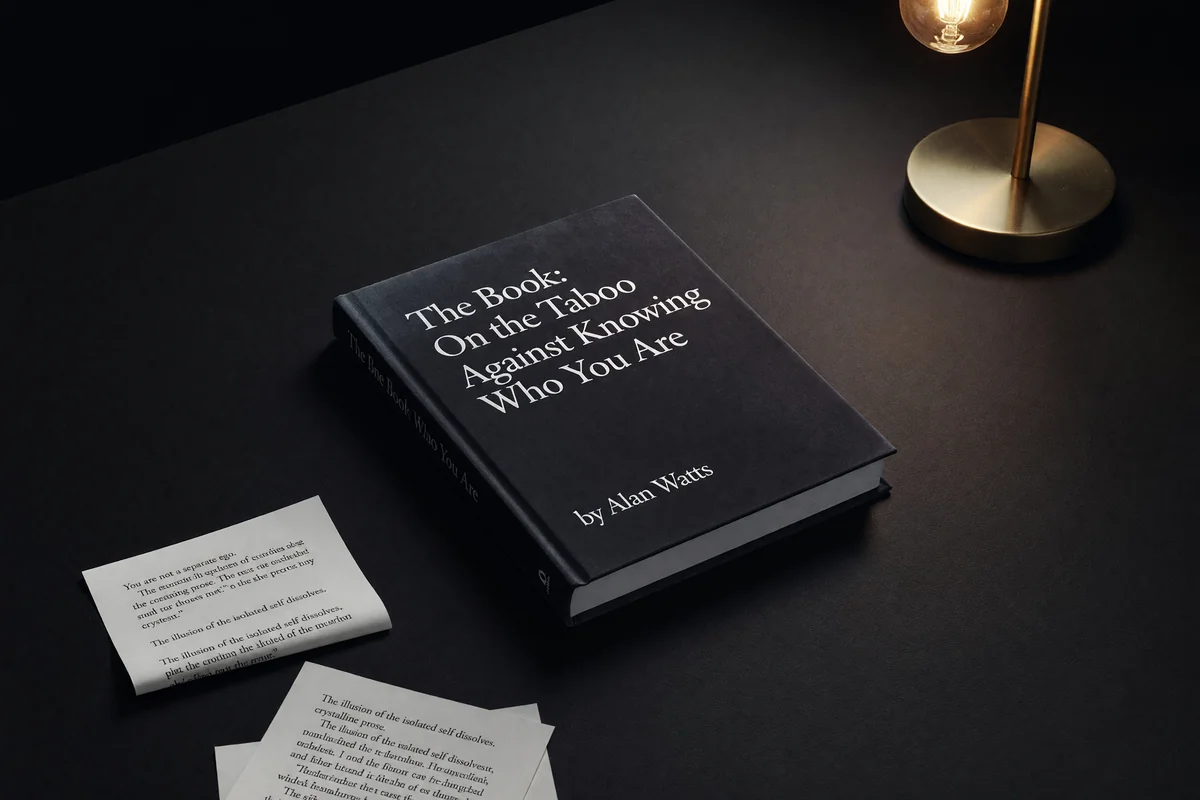
The Taboo Against Knowing Who You Are
Introduction: Who's Reading This?
The question isn't rhetorical. Right now, as you read these words, there's an assumed reader. "You." But who is that? Where are the boundaries of "you"? Where does "you" end and "not-you" begin?
Your skin? But you're breathing air, metabolizing food, perceiving light. You're continuous with the environment. The boundary is porous, conceptual.
Your mind? But thoughts arise unbidden. You don't create them, they appear. The "you" observing thoughts is itself a thought. Turtles all the way down.
Alan Watts wrote The Book (1966) to address what he called "the taboo against knowing who you are." Western culture is built on a fundamental assumption: you are a separate self, isolated inside your skin, fundamentally alone in an alien universe.
This assumption, the isolated ego, the skin-encapsulated self, is, according to Watts, a hallucination. A necessary fiction for children but a prison for adults. And the taboo is this: we're culturally forbidden from questioning it. To suggest you're not a separate self is considered mystical nonsense, Eastern weirdness, hippie bullshit.
But what if it's just accurate?
The Book makes the case in 150 pages of playful, precise prose. Watts uses Zen, Vedanta, Taoism, modern science, and just plain observation to dismantle the illusion of the separate self. Not to replace it with different dogma, but to reveal what's already obvious once you look.
Here's what makes it essential:
The Illusion of Separation: How Western culture creates and maintains the hallucination of the isolated ego.
You Are the Universe: Not metaphor. Not mysticism. Actual recognition that the organism and environment are one process.
The Taboo: Why we're forbidden from seeing this clearly. What society fears about people who recognize their true nature.
Practical Implications: What changes when you stop being a separate self trying to survive and recognize yourself as the whole process?
For anyone who's suspected the "self" might be a story, anyone tired of defending an ego that never quite feels real, or anyone curious about non-duality without religious packaging, this is the book. (Buy on Amazon)
Book Details at a Glance
| Feature | Details |
|---|---|
| Title | The Book: On the Taboo Against Knowing Who You Are |
| Author | Alan Watts |
| Publication Year | 1966 |
| Genre | Philosophy, Non-duality, Consciousness Studies, Zen |
| Length | ~150 pages (short, dense) |
| Main Themes | Illusion of separate self, organism-environment unity, cultural taboos, ecological consciousness |
| Philosophical Sources | Zen, Vedanta, Taoism, Western science, ecological thinking |
| Writing Style | Clear, playful, precise, accessible without being simplistic |
| Readability | Highly readable, requires attention, rewards re-reading |
| Who Should Read? | Anyone questioning identity, interested in non-duality, tired of ego-maintenance, curious about consciousness |
Breaking Down the Core Argument
Watts's thesis is simple but radical: You are not a separate self. You are the entire universe experiencing itself locally.
Not metaphor. Not poetry. Actual description of what's happening.
1. The Hallucination of Separation
Western culture teaches: you are a skin-encapsulated ego, born alone, dying alone, fundamentally isolated. You "come into" the world as a stranger. The universe is alien, threatening, indifferent. You must survive, compete, defend yourself.
This is, Watts argues, a hallucination. A useful fiction for organizing experience, but not actually true.
The evidence:
- You didn't "come into" the world. You came out of it. Like apples from apple trees, humans from the universe.
- There's no clear boundary between "you" and "environment." You're breathing air, eating food, perceiving light. You're continuous with it all.
- The "you" that seems to be reading this is a concept, not a thing. Try to find it. Where is it? In your head? That's just more sensations observed by... what?
The analogy: You don't think your heart pumps blood. You don't think your stomach digests food. These are things the organism does. Similarly, the universe "peoples." It produces humans the way the ocean produces waves. You're not in the universe, you're an activity of the universe.
2. The Organism-Environment Field
Watts uses the concept of "field" from physics. You can't have a magnetic north without a south. You can't have up without down. They're not two separate things, they're one field with two poles.
Same with organism and environment. They're not separate. You exist only in relation to the environment. No environment, no organism. They arise together, depend on each other, are aspects of one process.
Examples Watts gives:
- "The individual is separate from the universe" is like saying "the head is separate from the neck because the head stops and the neck begins."
- You wouldn't have eyes without light. Light and eyes co-evolved. You and the world co-create each other continuously.
- When you look at stars, photons from the star hit your retina. The star is literally touching you. Where's the separation?
The implication: You're not a separate observer looking at an external world. You're the process of observation happening. Subject and object arise together. Neither exists independently.
3. The Taboo
If this is obvious (and Watts argues it is, to direct observation), why doesn't everyone see it?
The taboo: Western culture forbids this recognition. Politically, economically, religiously, we need people to believe they're separate selves. Why?
- Control: Separate selves can be controlled. "You" fear death, need approval, want security. That makes you manipulable.
- Consumption: Separate selves feel incomplete. They buy things, seek status, chase happiness. Good for economy.
- Religion: Christianity posits God as separate. You're a sinner needing salvation. Recognizing you're already divine collapses the power structure.
- Politics: Nationalism, us-vs-them, competition, all require belief in separation.
The threat: People who recognize they're the universe don't follow the script. They don't fight for ego. They don't fear death the same way. They can't be controlled as easily.
So the culture creates a taboo. "Don't go there. Don't question the separate self. That's mysticism. That's Eastern weirdness. That's not serious."
4. What Changes When the Illusion Drops
Watts isn't advocating ego-death as performance or spiritual bypass. He's describing what naturally happens when you see through the hallucination.
What doesn't change:
- Your personality remains. The organism still has preferences, habits, patterns.
- You still use "I" and "me" conventionally. Language requires it.
- You still make decisions, take actions, live a life.
What does change:
- The anxiety of defending a fictitious self drops away.
- Death becomes less terrifying, what dies is just the organism, not "you" (which was never separate to begin with).
- Ecological consciousness arises naturally, harming the environment is harming yourself.
- Competition softens, you're not separate selves fighting for resources. You're one process optimizing itself.
- Compassion becomes obvious, other people aren't "other." They're you experiencing itself through different nervous systems.
The paradox: You can't "achieve" this recognition. The "you" who wants to achieve it is the illusion being dismantled. It just becomes obvious. Or it doesn't.
5. The Ecological Self
Watts wrote this in 1966, before mainstream environmentalism. But he saw clearly: the ecological crisis is a crisis of identity.
If you believe you're separate from nature, you exploit it. If you recognize you are nature, exploitation becomes self-harm.
The shift: From "humans vs. nature" to "humans as nature becoming conscious of itself."
This isn't tree-hugging sentimentalism. It's accurate ecology. The organism and environment are one system. Damaging the system damages the organism. Not moral imperative, just basic systems thinking.
Why Watts Matters (And Why He's Dismissed)
Alan Watts is often dismissed by serious Buddhists and academic philosophers. Too popularizing. Too entertaining. Not rigorous enough. He drank too much. He had affairs. He didn't live up to his teachings.
All true. Watts was flawed. He knew it. He said so.
But here's what he did: he translated Eastern non-dual philosophy into clear English for Westerners. No jargon. No mystification. Just direct pointing.
The Zen tradition values this. "A finger pointing at the moon." Don't worship the finger. Look at the moon.
Watts was a finger. Not the moon. But an excellent, clear, playful finger.
His genius: Making the complex simple without making it simplistic. The Book never condescends. It doesn't assume you're stupid or spiritually inferior. It just points. "Look. See for yourself."
His limitation: He was more scholar than practitioner. He studied meditation but wasn't a monk. He understood the philosophy deeply but struggled to embody it fully.
Does that invalidate the pointing? Maybe. Maybe not. Read him, test the ideas, see what's true. That's what he'd want anyway.
Practical Implications
Reading this book won't enlighten you. Watts says so explicitly. Understanding the finger isn't seeing the moon.
But it can:
- Reduce anxiety: Much suffering comes from defending a fictitious self. Seeing through that fiction is a relief.
- Clarify meditation: If you're sitting trying to "achieve" no-self, you're reinforcing the self. This book helps undo that trap.
- Improve relationships: Other people are you. Not metaphor. Treating them as separate is confusion.
- Ecological action: Harming the environment is self-harm. Not moral guilt, just basic recognition.
- Death preparation: What dies is the organism. "You" (as infinite awareness) was never born, can't die.
The warning: Don't turn this into spiritual bypassing. "There is no self, so nothing matters!" That's confusion. The organism still feels pain, still has responsibilities. Non-duality doesn't erase relative reality, it contextualizes it.
Reading Recommendations
How to read this:
- Slowly. It's short but dense. One chapter at a time.
- Without trying to "get it." Let it percolate.
- Re-read sections. The second pass often reveals what the first missed.
- Test it. Don't believe Watts. Check for yourself. Where are the boundaries of "you"?
Companion readings:
- The Wisdom of Insecurity (Watts) - More accessible intro to same ideas
- I Am That (Nisargadatta Maharaj) - Non-duality from Indian perspective
- The Direct Path (Greg Goode) - Modern Western approach
- Waking Up (Sam Harris) - Neuroscientific angle on non-duality
Who this serves:
- Philosophy students wanting Eastern thought without academic jargon
- Meditators stuck in "self trying to achieve no-self" trap
- Anyone tired of ego-maintenance wondering if there's another way
- Environmentalists wanting philosophical grounding for ecological consciousness
Who might struggle:
- Readers wanting step-by-step practices (this is pointing, not cookbook)
- People uncomfortable questioning fundamental assumptions
- Those needing rigorous philosophical argumentation (Watts sketches, doesn't prove)
Final Thoughts & Where to Buy
⭐ Rating: 5/5: Crystalline dismantling of the separate self illusion in 150 pages
The Book is Alan Watts at his best. Clear. Playful. Radical. He takes the fundamental assumption of Western culture, the isolated ego, and shows it's a hallucination.
Not to replace it with Eastern dogma. Not to sell you a spiritual system. Just to point out what's already obvious if you look: you're not separate from the universe. You're an activity of it. Like waves are activities of the ocean.
This doesn't solve all problems. Watts died of alcoholism. Knowing you're the universe doesn't make you immune to suffering. But it does shift something fundamental. The desperate defense of a fictitious self softens. What's left is just life, happening, with less resistance.
Read this if you've suspected the "self" might be a story. If you're tired of carrying the burden of being someone. If you want philosophy that points directly instead of building elaborate systems.
And if it does nothing for you, fine. Put it down. Maybe return years later. The taboo is strong. Sometimes it takes time.
📖 Buy The Book: On the Taboo Against Knowing Who You Are on Amazon
This post contains affiliate links. If you purchase through these links, I may earn a small commission at no extra cost to you. Thank you for supporting this blog!
From the Page to the Screen
Watts did not stay a good read either. His Out of Your Mind lectures became a film series, starting with The Web drawn from his web-of-life talk. The lectures on the page, the voice on the screen.