The Rest of the Map
The rest of my cybernetics reading list has its primers now, from Beer to Boyd: a companion, an audio primer and a printed sheet for every work, shared while I am still learning it.
Essays on making complex systems readable: loops, graphs, and the views a team is missing.
18 posts · all topics
The rest of my cybernetics reading list has its primers now, from Beer to Boyd: a companion, an audio primer and a printed sheet for every work, shared while I am still learning it.
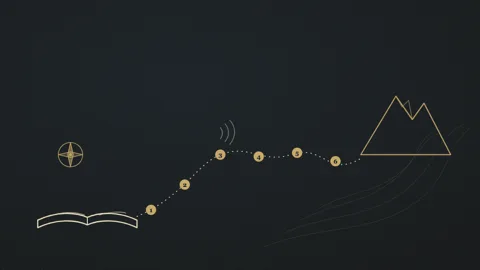
I opened the first paper on my cybernetics reading list and bounced. I had no map of the domain, so I stopped and built one: a primer for every work, in print and audio.

An agent can check a quote for me. It cannot read for me. So before I open Ashby, Wiener and the 1943 paper, here is the list, and what I expect to find, written down first.

I once wrote that our minds run on the same hardware as every other animal and that something rewrote the software. I think the software is culture, the oldest information technology we have.

A vision model read the top of my notebook page and filed it under a date eight years off, calmly. One reader cannot flag what it is sure of. So now two models read every page, and I look only where they disagree.

One of my health checks stayed red for eleven weeks by reading its own failure. A loop is the special case of a trajectory, the path that happens to close, and a life does not.
Denebola marks the tail of the lion, and a tail moves before the body does. Decan 12 is reform and intuition: catching the map before it is gone, reading the anomaly instead of the object, and finding out that the fix almost always belongs at the chassis rather than on the instance in front of you.

I typed my thirty-two loops, then drew them as a graph, and thought the loop was the top of the system. It turned out to be the roof of a stack eight floors deep, and the floor holding all the weight is the smallest one: the edge.

Typing my automation handed me most of its rules for free; the type carries the contract. One rule came free with nothing, and it was the one my system was breaking: every file gets exactly one job that writes it. On the difference between rules you remember and rules the structure carries.
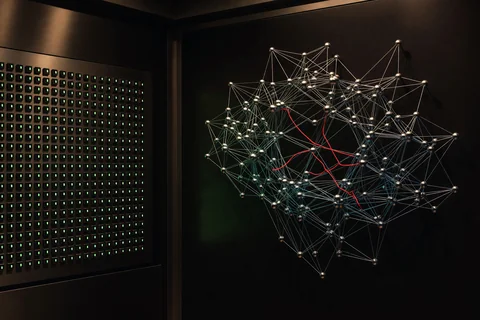
I gave every job in my automation a receipt, a health check, and a green light, and the system still would not fit in my head. A dashboard shows the state of the parts. The question I actually had was about the shape of the whole, and no amount of state answers a question about shape.

The best thing anyone told me about my own system this year was that I had not invented it. The scripts I grew by hand are a data pipeline, the shape is a DAG, and the discipline is solved. What the tools actually sell, why I am not buying yet, and the difference between wanting an engine and wanting a map.

Thirty-two automated jobs run underneath my days, I wrote every one of them, and I could not hold the system in my head. The problem was never my memory. It was a word. "Loop" was one word doing the work of seven.

I had thirty-three git repositories and treated all thirty-three as if they were on fire. The fix was not more discipline or a better tool. It was a census: an inventory, an edge, and a rule for what counts as alive. Domain cartography applied to my own sprawl.
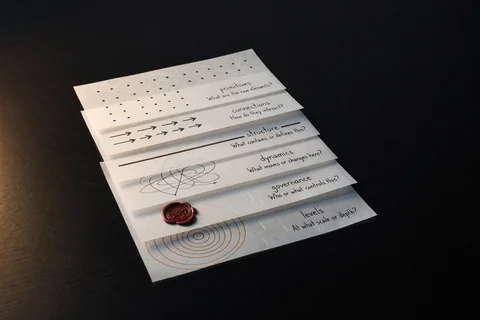
The hardest part of mapping a complex domain is the blank page. Here are the six layers I run every domain through, from primitives to levels, with the question each one answers, how to actually do it, and the failure mode that shows up when you skip it.
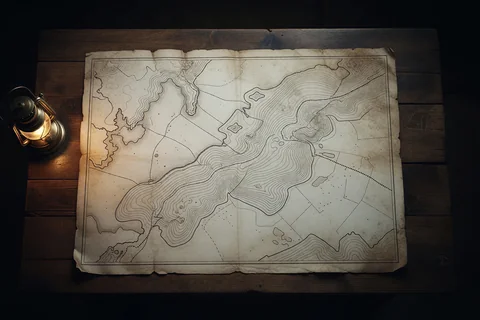
Domain cartography is the practice of charting a complex domain you have to live and act inside, until it is legible enough to navigate. Not making it simple. Making it readable. Here is the field, the method, and the six layers every map needs.
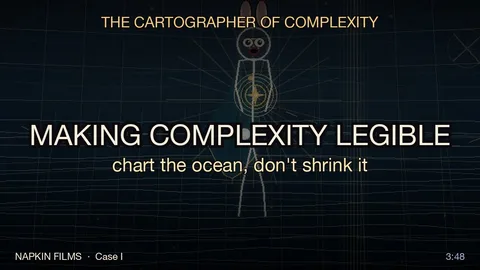
Making Complexity Legible is Case I of The Cartographer of Complexity, a new Napkin Films series about Making Complexity Visible. The idea: you cannot make a complex system simple without deleting what made it work, so you do not shrink the sea, you learn to read it. A tidal-EDM spit-rap, Plan 9 and OG Bobby trading bars over recomposed Telemann, with a cartographer bunny who roams a sea that brightens as it becomes legible. CC BY 4.0.
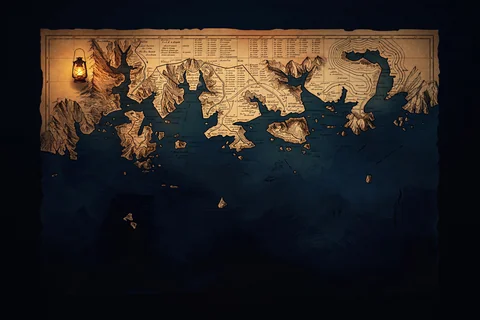
When a system is hard to see, decisions migrate to whoever holds the context. You cannot simplify the ocean, only chart it: why a live view of a system widens the circle of people who can think about it.
Coherent complexity is what you get when a complex system is made legible without being made simple. You do not reduce it. You map it, until you can move through it on purpose. A field guide to the practice, and the idea behind everything else I build.