
Level Up the Game
Kent Beck wants the genie to bear his toil and leave him his struggle. My first thought: then move the target. Go after what I couldn't reach alone, and the struggle is waiting there.
Essays on how software engineering is changing with AI, written from daily practice.
19 posts · all topics
Kent Beck wants the genie to bear his toil and leave him his struggle. My first thought: then move the target. Go after what I couldn't reach alone, and the struggle is waiting there.

The hackers didn't understand the machine when they started. That was the point. So why is someone exploring with AI written off for not understanding yet? FORTRAN, the genetic fallacy and a loop.

The fight over whether AI is good or bad is the wrong fight. AI is a friction-removal engine, and there are two kinds of friction: the kind that is building you, and the kind that is only taxing you. Telling them apart, in the moment, is the whole skill.

Most defenses of AI are about productivity, and they are weak. The strong case is older and bigger: this is the next rung on a seventy-year ladder of removing effort that was never building anyone. Here it is, made at full strength.

AI does not destroy your work in front of you. It moves the cost somewhere you cannot see: to later, to the invisible, to the version of you that stops getting built. The strongest case against leaning on it, made in full.

AI is strong in one place and confidently wrong half a step over, and from the inside the two feel identical. The real skill is not prompting. It is knowing when to delegate, when to steer, when to verify, and when to think alone.

AI took the typing, and the cost of software engineering did not go away. It moved from the hands to the head and got heavier. The new scarce resource is your attention, and the new discipline is managing it.

DevOps was always a feedback loop. The one worth building now runs on the system itself, so every failure and every change makes the next one cheaper and safer.

Agent mode is not a faster way to type. It moves the unit of thought up from syntax to intent, turns you into a conductor of parallel work, and makes the real bottleneck the clarity you can hold in your head at once.

When a system is hard to see, decisions migrate to whoever holds the context. You cannot simplify the ocean, only chart it: why a live view of a system widens the circle of people who can think about it.
What changes when an AI agent gets real access to your repository, terminal and tests: the patterns that hold, the failure modes that cost me time, and a four-week way in.
Vibe coding means accepting whatever the model hands back and shipping it. I build with AI every day, from a chiptune synth to an animated rap film, and that is not what I am doing.
The AI-generated code sailed through review and passed every test, then failed in production when two processes collided. Holding a quality bar when code arrives faster than you can read it.
The DevOps Handbook is the clearest account I have read of why some teams ship small changes often without breaking things. A walk through the Three Ways, the technical practices, and what has dated.
The index to my seven-part series on building with AI: six weeks at machine speed, a method, AWS infrastructure, a handwriting OCR pipeline, a company website, what it cost, and patterns from one game.
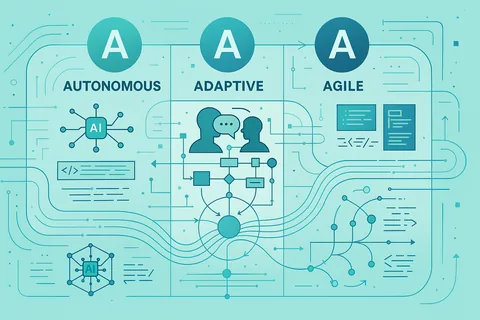
How my AI collaboration went from chaos to a method: the AAA Framework (Autonomous, Adaptive, Agile), a digital 5S, and what four very different repositories each taught me.
Early vibe coding: an AI partner all day, commits and branches, Sonnet 4 crunching on a problem again after each control+c, and a Flutter app moving fast with hot reload.
Tingling at being part of something historic: early work with AI tools, a race against limited energy, the gold rush fever of it, and the cold air that keeps the machine running.
I write software, and I read Levy's Hackers to see where the habits I take for granted came from, from the all-night MIT model railroad club to Homebrew and the fight over free code.