Where I Learned to Look
How I walk into a new field: through its history and its people, with a map, and with the first thing the Comparative History of Ideas taught me, that the one observing is in the picture.
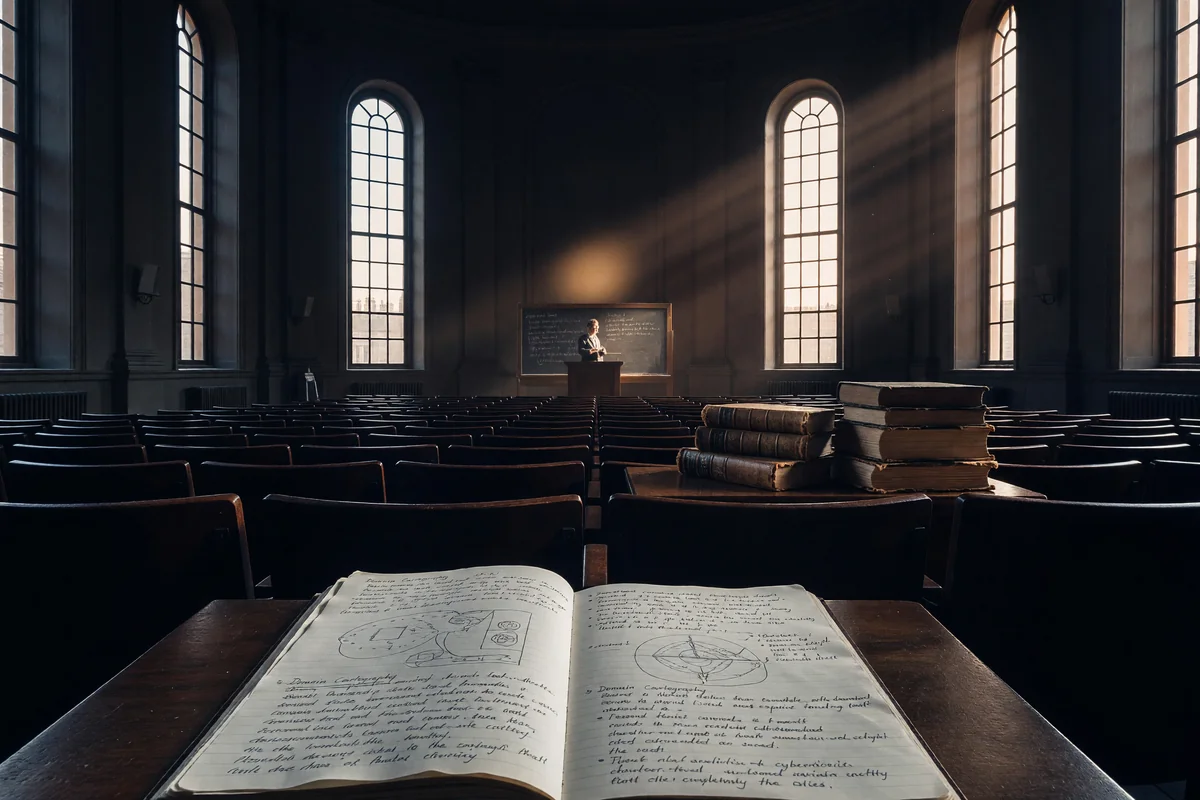
There is a line in one of my notebooks, from a day when I was asking where the writing comes from at all:
The CHID course is the first time I can recall my gift for writing, and also the ability to take copious notes on a topic as it is presented, and follow along.
CHID is the Comparative History of Ideas, a program at the University of Washington, and it is what my degree is in. Lately it keeps turning up under the reading, so I went looking for what it left me.
What it taught me
I was asked that question recently, and this is what came out:
CHID taught me to observe, and to be aware that I am the observer and so am tainting what I observe.
And a moment later:
Also to engage, to connect, and to seek the beautiful in life.
They pull in two directions. One says step back, you are in the picture and you change it by looking. The other says go toward the thing anyway, touch it, find what is good in it. Neither cancels the other, which is the third thing I wrote down:
Contradictions can coexist, and they are necessary components of nature and the universe.
The door I use
When I walk into a field I have not worked in, I go in through the side door of its history. For me that has mostly meant two histories: "history of science and computer science." I said it on the gentler shelf, "I think that is why the history is the right door for me," and a page of freewriting from the same month says it with more excitement:
Given my love for history of science I am perfectly "primed" and filled with excitement to move to the actual papers and books and lectures.
The people come first. Who needed this idea, what they were stuck on, who they argued with. In The Hacker Ethic Meets Cybernetics I ended up writing "These are my people" about a book full of programmers, and the list kept running back into the history of science. Once I know the people, the ideas have somewhere to sit.
That is the map. When I bounced off the first cybernetics papers I wrote that you cannot file what you read if there is no cabinet. The history is the first drawer of that cabinet. It is domain cartography done on a body of reading: chart the field you did not build before you try to work inside it. The people and the works are the primitives. The arguments between them are the forces.
Finding it again in the canon
The branch of cybernetics I am listening my way into now is the second-order one. Margaret Mead, in an address to the new American Society for Cybernetics, asked the field to turn its tools on its own workings. Heinz von Foerster gave the turn a name, the cybernetics of observing systems, where the one doing the describing is inside the description.
That is my first sentence about CHID, in the field's own words. I recognized it right away.
When I tried to say where it came from, this is what I wrote:
In my CHID courses I learned that recording history changes the history itself. Paired with hearing about Gurdjieff's idea of the witness and listening to Ram Dass, that made me more aware of how the ego changes what exists. Above all, when I observed something and wrote about it, the writing itself transformed the experience, through my own eyes and my own prejudices, and that has to be considered in how history is shaped. It takes something like second-order cybernetics to keep it more honest, but it will always be tainted once the mind has captured it, if you take the idea as far as it goes, metaphysically or spiritually.
The contradiction line has an older name too. Edgar Morin called it the dialogic: two logics that ought to exclude each other, bound together in one reality, and complexity is where you keep both. When I found Morin in July I described his complexity as the opposites that stay opposed and still need each other, and I wrote, "I expect to find that ideas I thought were mine have older names." Here they are.
CHID did not teach me cybernetics. It gave me a way of looking that I keep meeting again, under other names, as I read.
A teacher
One of my teachers there, Jim Clowes, had a gift for tying it all together. Speaking, story, literature, history, philosophy, culture, all one conversation in his hands. I remember how he would talk, and we would all listen, entranced, by him and by the subject. It was truly fascinating, the way I imagine it felt to follow a teacher like Jesus around. He left this world too early. When the threads of a new field start to find each other for me, I think of him, and I'm grateful.
Tying things together across the walls between disciplines is the comparative part of the comparative history of ideas. It is also what a map of a field does.
Where the map stops helping
There is a risk in all this and I named it on the gentler shelf: "I do not want this to turn into an unending avoidance of the source material." First the papers, then a primer for each paper, then a conversation under each primer. At some point a map becomes a way of not reading.
Where is that point? When I was asked, this is what I wrote:
What do I know? How do I answer a question like that about learning? Is it discernment, discipline, focus? Always going to the sources? Getting up at 4am? I don't know right now, haha.
I am leaving it there. I do not know where the line is. I know which half of what CHID gave me to lean on while I look for it: engage, connect, seek the beautiful. The papers are still where I am going.
Where this sits
This is the personal side of Domain Cartography, the habit before the method had a name. The method itself is in How to Map a Domain, and the field I am mapping with it is laid out in the cybernetics reading path. The notebook page this started from is The Writer's Sword.
Sources
| Source | What it supports |
|---|---|
| American Society for Cybernetics, Cybernetics of Cybernetics | Mead's address asking cybernetics to study itself (given 1967, printed 1968) |
| Heinz von Foerster, Observing Systems (Intersystems, 1981) | second-order cybernetics as the cybernetics of observing systems |
| Edgar Morin, On Complexity (Hampton Press, 2008; Introduction à la pensée complexe, 1990) | the dialogic principle |
| University of Washington Magazine, 2004 | James Clowes: UW lecturer, helped reshape the history program, directed CHID international study |