Finding Edgar Morin
Edgar Morin died in May at 104, and I met him through his obituary. He spent eighty years on the question I have been building around: how to think inside the weave without cutting it apart. Two book reviews are coming. This is the marker I am leaving at the trailhead first.
Edgar Morin died in Paris on May 29th. He was 104. I met him through his obituary, which is a strange direction to meet someone from: the life already complete, compressed to a page, and the page reading like it was addressed to me.
He spent most of a century on one problem. Knowledge got carved into disciplines, each one clean inside its own walls, and the carving made us better at parts and worse at wholes. His answer was what he called complex thought, pensée complexe. Not complexity as a pile of complications. Complexity as the weave: the loops where causes become effects and come back around as causes, the opposites that stay opposed and still need each other, the whole that lives inside its parts while the parts keep remaking the whole. Reduction asks what it can remove until a thing becomes manageable. Morin asked what has to stay connected for the thing to stay true.
I read that and sat still for a minute.
There is a question I thought belonged to me: how does a person stay oriented inside systems too large to hold in one head? I called the capability Complexence and started building the machine to run it. Maps instead of answers. Judgment kept for the human, structure handed to the machine. And here is a man born in 1921 who worked the same mountain for eighty years from the other face. He worked it as epistemology, as the question of how thought itself must change. I am working it as operations, as the question of what you actually build so a person can act inside the weave without coming apart. He is not a predecessor I can claim, only one I can study.
So I ordered the books. Homeland Earth is on my desk, barely started. On Complexity is in the mail. This is not a review of either one; I have read maybe twenty pages. This is the marker you leave at a trailhead so you can remember what you believed before the walk changed you. The reviews will come here when I have earned an opinion.
Opposite shores
Then I read about his family, and the thing turned personal.
Morin was born Edgar Nahoum. His family were Sephardic Jews from Salonica, the city now called Thessaloniki in Greece. Sephardic comes from Sefarad, the old Hebrew name for Spain. When Spain expelled its Jews in 1492 the families scattered east across the Mediterranean, and Salonica became one of the great cities of that scattering. Four centuries later the Nahoums moved again, Salonica to Marseille to Paris, where Edgar was born. He wrote a whole book about it, Vidal and His Family, his father's life told as the history of a people carried inside one household.
My own inheritance is split between two worlds: German genes on one side, Puerto Rican on the other. And the Puerto Rican half is itself a weave of three strands: African, Taíno, the Indigenous people of the island, and Spanish, the strand that traces back to Iberia. That is exactly what you would expect and proves nothing specific: Spain moved west across the Atlantic starting in 1493, and Puerto Rico is one of the places where that movement became a people, made of exactly those strands. I cannot name the town the Spanish strand left or the year the boat sailed, and the trace is likely many centuries deep by now. I do not need any of that for the shape to be visible.
Two lines out of the same peninsula. His went east through the Mediterranean, through expulsion and empire and Salonica. Mine went west through the Atlantic, through colonization and mixture and an island. Five hundred years later one line produced a philosopher of complexity in Paris, and the other produced me in Nevada, at a desk with a laptop and the same question in my chest. Morin and I may stand on opposite shores of the same Iberian dispersal, his line moving east through the Mediterranean, mine west through Puerto Rico, each arriving generations later at the problem of how fragments remain one.
It is not a blood claim. Ideas do not ride in DNA, and I have no genealogy connecting a Nahoum to anyone in my line. It is a pattern, and I am a person who notices patterns, and part of the discipline is saying out loud which patterns are evidence and which are just beautiful. This one is just beautiful. That is allowed.
Marseille
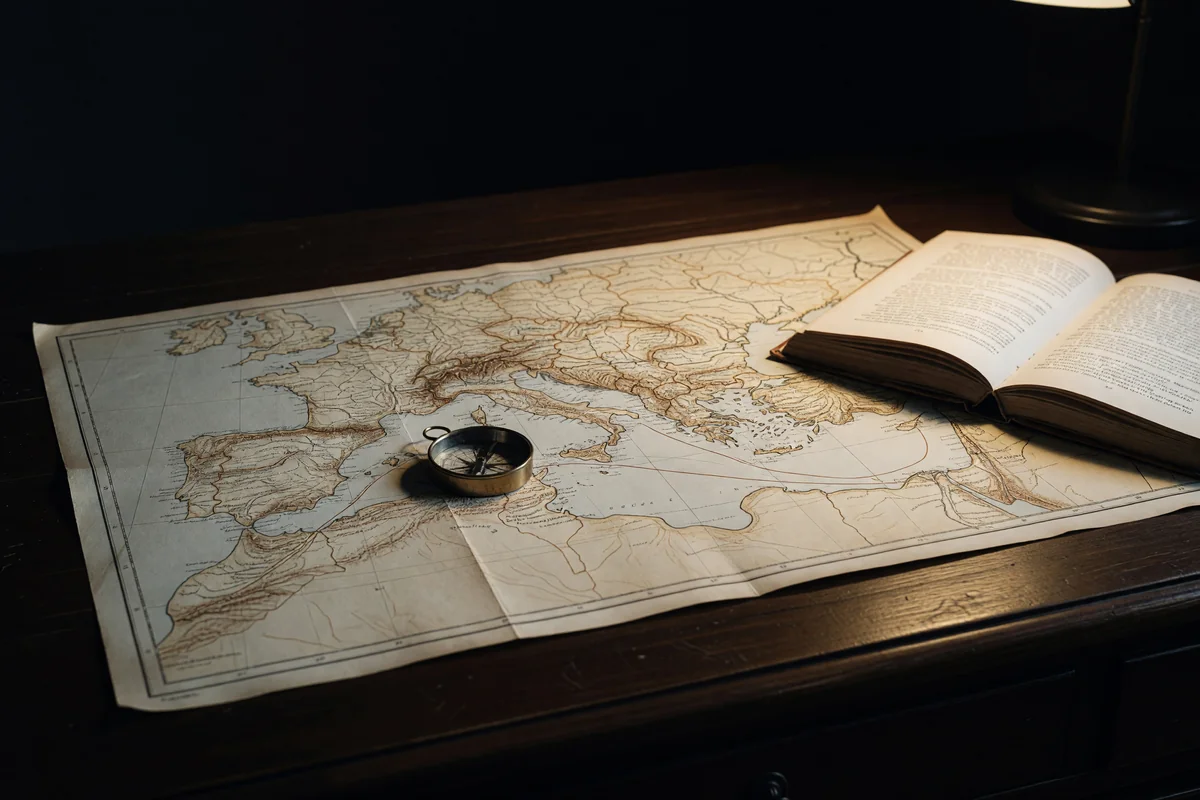
Get a map of the Mediterranean and put your finger on Marseille. 43.2965 north, 5.3698 east.
The city is 2,600 years old and it has never been finished. Greeks founded it, Romans took it, and everyone since has passed through: Jews, Occitans, Catalans, Italians, North Africans, Spanish traders. A port is a strange kind of place. It is a boundary that only works by being crossed. It stays itself by taking in what is not itself. Marseille sits roughly between the Spain my line left and the Salonica his family left, and his family passed through it on the way to Paris, and when I look at the map my eye keeps returning there like a tongue to a loose tooth.
Morin had a name for why. His hologram principle says the whole is written inside the part: a person carries a civilization the way a drop of seawater carries the ocean's chemistry. A port city carries the whole sea.
If someone in Marseille ever reads this page, that would please me out of all proportion to sense. The essay would have crossed back over its own subject.
The name
I had to decide what to call him in this post, so here is the story of the name.
Edgar Nahoum became Edgar Morin in the French Resistance. At a meeting of resistance fighters in Toulouse he introduced himself by the cover name Manin, after a character of Malraux's. His comrades misheard it as Morin, and the misheard name stuck, and he wore it for the next eighty years. A name he took on in danger, layered over the name Sefarad gave his family. Nahoum underneath, Morin on top, both true. He of all people would refuse to pick one.
So: Morin, because it is the name he made. Nahoum, once, because it is the name that carries the story. That is how I will write him.
Before the walk
Morin loved a line from the Spanish poet Antonio Machado: traveler, there is no path; the path is made by walking.
Here is my walking plan, stated now so I cannot pretend later that I never had one. I will read Homeland Earth as his planetary proposal, the argument that Earth itself is now the homeland and no local home makes sense apart from it. I will read On Complexity for the method. Each one gets its own review here when I finish it. And while I read, I will test his principles against the system I am building, one at a time, and write down where they hold and where they break.
I expect to find that ideas I thought were mine have older names. Good. That is the point of reading the dead.
He died six weeks before I found him. I missed him by that much, after 104 years. So this is the only greeting available:
Bless you, Edgar Nahoum Morin. Thank you for leaving the path unfinished. I am starting to walk it.