Decan 7: Don't Confuse the Label with the Light
Pollux, the brighter twin that Bayer named second, teaches that the label rarely matches the light. Ten days of holding two truths at once, at work and at home.
Part of The Decan Log: For the cosmology, astronomy, and journaling framework behind this decan, read the Pollux chapter. New to decanal journaling? Start with the Introduction.
Opening
The brighter of the two twins in Gemini was named second.
Pollux outshines Castor. Anyone can see it on a clear night. And yet in 1603, when Bayer lettered the stars, he called Castor "Alpha" and Pollux "Beta," and four centuries later the label still sticks. The brighter light wears the lower rank. That inversion ran through all ten days of this cycle, and the lesson it kept teaching, at work and at home, was the same one. Do not confuse the label with the light.
If you are new here, a decan is a ten-day reflection cycle tracked through The Decan Log.
The Star and the Twin
The light entering your eyes when you look at Pollux left the star in 1991. The year the Soviet Union dissolved and the Cold War's defining duality collapsed, the year the Web was opened to the public. Fitting light for a decan about twos.
Pollux is an orange giant, around 4,666 Kelvin, forty-three times the Sun's luminosity, the closest giant star to our own and a star in its second life, already evolved off the main sequence into something new. It still holds a planet in orbit. Even a star that has become a different kind of thing can keep what matters bound to it.
Its myth is the Dioscuri. Castor and Pollux, twins born the same night to different fathers, one mortal and one immortal. When Castor died, Pollux did not beg for revenge or for resurrection. He asked to divide his own immortality so the two could share a single fate, alternating forever between Olympus and the underworld. The highest move was not to fix his brother's condition. It was to enter it with him.
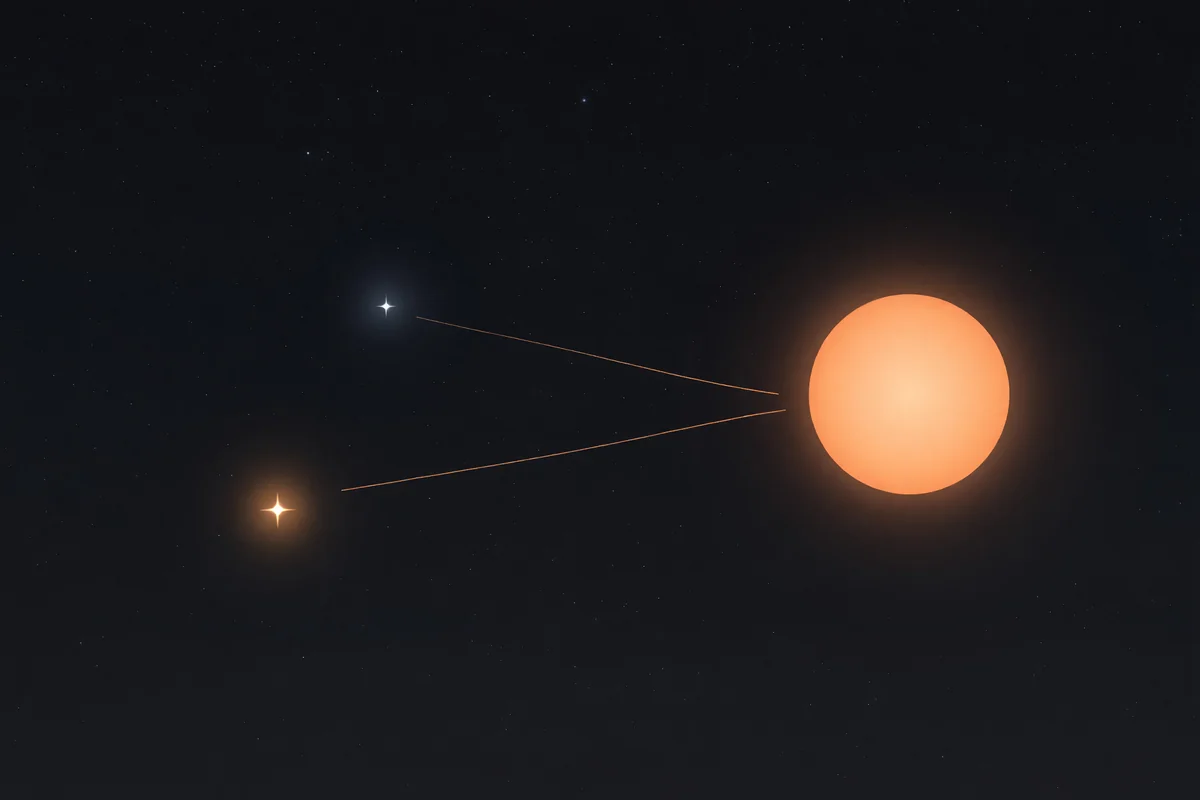
And the twins are not even bound to each other. Different distances, different directions, paired only by our line of sight. The constellation is a pattern we drew between two dots that physics left unconnected. Which turns out to be the truest thing about it. A chosen pattern, held long enough, becomes as real as gravity.
What Is a Decan?
I track consciousness in ten-day cycles aligned with stars, adapted from the ancient Egyptian calendar. Thirty-six decans of ten days make 360, and five days outside time close the year. Each decan has a ruling star, a theme, and three phases: Initiate, Flow, Reflect. Decan 7 belongs to Pollux, and its theme is duality and relationship.
Initiate: Days 1-3 (May 19-21)
The cycle opened on a reading. A shift in tone arrived that looked like warmth, even partnership, with something more deliberate running underneath it. Praise and a catch in the same breath. An opening that read as collaboration and was closer to positioning. That is the ordinary shape of it. What means to get ahead of you rarely arrives as opposition. It arrives looking ready to work together. The work was to read it clearly and stay open without going naive. The label said partnership. The light said something else.
The middle of the phase turned to building. A long writing day produced a framework I had been circling for a while, a way to hold several leadership archetypes at once instead of collapsing into a single style. The thesis underneath it is pure Pollux. Effectiveness at the senior level is not resolving the tensions. It is holding them. And one ordinary evening I closed the day at a family event, not at a desk, just present for something live. The institutional register and the intimate one, both of them relationship, tended on the same days.
Flow: Days 4-7 (May 22-25)
The expand phase was a making sprint, the heaviest of the year. I launched a film built as a two-voice argument about power. I finished the first song of a long series and scored it. I sent a book I had been assembling out of months of journaling to print, and watched it go live. I laid the infrastructure for the rest of that series, twenty-some pieces, real now because the scaffolding exists.
A practice exam I am working toward came back in the middle of it. Up overall, and down in the one area that carries the most weight. Progress and a slide in the same result. The duality of the decan showed up inside a single score.
Then a holiday that was not actually off. Early walks with the dog before the heat, the sauna where the heat removes the urgency and the real thing surfaces, and underneath the rest, the book going live and the series getting built. Rest and build at the same time, neither one canceling the other. That is the Pollux move. Two things held, not one thing chosen.
Reflect: Days 8-10 (May 26-28)
The last phase turned quiet, and then it turned honest.
The court days came first. Back-to-back conversations where the work was watching more than acting, closing a loose thread before it could become something, noticing what gets acknowledged and what gets met with silence, knowing which rooms send their contents traveling. Restraint was the move. On the first day of a reflect phase, it was right that the whole day was observation and not push.
Then the rhythm shifted on its own. Less making, more seeing. I noticed the deceleration before I reasoned it out, which told me the cycle was running deeper than the calendar I track it on. The body knew the phase before the intellect named it.
The honest part was closer to home. Something I meant as a gift was not received as one. Instead of absorbing the friction, I let it sharpen me, and it went unresolved. Running on empty, I had nothing left to meet it gracefully. The decan of relationship tested me where it was hardest to stay graceful, and I handled it badly.
The next morning the distance was still there. I did not try to solve it or win the point. I offered a small warmth across the gap anyway, got near silence back, and offered it again. That is the Dioscuri move in its smallest form. Not winning, not fixing the other person's mood. Just choosing to share the day. That is what you do.
Closing
Pollux was a decan of twos held without collapsing them. Praise and correction. Building and watching. Rest and ship. Warmth and friction in the same day. The star's whole teaching is that the label rarely matches the light, and that the highest thing you can do for someone is not to fix their condition but to enter it.
I spent the cycle making things, frameworks and films and a book, each one a pattern drawn between dots that were not otherwise connected. The quieter work was learning to live inside one of those patterns when it got hard. The maker builds constellations. The rest of the work is staying faithful to them after they are real.
Decan Navigation
Previous: Decan 6: Signal Discipline in a Noisy Week.