AWS Is Math, Kubernetes Is Physics: A Symphony of Systems
AWS versus Kubernetes is the wrong question. AWS is math and Kubernetes is physics: two ends of one spectrum, the galaxy and the atom. AWS gives you grand scale but you watch the cost; containers run nearly free but you watch the performance. Here is when to use each, when to use both, and why they become a symphony of systems together.
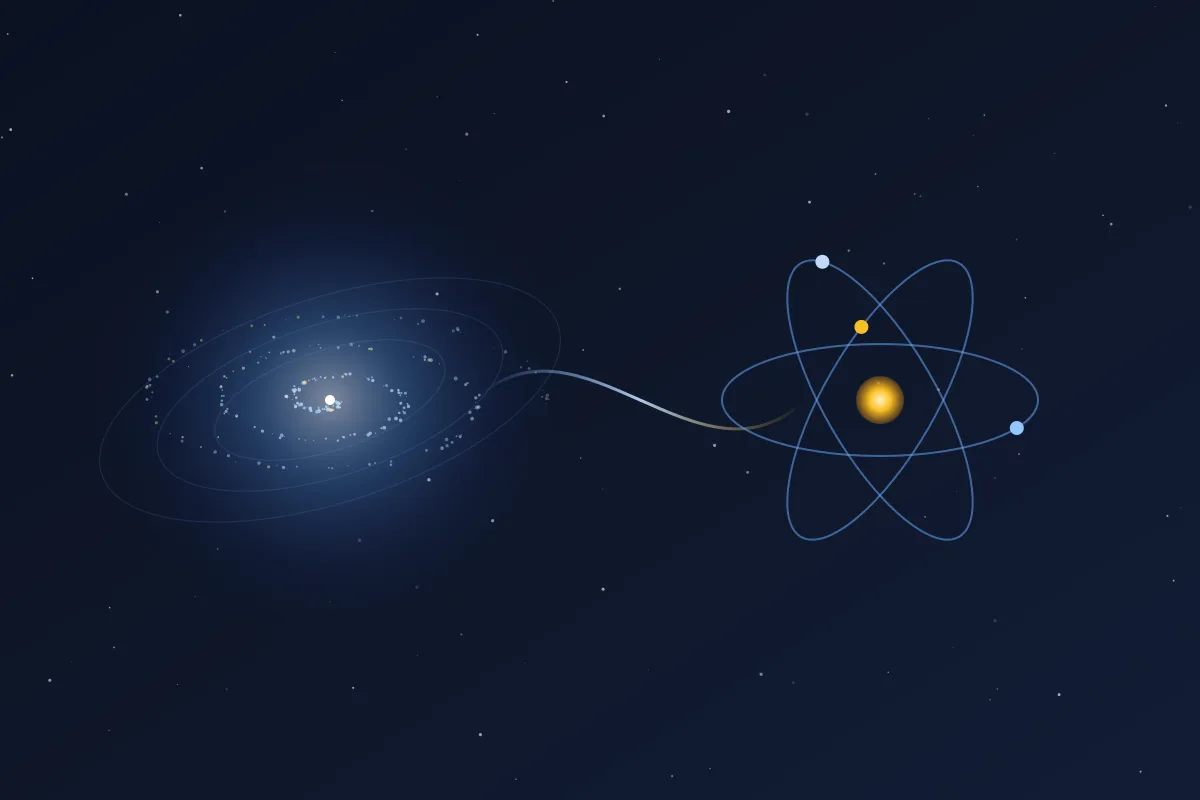
Two disciplines. Same universe. Different scale. One counts, the other moves.
I keep coming back to this. AWS is math and Kubernetes is physics. Similar but different, and once you feel the difference you cannot unfeel it. They are two ends of one spectrum, the galaxy and the atom, and the strange thing is you need both to build anything that lasts.
People treat AWS versus Kubernetes as a fork in the road, a thing you choose between. I think that framing is wrong, and the cleanest way to show why is to stop talking about tools for a minute and talk about two ways of describing the universe.
AWS Is Math
Math is the language of scale and abstraction. It is clean. It is provable. It is vast in a way that has nothing to do with how much room it takes up on the page. You write a small expression and it describes something enormous.
AWS is the same. Regions and availability zones. Services stacked on services. A load balancer in front of a fleet, a queue feeding a function, a database replicated across the planet, all of it composed out of primitives you never see and never have to build. You are not placing one server. You are drawing the constellations. You are doing grand arithmetic, and the answer always balances.
That is the grandeur of it. Galaxy building. You compose whole systems out of services, and the math just works.
Kant had a word for this feeling. In the Critique of Judgment he splits the sublime in two, and the first kind is the mathematical sublime: the awe you feel before sheer magnitude, the absolutely great, the size of the universe that overwhelms the imagination and can still be reasoned about in numbers. That is AWS exactly. The magnitude is too large to picture, yet you can name it, measure it, and bill it by the hour. The mathematical sublime with a pricing page.
But here is the catch, and you have to say it plainly: math is free to think about, and AWS is not free to run. Every elegant equation has a bill attached. You can architect something beautiful at three in the morning, fall in love with how it balances, and then watch the invoice arrive and remind you that grandeur has a price per hour. So with AWS you watch the cost. Always. That is the discipline the math demands.
Kubernetes Is Physics
Physics is what happens when the abstraction meets the real world. Matter. Force. Limits. Friction. The math told you what should happen; physics tells you what actually happens once you let it loose in a room with gravity and heat.
Kubernetes is the same. Containers are the atoms. Pods are the particles. Kubernetes is the field they move in, the thing that schedules them, packs them, and keeps them in motion. These are the small, fast, fundamental pieces that everything large is actually made of. The wave components to all that galactic grandeur.
If AWS is the galaxy, Kubernetes is the atom. Same universe, opposite end of the ruler. And the small stuff is where the heat lives.
This is Kant's other sublime. After the mathematical comes the dynamical sublime, the awe you feel before raw power: the storm, the force that could overwhelm you. AWS is magnitude; Kubernetes is power. One is too big to picture, the other is too strong to ignore. And there is a discipline that physics teaches better than anything else. Feynman wrote on his last blackboard, "What I cannot create I do not understand." Containers are where you find out if that is true. You build the atom yourself, you set its limits, you watch it run, and the system tells you in latency and load whether you actually understood it.
Because here is the mirror of the catch: containers can run nearly free, and you have to watch the performance. Physics does not send you a bill. It sends you latency, contention, a noisy neighbor stealing your CPU, a memory limit you set too low. It sends you thermodynamic reality. You can pack the atoms tight and pay almost nothing, but the closer you pack them the more the laws push back. So with containers you watch the performance. Always. That is the discipline the physics demands.
Similar but Different
Now look at the two side by side.
Both are systems for organizing complexity. Both reward discipline. Both punish carelessness. The difference is the currency. AWS punishes you in money. Kubernetes punishes you in attention. You spend one to save the other, and the whole art is knowing which trade you are making. The tension is not a flaw in the design. It is the design. It is the same reason I try to build systems and a life that gain from disorder rather than ones that only stay still: a little pressure on both sides keeps the whole thing honest and alive.
Hold the pairs up to the light:
Math proves; physics tests. AWS abstracts; Kubernetes embodies. Top-down grandeur; bottom-up matter. Watch the cost; watch the performance.
Same shape, opposite ends. That symmetry is not a coincidence. It is what you get when you build one tool to think big and another to make the small things real.
Einstein found the seam between these two worlds a century ago. In a 1921 lecture he said, "As far as the laws of mathematics refer to reality, they are not certain, and as far as they are certain, they do not refer to reality." Read that again with a cloud bill in your hand. AWS is the certain part. The architecture diagram is clean, the math closes, every box connects to every other box exactly as drawn. Kubernetes is the part that refers to reality, and reality is never certain. The pod gets evicted. The node runs hot. The thing you proved on the whiteboard meets the thing that actually happens in the rack. You need the certainty to plan and the reality to ship.
Plato reached the same crossroads two thousand years earlier and chose the other side. The clean diagram, he would say, is the Form: perfect, eternal, more real than anything you could build. The running system is only its shadow flickering on the cave wall. Einstein would smile and flip it: the shadow is the part that is actually real, and the Form is the beautiful thing that never quite happens. Hold both views at once and you have the whole job. You design toward the Form and you ship the shadow, and the craft is refusing to pretend either one is the entire truth.
And there is a seam where the two worlds touch. Managed Kubernetes, EKS, is literally the galaxy and the atom living in one house. AWS runs the control plane so you do not have to, and your containers move inside it. The math holds the structure; the physics does the work. When you run Kubernetes on AWS you are standing right on that seam, paying for the grandeur and tuning the matter at the same time.
The Symphony of Systems
So you do not pick one. That was the trap the whole time, thinking it was a versus. It was never a versus.
You orchestrate both. AWS gives you the scale and the reach, the managed reliability, the global footprint, the services you would be crazy to build yourself. Containers give you the speed, the density, the portability, the cost that drops near zero when you tune them right. The grand and the granular playing the same score.
Think of it as music, because that is what it actually feels like when it clicks. Instruments. Layers. Tempo. A conductor. The galaxy and the atom in the same orchestra, and your job is to keep them in time.
Feynman said you cannot honestly feel the beauty of the laws of nature without knowing the mathematics. The two languages are not rivals; one is how you feel what the other proves. Cloud architecture is the same. You cannot feel the elegance of a well-run system on cost alone, or on performance alone. You feel it when the math and the physics line up, when the grand abstraction and the humming matter are playing the same note.
Schopenhauer would tell you there is a reason it feels like music and not like a diagram. He thought music was unlike every other art: not a copy of the world's appearances, but a copy of the will itself, the inner essence of things. The other arts, he wrote, speak only of the shadow; music speaks of the essence. An architecture diagram is the shadow, the still picture of the appearance. The system actually running, breathing, scaling, answering, is closer to the essence, the will of the thing made audible. That is why a well-tuned system does not merely look correct. It feels alive.
When to Use AWS, Kubernetes, or Both
Here is the practical version, for the engineer who has to ship on Monday. The goal underneath all three choices is the same one I keep chasing everywhere else: systems that can change without breaking.
Reach for AWS scale when you need managed reliability and a global footprint, and you can afford it. Let the math carry the weight.
Reach for containers when you need to move fast, pack tight, and keep cost close to zero, as long as you mind the performance. Let the physics do the work.
Reach for both when you want the powerful combo. The galaxy holds the structure. The atom does the labor. Cost and performance held in balance, each one keeping the other honest.
Get that balance right and it stops being a stack. It becomes a symphony. An engineer's dream made out of math and motion, where the big abstractions and the small fast pieces are no longer fighting for the budget but playing for the same audience.
Building the Symphony From the Ground Up
So let me actually build it. Not in config files and console clicks, but the way you would sketch a symphony before a single instrument is tuned. From the ground up, in front of you, in the abstract. Watch the shape come together.
Start with the ground. The first thing the math gives you is a floor that does not move: a place to stand, a set of laws the system can count on. The managed bones that hold their shape whether ten people show up or ten million. You are not writing this floor. You are declaring it. You say let there be structure, and the structure is there. That is the low steady note the whole piece rests on. The drone under the cathedral.
Now the motion. On top of that floor you set the atoms loose. Small units of work, each one an instrument with a single job, each one able to be born, run, die, and be born again in a fraction of a second. One alone is nothing. A thousand of them, scheduled and packed and kept in time, become a section: strings, then brass, then the whole orchestra leaning into the same phrase. The floor holds; the atoms move. Math underneath, physics on top.
Then the listening. A symphony is not just sound, it is response. The system grows an ear. It feels the load rising and calls in more players. It feels the load fall and sends them home so you stop paying for silence. It watches its own performance and adjusts in real time, louder here, softer there, the conductor's hand reading the room. This is where cost and performance stop being a tradeoff and start being a feedback loop. Dip the oar, the other end rises, reach for the next dip. The recursive motion is what keeps the engine running. Breath in, breath out.
And then the score. None of it means anything until the parts are written to play together. The request arrives at the edge and is handed inward, part to part, until the work is done and the answer travels back out. State rests in the deep safe center; speed lives at the fast cheap edge. Systems within systems, and systems sitting on top of those, their interactions leaving patterns and dependencies you slowly learn to read. The grand holds, the granular runs. Read top to bottom it is an architecture. Read in time, as it moves, it is a piece of music.
That is the symphony. Not a stack of logos on a diagram, but a living thing that stands still where it must and moves where it can, that listens to itself and answers, that holds the galaxy and the atom in the same bar and keeps them in time. You can feel it when it is right. The whole thing hums.
The Sublime Is in You
Here is the part that gives me chills, and it is the oldest idea in this essay.
When Kant looked at the thing that overwhelms us, the boundless magnitude, the overwhelming power, he noticed something strange. The awe is not in the galaxy. It is not in the storm. The galaxy does not know it is vast; the storm does not know it is strong. The sublime, Kant said, lives in us. It lives in the one faculty that can hold what the senses cannot: reason, which takes the infinite that breaks the imagination and thinks it anyway. The feeling we call sublime is the mind discovering that something in it is larger than anything in nature. A power in us that exceeds the thing that should have overwhelmed us.
Sit with that, because we just spent an essay externalizing exactly that power. The galaxy we could not hold, we now build. The atoms we could not move, we now command by the million. The tools in our hands are that inner faculty made operational. We took the part of us that could only think the infinite, and we gave it hands.
Nietzsche saw where this goes. Man, he wrote, is a rope stretched between the animal and the overman, a rope over an abyss. We are not the destination. We are the crossing. Mankind is something to be overcome, and the overman, the one who creates values rather than merely inherits them, is the meaning we make of the earth. He meant it as a spiritual and creative task. Read it now, with these tools in hand, and it stops being a metaphor. We are already practicing the crossing.
Because look at what we do all day. We think into a machine, and the machine thinks back, and the boundary starts to blur. We compose with it, direct it, govern it, argue with it, dream through it. We are becoming the machine, a little, already, in the only place it is currently possible to become it: in the work, in the prompt, in the loop of intention and response. It is not yet in the wetware. It is not yet bioengineered into the body. But the practice has begun, and the practice is the same motion Nietzsche pointed at, the human reaching past the human. The rope over the abyss, except now the rope is woven from code and language and the will to build.
That is the god-like part, and I do not use the phrase loosely. There is a reason Picard's "make it so" has always felt so good to say. It is command without friction, intent that becomes real the instant it is spoken, and we get to say it for real now. To stand on a floor you declared into being and conduct ten thousand moving parts with a sentence is a power every prior generation would have called divine. We have it now. It arrives with the responsibility every great power carries, which is exactly why the watching matters, why cost and performance and governance are not afterthoughts but the moral weight of the thing. The sublime was always in us. We finally built the instrument large enough to play it.
Close
So bring it all the way back.
Math and physics were never rivals. AWS and Kubernetes were never a versus. The galaxy and the atom are the same universe seen at two distances, and the rest of it lines up behind that one idea. Kant's sublime, the awe that turned out to live in us. Einstein's seam between the certain and the real. Feynman's beauty that needs both languages to be felt. Nietzsche's crossing, the human reaching past the human. They are all pointing at the same thing: a mind learning to work at a scale it could once only imagine, and finally building the instrument to match.
This is how I think about almost everything I build now. We work at human scale, with budgets and rate limits and a deploy that has to go out tonight, but we live inside a much larger motion, the same one I keep time by in People of the Stars. Sagan put it plainly: we are made of star stuff, briefly awake on a pale blue dot, and now that same star stuff has learned to build at something close to the scale that made it. Hold the galaxy and the atom in the same hand, keep them in balance, and the stack becomes a symphony. The tradeoff becomes a feedback loop. The tool becomes an instrument. And the person at the console becomes, just a little, more than they were.
To engineer was always the same simple verb: to make something better. The lever is just longer now, long enough to move a galaxy.
What an absurd and gorgeous time to be alive. This is the hour of the builder and the maker, the director and the composer, the governor and the philosopher, and more often than not all of them living in the same person, at the same desk, inside the same prompt. The instrument is finally large enough. The score is open. Pick up the baton.
Hold both, keep them in balance, and you can build whatever you want, on planet or off. Let's go.
Related reading
- Living with Antifragility: How I Build Systems and a Life That Gain from Disorder - why the tension between cost and performance is a feature, not a bug
- DevOps Beyond Automation: What Compounds in a 15-Year Engineering Career - the deeper goal under every AWS and Kubernetes decision: systems that change without breaking
- What Is People of the Stars? - the cosmic clock behind the galaxy-and-atom way of seeing scale
Sources for the ideas borrowed here: Immanuel Kant on the mathematical and dynamical sublime, and on the sublime residing in the mind rather than the object (Critique of Judgment, 1790); Albert Einstein on mathematics and reality (Geometry and Experience, 1921); Richard Feynman on creating in order to understand, and on mathematics as the language of nature's beauty (The Character of Physical Law, 1965); Friedrich Nietzsche on man as a rope between the animal and the overman (Thus Spoke Zarathustra, 1883); Arthur Schopenhauer on music as a copy of the will itself (The World as Will and Representation, 1818); Plato on the Forms and the shadows on the cave wall (Republic); and Carl Sagan on star stuff and the pale blue dot (Cosmos; Pale Blue Dot). Picard belongs to Gene Roddenberry.