Working at the Frontier: What It Actually Feels Like
A field report from inside sustained agent-mode work: the heat behind the eyes, the way speed bends your sense of time, what it costs the body, and the practice that lets you build at the frontier anyway.

There is a heat that comes with working alongside capable agents, and it is worth talking about, because almost nobody does. Much like a too-tight headband, or a beanie a size too small, it is a familiar kind of pressure, and it surfaces, eventually, as a real headache. When I notice it now I ask the plain questions first. Have I had enough water. When did I last take a break. I look out the window. I name something outside, a tree, a roofline, the color of the sky, and if the heat is still there I put on shoes and walk until it goes. The heat is information. It is a sign, the way a runner's blisters are a sign, that a good limit has been reached.
Because this is closer to training than to typing. You feed yourself a measured dose of hormesis, the useful kind of stress, the kind that builds cognitive holding capacity instead of breaking it, and you learn to work with the heat without standing in the fire so long that you burn out. You work near the forge where new ideas are born the way stars are born out of a nebula. Like all training, the worn synapses take their own time to come back. But the mind itself is resilient, and underused, and capable of far more than we tend to ask of it. What limits it, I think, is language, the narrow channel cognition has to pass through to become anything you can share. Once thoughts can travel faster, the thinking speeds up with them. I followed that same idea down into sound itself in The Language of Sound: you cannot make a thing you cannot name.
Both the speed and the ability to scale cognition change your perception of time. You get thrown into project-level wormholes, folding hours against the gracious estimates the tools hand you, until the only real limit becomes a question of how slow you are, and where the time went. All of it is in service of building something useful, and that is exactly where the huge missed opportunity lives, because most people take the speed and waste the build. So you develop the practice the way you would develop morning pages, by showing up to it. It is fine to vibe code, to try things, to let the agent run, and it should be encouraged. But as the system grows in complexity you add the appropriate layers in the same motion, the planning, the context, the guardrails, the structure, at the rate the complexity actually demands them.
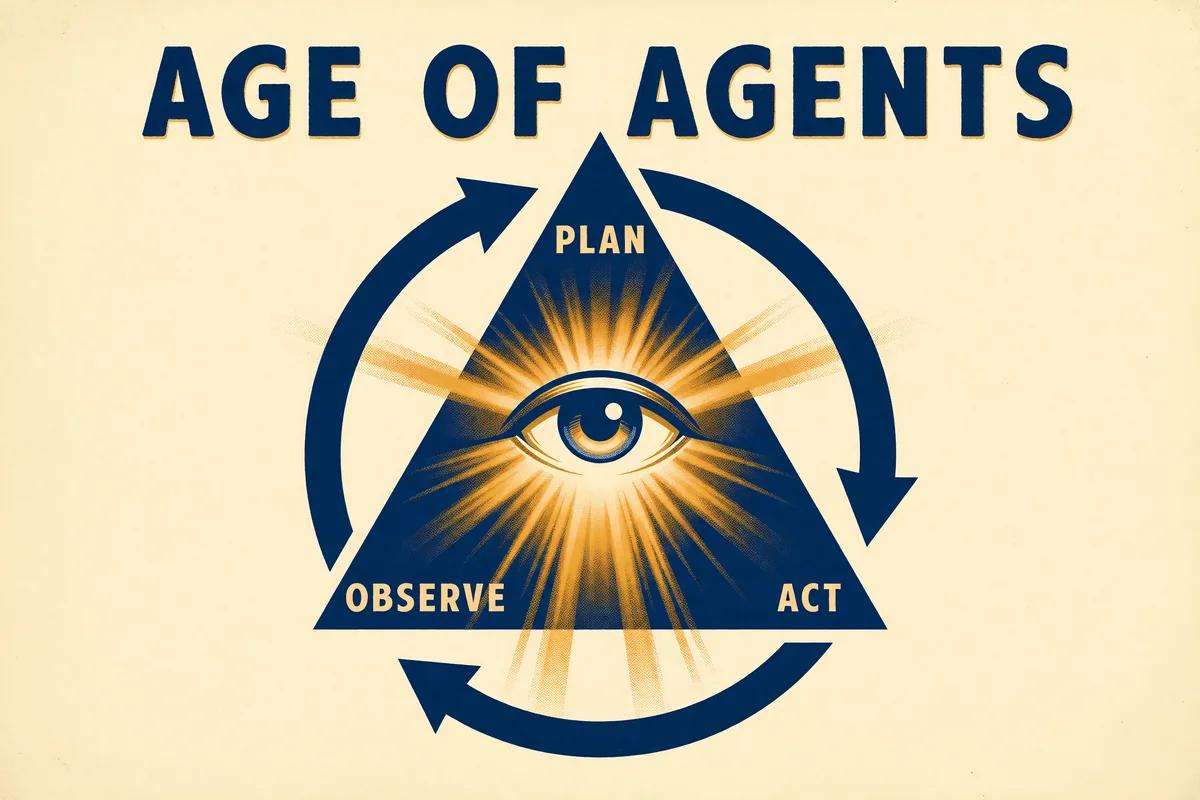
I have started calling this the age of agents, and I draw the same small figure in the margin every time. Plan. Observe. Act. It is not only the speed. The results that come out of scaling cognition under the right direction are astounding, given the calibre of the output. What changes underneath is the shape of the work itself. The way you think about the job moves from implementation to design, to orchestration, to efficiency, to anything and everything in between. It is devops applied to the whole of it.
That shift drives a real need, for technical ability and for familiarity, leaning harder than ever into architecture, into quality, into security, and into cost, all of it broken down continuously and accurately and kept attached to what it actually costs. Here is what I could not have written down eighteen months ago. This lets you leap-frog across domains. Once you have a general grasp of a new territory, its codex and its language, once the vocabulary is understood, there is great power waiting on the other side of it.
With the right context and the right systems you get to a high standard in a field in far less time than it used to take, and you start to find what I call the edges. The places where, with proper tools and the meta-capability of these models to abstract models and patterns, you can take some of the most sophisticated machinery there is and model the domains, the systems, the cognition itself, and bring coherence to complexity. The overwhelming becomes navigable. The illegible becomes legible. You draw the maps that let you work near the furnace, close to the source of the heat and the energy, and still keep enough of yourself in reserve to make sense of it all, or to hold what has to be held, and carry it.
Don't panic.
Related reading: The Jagged Frontier, The Cognitive Cost of Modern Software Engineering, and Germane Friction.