The Patient Part
My head does not run in a line, it runs in branches. A tool arrived that does the exact part I cannot do and amplifies the exact part I already do too much. On building with an agent when your attention has its own ideas.
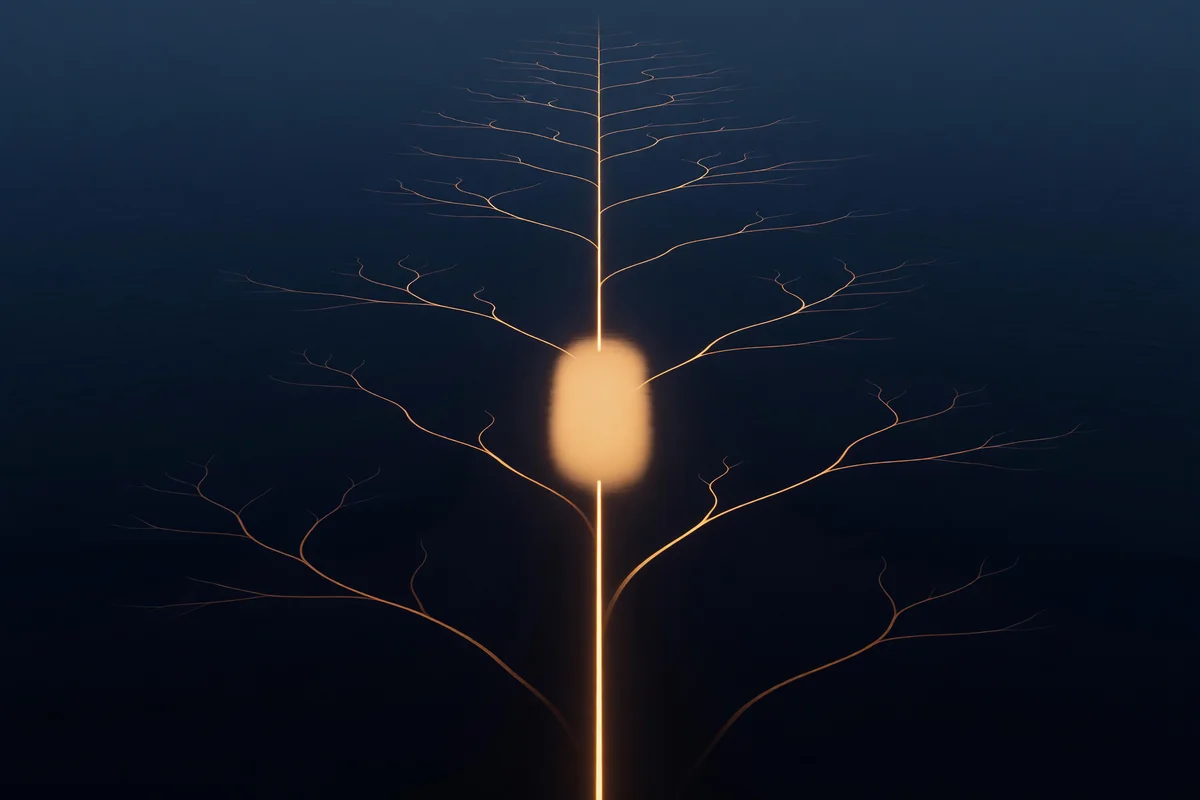
My head does not run in a line. It runs in branches. I will be doing one thing and three more will arrive uninvited, fully formed, each one sure it should be started right now, and the thing I was actually doing quietly loses its color. I have started more projects than I will ever finish. I have a folder of them. I have a folder of folders.
For most of my life this was just a fact about me, and the rooms I worked in were built for a steadier kind of attention than the one I have. The ideas were never the problem. The ideas came for free, more than I could ever use. The problem was the long flat middle of any single one, the stretch with the novelty burned off, where you have to sit and do the next unglamorous step forty times without flinching. That part and I have never gotten along. My attention is a strong current that goes where it wants, and the middle of a project is slack water.
Then I started building with an agent in the room, and something I did not expect happened. The tool fit.
Not the usual way, where you sand yourself down to match the tool. This one bent toward the way my head already worked. I could think out loud at it, jump, contradict myself, chase the branch that just walked in, and it held the thread I had dropped. When the current moved, it kept the place I left. The long flat middle, the forty steps with no shine on them, turned out to be exactly the part a machine is glad to do while I am off somewhere with the next idea. I bring the surges. It brings the patience. I once wrote about what it feels like to run many threads at once at machine speed; this is that, one floor down, where it stops being a productivity story and gets personal.
There is a quieter piece too. The feedback is fast. You say a thing and a minute later the thing exists, and that small hit of a result right now is enough to keep me in the chair through a stretch that used to be unsurvivable. I am not white-knuckling the boring part anymore. The boring part got handed off, and what is left is the work I was always built for, the seeing and the deciding and the next jump. Over enough months it has even changed the shape of the thinking itself.
There is another edge, and it is sharp. The same machine that keeps up with me is the most efficient way I have ever found to start forty things and finish none of them. It will chase every branch with me, equally delighted by all of them. It never gets tired, never says we already have three of these, never once asks whether the bright new thing is actually better than the half-built thing I walked away from an hour ago. A novelty engine pointed at a mind that runs on novelty is a gorgeous way to spend a year and have nothing to show for it. I know, because I have done it, and I can still feel the pull on a good day, the tool happily helping me scatter myself across the table.
So the thing I have actually had to learn is not how to prompt. It is how to build the fence. The agent is the engine, and the discipline has to come from somewhere outside my own head, because my head is far better at starting things than at keeping them. So I put the plan where I can see it. I make the state legible to me on a page instead of leaning on a memory I have never been able to trust to hold one. I keep a second agent whose only job is to finish what I started and to ask, out loud, whether the new idea is really worth more than the open one. I build gates that close the loops I would otherwise leave hanging forever. None of this is about the model, and none of it is about fixing me. It is scaffolding, and I worked it out the slow way, by failing at it for years and watching exactly how I failed. It is the same move I have been making my whole life. Not to become someone steadier. To work with what is actually there, and get more out of it than the steadier version of me ever could.
So when someone asks me whether these tools are overhyped, I never have a clean answer, because the question is more personal for me than it is for them. A tool showed up that does the exact part my attention will not sit still for and amplifies the exact part I already do too much. It is the best thing that has happened to the way I work and a loaded gun aimed at it, and which one it turns out to be on any given day comes down entirely to whether I built the fence before I picked up the engine.