The Multithreaded Mind: Six Weeks Living at Machine Speed
Six weeks after an O'Reilly AI conference flipped a switch, I went from copy-pasting LLM output to more than a dozen repositories, and a month started to feel like a year. Notes on time dilation and vibe coding.
The Multithreaded Mind: Six Weeks Living at Machine Speed
The moment everything changed
May 8, 2025. Four hours of an O'Reilly event going into my head: "Coding with AI: The End of Software Development as We Know It." I could not do anything with it. A family wedding overseas meant I had to shelve all of it and go. For weeks the ideas just sat there churning while I attended to the things you attend to.
It was late May before I could start experimenting. I thought I was catching up on industry trends. By July 8 I had created 13 repositories, written hundreds of thousands of lines of code, and rewired how my head works.
"Does it feel like one month? No. It feels like 1 YEAR." I wrote that in my journal on June 25th, deep in it. Time had gone elastic. The line between my thinking and the machine's processing had mostly stopped existing.
What followed was a steep climb. Every day there was a new tool, a new framework, a new way to think about the problem. The learning never let up. From my journal: "I'm encountering more frameworks, languages, libraries and systems in a week than I'd previously only read about in a year, but now through direct, hands-on experience." It all happened at once, and the speed was hard to put down.
This is the story of those six weeks.
The timeline that broke time
| Date | Milestone | The Real Story |
|---|---|---|
| May 8 | O'Reilly presentation | Four hours that flipped the switch. "I've never seen something move and change so fast" |
| May 14 | O'Reilly subscription | Knowledge hunger becomes action. The feeding begins. |
| May 28 | First AI code at work | Theory meets practice. Reality starts bending. |
| May 30 | Repos for exploration | First of 13 repos. 155 commits will follow. "Coding at the speed of thought" |
| June 2 | GitHub Copilot subscription | The symbiosis begins. "Working with a partner all day is tiring" |
| June 10 | Idea to MVP in one day | Simple game materializes. "Weeks of work compressed into afternoons" |
| June 25 | Using AI tools at work | "Heady feeling. Exciting and fast. Lightning fast." |
| July 4 | Claude CLI added | Multiple AIs now. The hunger intensifies. |
| July 8 | "MAXED OUT PREMIUM CREDS" | Time has no meaning. Only creation matters. |
| July 16 | Major AI investment increase | "When you're this productive, it's not a cost. It's rocket fuel" |
In six weeks: 13 repositories. 344+ commits. 4.2MB of code. And a head that no longer worked the way it had in April.
The birth of vibe coding
By early June I had run into what people call "vibe coding." The old words for it do not fit. You state what you want, the machine takes a swing at it, you watch where it goes wrong, you correct it, and you do that over and over until the thing is real.
"The AI is creative as a software engineer," I wrote, watching it "put together tools, reduce problems, try different angles and approaches." Sometimes I would hit Control+C when I saw a better path, then watch it take the problem on again. Not commanding it. Working alongside it.
The physical part was real too. My computer ran hot from the load, which more or less matched what was going on in my own head. "Working with a partner all day, whether human or not, is tiring." But the tiredness came with a charge to it. We were building about as fast as I could think.
The dual life of creation
During business hours I kept a steady stream of automation and tooling projects going. Five big repositories came out of it, each one solving a real problem, each one a little more capable than the last. The commit counts told their own story. One project alone took on over 150 commits in six weeks.
The bigger change happened in the margins. Thursday 2am commits. Friday 4am pushes. Weekend marathons. Not because I had to. Because I could not stop. When you can make ideas real about as fast as you have them, sleep starts to feel like an interruption.
One weekend stands out. Started Friday evening, coded until 4am, back at it 10am Saturday. The size of a single pull request was hard to believe. Tens of thousands of lines changed. Whole architectures redone inside a 48-hour window.
The data showed a pattern. Most of the personal work happened outside normal hours. Not sneaking side projects past anyone. Just more ideas than a 9-to-5 could hold. Building whole systems while the house slept. I had never worked at that pitch before.
The multithreading of mind
"Multitasking no. It's more like multithreading," I wrote on June 25th. This was not scattered attention. It was running several lines at once and keeping each one straight:
- One thread talking through architecture with the AI
- Another refining UI components
- A third weighing deployment strategies
- A fourth on performance
All of it coherent. All of it moving. Held together through the one interface in front of me.
By late June something had shifted. I was "living in the clouds of abstraction and pure thought and design." The layers stacked up until I was working almost entirely in concepts. Systems and patterns and architectures were the material I had in my hands.
From idea to MVP in one day
June 10th proved it was real. Could I go from an idea to a working prototype in a single day? Yes, and not barely. A game came out of nothing. My list of things to add next, sounds, timers, leaderboards, physics, was weeks of normal work that now read as a few afternoons.
The speed was hard to hold. On June 12th I wrote, half in disbelief: "When did I start this project? Four days ago. Four days! I'm floored. Life with AI is extraordinary." Four days from idea to running app. The old rules had stopped applying.
"The unfamiliar becomes familiar through small experiments and rapid iterations, messy at first, then suddenly clear." Each small win sat on top of the last one, and the momentum started to feel like it had its own motor. The AI was not only helping. It was teaching me to look at problems a different way.
Four projects, and the mess
The same shift showed up across four very different pieces of work, all running at once.
| Project | What it was | What it did that I did not expect |
|---|---|---|
| Enterprise infrastructure | AWS CDK stacks that should have taken months | Held the dependencies between services and offered architectures I had not thought to try |
| Content automation | Years of handwritten journals turned into clean text | Understood the editing, not only the OCR, and kept the voice in |
| Business applications | Retro design over modern guts, Flutter web pushed harder than it wants to go | Made visual decisions fast |
| Game development | A physics engine | Taught me to shape the architecture around the fact that a machine would be working in it too |
Each one took real attention. It was not prompting. It was leading the work while the machine moved fast under it. From my journal, deep in the infrastructure move: "1 week into the migration and almost there. 1 week. To build. To move to reimplement. To plan. To vision. Nuts. So fast. Wow."
None of it was clean. I tore down CDK stacks and redesigned them when the AI built circular dependencies into them. Long nights went to chasing permissions it had set wrong, and whole weekends to networking config that held until it didn't. The handwriting went through several OCR approaches before one kept it intact, and pipelines got rewritten when a suggestion worked fine and then would not scale. The question that followed me through all the debugging: am I still engineering if the AI does the implementation? Where does my idea end and its suggestion begin?
The economics of transcendence
The money tells its own story:
- June 2: First paid AI subscription (seemed expensive)
- July 4: Added more AI tools (the experimenting picked up)
- July 16: Spend multiplied 25x (seemed cheap)
When you can build in an hour what used to take a week, the usual ROI math falls apart. When one month of work holds a year of progress, what is the right price for that? The market has not worked it out yet. The early ones are buying the future at a discount.
Living at machine speed
"Hard to express what this work feels like," I wrote on June 25th. Let me try.
Picture having a long conversation with an intelligence that is genuinely strange to you, one that puts out code as a side effect. Now picture that it can see solutions from angles you never would, approaches that were "admirably creative, sometimes surprisingly human-like, and sometimes alien."
You are not really coding. You are working in pure thought. The old bottleneck, turning the idea into syntax, mostly goes away. What is left is the imagination and your ability to say clearly what you want.
The relationship gets close, almost parental. "My productivity children is often what it feels like," I wrote on June 27th. These things came out of putting my imagination and the machine's capability together, and they asked for both attention and care. "When did work become like play while I can't wait for the next session?" Work had turned into something I did not recognize.
What it means to think with a machine
What does it mean to think with a machine? Not to use it, not to order it around, but to actually run your own thinking through its processing?
After three weeks you notice the AI does not just finish your code. It finishes your thoughts. The stranger part: you start finishing its thoughts too. The line between you and it stops mattering. You are working as something a little different than before.
"Living in the clouds of abstraction and pure thought and design" was not a figure of speech. It was the plain description of working up there. You are not down in the implementation. You are arranging systems that go off and build themselves.
The personal cost and reward

"The intensity of the agentic mode work and rapid AI tool adoption affected evenings, weekends, and sleep patterns." Tidy words for something that was not tidy:
- 5-6am: Code before the family wakes
- 9am-5pm: Regular work
- 6-8pm: Family time, non-negotiable
- 9pm-2am: Personal projects, where most of it happened
- Weekends: 48-hour stretches
The notes I left myself read like warnings, because they were: "If you are planning to fly close to the sun, bring metal wings." And: "Prepare to feel unbalanced, precarious, and extremely frustrated. The time you spend with these tools will strain your family relationships."
Not all of it felt good. June 12th brought the other side: "With the highs come the lows. With productivity, the tide comes in, the tide goes out." I was burned out from going "almost non-stop for the whole week." The weight of the whole thing pressed down.
And still, I was happy in a way I had not been before. When every day hands you a new thing you can do, when you can build an idea about as fast as you can have it, the tiredness reads as something closer to being awake. I was worn out and glad to be.
What comes after human?
As I write this in late July, having just rebuilt a blog in a week that would have taken months, the line is easy to see. The 13 repositories in six weeks were the warm-up. The rising AI spend is the cost of doing this at all.
Something is changing in how the work gets made, and maybe in how a person making things gets to spend their days. The mix of human judgment and machine capability is not on its way. It is already here, and the people using it are working in a different reality than the one I was in three months ago.
The view from the edge
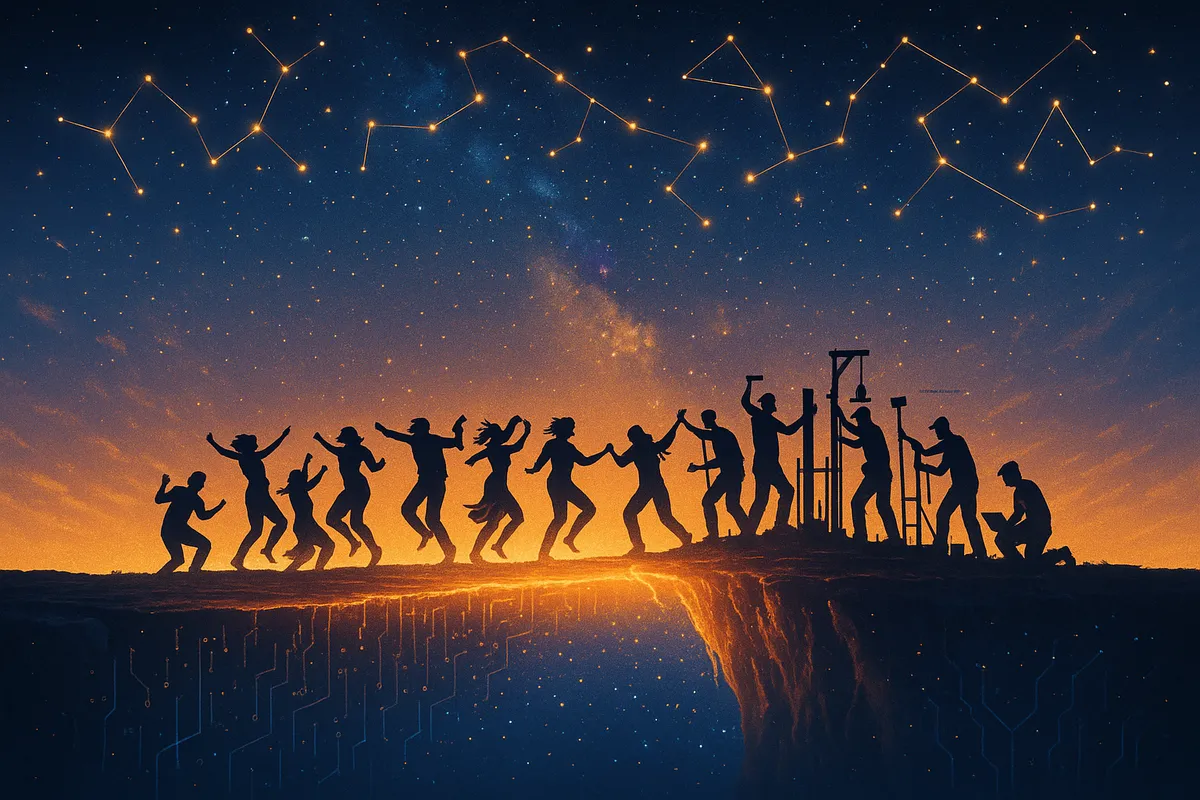
From the manual copy-paste of early in the year to July's multithreaded version of the work, the whole thing took six weeks. But those six weeks held a year of growth and a shift in how I see the work that I do not expect to go back on.
The heaviest part hit me on June 27th: "Above all else the domain of the human is still very much to imagine, ideate and direct as life and spirit imbue our fragile bodies and being." We had not been replaced. We had been handed more reach.
"It's more like doing things in a week that might have taken a year," I wrote, trying to get my arms around it. "The pace has been incredible. What took days or weeks before now takes hours, but the results are more creative, producing reusable patterns, concepts and tools."
The repositories tell one story. The spending tells another. The real one is the change in how my thinking works, the point where you notice you are not just using AI anymore. You are thinking through it. I kept pulling on that thread later, in how agent mode changes the shape of thought and in what changes when you give an agent your repository, but this was the week it started.
"I've never lived through a revolution like this," I wrote. "This isn't just technology changing. This is the nature of work, life, and creativity being rewritten in real time."
It did not announce itself. It came in through a four-hour video, picked up speed across 13 repositories, and turned into a different way of working before I had the words for it.