The Book Drop and the Greeter: Two Short Films on How Services Talk
Two short films that open the services-talking arc of Learning Maps. The Book Drop is how one part of a system hands work to another without waiting on it. The Greeter is how a crowd of requests gets spread across a fleet that can lose a machine and not miss a beat.
All 2 films in this post
 8:14 Learning Maps CC BY
 The Book Drop
 8:17 Learning Maps CC BY
 The Greeter
There is a slot in the wall by the library door. You walk up with an armful of books, you drop them in, and you leave. You do not wait for a clerk. You do not care that the clerk is on a break, or slammed, or halfway through someone else's cart. The slot took your books the instant you arrived, and the work of shelving them happens later, on the clerk's own time. That little slot is the most quietly radical object in the building, and it is the first thing this pair of films is about.
That scene opens the next arc of Learning Maps: two short films about how the parts of a system talk to each other without dragging each other down. The coordination pair was about machines agreeing on one truth. These two rooms step up a level, to services. How does a fast producer hand work to a slow consumer without either one waiting on the other? And how does a single front door serve a crowd far too big for any one machine behind it? Same series, same rules: the story carries the lesson, the napkin map rewards watching, and every room splits the durable principle from the rented AWS label.
Episode 9. The Book Drop
Watch The Book Drop on YouTube (8:13).
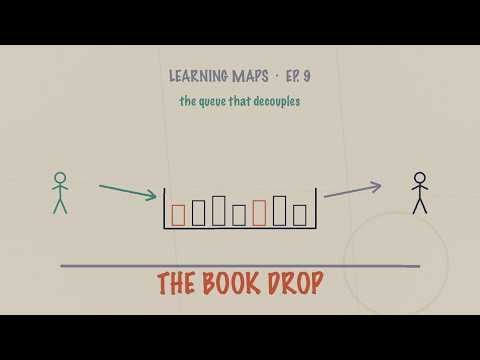
The slot is a queue, and its gift is that it decouples the two sides of a handoff. The producer drops work and walks away. The consumer pulls work when it is ready. A rush hour that would have crushed a direct call just piles up safely in the bin, and if the consumer falls over for an hour, the work waits for it instead of vanishing. That is the whole reason to reach for a queue: not speed, but the freedom of each side to move at its own pace.
There is one honest catch, and the film names it plainly. A standard queue promises to deliver each message at least once, not exactly once, and it makes a best effort at order rather than a guarantee. So the same book can come back to be shelved twice, and it may not arrive in the order it was dropped. The cure is not to fight the queue but to design the consumer so a repeat does no harm, which engineers call idempotency, and to reach for a FIFO queue only when strict order truly matters. When one event needs to reach many listeners at once, you post it once to a board and let everyone subscribe, which is publish and subscribe, and a message that keeps failing gets routed to a dead-letter queue that you switch on yourself, so one poisoned book never jams the slot for everyone else. Queue, decouple, absorb the spike, survive the outage, and never assume it happened only once.
Episode 10. The Greeter
Watch The Greeter on YouTube (8:16).
Now the crowd arrives at the front. One desk cannot serve everyone, so you put ten identical clerks behind the door and a greeter in front of them. The greeter spreads each visitor across the clerks, and it quietly taps each clerk on the shoulder to check they are still standing. A clerk who does not answer is marked out and gets no more visitors until it recovers. That greeter is a load balancer, the tap is a health check, and together they buy you two things at once: you scale by adding clerks, and you survive by routing around the ones that fall.
The price of identical is that no clerk may remember you. The moment a clerk keeps your half-finished cart under the desk, the next request lands at a different clerk and your cart is gone. So you keep nothing personal on any one server, and push the session out to a shared store that all of them can see. That is statelessness, and it is the precondition for growing out instead of up. The labels split by layer. An application load balancer reads the request and routes by its path, its host, or its header, up at layer seven, the choice for slash-checkout-to-one-service. A network load balancer moves raw traffic at layer four, blindingly fast, and hands you one fixed address per zone that a firewall can allow and the real client's address underneath. Pair the whole thing with an auto scaling group that hires and fires clerks as the crowd swells and thins, and scale stops being a plan you make once. Grow out, not just up.
What the pair adds up to
The Book Drop and the Greeter are the two front doors of a system. One is asynchronous: drop the work and go, and let it happen on someone else's clock. One is synchronous: step up to a desk and get served now, by whichever of many identical desks is free. Almost every architecture you will ever draw is some weave of those two doors, a queue where the caller can wait and a balanced fleet where it cannot. The queue's freedom-to-wait is the same freedom the branches got from a cache. The greeter's route-around-the-dead is the vote's majority wearing work clothes. The season keeps rhyming.
The systems-talking wing continues from here: the circuit breaker that stops one slow dependency from taking the whole desk hostage, the rate limit that keeps one greedy caller from eating the counter, and the edge that carries the answer to the reader's door. Room by room on Learning Maps. If you are just arriving, start with the Data Wing, then the coordination pair. And if you want the frame the whole series sits on, there is AWS is math and Kubernetes is physics.

