Decan 24: Building Systems That Outlive You
Ten days under Markab, the corner star of the Great Square: a barbell money system designed in a day, a blog pipeline that runs without me, and an outage on day nine that tested both.
Part of The Decan Log: For the cosmology, astronomy, and journaling framework behind this decan, read the Markab chapter. New to decanal journaling? Start with the Introduction.
Opening
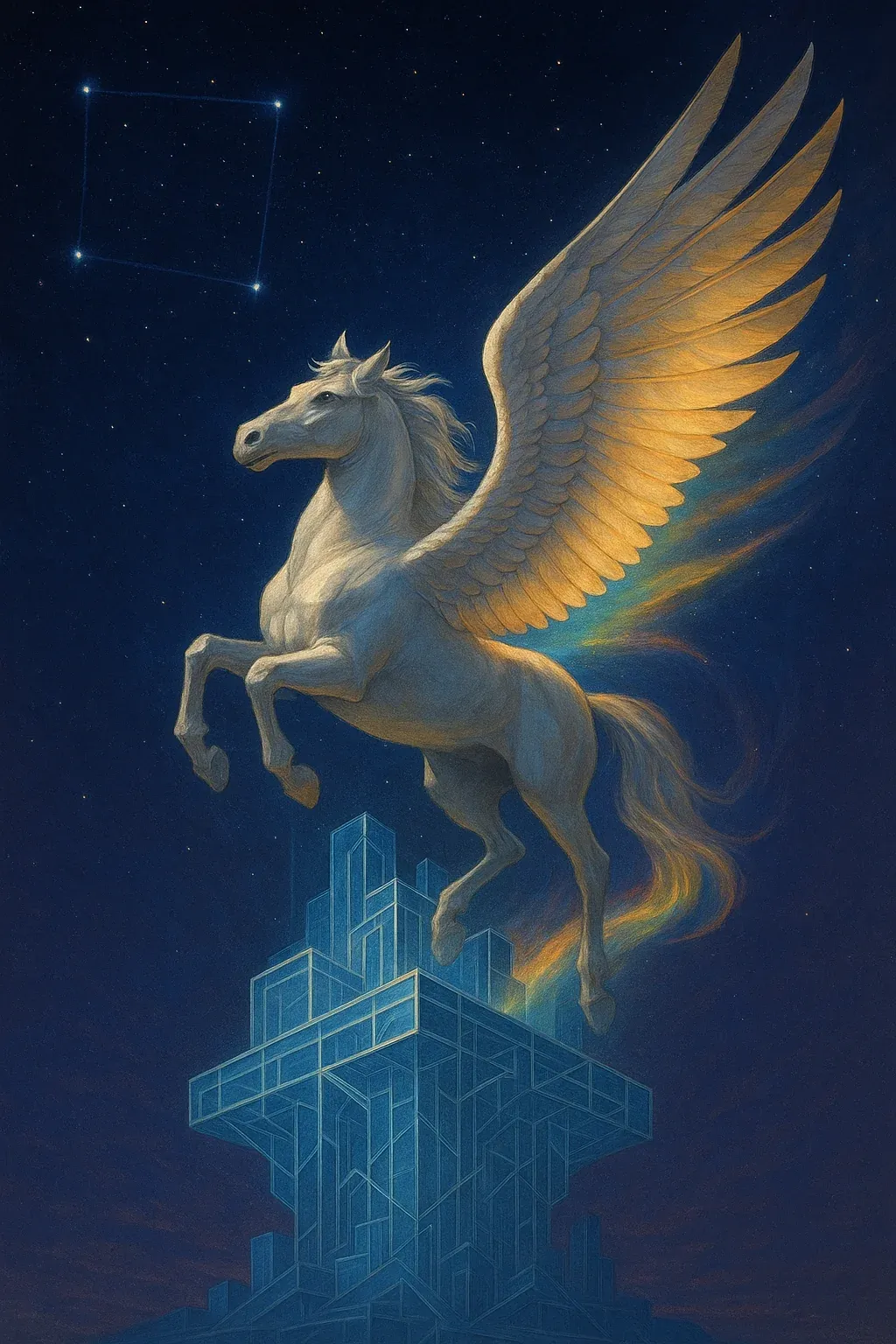
Markab is the navigator's star, the southwestern corner of the Great Square of Pegasus. Alpha Pegasi, a blue-white giant 133 light-years out. The light I was looking at this decan left it in 1892. A corner you steer by has to stay where it is, or the whole map stops working.
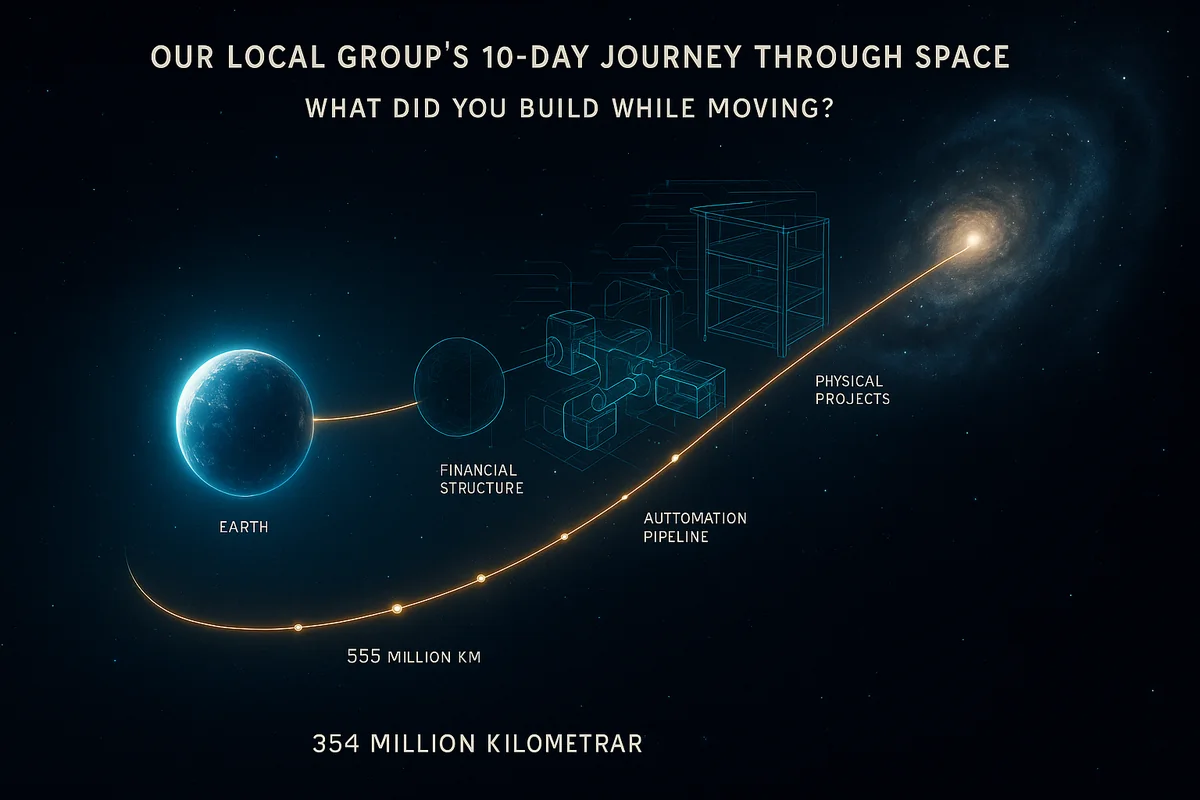
That is the question this cycle kept asking me. Not what did I get done, but what will still be standing if I walk away from it. During these ten days our part of the galaxy moved about 535 million kilometers toward the Great Attractor. Half a billion kilometers of motion while I built things, tested them, broke a few, and patched them back together. The motion does not stop for me. The only choice is what I build while it is happening.
If you are new here, a decan is a ten-day reflection cycle tracked through The Decan Log.
What Is a Decan?
I track consciousness in ten-day cycles aligned with stars, adapted from the ancient Egyptian calendar. Thirty-six decans of ten days make 360, and five days outside time close the year. Each decan has a ruling star, a theme, and three phases: Initiate, Flow, Reflect.
Decan 24 belongs to Markab (Alpha Pegasi) in Pegasus. The theme is foundation and what outlasts you. November 5 through November 14, 2025.
Initiate: When Necessity Meets Agent Mode (Days 1-3)
Day one started with a plain question. What kind of builder do I need to become, and what falls apart if I do not become it. I got the blog automation pipeline back on track and started laying the infrastructure for content that keeps running without me babysitting it.
Day two showed me an imbalance. One project was eating the resources meant for three others. Too much weight on a single support. Time to redesign before it cracked.
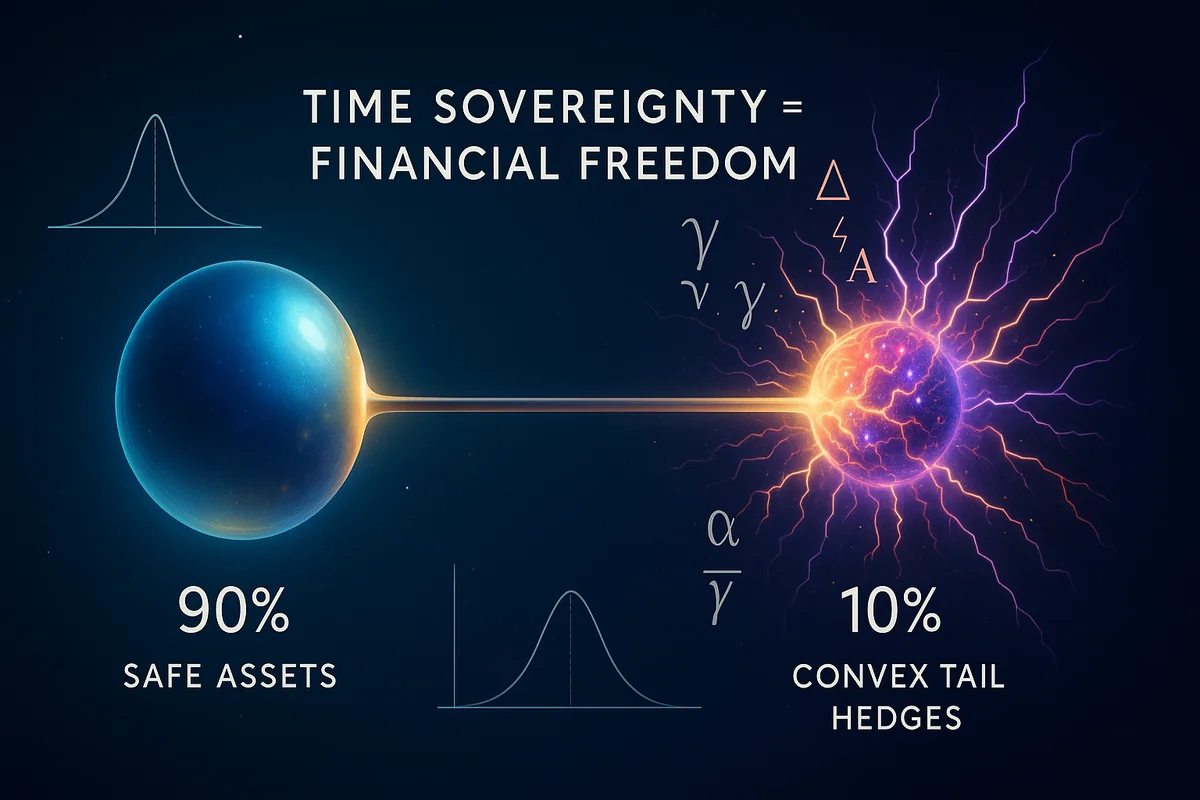
Day three was the breakthrough. I gave myself one day to design a complete antifragile financial framework in agent mode, with a hard rule that it had to be validated against real history, not just theory. By evening I had the strategy written, an analytics framework built, and the whole thing stress-tested against past market disruptions. The shape it took was a barbell. A protected, boring core, plus a small slice aimed at convex bets. Small recurring costs while things are calm, large gains when volatility shows up. When the crash comes, the protected core holds and the convex side pays, so you buy good assets cheap while everyone else panics.
The interesting part was not the system. It was understanding, for the first time, why this kind of strategy is so hard to stomach. It asks you to lose small amounts for a long time, to wait years for the asymmetric payoff, to treat the slow bleed as the plan working rather than failing. The brain wants steady linear progress. Life does not pay out linearly. It pays in rare, lopsided events. Designing for that means accepting that looking like you are losing is part of how it wins.
The same barbell logic shows up everywhere I looked. Proven fundamentals plus experimental edges in what I study. Structured deep work plus unplanned discovery in how I spend time. Agent mode for the genuinely hard problems plus intuition for the familiar ones. The principle is not balance, it is deliberate asymmetry. Protect the downside, leave the upside open.
But the real takeaway was about the thinking itself. A hard problem plus agent mode collaboration got me a working, measured solution in hours instead of weeks. The limit was never raw intelligence. It was thinking systematically about the structure of the problem. This was never really about a portfolio. It was a test of whether agent mode could take on a genuinely difficult architectural problem and produce something I could verify. It could.
Flow: When Systems Lock In (Days 4-7)
Day four was about testing with real data. I validated the analysis against historical datasets and set up tracking so the system measured itself instead of relying on my gut. You cannot improve what you cannot measure, and agent mode helped me build something measurable from the start. Every assumption testable, every outcome logged. The Stoic version of this is simple. I cannot recover the opportunities I missed before I had any of this. I can set up the measurement now and stop lamenting the data I never captured.
Day five was physical and digital at once. I pushed my body past its usual range on a long effort, then spent the evening building a documentation repository for the financial system, a README that explained the antifragile thinking plainly enough that someone else could pick it up. I read more of Taleb's Antifragile alongside my own plan, and the theory started clicking because I was implementing it at the same time. I tried to find Pegasus in the sky and failed. The stars were faint, the pattern would not resolve. I kept at it anyway. The difficulty is part of the practice.
Day six was recovery, and I had to treat that as part of the foundation rather than a break from it. My body asked for rest and I gave it, because physical limits are data, not failure. I started actually implementing the financial system, opened the first positions, and moved the barbell from paper into the real world. I also held some boundaries, declining to over-extend when the tank was low. The orthodoxy says push through. I am learning that strategic recovery is what keeps the whole thing from collapsing.
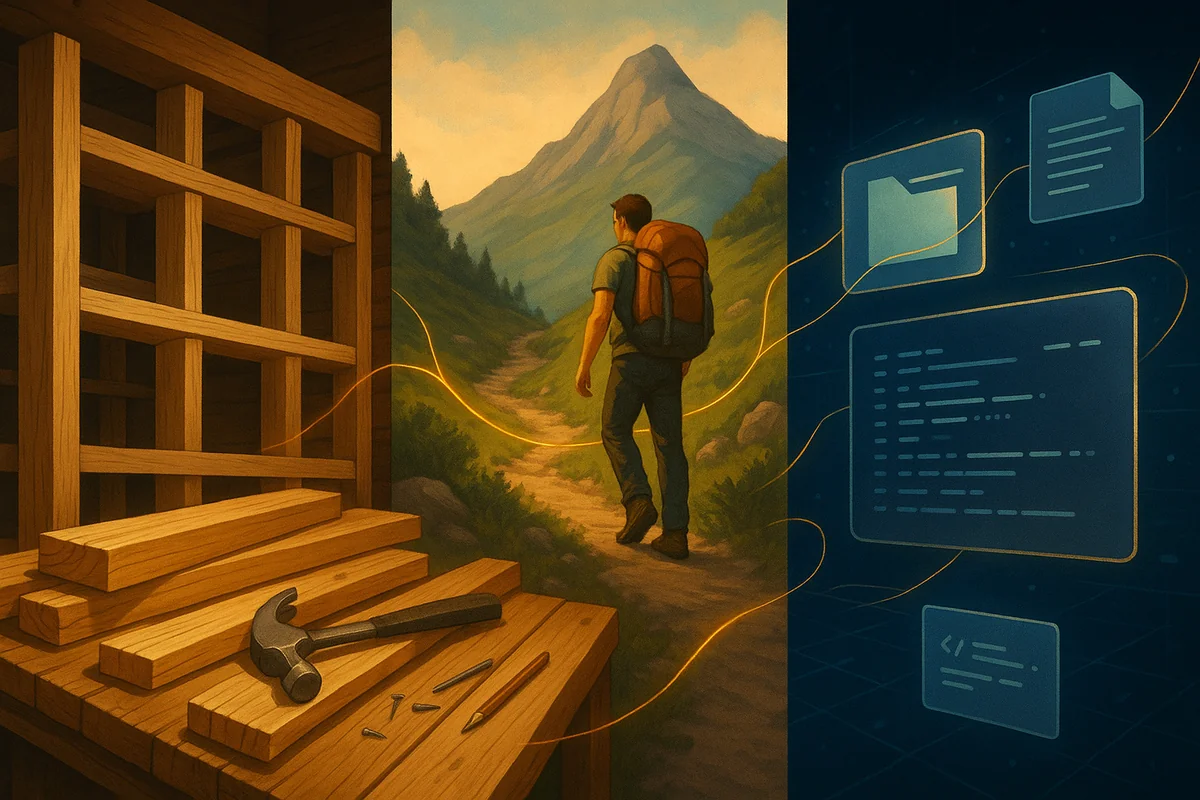
Day seven the foundations took shape. Physical construction moved forward even with limited materials, and I validated a new recovery method that worked. A vision for a multi-purpose workshop space started forming, somewhere physical restoration, deep work, and making could all live together. I tried for Pegasus again, maybe found it, could not be sure. The sky appeared to shift as the Earth turned under me, a reminder that I am always moving even when I feel still. The lesson of the Flow phase was that the vision comes out of the doing, not before it. I was not theorizing about the workshop, I was building a bookshelf base. Not imagining astronomy, just standing under the stars staring up.
Reflect: Testing What Holds (Days 8-10)
Day eight I felt the decan turn from Flow to Reflect before I checked the calendar. The question underneath everything sharpened. If I stepped away right now, would these structures hold. Looking back at the blog automation from day one felt like another era, so much compressed into ten days.
I took stock of what I had built. A financial foundation with a tail-hedge design and accessible entry points, a simulation environment to practice execution without real risk, and tracking in place. Physical infrastructure with recovery practices and a documented workshop vision. Automation pipelines designed to run without constant attention. Then I asked the hard version of the question. Is this documented well enough that it survives me, that someone else could maintain it if they had to.
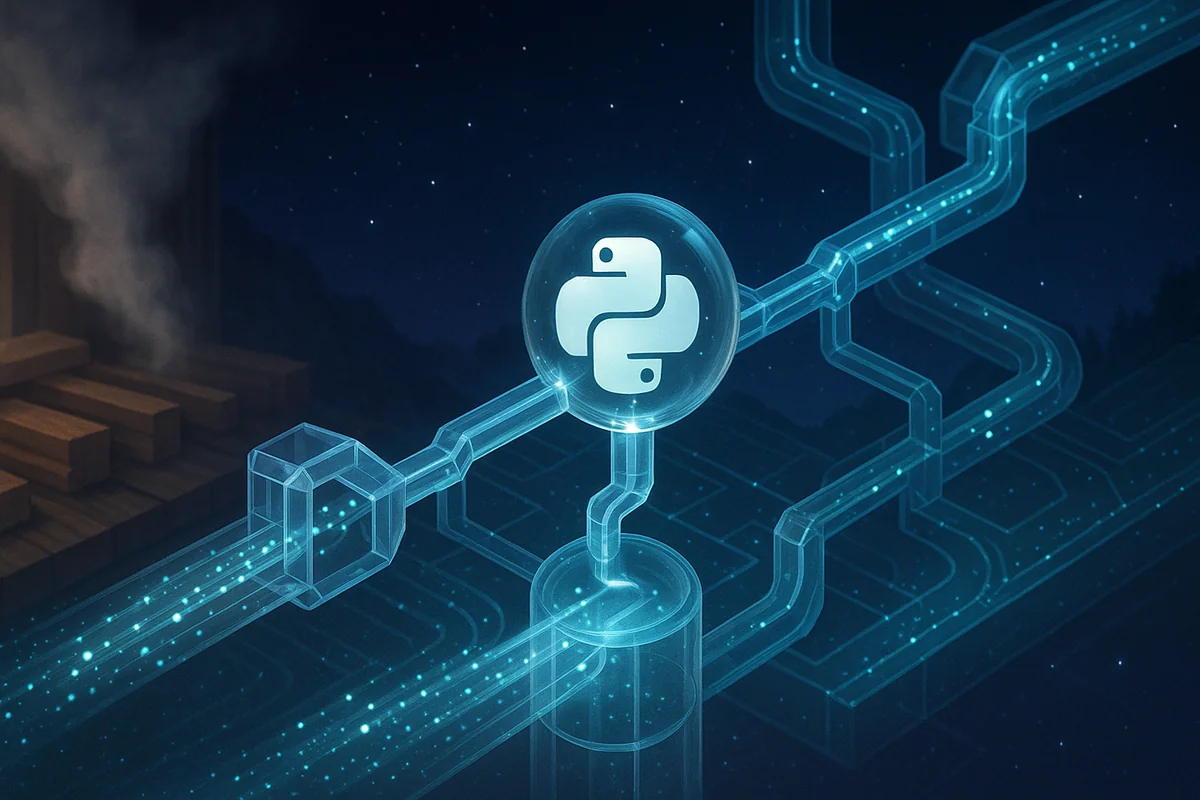
That evening the automation pipeline started collecting data and uploading on its own, built in agent mode. The thing that unlocked it was a small Python layer wrapping the API. Once that abstraction was in place, the friction that had been costing me huge amounts of time disappeared and everything flowed. The rest is plumbing now. Connect the dashboard, move the code to a permanent home, and it is self-sustaining.
This is where Camus showed up for me. The pipeline does not answer any ultimate question. The building is the meaning. Sisyphus is not happy when the boulder reaches the top, he is happy in the pushing. The Python layer, the API calls, the debugging at eleven at night, and then the quiet of watching data flow without me touching it. Legacy is not immortality. It is a system that runs Monday morning whether I am there or not.
Day nine tested all of it. An external dependency failed and knocked things offline for a while. This is exactly what the design was for. I switched to backup systems while the main one recovered, then built in protection so the same failure could not hit me twice. That is antifragility in practice, getting stronger from the disorder instead of just surviving it. The point was never to prevent every failure. It was to assume failure will come and build the redundancy before I needed it. I kept things running, moved to backup infrastructure, found the weak point, and added redundancy on the spot. By evening I was drained from the extended demands. The systems held, but I did not. Systems can be antifragile. The person running them stays fragile. The foundation has to include that, has to build repair and rest in for the human, not just resilience for the machine.
Day ten I reflected during recovery. I felt genuinely aligned with this decan's theme. I had spent ten days laying solid foundations, and not just building, but building with the intention that the structures persist when I step back. The financial system, the automation pipeline, the physical infrastructure, the workshop vision. The shift in my head was from what did I accomplish to will this hold when I am gone from it.
The real transformation was not any single output. It was how I think about problems now. The tools, agent mode and AI collaboration, are accelerants. What changed is that breaking a complex problem into systematic pieces, designing for automation from the start, documenting for my future self, and building abstractions that kill friction have become my default mode. Agent mode sessions do not just solve the problem in front of me. They teach me to think like that on my own. The visible results are the pipeline and the strategy and the project progress. The invisible part, the change in how I approach problems, matters more than any of them.
That night I saw something move in the sky near Pegasus. Not a satellite, not a plane, a faint light on a trajectory I could not explain. I never figured out what it was. It felt like the right ending for this decan. I went out looking for Markab and found a mystery instead, and the act of standing there looking was its own kind of freedom. Markab's lesson was to build what persists when you are gone. The deeper one I took from it was to build what makes you free while you are here.
What Persistence Taught Me
The barbell is not only a financial strategy. It is a way to design anything that has to survive volatility. A robust core, a small convex edge, deliberate asymmetry instead of balance. It maps onto knowledge, onto time, onto how I pick which problems get the deep systematic treatment and which get intuition, onto training, onto the way stable commitment plus growth through stress works in relationships. The bottleneck is almost never intelligence or resources. It is thinking systematically about the structure of the thing.
So the question Markab kept asking. What holds when you step away. Financial systems that rebalance on their own. Automation that runs Monday morning. Documentation that lets someone else maintain what I built. Recovery protocols that became habit. A workshop that serves several purposes. And the softer things too, relationships repaired through honest acknowledgment, boundaries held even when I was depleted, mystery left intact alongside the measurement. Systems can be antifragile. Humans stay fragile. The foundation has to hold both, the resilient architecture and the repair.
The Cosmic Motion Context
We traveled 535 million kilometers toward the Great Attractor in these ten days, more than three and a half times the distance from Earth to the Sun. The motion was going to happen regardless of whether I worked on anything. The question Markab leaves me with is whether what I built will still work the next 535 million kilometers out. The financial architecture is documented. The pipeline runs. The physical infrastructure is sturdier. The thinking has moved inside me. The motion is constant. The only thing I get to decide is what I build while moving.
Transition to Enif: From Foundation to Aspiration
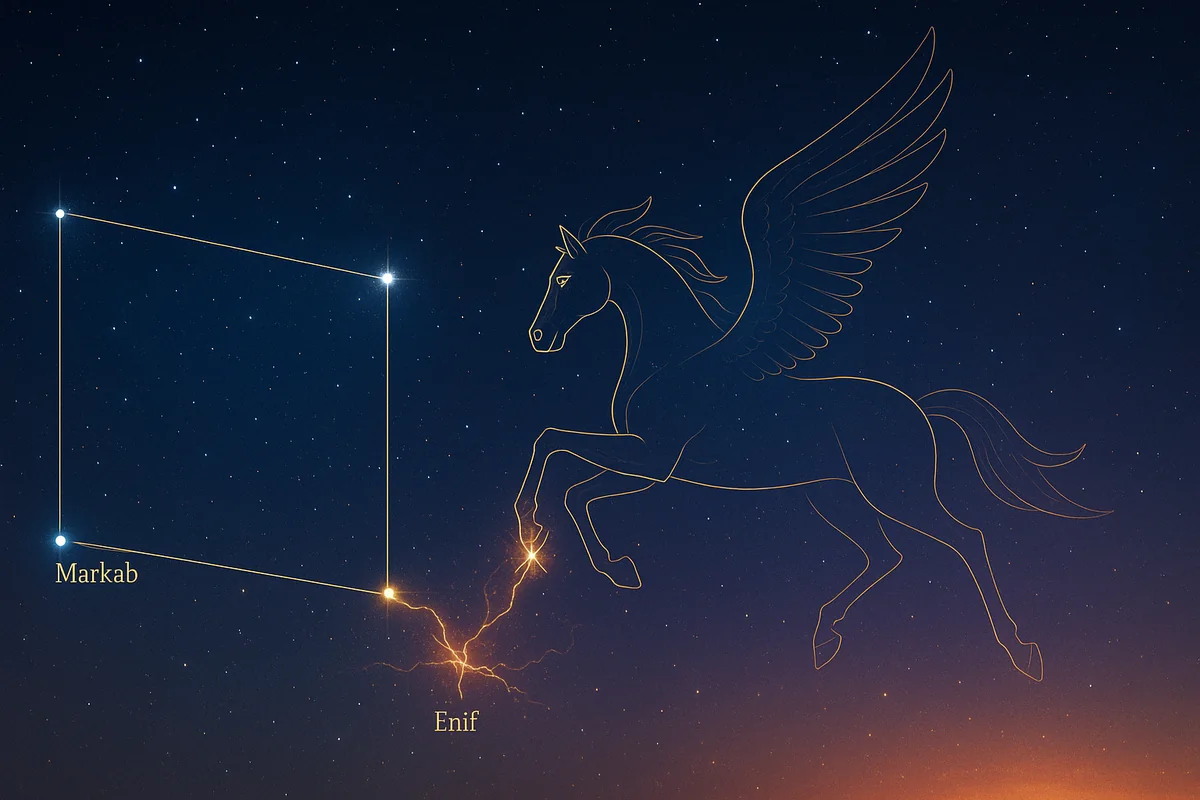
Markab is the steady corner of the Great Square. Enif, the next star, is Epsilon Pegasi, an orange giant marking the nose of Pegasus reaching forward. Markab held the corner. Enif points past it.
Pegasus is the winged horse born out of chaos, the carrier of heroes. Markab asked what would endure. Enif asks a different thing, what I want to become now that the foundation is solid. The systems are operational, the methodology is internalized, the floor is built. So the next phase is not more building for its own sake. It is figuring out where the horse carries you once it can finally fly.
Closing
Markab will burn out eventually. Blue-white giants do not last. But the light that left it in 1892 still guides anyone who looks up tonight. The foundation outlasts the moment it was laid.
Build what persists when you step away. And build what gives you the time and the freedom to make what actually matters while you are still here. That is the whole of it.
Decan Navigation
Previous: Decan 23: Scheat / Blooming in the Desert.
Next: Decan 25: Enif / When the Hidden Star Teaches Vision.